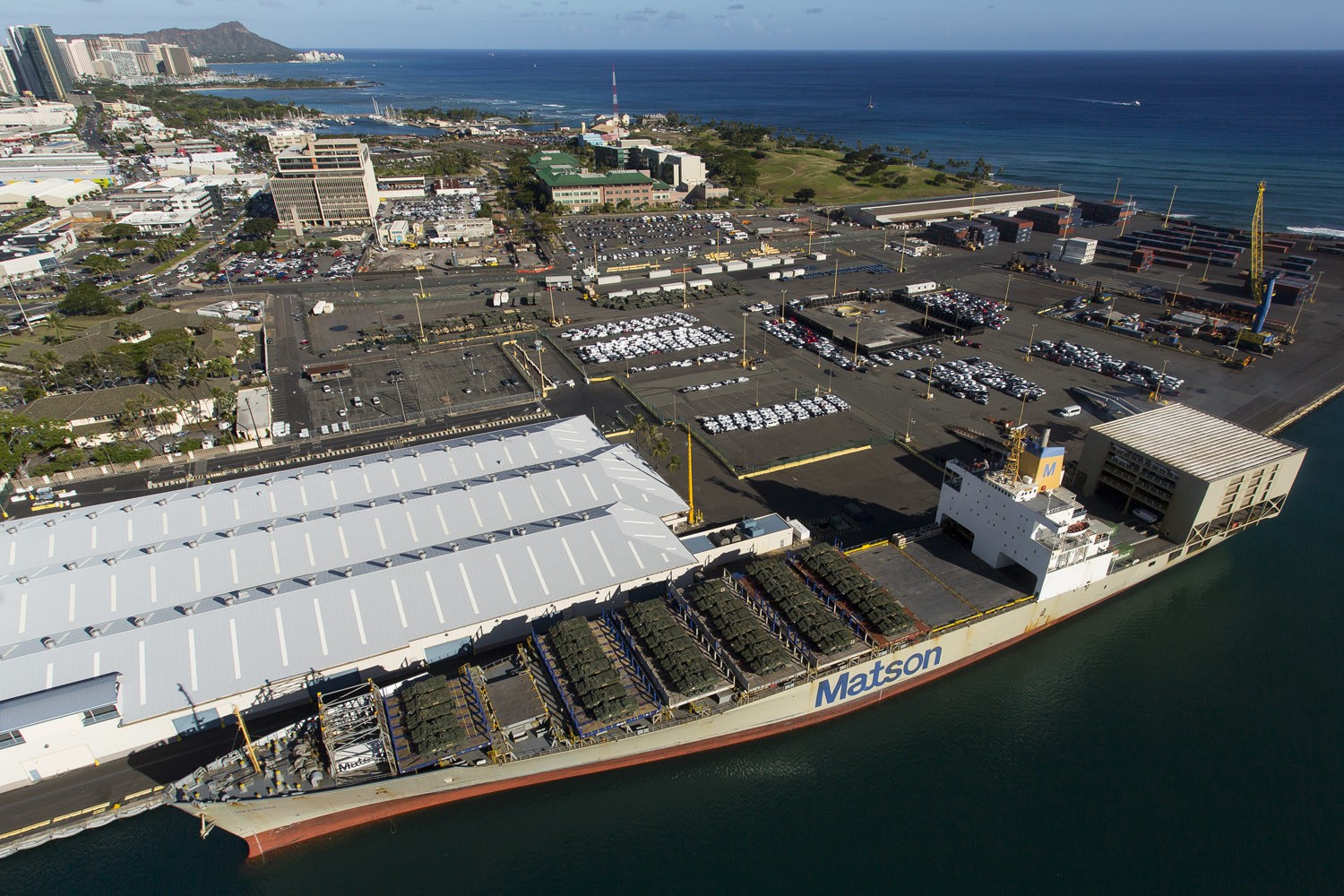
Schofield Barracks, Hawaii, await the 2,700- mile journey to the Port of Seattle. Military Surface Deployment and Distribution Command is overseeing the redistribution of 320 S... VIEW ORIGINAL
When Vice Chief of Staff of the Army Gen. Daniel Allyn announced the Army would reorganize 20 Brigade Combat Teams and inactivate six others as part of Fiscal Year 2016 reorganizations, one of the realignments involved the repositioning of Stryker vehicles belonging to the 2nd Stryker Brigade Combat Team based in Hawaii to 2nd Infantry Division's 4th Brigade Combat Team at Joint Base Lewis-McChord (JBLM), Washington.
The realignment of the 2nd Stryker Brigade Combat Team not only requires the movement of its 320 Stryker vehicles, but also more than 40,000 additional pieces of support equipment. This seemingly daunting task falls to the surface warriors of the Military Surface Deployment and Distribution Command (SDDC), headquartered at Scott Air Force Base, Illinois.
"While this mission is unique in nature, we routinely move military equipment throughout the globe for life cycle management and sustainability of our forces," said SDDC Chief of Operations Navy Capt. Aaron Stanley.
SDDC's 599th Transportation Brigade, strategically located in the Pacific Command area of responsibility with its headquarters at Wheeler Army Airfield, Hawaii, is the primary booking agency for the Stryker realignment and will provide oversight of the entire mission.
"SDDC's strategically located brigades enable us to operate at peak efficiency around the globe," said SDDC Commanding General Maj. Gen. Susan A. Davidson.
In sync with the program manager's desire to receive a steady flow of equipment so as to not overwhelm final destination reception, the movement process began in mid-March. The 599th expects to ship about 28 Strykers every week from the port in Honolulu to Seattle's port, with final destination at JBLM, with expected completion in August.
"Once the Strykers have cleared maintenance at our East Range, they are turned over to Project Manager Stryker, who then offers the cargo for shipping, and the 599th books the movement with a commercial carrier," said John Fisher, chief of the 599th Transportation Brigade Pacific Sealift Management Office.
The special nature of a Stryker requires certified operators every time the vehicle is on or offloaded. Additionally, the shipper will utilize the low profile Busby chassis with Stryker-capable 40-foot flatracks as conveyance for the movement.
"The military entities are responsible for driving the Strykers onto the flatracks at Schofield Barracks and offloading the Strykers from the flatracks at JBLM. In-between pick-up and delivery, they are in the hands of the carrier," said Bobby Lyons, an SDDC operations supervisor.
Once picked up at Schofield Barracks, the Strykers are delivered the same day to the Honolulu port, known as the port of entry.
"Matson [a shipping contractor] comes in with their special flatrack vehicles and transports the Strykers down to the port. The number shipped at one time is driven by the amount of flatracks available," said Fisher.
The Strykers are then loaded onto vessels to be received at the Seattle port of delivery after four days spent crossing the Pacific Ocean.
SDDC's 597th Transportation Brigade, based at Joint Base Langley-Eustis, Virginia, is on the receiving end in Seattle to "catch" the 599th's "pitch." Responsible for operations in the Northern Command area of responsibility, the 597th's Pacific Northwest Detachment will oversee port offload operations at the Seattle pier.
"This 'pitch and catch' between our brigades gives SDDC the capability to ship and receive items with 100 percent oversight throughout the distribution process, substantially increasing efficiency," said Davidson.
After offload from the vessel, the Strykers will then be trucked from the port to JBLM.
The all-encompassing Stryker movement requires different modes and nodes throughout the operation. Additionally, the equipment seamlessly changes hands from military, to civilian, to contractor personnel many times during the redistribution.
In conjunction with the Stryker reorganization, some pieces of equipment will be further moved through to depots for retrofitting and upgrading, which will require additional movements, all managed and tracked by SDDC and its brigades.
Social Sharing