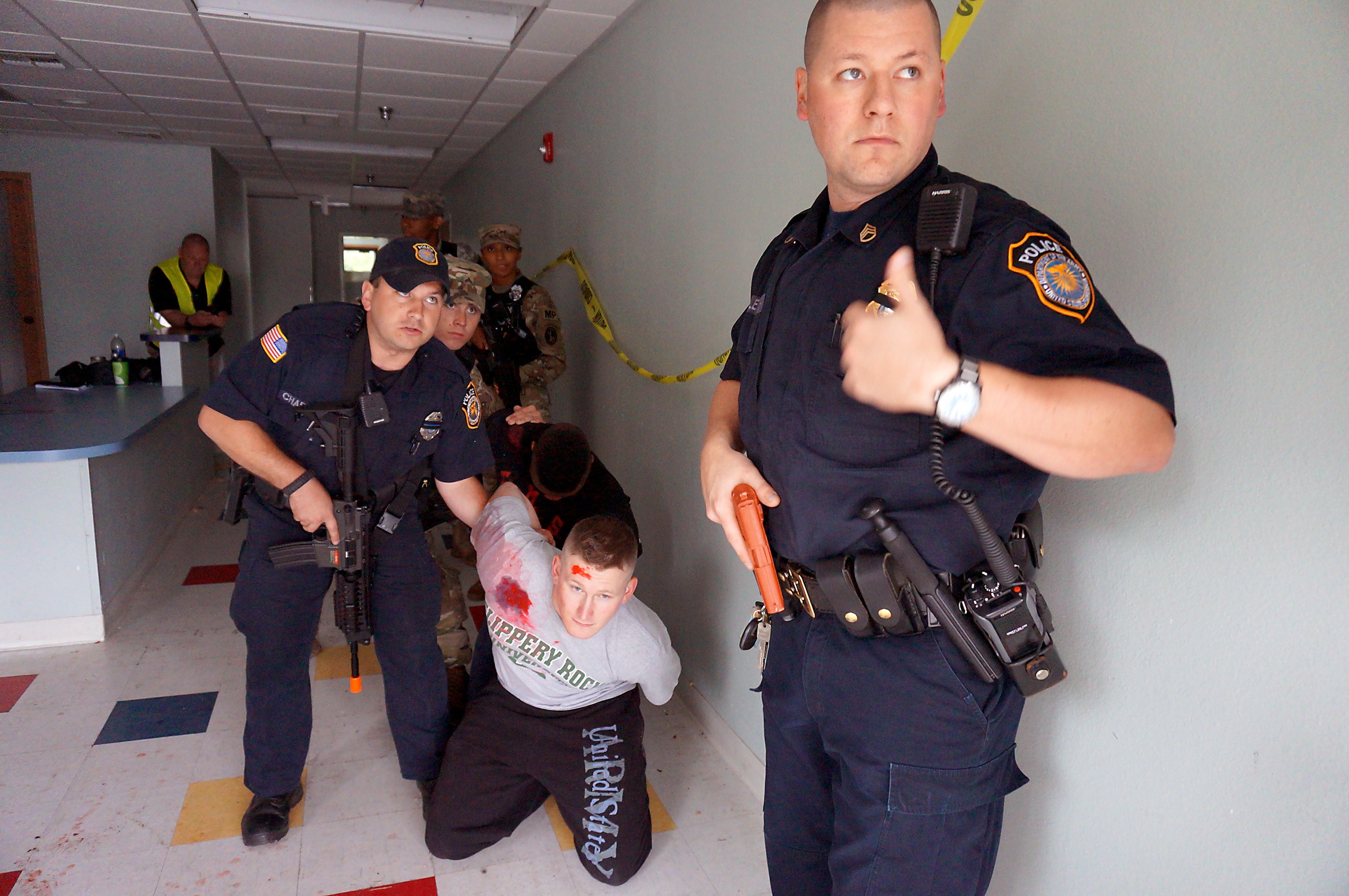

On the morning of May 17 at 9 a.m., "Sgt. Hood," a service member stationed at Joint Base Myer-Henderson Hall was picking up his son A.J. from the installation's child development center, with no idea that his wife--with whom he's currently in the process of a custody battle and divorce--had recently placed him on a restricted list. Less than 10 minutes later, the center's receptionist was dead; a half-dozen other personnel were killed or seriously injured; and "Sgt. Hood" had put a bullet in his own head.
That's the scenario that unfolded during a mass active shooter exercise, a simulated hostile situation at Bldg. T-482 on the Fort Myer portion of the joint base. The response to this functional scenario entailed a conglomerate of everyone involved in crisis response operations on the installation, including the Public Affairs Office to push information out to affected communities, according to Malanya Westmoreland, JBM-HH Emergency Management specialist.
"It's very important to do these active shooter exercises because people get complacent and there's so many ways a bad scenario can occur," said Westmoreland.
Additionally, there are visitors to the installation--to include personnel associated with the approximately 30 funerals happening adjacent to the joint base, retirees who come to the base commissary and Andrew Rader U.S. Army Health Clinic--in addition to a range of other activities on the installation, she said.
"Look at the shootings at Fort Hood, or the shooting at the Washington Navy Yard: those installations have gates and sentries, and the reality is you never know where the threat will come from," said William R. Johnson II, JBM-HH Police chief. "It could be [a person] from the inside or the outside."
During the exercise, it took law enforcement seconds to arrive on scene, set up a cordon and neutralize the threat. Those efforts included setting up an incident command center with fire officials and receiving assistance from the Arlington County Police and Fire Departments.
Meanwhile, inside the building, law enforcement and fire and emergency personnel (rescue task force) conducted multiple sweeps to clear the building, then treated and extracted personnel in need of urgent medical care.
"We had the support of Arlington County officials because this is a regional issue," Johnson said. "The process that we practiced today can take eight to 10 hours in some cases."
"I took this role and the training associated very seriously," said Frank Hood, JBM-HH security guard who was acting as the scenario's active shooter. "These scenarios can happen--be it on [military] installations or the recent shootings that have happened in Maryland."
"It's imperative that first responders on this installation understand their capabilities and know how to do their job," added Lanessa Ferguson, another JBM-HH security guard who served as the receptionist during the active shooter exercise.
Planning has already begun for the next annual Military District of Washington active shooter exercise set for August, which will include volunteers and role players for the full-scale event. In accordance with Army Regulation 525-27, the Army Emergency Management Program (under the Directorate of Plans, Training and Mobilization) must provide a full-scale, annual all-hazard approach (exercise) to planning, preparation, response, and recovery.
Westmoreland stressed that such exercises do more than just test the joint base's response capabilities, but also challenge everyone across the joint base to be alert to their surroundings.
"There's continuous learning for the installation population, on the installation and on the metro and highways people take to get to and from work every day," she said. "We're not asking people to be Superman or Superwoman--we are asking people to be vigilant."
Social Sharing