

at the Solomon Center. The event was designed to test the response capabilities of emergency responders... VIEW ORIGINAL
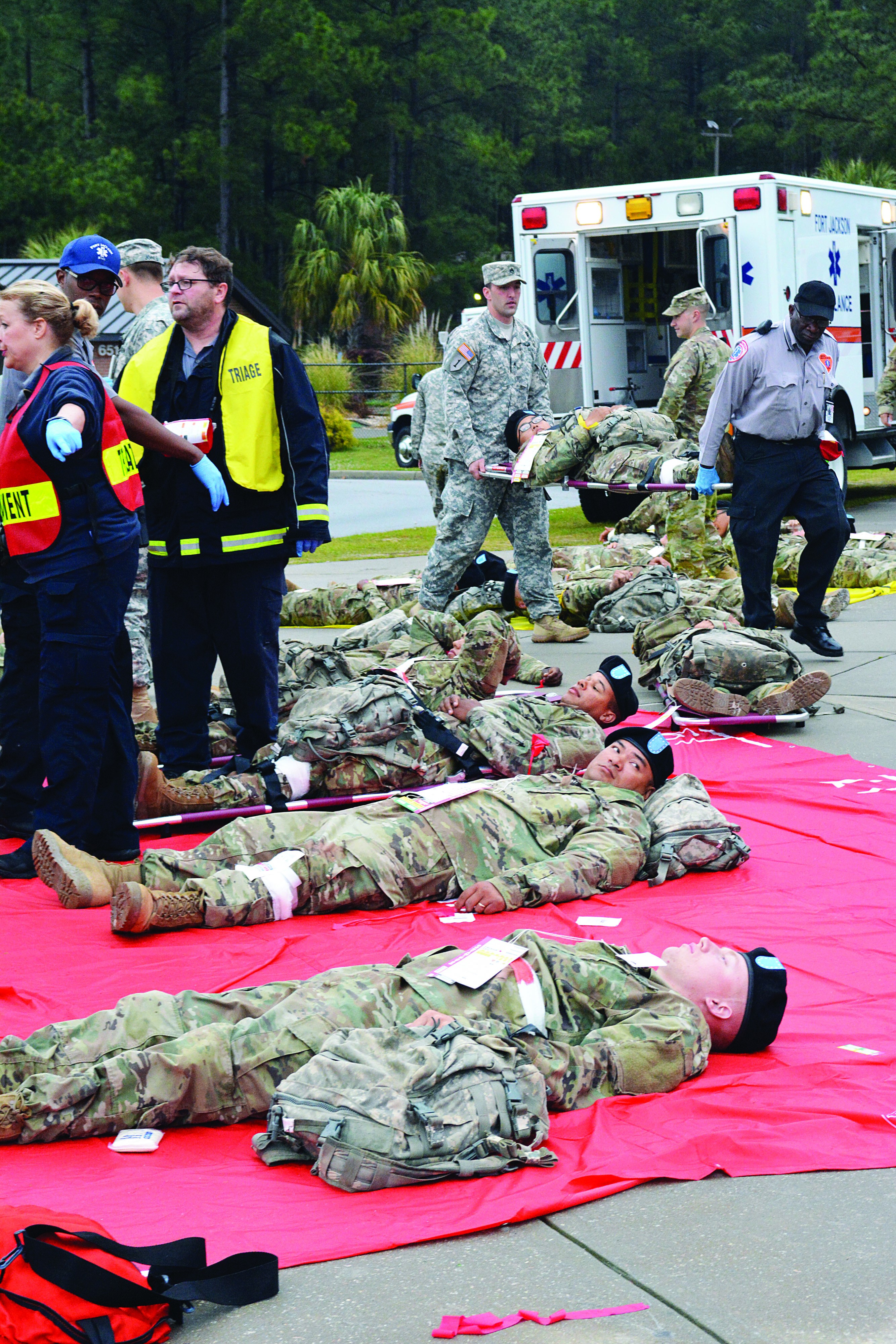


Fort Jackson staged a mock active-shooter scenario Tuesday to test the emergency response of an entire community.
While the incident was centered primarily on the Solomon Center, the exercise involved emergency responders from multiple hospitals, fire departments and law enforcement agencies from around the Midlands. The goal was not only to test the installation's abilities to respond during a crisis, but to
test its relationship with services off post, as well.
"On the individual level, our first responders are extremely well trained," said Maj. Gen. Roger Cloutier, Jr., Fort Jackson commanding general. "They know their business. What we have to do on the installation and community level is integrate those resources."
Tuesday's exercise involved two separate incidents. The first was a vehicle explosion, followed by gunshots reported during a staged graduation ceremony at the Solomon Center. When emergency responders arrived at the scene, they had to deal with an uncertain situation, as well as dozens of dead and injured role players.
This kind of exercise puts enough stress on these resources to give leaders an idea of both the strengths and weaknesses of the community's emergency response abilities, he said.
"Not only were we able to test our internal operation procedures, we were able to lock down the
gates and coordinate with first responders outside the installation," Cloutier said. "We're evacuating
these simulated casualties to five different hospitals."
This week's event had been in the planning stages since last September, said Dwight Peters, operations security manager for Fort Jackson.
"We coordinated with every (agency) on this post," he said. "The biggest thing we tried to do
was keep (advance) information from getting out into the public, so we got more out of the exercise."
Information about the exercise was limited to command groups for participating organizations.
The participating agencies were accompanied by observers, who kept track of how these incidents
were met by responders.
"We, as observers, knew what time the demonstration was, but our special responders did not,"
said Lt. Dominick Pagano a trainer with the Richland County Sheriff's Department and an Army
veteran. "It was a real world call out for them and they handled it like they would any other task."
"It did surprise a lot of people," said Col. James Ellerson, Fort Jackson garrison commander. "We
had a small planning cell that actually coordinated with the surrounding community for the event, but the people who live on post and work on post did not know the timing of when it was going to happen. We want to learn from this."
First responders were not the only ones to exercise their capabilities: Fort Jackson command and
control was taxed too. The event allowed the post's Emergency Operation Center to exercise Fort Jackson's response plans too. At the EOC, representatives from different on post agencies gathered to share information and coordinate behind the scene responses.
"It makes the entire installation safer, and creates that connective tissue between us and Columbia
and the Midlands," Cloutier said. "So that -- if something happens on post or off post -- we can
work together to collectively respond. You don't want to start building relationships on the day that
you need them."
Demetria Mosley and Robert Timmons contributed to this story.
Social Sharing