

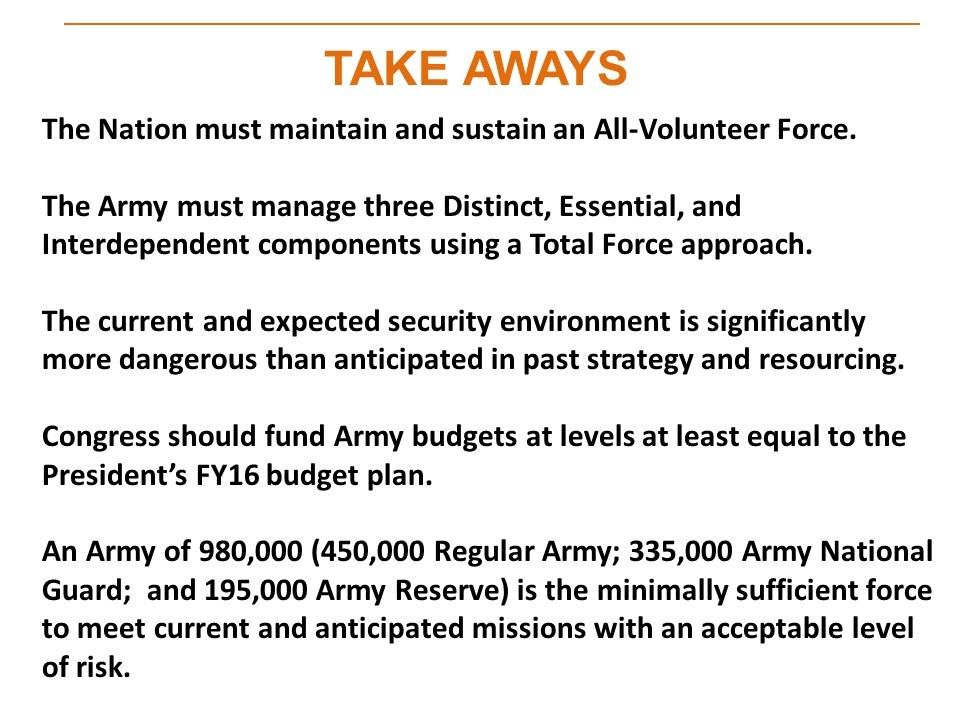

Don't cut the force below 980,000, keep Apache helicopters in the Army National Guard, maintain the all-volunteer force, embrace the Total Force approach and fund the Army at current or higher levels. Those are just a few of the 63 recommendations put forth by the National Commission on the Future of the Army in its report to the president and Congress released Jan. 28.
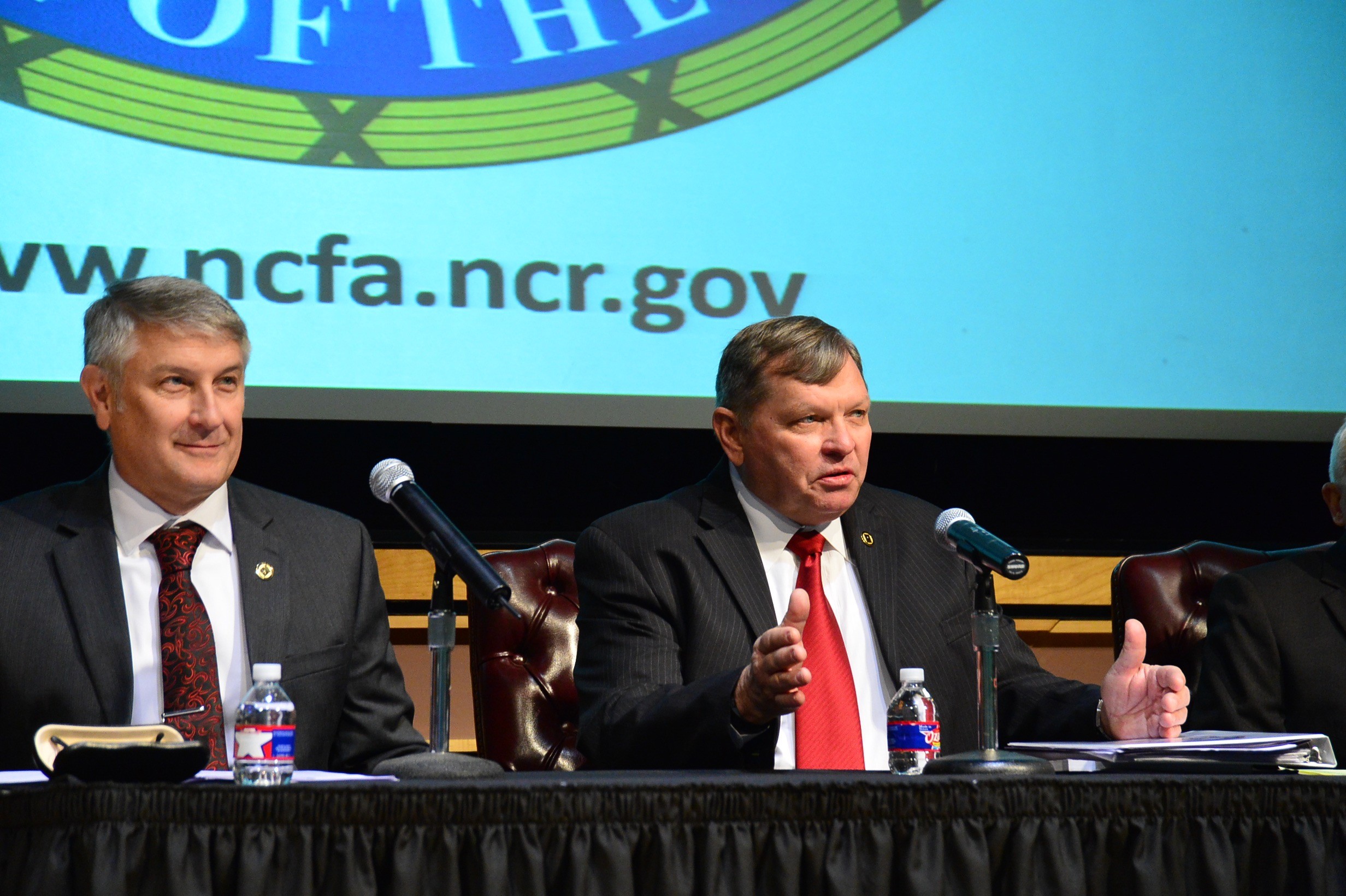
On Feb. 2, the cadre and students of Sergeants Major Course Class 66 were briefed firsthand by three of the commission's members: commissioners retired Gen. James D. Thurman, former commander of United Nations Command, ROK-U.S. Combined Forces Command and U.S. Forces Korea; retired Sgt. Maj. of the Army Raymond F. Chandler III; and Maj. Gen. Raymond W. Carpenter, former acting director of the Army National Guard and executive director of the Commission.
Thurman opened the briefing saying they were at the academy to inform them about "what we have been doing for the last 10 months." He said the commission was tasked to look at two things: How should the Army organize in a time of declining resources and diverse threats, and should the Army proceed with the transfer of the AH-64 Apache helicopters from the National Guard to the regular Army, as planned through the aviation restructuring initiative.
A top concern for the commission, he said, was maintaining the all-volunteer force.
"The declining population of youth who can meet the standards to enter the Army is a major concern," he said. "We have to sustain the all-volunteer force. You are the true standard bearers who are keeping America's Army strong and ready."
Thurman noted that as the commission went about doing their work, they observed tensions between the components, particularly on the Apache helicopter recommendation, and encouraged the students to embrace the Total Force concept.
"This is all about relationship building," he said. "It takes the total Army to work, and that's what we need for this nation. We need to heal the rift that is out there that we have seen [between the components]."
As the only enlisted member to be asked to serve on the commission, Chandler said his task was to look after the Soldier.
"My charter was to look after the Soldier and to remember that at the end of the day, a Soldier was going to have to do something for the nation," he said. "Whatever the commission's findings are, we have to take into account our Soldiers that we ask so much of."
Chandler reiterated that the all-volunteer force was a national treasure and must be maintained.
"We cannot exist as an Army without an all-volunteer force, even though it is extremely expensive and difficult to maintain," he said. "A return to the draft, as some have indicated, is absolutely the wrong approach for the nation. "
Chandler also agreed with Thurman's earlier comment and said the Army needs to embrace the Total Force concept.
"The Army, Army National Guard and Army Reserve are distinct, essential and dependent upon one another, and they are meant to operate as one force with the efforts fully integrated," Chandler said. "That is a key theme throughout the report -- that the Army cannot exist, and cannot function effectively, without all three components contributing to whatever it is we have been asked to do."
The commission found that a force of 980,000 was the absolute minimum needed, based on current and future war plans, to ensure the Army could meet its demands.
"Any deviation from that, any lowering of that number, we could put the Army and the nation in extreme risk," Chandler said.
The commission came about as a result of the National Defense Authorization Act of 2015, Carpenter explained, and was made up of eight commissioners -- four appointed by Congress and four by the administration. During the 10-month period, they traveled across the United States and Europe visiting major installations, National Guard formations and Army Reserve formations to gather input for the report.
"We needed to be open, transparent and inclusive, and we needed to hear from as many people as we could," Carpenter said. "I believe that we have done that. Wherever we went, we wanted to find a concentration of all three components to get the best bang for the buck."
Carpenter added that the report contains the names and numbers of everyone they talked to, emphasizing the number of enlisted Soldiers contacted.
"There are over 1,000 names there, and if you look at that, there are probably as many young Soldiers and NCOs and sergeants major listed in there than anybody," he said. "So your voice has been heard."
Asked how they felt about being on the commission, each said it was an honor to serve.
"When I was asked to do this, I took that as an obligation to help," Thurman said. "I think when you retire and you are asked to do certain things it is important to one, see if you are able to do it, but more importantly, can you offer something that may help folks understand what the problem is. I, frankly, was delighted that I was asked. … I felt I could help offer up some things that may get the total force back together. My name is on there because I believe in what was recommended. I believe folks should take action on this stuff because I believe it will help the future and it will help youngsters coming up that are not even in the Army yet, if we do the right thing here."
"If you get an opportunity or are asked to serve your nation, I am not sure how you can turn away from that other than some profound family issue," Chandler said. "This is a privilege to have been able to serve not only as a citizen, but as a retiree and a Soldier in the Army. I am proud of the body of work that we did. My name is on there, but more for me, it has been a humbling experience."
"I think it was a great opportunity, ; I got the chance to serve with some great people that I have served with before," Carpenter said. "I think there has been some great work done here. I hope it is a historical document as opposed to a document that gets relegated to the dustbin of history. I am proud to have served."
The complete report can be viewed and downloaded at www.ncfa.ncr.gov.
Social Sharing