
QUANTICO, Va. (Army News Service, June 23, 2015) -- It wasn't supposed to unfold like this in Army's wheelchair basketball playbook and in countless players' mental imagery exercises.
Air Force, in a 52-45 game June 22, snatched Bronze, knocking Army off the podium where they'd imagined they'd be.
Army headed to the semifinals after toppling United Kingdom 36-31, July 21.
Army was pitted again the Marines June 22 in a game where the winner would advance to the finals.
ARMY V. MARINES
The game was in Barber Gym, enemy territory, packed at least 2-1 with noisy rival fans.
Within the first two minutes, Eric Rodriguez placed 4 on the board for Marines. Army defense quickly and effectively contained him, but only for a little while.
Problem for Army was that Rodriguez wasn't the only talented shooter. Others breached Army's defense as well.
By end of the first 20-minute half, Rodriguez, who garnered 10 points, was joined on the scoreboard by Matthew Grashen with 7, Zach Blair and Ray Hennegir with 6 apiece, and Alex Nguyen with 4, for a 33-point total.
Army coughed up 14 points, with Alexander Shaw contributing 8, Nicholas Titman 4 and Terry Cartwright 2.
The wall of crimson uniforms continued to stymie any hoped-for Army rally in the second half.
During timeout huddles, Williams exhorted, inspired and coached: "You're missing easy shots. Take your time. Get behind their screen and shoot. Give it your best." And so on.
But the Marines pulled further and further ahead. Even when they missed, they more often than not picked up the rebound and made the shot, at times, even picking up more than one rebound, grinding away at Army's defense.
When it ended, the 52-21 Marines win nearly mirrored the June 20 game's 52-20 between the two.
Highest Army point earners were Shaw, 9; Cartwright, 6; Titman, 4; and Dustin Barr, 2.
Top Marines: Grashen, 13; Rodriguez, 10; Hennegir and Nguyen, 8 apiece; Blair, 7; and, Timothy Shaw, Clayton McDaniel and Adam Vickery, each 2 apiece.
ARMY V. AIR FORCE
Army earned a two-hour rest as Air Force and Navy battled it out. Navy brought out their carrier strike force and blew AF away, 27-44. This set the stage for the third game of the long night as two tired teams, Army and AF vied for bronze, a final chance for a measure of glory.
With just a few minutes' rest between games, AF was caught off guard in the opening with Army netting the first 6 points.
But AF regained composure and with 5 minutes remaining in the first half, Army was just a point ahead at 15.
A late rally before halftime gave Army a 4-point lead of 28. Confidence oozed in Army players and coaches, and during the halftime huddle, Williams congratulated them with their lead, but also urging: "Bring up the intensity. Take time to take the shot."
Both teams sensed victory within grasp. With 15 minutes left in the second half, AF finally caught up and the score was tied at 28. With 11 minutes remaining, they tied again at 32-32.
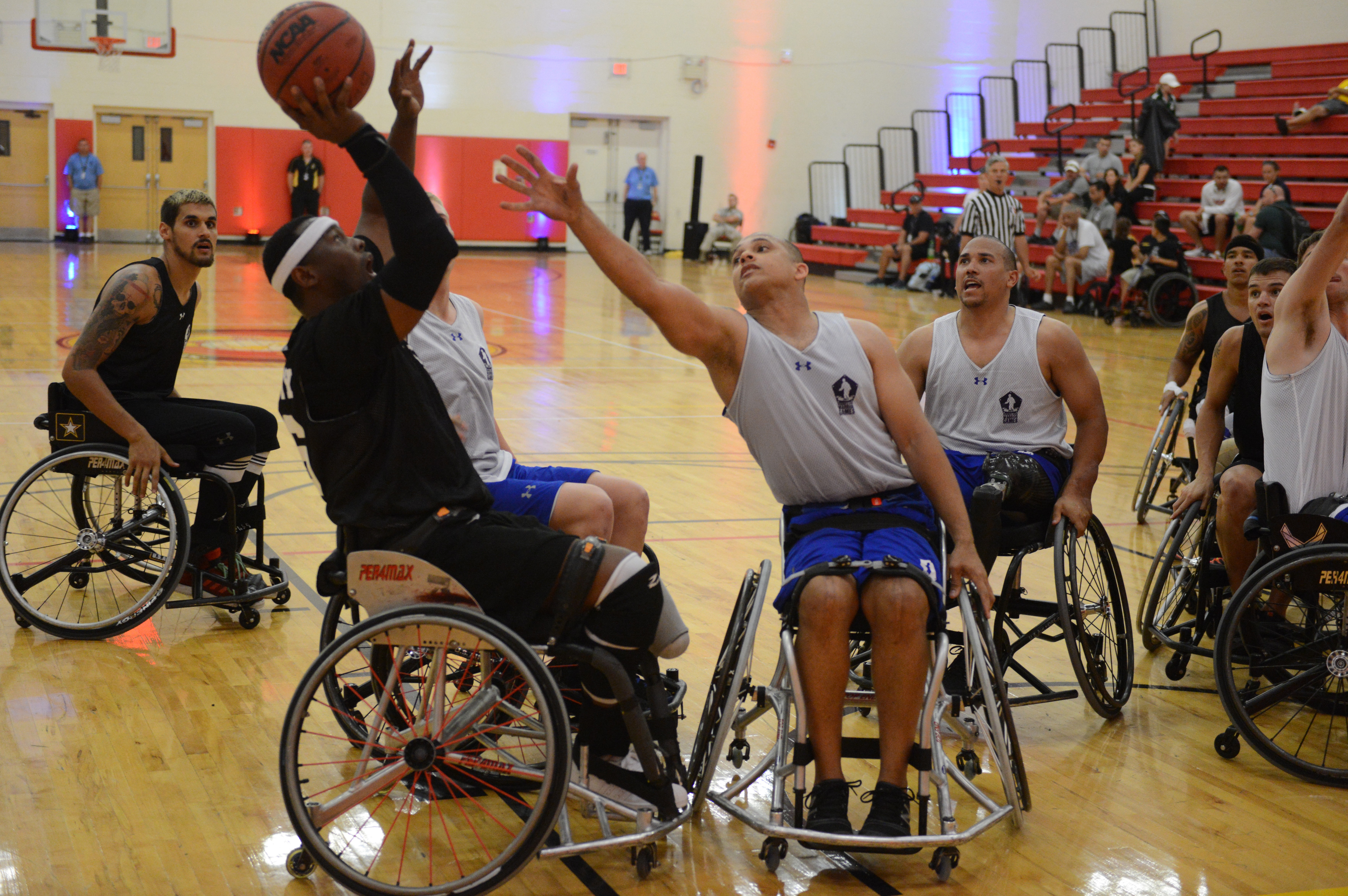
Fans on both sides sensed victory and ratcheted up the volume. Wheelchairs collided. Athletes landed on the floor. Refs double-timed to keep up.
As the final minutes ticket away, AF slowly pulled up and away, like a lumbering cargo plane. The Army had layups. But none of them seemed to be going in. AF had a lot of easy shots, a lot of second-chance shots.
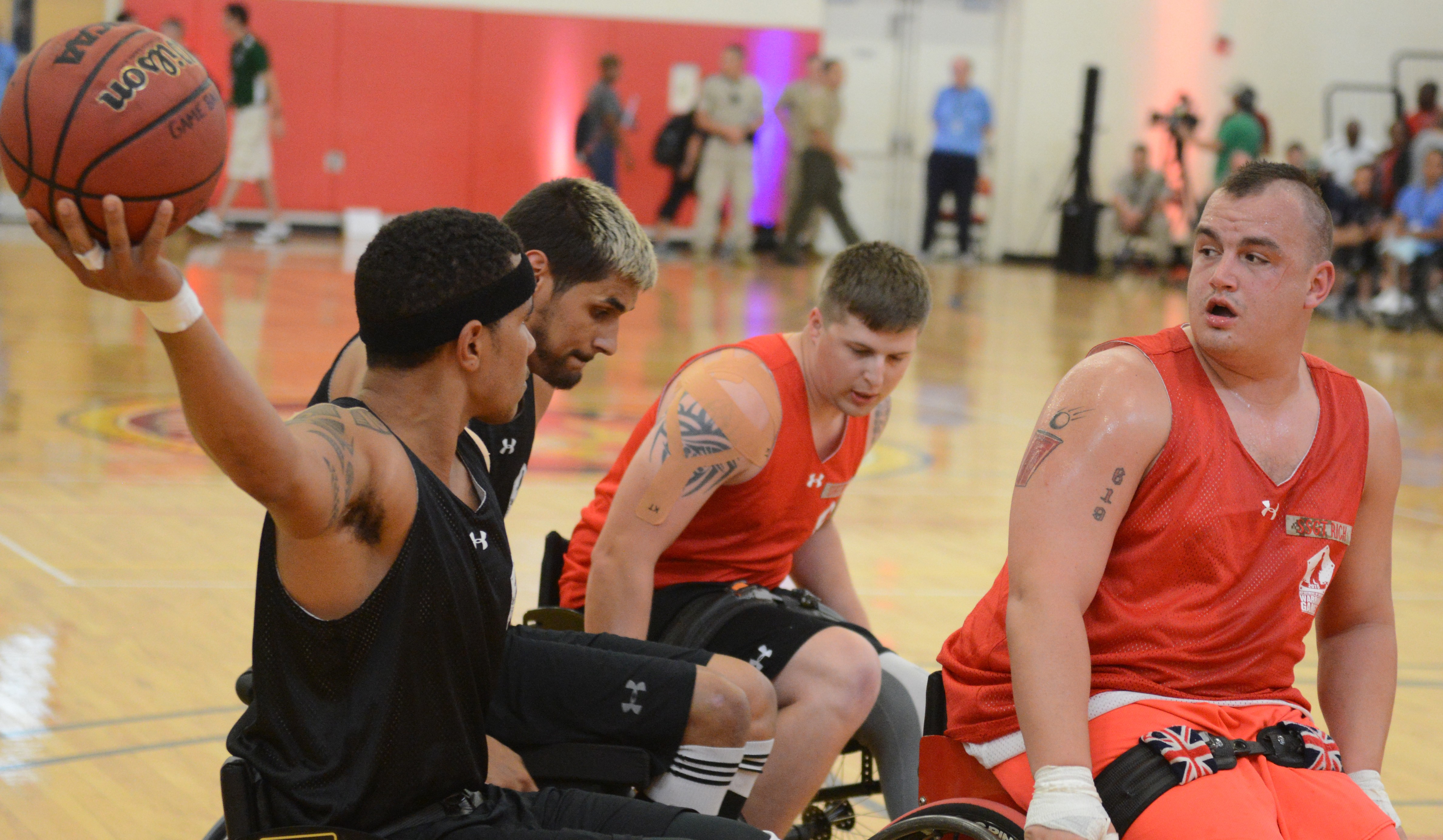
Army tried catching up and the closest they got was 47-41 at the two-minute mark. But AF wasn't about to power down this close to final approach. As the seconds ticked away, Army faces bore expressions of frustration at dominating for most of the game and getting this close. AF had built up a big enough reserve of points in the final moments that a hail-mary throw couldn't affect the outcome.
Those chalking up the most points in the 52-45 AF win on both sides:
Army: Barr, 14; Titman, 12; Shaw, 7; Jasmine Perry, 6; Blake Johnson, 4; and, Cartwright, 2. Also on the Army team were: Sydney Davis, Joshua Wirth, Sean Timmins and Chris Parks.
AF: Jason Ellis, 20; Zachary Burnash, 18; Cal Gentry, 7; Patrick Young, 5; and, Brian Williams, 2.
POSTGAME ASSESSMENTS
In a post-game huddle, Williams urged the athletes to work on their game this year and come back stronger next year. "We'll give it the good fight again. I plan to be on that podium getting the gold medal next year. That's my goal."
Minutes after the game, Williams poured out his soul: "I'm disappointed in myself. They did the best they could under the circumstances.
"The excitement got to them a little bit," he continued. "I call it kinetic intelligence sometimes. When the body starts moving, the brain stops working. And sometimes you see it in different degrees. And, I think with the fatigue, the excitement and the tenseness of everything they locked up a little bit."
He added: "I'm not disappointed for me. I'm disappointed for them. I just hope they take the disappointment the right way. I hope they look at this as an opportunity to get better."
As part of the winning strategy for next season, Williams said he'd like to get in more camps this year so the team is better prepared.
Despite rival onslaughts, Army put up a feisty defense and offense in both games and despite rough and tumble games resembling hockey more than b-ball at times with all the collisions, both teams acted chivalrous.
To illustrate, Army's Johnson flipped during a high-G turn, his wheelchair coming to rest on top of him. Marines' Marcus Chischilly helped him up and they shook hands. Vignettes like this took place throughout all the games, a tribute to the warrior spirit of all the athletes, on or off the field.
Social Sharing