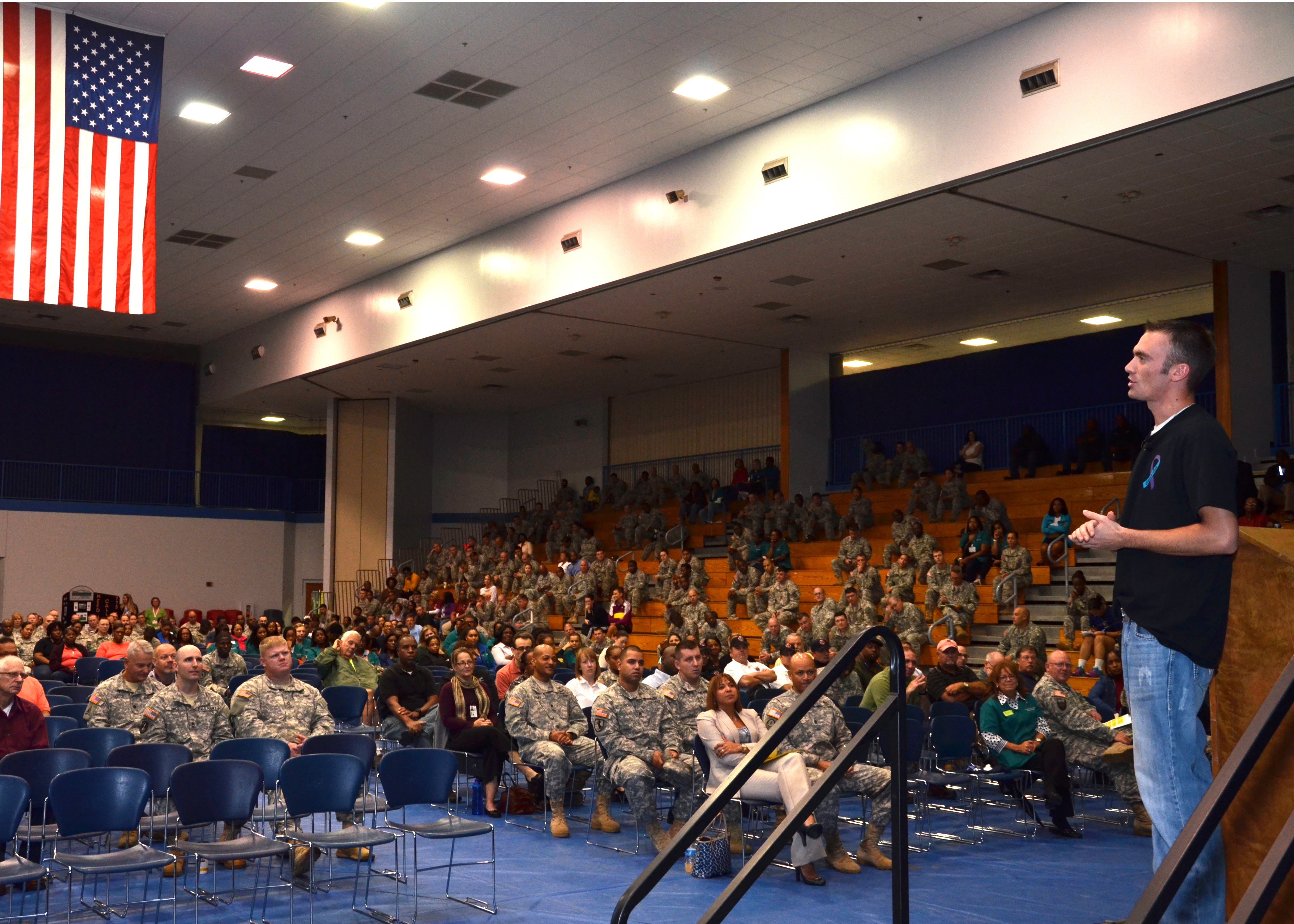
FORT JACKSON, S.C. (Oct. 2, 2014) -- Andrew O'Brien, a former Soldier assigned to 3rd Brigade Combat Team, 25th Infantry Division in Hawaii, spoke to Soldiers and civilians Sept. 26 and 29 at the Solomon Center about his personal battles that led him to attempt suicide in 2010, after returning from Iraq.
"I took over 120 pills in less than 3 minutes, and I chased it down with 2 beers," he said.
O'Brien's visit was the last in a series of activities that took place on post during September to raise awareness for suicide prevention.
He said his downward spiral began when he was on rest and recuperation leave from a deployment to Iraq in 2009. During his leave, he found out that one of his best friends was wounded in action.
"When Spc. Mendoza was shot, I wish that I had been there for him. I feel like I let my brother down. Although Spc. Mendoza, survived the attack, I felt guilty for not being there," O'Brien said.
He explained that although he felt guilt about not being there for his battle buddy, the reality of war had not hit him yet.
"One day we went out on a convoy, and when we returned we had received word that one of our military police convoys had been hit by an IED," he said. "We were ordered not to go look at the (Mine-Resistant Ambush Protected Vehicle) under the white tarp."
He explained that a white tarp over a vehicle meant the vehicle had not been cleaned of human remains.
"I just had to see what could really happen in war. Up until this point I had not seen what could really happen if I stay complacent. I needed to see for myself," he said.
O'Brien said he pulled back the tarp and what he saw made him sick to his stomach. However, he said he did not have the time and opportunity to process his feelings then.
"During my deployment, I mentally blocked certain thoughts in order to make it through the deployment," he said. "What many Soldiers don't know is that when you mentally block all of those thoughts while you're deployed, when you return home your mind will start to process all of the things you blocked out because it realizes that you are in a safer place."
After his return, he started showing warning signs that something was wrong, O'Brien said.
"I began showing up to (physical training) formations hung over from drinking so much the night before," he said. "I also stopped seeing the behavioral health specialist. And sign number three was that I got arrested for driving 140 mph down the highway -- risky behavior."
He said the day he tried to commit suicide, he got into an argument with a friend about a woman.
"It was like shaking a soda can and popping the tab. That was the final straw and everything exploded," he said.
O'Brien said he took a combination of sleeping pills, painkillers and anti-depressants. But as the medicine started to take effect, he became really frightened and realized that he didn't want to die yet, so he called 911, he said. Emergency responders rushed him to a hospital, where he was in a coma for two days.
O'Brien said when his brother, Lee, an infantryman, found out about his suicide attempt he cried. He explained that his brother was upset because he did not tell him about his issues and that it was a selfish act on his part.
"My brother said, 'I've been to Afghanistan. I've done 18 months, I've done hand-to-hand combat. I've been in fire fights. How come you didn't talk to me about all of things you were going through?'" O'Brien said.
O'Brien said he told his brother that the reason why he didn't confide in him was because he thought his brother had been through so much more and that he felt his experience did not compare to his brother's.
"These next words my brother told me change my life," he said. "(He said), 'Shut-up! I am going to talk to you as veteran not as a brother. The worst thing you have been through is the worst thing you've been through. You do not have to sit here and compare with other people about your experiences.'
"That moment changed my life, because someone wearing that uniform gave me permission to have feelings about what I went through," he said. "He told me it was OK to feel the way I felt about the situation and to not just suck it up."
O'Brien said he took his brother's advice and was able to turn his life around.
"I am now 26 years old, and I have just bought my first house on five acres of land. I have a beautiful fiancé, a 6-year- old daughter and a 5-month-old baby boy whom I love," he said. "Look at me. I have a second chance at life now because I chose to put my past behind me. For those of you who are struggling, all I can is that either you can control the things in your life or you can allow them to control you."
Social Sharing