
FORT DRUM, N.Y. -- More than a decade of war has taught members of the emergency medical services community a lot.
It's why Fort Drum officials invited off-post civilian EMS pro-viders onto post last week for the annual EMS Day training event, allowing them to learn from some of the Army's most advanced medical protocols while touring the installation's world-class medical simulation complex.
"It used to take up to 10 years for Army medical protocols to make it into the civilian system," said Capt. Martin L. Stewart, officer in charge of the Bridgewater-Vaccaro Medical Simulation Training Center. "Now, there's a paradigm shift, and it's down to two to three years."
Some protocols, including the self-applied "CAT," or combat application tourniquet, have been adopted in the local community over the past two years because of previous EMS Day events, Stewart said.
The daylong training event at the MSTC supported the greater North Country EMS community's observance of National EMS Week, which took place May 19-25 this year. EMS Week honors the men and women nationwide who save lives when accidents and sudden illness occurs.
Some 60 EMS personnel and medical providers from throughout the North Country and beyond attended the event.
Morning lectures touched on everything from military trauma to behavioral health medicine, while afternoon training consisted of tour-guided, instructional sessions within the medical simulation complex.
Stewart explained that constant deployment cycles in the Army have meant faster and more accurate data collection on the battlefield, which can translate into the quicker implementation of medical solutions.
He cited "junctional tourniquets" as a good example of a recently approved system that is saving Soldiers' lives down range.
"Right now, we are 98 percent successful at saving lives on the battlefield," Stewart said. "There's no city in the U.S. or the world that can compete with that. Afghanistan is actually the safest place on the planet to get injured because of the medicine and the techniques that we use to save lives."
George Eiholzer of the Madison County Sheriff's Office, which is about 25 miles east of Syracuse, said he most appreciated the simulated tourniquet training on mannequins that breathe and bleed.
"We don't have this kind of training back home, not to this intensity," he said. "They really do a nice job bringing that intensity out in the training."
A large focus of the medical training throughout the day centered on blast injuries and wound patterns of improvised explosive devices, such as pressure cookers.
Medical personnel from throughout the U.S. military have more than 10 years of training and experience in dealing with IED wounds, Stewart explained. Feeding that information out to civilian EMS communities is becoming a priority.
"IEDs are, unfortunately, not going away," he said. "So there's a big emphasis in civilian EMS right now to obtain knowledge on IEDs and how to treat the injuries. When you are dealing with a blast injury, it's not just what you see on the outside. It's what happens on the inside."
Allan Bille of the Skaneateles Volunteer Fire Department said the information he learned about IED injuries was extremely interesting.
"I had never been to any kind of IED or blast casualty training before," he said. "With the (recent) Boston bombing incident, this training was very eye-opening.
"Hopefully," he added, "we won't ever need to use it."
Another popular training event involved a morning briefing about Tactical Combat Casualty Care, or TC3 -- the guidebook for all Army medicine.
"I showed our civilian EMS people our protocols on how we take care of our injured patients," said Stewart, who taught the TC3 class. "I also showed them new protocols that just got instituted in Army medicine, which are pretty miraculous.
"There are some big advances in things like junctional trauma and burns," he added.
After lunch, participants got their hands dirty.
They first witnessed a team of Army medics undergoing combat medical training in MSTC "validation rooms," which are designed to simulate the chaos of war. Soldiers stepped over life-like mannequins looking for the most critically injured in dark, smoke-filled rooms that shook with high-definition sounds of war.
Afterwards, civilians were invited to fire weapon simulators at the Engagement Skills Trainer before going on to experience the new vehicle rollover simulator.
Participants also had a chance to meet with representatives from major national vendors to ask them questions about the latest tactical medical gear and equipment on the market.
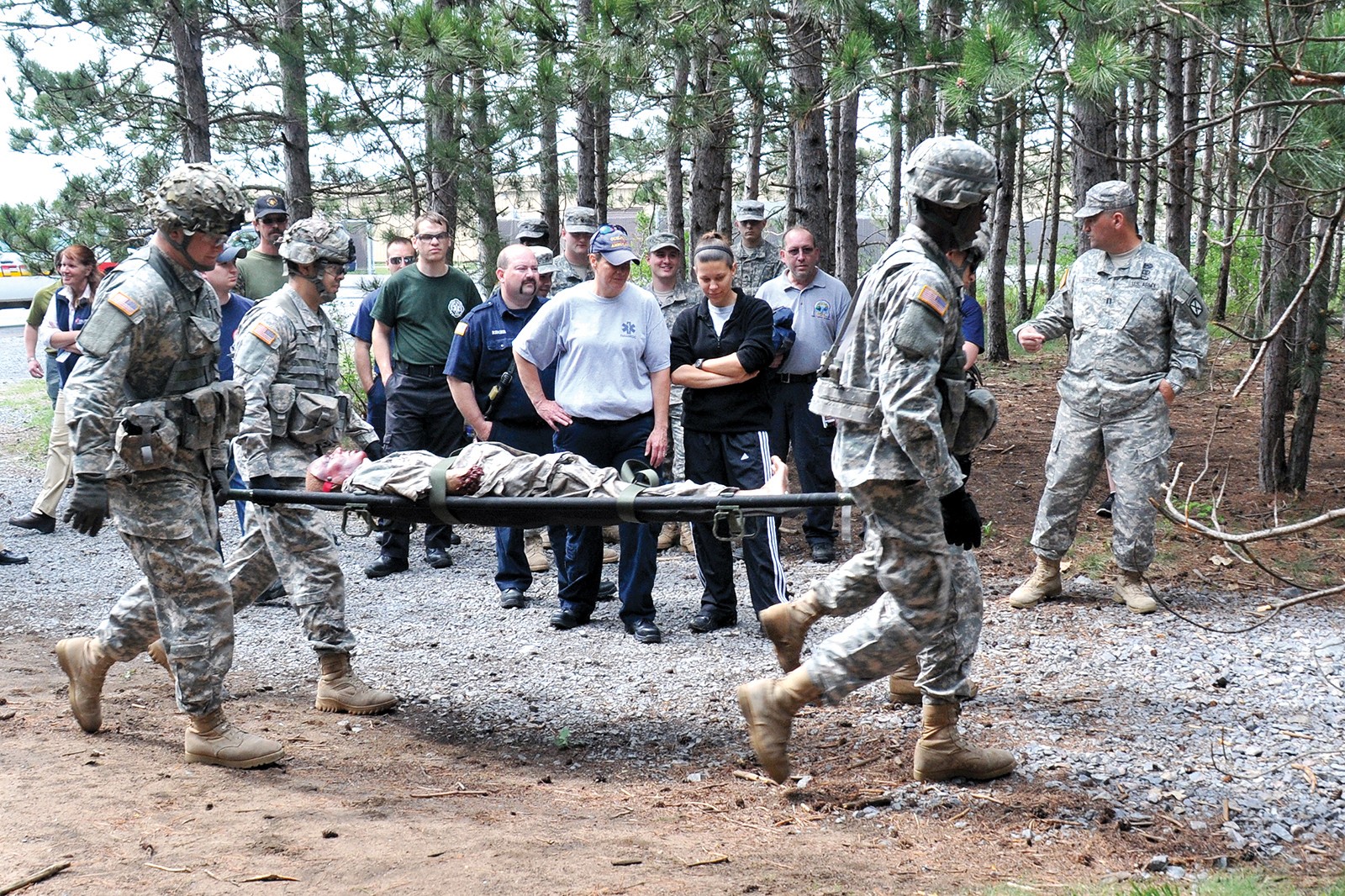
EMS Day training was topped off with a demonstration at the MSTC Obstacle Course and an opportunity for civilian EMS personnel to brave the elements of virtual combat and transport a simulated casualty on a 180-pound litter through smoke, ditches and waist-level water hazards to a waiting medevac helicopter.
Stewart said that exposing the surrounding medical community to the simulation complex not only provided civilian EMS personnel with valuable and specific training, but it also further established Fort Drum as one of the premier medical training centers in the Northeast.
"Everybody here learned something today," Stewart said. "It was a very positive event."
Social Sharing