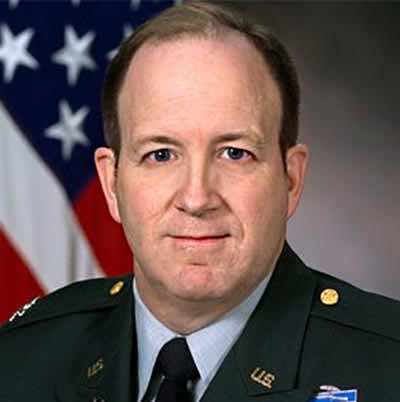
Throughout Colonel Guy T. Shields' time as an Army Public Affairs Officer (PAO), he demonstrated exemplary leadership, innovation, flexibility, adaptability and instincts that took media relations and contingency operations communications to the highest levels of strategic importance for both the Army and Department of Defense. Firmly grounded as a combat infantryman, he had credibility with both domestic and international journalists, as well as his fellow operators. The achievements with several exemplars are just a small sampling of the many achievements and legacy left by this exemplary Soldier and public affairs officer.
Col. Guy Shields established himself as the media relations expert for the Army throughout his nearly twenty years in public affairs, demonstrating his flexibility, instincts, public affairs, Army and situational acumen, and ability to rapidly assess a situation…or a question…and quickly and deftly develop and execute the best course of action. Any of the examples provided below could represent and enduring achievement; however, when combined as a singular media relations achievement they highlight why Guy Shields was universally respected and trusted by internal and external media, his military superiors, his peers and his subordinates.
NATO Nuclear Planning Conference in 1987. Col. Shields' first “opportunity to excel on the national stage came when on “no-notice,” he formed an international press center for the NATO conference. Capt. Shields met directly with the then-Assistant Secretary of Defense for Public Affairs (Fred Hoffman) at the downtown venue hotel, rapidly developed a plan, and executed the plan later that afternoon. He took a risk putting all junior enlisted personnel in civilian clothes to facilitate media coordination and coverage. The incredibly successful team handled more than 200 international media for four days, including arranging media availabilities with senior international military leaders.
Operation Golden Pheasant. Golden Pheasant was the President-declared “training” mission to Honduras in 1988. It was declared training, but one of the strategic initiatives was to make sure the media had video of the live ammunition being loaded. Capt. Shields handled hundreds of media, as well as demonstrators, and irate wives. Overnight, an antenna farm sprouted outside the front gate of Ft. Ord, eventually requiring the California Highway Patrol to close one lane of traffic on Highway One. With Ft. Ord's close proximity to the University of California - Santa Cruz, it was inevitable that the controversial deployment would attract demonstrations as the focal point for the Administration's Central American policy. At this point, Capt. Shields' quote that, “There are 20,000 Soldiers behind this gate sworn to defend these folk's right to demonstrate. Our only concern is their health and safety. That's why we have the CHP here directing traffic and we have provided water for the demonstrators,” was well received by the media, as well as the leadership in Washington.
Capt. Shields' efforts were recognized on the editorial page of the Monterey Herald when one letter writer called him a “Mensch.” Handling irate wives was not totally unexpected. The division commander decided to use the deployment process as a training event for the entire division. This included locking down the entire division and forbidding any communication with families. This went on for three days until wives started appearing on CNN with “less than positive” comments about the Army and division. After gaining support from the Army Public Affairs Office (OCPA), Capt. Shields countered the negative wives with interviews of wives who were supportive of the Army. He was also instrumental in setting up the “pink bayonet” family notification system for future operations, the forerunner of what are now called Family Readiness Groups.
50th Anniversary of the Normandy Landings. In the Spring of 1994, Maj. Shields' media relations expertise was recognized as he was the only major selected to be a public affairs “site officer-in-charge (OIC)” for any of the 50th anniversary of the Normandy Landings commemoration sites. He also was the only public affairs site OIC to be responsible for two sites, the Utah Beach Presidential Ceremony, as well as the Ste. Mere Église airborne ceremony. At the Utah Beach Ceremony he led an international team of PAOs and worked with the French Government and the White House Advanced Team to ensure all aspects of the media coverage of the event would maximize the positive messages. Planning for this operation had been on-going for a year, while “on the ground” preparation began in April, in advance of the June execution.
Maj. Shields set up a “sub-JIB (Joint Information Bureau)” for the Ste. Mere Église airdrop ceremony. This ceremony involved a jump which included Soldiers from the 82nd and 101st Airborne Divisions, as well as WWII Veterans who had actually made the jump into Normandy in 1944. The worst-case scenario came into play as one of the Veteran jumpers experienced a malfunction. Although it wasn't a complete “streamer,” the Veteran came in very hard, 100 yards off the drop zone, only 100 feet away from the JIB tent. That location probably saved him since it was a very swampy area. Maj. Shields was one of the first on the scene (in the swamp in service dress Class A uniform) to render assistance until he could be evacuated. (The Veteran suffered a broken hip.)
Double Eagle. Exercise Double Eagle was the first joint U.S. – Polish training exercise, held in Poland. Throughout 1995, Maj./Lt. Col. Shields was part of a team that went into former “Eastern Block” countries and taught their Ministries of Defense (MODs) and militaries how to conduct public affairs in a democratic environment. Lt. Col. Shields was the obvious choice to run the media aspects of this important exercise. His work and innovative execution set the standard for public affairs military to military engagements throughout Europe that would dramatically increase over the years.
Media Relations Division at OCPA. Lt. Col. Shields' media relations expertise was once again put to the test when he was assigned as a media officer at OCPA, rotating between the Personnel Team and the Operations Team, depending on what was “hot” at the time. He culminated that assignment as the Chief of Media for the Army. During this period, he was the Army spokesman on issues including the Sergeants Major of the Army courts martial, Maj. Gen. Hale court martial, the Aberdeen Proving Ground sexual misconduct scandal, the Hackworth Military Awards and Decorations controversy and alleged massacre of 1200 black Soldiers at Camp Van Dorn, MS, during WWII, always ensuring that the Army's messages were clearly communicated. The Army's reputation was on the line daily and it was Lt.Col. Shields who was on the front lines defending and reinforcing it.
Ft. McPherson, GA, 9-11 Anthrax Scare. In late 2001, while serving as the Chief of Public Affairs for U.S. Army Forces Command (FORSCOM), in the midst of the aftermath of 9-11, DC snipers and anthrax scares around the country, Col. Shields was once again put in the media relations spotlight, when on a Friday night at one of the command buildings on Ft. McPherson, GA, a “white powder” was discovered. Normally the installation Public Affairs Officer would handle this type of event, but given the sensitivities of the period, and the proximity to CNN headquarters, the FORSCOM Commander directed Col. Shields to take charge of the media situation. Throughout the night and the rest of the weekend, he coordinated statements and the public release of information, with the FBI, CDC and Atlanta first responders to ensure there was a unified message. By the end of the weekend, tests indicated it was not anthrax. Col. Shields' work with many of these same individuals during the 1996 Olympics, when he was the PAO for the Response Task Force, paid dividends throughout this brief event, as he maintained control of a coordinated, unified message.
Simultaneously with these many remarkable media operations contributions, Col. Shields' legacy as the consummate contingency public affairs officer set the example for peacetime, war and contingency deployments worldwide. Frankly, he established the standard for contingency public affairs operations for both the Army and Joint Operations. Again, just a few of many examples:
Operation Just Cause. His first major contingency operation was in Panama in 1989. Although Capt. Shields was no longer the division PAO, that did not keep him out of the media spotlight during combat and follow-on security operations in Panama. As the battalion operations officer of the unit responsible for securing the U.S., Cuban, and Libyan embassies, as well as the Panamanian university and government buildings, he was one of the very few operators willing to accept media. On nearly a daily basis, the media would show up in the Regimental and Battalion areas. Understanding the strategic value of communications, he spent a significant amount of time working with leaders to make sure the right messages were communicated clearly. His successes in no small measure resulted in the embedded media program that still receives wide acclaim internally and externally to the Department of Defense.
Operation Provide Promise, Deny Flight, and Task Force Able Sentry. This started as an international air re-supply to Bosnia in January 1993 but quickly progressed to an air-land resupply operation, mostly into Sarajevo, with Maj. Shields as the Joint Information Bureau Operations Officer. Operation Deny Flight was initiated during the operation creating a “no-fly” zone over Bosnia conducted by NATO. Maj. Shields assumed public affairs responsibility for that operation concurrent to his original duties, culminating with him being the only American at an Italian Air Force Base, acting as the spokesman for an RAF Squadron.
Task Force Able Sentry (the operation that involved deploying a battalion task force into the Former Yugoslav Republic of Macedonia (FYRM) as part of the United Nations Observer Force already in place) also added to his duties with the other operations. Upon arrival in the FYRM, he was greeted by the FYRM Minister of Defense and UN head of mission and immediately taken the FYRM national TV studios where he did a half hour live interview. Heeding the guidance from the CINCEUR, “I don't want another Somalia landing debacle,” he continued the planning and coordination, and was on the tarmac at Skopje airport to have the media positioned for the Berlin Brigade's Advance Party arrival. After the arrival of the unit's main body several days later, Maj. Shields dis-banded the JIB and turned the public affairs operation back to the unit. He then went back to his duties as the Provide Promise PAO.
Support Hope. In the summer of 1994, Maj. Shields was personally selected by Commander-in-Chief-Europe (CINCEUR), and approved by the Chairman of the Joint Chiefs of Staff (CJCS) to be the first PAO on the ground as the United States responded to the Rwanda refugee crisis. This was due in no small part to his public affairs work during Operation Distant Runner (evacuation of the U.S. Embassy in Rwanda in the Spring of 1994). During Operation Support Hope, Maj. Shields deployed on the first plane into Goma, Zaire, passing through what was to be the logistics hub in Entebbe, Uganda. The first trip was to be an assessment team, two-hour meeting with the United Nations and other non-governmental organizations. He didn't leave for six weeks. Upon arrival, the airplane was surrounded by many of the 600 international media who were already in a tent city at the Goma airport. Media interviews were a constant. Maj. Shields also setting up and secured the landing zone for the Secretary of Defense at the future site of a “planned” refugee camp. Because of his innovative work making things happen in an undeveloped theater of operation, Maj. Shields was recognized at a special awards ceremony, hosted by both the Secretary of Defense and the Chairman of the Joint Chiefs, at the Pentagon in December of 1994.
Strategically Deployable Joint Information Bureau Infrastructure (JIB-in-a-Box). Based on the lessons learned from his countless deployments in underdeveloped theaters, Maj. Shields was the principal architect and in developing U.S. European Command's (USEUCOM) “Jib in a Box” concept. With his experience, he knew what equipment needed to be included in order to get a internal and external media operation up and running with virtually no prep time. This concept gave USEUCOM the capability to deploy a JIB on short notice by just adding the people. This concept was the initial basis for future Army and Joint Forces manning and equipping doctrine for public affairs contingency operations worldwide.
Joint Guard. In January 1997, Lt. Col. Shields became the first Lt. Col. to serve as the operational PAO for U.S. Forces in Bosnia (previously filled by a Colonel). As soon as he arrived in country, the first major crisis hit, the controversy over the Brcko Bridge. This was the focal point of hundreds of international media. Lt. Col. Shields personally went forward to work with the Task Force Commander to ensure that the U.S. messages were communicated effectively through the international media. Lt. Col. Shields' tenacious emphasis on getting our message out, contributed greatly to the re-opening of the bridge on June 2, 1997, during a ceremony attended by the U.S. Secretary of State. Lt. Col. Shields was responsible for all media aspects of her trip to the area.
Iraqi Freedom. In the Fall of 2002, Col. Shields was selected by the Assistant Secretary of Defense for Public Affairs to organize and run the largest operational media program in the history of the Department of Defense, Operation Iraqi Freedom. In this position he was responsible for creating the program to train, equip, and medically prepare more than 700 international media, as well as work the logistics required for embedding them with Coalition forces. Additionally, he had to support more than 8000 additional media in the combat zone. He led an international team of more than 90 personnel, consisting of PAOs from all U.S. Military Services, the U.S. State Department, Kuwaiti Army, the Kuwaiti Ministry of the Interior, United Kingdom and Australia, as well as an Army Reserve Press Camp Headquarters. Of particular note, the Kuwaiti Ministry of the Interior delegated visa approval authority for accredited media to Col. Shields, something unheard of in the past.
When nearly all “unilateral” media departed Kuwait to move forward into Iraq, Col. Shields was in the process of redeploying the augmentees that made up the bulk of U.S. Forces in the Coalition Public Information Center (CPIC), back to home station when Ambassador Margaret D. Tutwiler, (former State Department Spokeswoman, and then-current U.S. Ambassador to Morocco) arrived at the Organization for Reconstruction and Humanitarian Assistance (ORHA) to rescue the “follow-on” mission. (ORHA was staging at the same hotel complex as the CPIC.) Two hours later a message arrived in theater attaching CPIC-Kuwait to ORHA.
CPIC-Kuwait immediately changed course from redeployment home to forward deployment into Baghdad. In late April, CPIC-Kuwait conducted both air and ground movements into Baghdad. At this point, Ambassador Tutwiler named Col. Shields her Chief of Staff. In mid-May, there were multiple suicide bombings in Morocco, the worst terrorist attack in their history. Ambassador Tutwiler had to return, and named Col. Shields as her replacement, initially as the ORHA communicator, transitioning to the Coalition Provisional Authority (CPA) public affairs officer. In late June, Col. Shields was named Combined Joint Task Force (CJTF) 7 Operational PAO, Military Coalition Spokesman and daily briefer.
His actions demonstrated the tremendous breadth of skills a public affairs officer needs to adapt to changing missions, be successful, and contribute to the battle space environment. Simply put, he set the conditions for success for all those who followed.
Col. Shields was one of the first public affairs leaders focused on integrating, harmonizing and synchronizing all organizational communications including prudent integration of public affairs, civil affairs and psychological operations (PSYOPs). The lasting achievements in doctrinal evolution, and operational fusion centers, and strategic communication are evident today throughout the Army and Defense Department.
Operation Nimrod Dancer. The integration, synchronization and harmonization of public affairs, psyops, and civil affairs have their roots in Operation Just Cause. Guy was at the forefront of the effort as the Deputy Operations Officer with additional duty as Public Affairs officer for Operation Nimrod Dancer (deployment to protect U.S. personnel and property in accordance with the Panama Canal Treaty). After helping to develop the eventual “take down” plan for what would eventually be called “Just Cause,” TF Atlantic began an extensive program that not only reinforced U.S. Treaty Rights in the Canal Zone but also rehearsed various aspects of the plan.
Every one of these operations had coordinated, harmonized and integrated public affairs, PSYOPs and civil affairs aspects, and all were covered extensively by Panamanian and international media. This resulted in “desensitizing” the Panama Defense Force, so that when the actual operation was executed, they assumed it was just another training exercise. One needs only to review the many lessons learned through this operation and Operation Just Cause to see the beginning of a fully integrated strategic and tactical operational communications battle space.
Joint Guard, Bosnia. Col. Shields developed a concept for a “three-lane-highway” allowing the Public Affairs and PSYOPs functions to work together to deliver a unified message to multiple audiences. Prior to this, there had been a historical and regulatory “brick wall” between the functions. Col. Shields worked with the PSYOPs team commander to learn his priorities and then find ways to support. One example was a Serbian mayor who refused to sign on to the Dayton Peace Accords. The PSYOPs approval process in effect at the time required weeks to get any message approved but allowed them to immediately use information released by a PAO. The key point was that if the Serbian major didn't sign on to the Accords, his town would not get heating oil for the winter. The U.S. Commander agreed to write a factual letter stating the implications. The CPIC then did a release on that letter, which Western journalists largely ignored, but allowed the PSYOPs team to get the message out. The result was that when local residents found out what was going on, they made the mayor sign the Accords.
Also, while in Bosnia, the PSYOPs team had a radio station but had no idea how to put it together, or how to run it. Over the course of a month, Col. Shields coordinated with broadcast public affairs professionals and engineers to put the station together and teach the PSYOPs team how to run it, resulting in effectively communicating a coordinated message to the Bosnian population. His actions also developed relationships that were instrumental in convincing other “operators” and commanders that the disciplines not only could be integrated, synchronized and harmonized, but must be to achieve the operational intent of each and the overall mission.
Other Significant and Lasting Contributions to the U.S. Army Public Affairs Field:
Army Public Affairs Association. Retired Col. Guy Shields took the lead in the establishment of the Army Public Affairs Alumni Association. (Alumni was dropped from the name in 2015). Throughout 2008, he arranged numerous organizational meetings and dinners with retired and active Army PAOs, from all three components, to build a consensus on the formation of the Association.
Col. Shields wrote the articles of incorporation and the initial draft of the by-laws for the organization. The Association was incorporated on 13 FEB 2009 in the Commonwealth of Virginia and received IRS tax-exempt status effective 13 FEB 2009. He was the first Chairman of the Association, served on its Board of Directors, and is now a member of the association's Senior Advisory Council.
During his years after retirement from the Army, Guy Shields continued to mentor PAOs of all Services as they transitioned to civilian life, hiring four retired PAOs himself, and placing a dozen more throughout the corporate world in the years since he retired. He has been an accredited member of the Public Relations Society of American for nearly three decades and served two years as the vice president of the Boston chapter.
Army Emergency Relief (AER). In 2011, after seven years in the corporate world, Col. Shields returned to a position where he could continue to help take care of Soldiers and their Families. As the first Chief of Communications and Public Affairs for this private non-profit, he had an open mandate to develop…and execute…a communications strategy to inform Soldiers and Families of the important benefits that are available to them in their time of need. AER is a private non-profit that works closely with the Army to take care of Soldiers and Families when they meet unexpected financial challenges. Since it was founded in 1942, AER has provided more than $1.7 billion to more than 3.5 million Soldiers and Families.
In summary, Col. Guy Shields is a leader who set the example and set the standard for media and contingency operations in the Department of Defense. In an office, or in a remote field location, he demonstrated the epitome of professionalism as a soldier and public affairs officer. He is without doubt one of the most innovative and dynamic public affairs officers ever to serve. His ability to see the big picture, quickly form strategic and tactical plans, and accomplish missions others thought overwhelming (and shied away from) were critical to communicating the Army's story during peace and contingencies, in garrison locations and remote battlefields.
Col. Shields' proactive public affairs acumen and media relations skills, all grounded in an infantryman's mentality and unparalleled environmental and political instincts, set the standard for media relations and contingency operations across the Army and DOD. Guy Shields' lasting contributions can be seen in daily operations throughout the Army and in the DINFOS instruction.
Every past, current and future public affairs professional is in his debt.

FOllOW THE OFFICE OF THE CHIEF OF PUBLIC AFFAIRS
Public affairs fulfills the Army's obligation to keep the American people and the Army informed, and helps to establish the conditions that lead to confidence in America's Army and its readiness to conduct operations in peacetime, conflict and war.