
Secretary of the Army's Cyber Strategic Seminar
Interested in applying to the Secretary of the Army's Cyber Strategic Seminar?
Access the application and teams channel using the code listed in MILPER 26-327.
Don't have access to the MILPER or Army Teams?
Reach out to Seminar Team via e-mail with any questions or to receive the application at usarmy.pentagon.hqda-secarmy.mbx.pca-cyber-strategic-seminar@army.mil.
Learn more and apply now!
Office of the Principal Cyber Advisor News
-
 Army opens cyber strategic seminar to emerging leaders
September 30, 2026
Army opens cyber strategic seminar to emerging leaders
September 30, 2026
-
 Secretary of the Army hosts Defense Critical Infrastructure Summit at Fort Bragg
May 15, 2026
Secretary of the Army hosts Defense Critical Infrastructure Summit at Fort Bragg
May 15, 2026
-
 Army, interagency, industry and local leaders unite at inaugural DCI Summit
May 14, 2026
Army, interagency, industry and local leaders unite at inaugural DCI Summit
May 14, 2026
-
 Army convenes industry leaders for AI tabletop exercise focused on cyber defense
May 4, 2026
Army convenes industry leaders for AI tabletop exercise focused on cyber defense
May 4, 2026
-
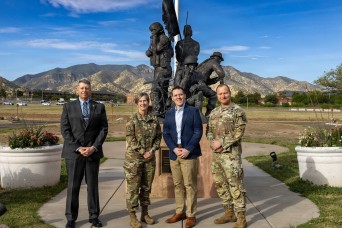 The Principal Cyber Advisor to the Secretary of the Army visits NETCOM to review global network, cyber operations and readiness
April 28, 2026
The Principal Cyber Advisor to the Secretary of the Army visits NETCOM to review global network, cyber operations and readiness
April 28, 2026
-
 Army’s principal cyber advisor recognized with cybersecurity visionary award
April 24, 2026
Army’s principal cyber advisor recognized with cybersecurity visionary award
April 24, 2026
-
 Army strengthens cyber partnerships through multinational engagements
April 19, 2026
Army strengthens cyber partnerships through multinational engagements
April 19, 2026
-
 Secretary of the Army sees future of cyber warfare, AI integration at ARCYBER
April 1, 2026
Secretary of the Army sees future of cyber warfare, AI integration at ARCYBER
April 1, 2026
-
 Secretary of the Army’s Cyber Strategic Seminar examines cyber policy, talent and future force readiness
March 22, 2026
Secretary of the Army’s Cyber Strategic Seminar examines cyber policy, talent and future force readiness
March 22, 2026
-
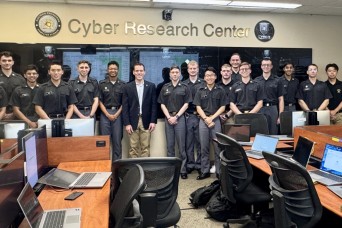 Army Principal Cyber Advisor engages cadets and faculty during West Point visit
December 16, 2025
Army Principal Cyber Advisor engages cadets and faculty during West Point visit
December 16, 2025
-
 Army's Cyber Strategic Seminar application now open
September 16, 2025
Army's Cyber Strategic Seminar application now open
September 16, 2025
-
 Army's principal cyber advisor says cyber key to preparing for future fight
September 15, 2025
Army's principal cyber advisor says cyber key to preparing for future fight
September 15, 2025
About the Office
The Principal Cyber Advisor (PCA) is the principal advisor to the Secretary of the Army and the Army Chief of Staff on all cyber matters and implements the Department of Defense Cyber Strategy in the Army. Areas of responsibility include:
- Review and certification of the Army cyber budget;
- Recruitment, resourcing and training of cyber forces, as well as assessing their readiness;
- Acquisition of cyber tools and capabilities;
- Fostering and improving a culture of cyber warfighting;
- Cybersecurity supply chain risk management;
- Security of information systems and weapon systems; and
- Advising on the Army’s electronic warfare and information advantage policies, programs, capability solutions, and resourcing.
Established by Congress in 2020, the PCA must report directly to the Secretary of the Army, be at least a three-star general officer equivalent, brief Congress, and be an independent office. The PCA serves as an Army Principal Official.
Mr. Brandon Pugh, Principal Cyber Advisor to the Secretary of the Army

Mr. Brandon Pugh is the Principal Cyber Advisor to the Secretary of the Army. He is responsible for advising the Secretary of the Army and the Army Chief of Staff on all cyber matters, including issues of readiness, budget, capabilities and strategy.
Most recently, Mr. Pugh served as the director and a resident senior fellow for a DC-based think tank, focusing on emerging cyber and national security threats, data privacy and security, and artificial intelligence.
Mr. Pugh continues to serve in the U.S. Army Reserve as a national security law professor at The Judge Advocate General’s Legal Center and School, having previously served as a paratrooper and international law officer. Mr. Pugh is also a nonresident fellow with the Army Cyber Institute at the United States Military Academy at West Point, a member of the International Association of Privacy Professional’s Research Advisory Board, a member of the Federalist Society's Cyber and Privacy Working Group, and a board member for a Governor’s Advisory Council.
Mr. Pugh’s past roles include serving as a fellow with the Federal Bureau of Investigation; Managing Editor of the Journal of Law and Cyber Warfare; Legislative Counsel for the New Jersey General Assembly Minority Office, handling nearly all policy and legislation on cybersecurity and emerging technology; President and CEO of a Homeland Security Advisory Firm; and member of the Rutgers University Cybersecurity Program Board.
Mr. Pugh also served as an elected and appointed official at the local, county, and state levels. This includes service as Vice President for legislation of the New Jersey School Boards Association, a quasi-governmental entity representing the state’s nearly 600 school boards. His early work was in emergency management and chemical, biological, radiological, and nuclear incidents.
Mr. Pugh has presented and been published dozens of times; delivered congressional testimony; appeared on C-SPAN and other networks; contributed to the U.S. Army’s Critical Infrastructure Resiliency Project; and prepared cybersecurity guidance sent to thousands of public entities. He has received awards for his work from members of Congress and state legislators, among others.
Mr. Pugh holds a juris doctorate from Rutgers Law School and a bachelor’s degree from The College of New Jersey. He is a master continuity practitioner through the U.S. Department of Homeland Security, a Certified Information Privacy Professional, and a fellow of information privacy. He is licensed to practice law in New Jersey and the District of Columbia, along with being admitted to the Supreme Court of the United States.
Mr. Pugh lives in New Jersey with his wife, who serves as an Air Force pilot, and their two sons.
Contact Information
LinkedIn: Click Here
Email Us: Click Here
Visit Our Partners
Army Cyber Institute: Explores cutting-edge research, analysis, and talent development in the cyber domain (Learn more here: Army Cyber Institute).
Army Cyber Command: Operates and defends Army networks and deliver cyberspace effects against adversaries to defend the nation with over 16,500 Soldiers, civilians, and contractors working 24/7 across the globe (Learn more here: Army Cyber Command).
Army Cyber Center of Excellence: Serves as the U.S. Army's force modernization proponent for Cyberspace Operations, Signal/Communications Networks and Information Services, and Electronic Warfare (EW), and is responsible for developing related doctrine, organizational, training, materiel, leadership/education, personnel, and facility solutions (Learn more here: Army CCoE).
U.S. Army Recruiting Command: Explores opportunities to begin a rewarding career in Army Cyber and other vital fields (Learn more here: U.S. Army Recruiting Command).