MEDAL OF HONOR
War in AfghanistanLive Webcast: Medal of Honor Ceremony
Watch the Medal of Honor ceremony live webcast, at
President will award the Medal of Honor to Captain William D. Swenson for his heroic acts during the War in Afghanistan.

Live Webcast: Hall of Heroes Induction
Watch the Hall of Heroes Induction Ceremony live webcast, at
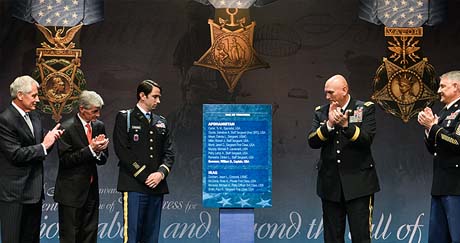
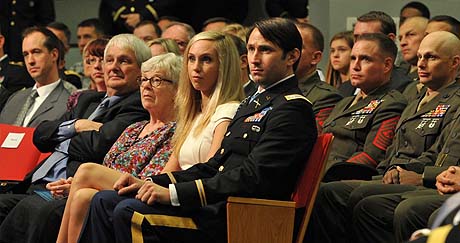
The U.S. Army will induct Captain William D. Swenson into the Pentagon's Hall of Heroes. The Pentagon ceremony will add Captain William D. Swenson's name to the distinguished roster in the Hall of Heroes, the Defense Department's permanent display of record for all recipients of the Medal of Honor.

Captain William D. Swenson

hometown
Seattle, Washington
Enlistment date
September 1999
Unit
1st Battalion, 32nd Infantry Regiment, 10th Mountain Division
Deployments
Operation Enduring Freedom
Capt. William D. Swenson joined the U.S. Army in 2002. He then attended Officer Candidate School at Fort Benning, Ga., where he was commissioned as a second lieutenant. He attended the Infantry Officer Basic Course and earned his branch qualification in Infantry.
Swenson served one tour in Iraq and two tours in Afghanistan. For his final tour in Afghanistan he was assigned to Task Force Phoenix, Combined Security Transition Command-Afghanistan and served as an Afghan Border Police advisor, in support of 1st Battalion, 32nd Infantry Regiment, 3rd Brigade Combat Team, 10th Mountain Division (Light Infantry).


His civilian education includes a Bachelor of Science in Political Science from Seattle University.
His military education includes the Infantry Mountain Leader Advanced Marksmanship Course, U.S. Army Airborne School, U.S. Army Ranger School, and the Infantry Maneuver Captains Career Course.
Swenson's awards and decorations include, the U.S. Army Parachutist Badge, the Ranger tab, the Combat Infantryman Badge, Bronze Star (2 Oak Leaf Clusters), the Purple Heart, the Army Commendation Medal, the Global War on Terrorism Service Medal, the Global War on Terrorism Expeditionary Medal, The Iraq Campaign Medal with two campaign stars, the Afghanistan Campaign Medal with one campaign star, the National Defense Service Medal, the Army Service Ribbon, the Overseas Service Ribbon (Numeral 2 device) and the NATO Medal.
 PHOTO: Capt. William Swenson has lunch with Afghan National Army local leadership and former Mujahadeen outside of Asadabad, Afghanistan, March 2009.

No surrender and no one left behind.
Learn more about Captain William D. Swenson heroic actions during the battle in Ganjgal Valley.
The Battle
No surrender and no one left behind.
September 8, 2009 | Ganjgal Valley, Kunar Province, Afghanistan

1st Battalion, 32nd Infantry Regiment, 10th Mountain Division
The distinctive unit insignia of the 10th Mountain Division.
The blue background of the patch and the crossed bayonets suggest the infantry, the bayonets also form a Roman numeral "X" (10), representing the unit's number. The overall shape of the patch is of a powder-keg suggesting the division's explosive power. Red, white, and blue suggest the national colors. The word "MOUNTAIN" is white on a blue tab affixed directly above the patch. Read Full Unit History
On Sept. 8, 2009, elements of the 1st Kandak, 2nd Brigade, 201st Afghan National Army Corps; 3rd Kandak, 1st Zone Afghan National Border Police, known as the ABP; U.S. Marine Corps Embedded Training Team, or ETT, mentors; U.S. Army ABP advisors; and Task Force, or TF, Chosin, conducted Operation Buri Booza II (a.k.a. Dancing Goat II) in the valley of Ganjgal Gar, in Eastern Afghanistan, along the volatile Pakistan border. The operation, Buri Booza, was to engage the elders in the lower Ganjgal Valley, in both the villages of Dam Darah and Ganjgal, in order to separate the isolated mountain communities from insurgents, and, through engagement and development initiatives, connect them with the Afghan government. The Afghan National Security Force-led mission also provided an opportunity for the Afghan National Security Force, known as the ANSF, to demonstrate their capabilities. For Maj. Kevin Williams and Capt. William D. Swenson and the Marine ETTs, the mission was particularly significant because it represented the culmination of a series of operations, a necessary step for the eventual transition of lead security responsibilities in areas where insurgents still undermine the state.
The rugged terrain in Ganjgal Gar is typical of the capillary valleys seen throughout Eastern Kunar Province, where a steep mountain range marks the invisible boundary between Afghanistan and Pakistan. The valley begins just off of the Kunar River and east of Auxiliary Supply Route, or ASR, Beaverton. A narrow, ungraded trail created by small vehicle and taxi traffic leads into the valley, and rock walls lining the sides of the road limit traffic by larger coalition vehicles. Opportunities to turn around are limited, and it is not until the road cuts north and across a large “washout” that there is any real space to spread out and expand mounted formations. The road ends just beyond Ganjgal village.
The grade on all sides rises considerably off of the valley floor, and terraced fields and boulders provide excellent observation of any approaching mounted and dismounted elements. The valley itself winds eastward nine kilometers, slowly rising in elevation, until it eventually peaks at the Pakistan border. Travel beyond Ganjgal and Dam Darah is rare because of the restrictive terrain, the lack of a viable road, and the sparse population that lives in this valley - although insurgents are known to traverse the seasonal passes with abandon.
Elements of the ANSF and TF Chosin had recently been in Ganjgal and Dam Darah. Four days prior to Operation Buri Booza II, Sept. 3, 2009, the Afghan National Army, known as the ANA, the Afghan National Border Police, referred to as ABP, and TF Chosin conducted a cordon and search in Dam Darah, in an attempt to engage the elders and search for an enemy mortar position. The engagement with village elders was positive. The elders traveled to Forward Operating Base, or FOB, Joyce, Sept. 4, provided a public radio announcement to be played over the FOB' s radio-in-a box, or RIAB, that denounced the insurgents, and invited the ANSF and Coalition Forces back into the valley to assess needed improvements to the Ganjgal mosque. To follow this momentum, Operation Buri Booza II was planned for Sept. 8.
Unknown to the ANSF and Coalition Forces, up to 60 insurgents had infiltrated Ganjgal Village from deeper within the valley, and from Pakistan. The insurgent presence was not reflected in corroborated advance intelligence. When combined forces entered the valley, they were ambushed by a host of well-armed, well-positioned insurgents, and the six-hour firefight that ensued produced 15 coalition and ANSF deaths — including four ETTs (three Marines and one Navy Corpsman) and one ETT interpreter — plus 17 more were wounded-in-action.

On Sept. 8, ANSF entered the mouth of the valley. Though a large or heavily-armed foe was deemed unlikely, patrols that entered into the valley historically were engaged by small arms fire and rocket-propelled grenades, known as RPGs, usually from small groups from the high ground. Before dawn as the combined force turned off ASR Beaverton east toward Ganjgal Gar, all were prepared for the potential of small arms contact and RPGs, despite the warm invitation by the elders to come into the village.
Shortly after twilight lifted, at approximately 5:30 a.m. local time, the column departed the vehicle objective rally point, or ORP, at the bottom of the valley and began the movement up the long, gently sloping hill toward Ganjgal Village. Because of the rough road and intelligence suggesting improvised explosive devices along the route, they approached on foot. The column consisted of 106 personnel, which included 60 ANA soldiers, 14 ANA mentors, 30 ABP members, and U.S. Army Soldiers Capt. William Swenson and Sgt. 1st Class Kenneth Westbrook, both advisors to the ABP. After departing the ORP, Marines and ANSF broke off to the north and south to take up various support positions, while a smaller contingency — approx. 65 troops - continued up the center of the treacherous wash leading to the village.
At the front of the column approaching the village were four ETTs — three Marines and a Navy Corpsman — and their ANA counterpart. Behind them was the command element, or Tactical Action Center (TAC), led by Maj. Kevin Williams and consisting of 1st Lt. Ademola D. Fabayo, a Marine ETT operations officer; First Sgt. Christopher Garza, ETT first sergeant; an ANA radio telephone operator, or RTO; and Jonathan Landay, an embedded reporter with the Marine ETT. To the rear of the TAC and their ANA counterparts were Swenson and Westbrook, with their ABP counterparts.
As the lead Marine ETT mentor crested the washout and moved within 100 meters of Ganjgal Village, an RPG motor suddenly ignited from the front of the column. Before this round even had time to impact, the combined force in the valley had already begun to take enemy PKM machine gun and AK-47 small arms fire from the east. The enemy had maneuvered into the village from the north and south using previously unobserved trenches, and heavy fire erupted from homes and buildings to the front of the dispersed lead column. Coalition forces and the ANSF dove for cover and returned fire with their individual and crew-served weapons. Swenson observed enemy fighters to his east, swarming out from the high ground, attempting to flank his position. He immediately returned fire, and directed and coordinated the response of his partnered ABP soldiers, upon the visible enemy, in an effort to establish a base of fire for the ANA soldiers in the front of the column, who were pinned down by the insurgent' s initial volley.
While the enemy fire at that time remained effective and accurate, the combined force most exposed within the wash were successful in moving out of this dangerous area with little cover and into the limited protection provided by the terraced farmland to the north and south. The TAC struggled to maintain command and control as, once out of the wash, squads and platoons disappeared from visual and voice control, swallowed by the extreme terraces. Swenson remained aware of his position relative to the dispersed column of ANSF and coalition forces, and called in fire missions on known targets to disrupt the enemy' s efforts to maneuver and mass on individual pockets of ANSF. As coalition artillery fell, the enemy drew closer to both the column and the population center, hugging the protective southern terrain and friendly positions. Due to the extreme close proximity of insurgent fighters to the ANSF positions, multiple fire missions were unsuccessful in deterring the enemy' s advance. In the span of 45 hectic minutes, the initiative passed to the insurgents. The calls of wounded Soldiers began to make their way over the din and crash of rockets and artillery.
It became evident that coalition forces were now effectively flanked, under defilade fire from multiple angles and elevations, and even individual squads were becoming suppressed and maneuvered upon by the enemy. Unable to observe the most forward coalition forces and ANSF elements, the TAC could not perform any sort of retrograde until they could be assured their lead elements were informed, and covered by fire. Repeatedly, Swenson called for white phosphorous smoke to obscure the valley, but wary of placing incendiary rounds into a populated civilian area, the closest obscuring effect of the shells placed was 400 meters away.
Image above: Capt. William Swenson looks out at the rough terrain of Eastern Afghanistan from a Black Hawk helicopter. Photo courtesy of U.S. Army.
An hour into the firefight, communication with the lead elements had been lost and could not be re-established. Surrounded on three sides, and fixed by overlapping fields of fire with crew-served weapons, RPGs and sporadic enemy indirect fires, the TAC' s position was desperately untenable. Wounded troops accumulated, including Williams, who had been shot in the arm, and Garza, whose eardrums were ruptured by an RPG. Physically unable to evacuate the wounded down the steep terraces and unwilling to enter the enemy kill zone in the wash, Swenson coordinated for combat aviation and helicopter support.
The enemy, now within 50 meters, had successfully isolated Swenson from his partner advisor, Westbrook. Swenson learned that Westbrook was shot in the upper chest, and lay in an exposed position. Attempting to reach Westbrook, Swenson returned accurate fire on the enemy, despite coming under direct enemy fire that killed two adjacent ANA soldiers, and wounded another. Finally able to repel the enemy with the assistance of another ANA soldier, Swenson, Garza and Fabayo maneuvered over 50 meters of open space, fought their way to their fallen comrade, and began to render first aid.
Now consolidated, but still in the kill zone under a barrage of enemy fire, Fabayo observed three insurgents maneuvering out of a house to the front of the TAC. Fabayo made direct visual contact with an insurgent who was wearing fatigues, body armor and a helmet, waving for Fabayo to surrender. Calling to Swenson, Fabayo reported the insurgent' s presence and their demands to surrender to the Taliban. Outnumbered, flanked and facing enemy capture, Swenson put down his radio and halted his treatment of Westbrook long enough to reply to the enemy' s demands for surrender, by throwing a hand grenade. Following his example, the members of the TAC rallied. Swenson' s example, and his element' s stout resistance, effectively disrupted the enemy attack and pushed them back beyond hand grenade range.
At 7:47 a.m., after an hour and forty minutes of fighting, a team of OH-58D Scout Helicopters — call signs Palehorse 50 and Palehorse 60 — arrived in the valley. Swenson, still treating Westbrook, whose condition was quickly deteriorating, began to talk the aircraft' s fires on the various enemy targets he had observed around the valley. The enemy sporadically engaged the aircraft, yet appeared hesitant to engage coalition forces while they were overhead. This provided the TAC the slim opportunity they needed for successful retrograde back to the support-by-fire position A, or SBF-A. Swenson, Fabayo, and Jonathan Landay carried Westbrook, and with the group suffering more casualties every moment, the column ran, bounded, and broke contact down the steep terraces.
After what seemed like hours under effective and suppressive enemy fire, the combined force arrived at SBF-A and began immediate medical evacuation, or MedEvac, procedures. Soon after, a UH-60 helicopter arrived at the landing zone, located outside of small arms and RPG fire, and Swenson loaded Westbrook who was immediately taken to the forward support hospital at FOB Wright. The valiant effort by Swenson and the members of the TAC to maneuver under accurate and unmitigated enemy fire, moving Westbrook as well as ambulatory and non-ambulatory Afghan casualties, no doubt saved the lives of Westbrook and several others. Unfortunately, Westbrook would later die of his wounds, but not before departing theater and spending the last few weeks of life with family and loved one.
After Westbrook' s evacuation, Swenson and Fabayo manned an ABP unarmored vehicle and reentered the kill zone at least twice, evacuating wounded and bringing them to the casualty collection point, or CCP. Throughout, Swenson communicated via radio with the air support pilot, attempting to determine the location of the missing ETTs. At the same time, Marine Staff Sgt. Juan Rodriguez-Chavez and Marine Cpl. Dakota Meyer were retrieving wounded in an up-armored Humvee.
 PHOTO: Image captured from video depicting the battlefield actions of Cpt. Swenson on Sept. 8, 2009 near the village of Ganjgal in Kunar Province, Afghanistan. He directed MedEvac landing for the evacuation of his critically injured teammate, Sgt. 1st Class Kenneth Westbrook. The video was captured by two different MedEvac crew members and shows each crew member's perspective of events spanning the same time period. Video is courtesy of Mrs. Charlene Westbrook.
At around 8 a.m., contact was still not established with the three Marines and one Navy corpsman ETTs, and the unarmored truck carrying Fabayo and Swenson was too damaged to take back into the wash. A Combat Search and Rescue (CSAR) helicopter arrived on station, but it was clear that any landing zone in the immediate area would be dangerously close to enemy positions and RPG teams. The need for a ground recovery of all remaining casualties became clear. Going above and beyond the call of duty, Swenson began making preparations to return up the wash into the kill zone.
After convening with Fabayo, Rodriguez-Chavez, and Meyer at the CCP, Swenson returned with Rodriguez-Chavez and Fabayo to the ORP to gather all available combat power. Meyer remained at the CCP and evacuated injured teammates Williams and Garza. The convoy assembled by Swenson consisted of an up-armored Humvee, an armored ABP Humvee, and two up-Armored ANA vehicles. After picking up Meyer at the CCP, the convoy continued into the wash. The ANA vehicles stopped early in the movement to recover the first set of casualties encountered. Under withering fire and without the necessary combat power to sustain the rescue or the ability to extract themselves, Swenson pressed on. Swenson, Fabayo, Rodriguez-Chavez and Meyer took the up-armored Humvee all the way to the suspected objective area in the village.
While they succeeded in rescuing and recovering several ANSF wounded and dead, they were forced by the volume of fire to drive past several marked positions deeper into the ambush, because of the pinpoint accuracy of the enemy' s small arms fire. Throughout the trip, Swenson communicates with the air support pilot, calling in targets and inquiring about the location of the missing ETTs. After a dismounted search was unable to find the ETTs, the rescue party realized that previously isolated ANSF have been moving from the cover of their terraces to the wash in a desperate attempt for extraction, and were taking effective small arms fire, which produced three new casualties. Swenson made the decision to return to SBF-A, to download casualties, and assist the ANSF who had just come down off the terraces and into the wash.
At around noon, the CSAR aircraft finally spots the location of the missing ETTs, and attempts to land and recover the fallen. The rescue convoy provided covering fires from a westerly position as the CSAR bird tried to land, but is forced under close RPG fire to leave station. Swenson called for smoke to mark the location of the bodies, and then from the position at the entry of the town, the convoy began to maneuver the CSAR bird into a supporting position. ANA joined to support a rescue attempt of the fallen.
Swenson, Fabayo, Rodriguez-Chavez, Meyer, with another small contingent of ANSF following, moved back east to a closer position to the fallen. Their objective was now the smoke rising at the top of the hill that marked their fallen comrades. With Palehorse elements suppressing known and suspected insurgent strongholds, and Fabayo operating the M240 machine gun, they faced precise and deadly fire for a second time. Coming to a stop directly adjacent to the ETTs' position, they found their comrades in a deep trench that had been impossible to see from ground angles during previous trips into the valley. Meyer and Swenson, along with ANA and ABP soldiers, dismounted and loaded the bodies into the back of the flat-bed ANA Humvee, while Rodriguez-Chavez and Fabayo provided covering fire. Driving back down the wash, receiving accurate and sustained fire to their rear, they completed the recovery operation.
 PHOTO: Capt. William Swenson leads Afghan Border Police members as they board a UH-60 Black Hawk helicopter, May 2009.
Swenson drove straight to the ORP to verify accountability of all soldiers with the ANSF. It would be determined after the engagement that Swenson' s actions directly contributed to the preservation of more than a dozen Afghan lives. Swenson was the core of the initial defense and two subsequent rescue efforts. In seven hours of continuous fighting, Swenson braved intense enemy fire, and willfully put his life in danger against the enemy' s main effort, multiple times in service of his fallen and wounded comrades, his unit, his country, and his endangered Afghan partners.
"The Battle of Ganjgal was ferocious. And it was tragic. And we lost so many good lives that day. But following the violence, and the death, came inspiration. And we were inspired by those who fought there, by those who would not accept defeat."
- John M. McHugh, Secretary of the Army
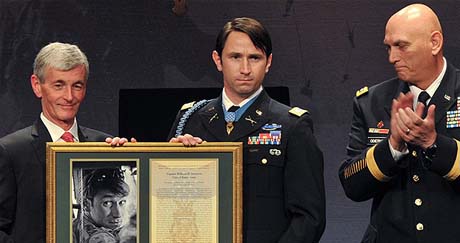
Hall of Heroes Induction, October 16, 2013
The Ceremony
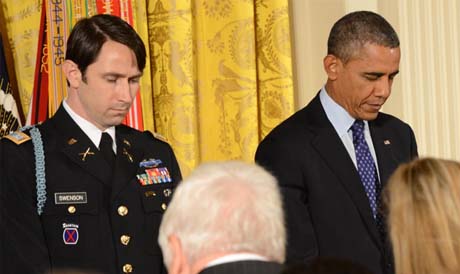

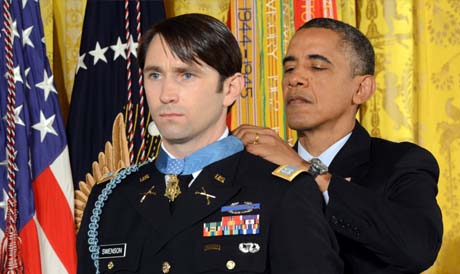
“...But more Americans -- and more Afghans -- are still out there. So Will does something incredible. He jumps behind the wheel of an unarmored Ford Ranger pickup truck. A Marine gets in the passenger seat. And they drive that truck -- a vehicle designed for the highway -- straight into the battle. Twice, they pick up injured Afghan soldiers -- bullets whizzing past them, slamming into the pickup truck. Twice they bring them back. When the truck gives out, they grab a Humvee. The Marine by Will's side has no idea how they survived. But, he says, "by that time it didn't matter. We [were] not leaving any Soldiers behind.”
President Barack Obama,
White House Medal of Honor Ceremony, October 15, 2013
RELATED STORIES FROM ARMY.MIL
1st Battalion, 32nd Infantry Regiment, 10th Mountain Division
Birth of the Division
In November 1939, the Soviet Union invaded Finland. Finnish soldiers on skis annihilated two tank divisions, humiliating the Russians. Charles Minot (Minnie) Dole, the president of the National Ski Patrol, saw this as a perfect example of why the U.S. Army needed mountain troops. Dole spent months lobbying the War Department to train troops in mountain and winter warfare. In September 1940, Dole was able to present his case to Army Chief of Staff General George C. Marshall, who caused the Army take action on Dole’s proposals to create ski units.
On Dec. 8, 1941, the Army activated its first mountain unit, the 87th Mountain Infantry Battalion, which later became an entire regiment, at then-Fort Lewis, Wash. The unit was dubbed "Minnie’s Ski Troops" in honor of Dole. The 87th trained on Mount Ranier’s 14,408 foot peak. The National Ski Patrol took on the unique role of recruiting for the 87th Infantry Regiment, and later the division. After returning from the Kiska Campaign in the Aleutian Islands near Alaska, the 87th formed the core of the new division.
10th Mountain Division - World War II
This unique organization came into being July 13, 1943, at Camp Hale, Colo., as the 10th Light Division (Alpine). The combat power of the division was contained in the 85th, 86th, and 87th Infantry Regiments. The division’s year training at the 9,200 foot high Camp Hale honed the skills of its Soldiers to fight and survive under the most brutal mountain conditions.
On June 22, 1944, the division was shipped to Camp Swift, Texas, to prepare for the Louisiana maneuvers of 1944, which were later canceled. A period of acclimation to a low altitude and hot climate was necessary to prepare for this training.
On Nov. 6, 1944, the 10th Division was redesignated the 10th Mountain Division. That same month the blue and white "Mountain" tab was authorized.
Combat - 1945
The division entered combat on Jan. 28, 1945, in the North Apennine Mountains of Italy. The division faced German positions arrayed along the five-mile long Monte Belvedere-Monte della Torraccia ridge. Other divisions had attempted to assault Mount Belvedere three times, even holding it temporarily, but none had succeeded. To get to Mount Belvedere the division first had to take a ridge line to the west known to the Americans as the Riva Ridge. The Germans on Riva Ridge protected the approaches to Mount Belvedere. The assault on Riva Ridge was the task of the 1st Battalion and F Company, 2d Battalion, 86th Mountain Infantry. After much scouting, it was decided the assault would be at night, a 1,500-foot vertical assent. The Germans considered the ridge to be impossible to scale and manned it with only one battalion of mountain troops. The attack by the 86th on Feb. 18, 1945, was a complete success and an unwelcome surprise to the Germans.
Mount Belvedere was assaulted next. Belvedere was heavily manned and protected with minefields. Shortly after the 86th assault on the Riva Ridge, the 85th and 87th Regiments made a bayonet attack without covering artillery fire on Belvedere, beginning Feb. 19. Again, the surprise of the assault was successful, and after a hard fight, the peak was captured. Realizing the importance of the peak, the Germans made seven counterattacks over two days. After the first three days of intense combat, the division suffered 850 casualties, to include 195 dead. The 10th had captured more than 1,000 prisoners. The 10th was now in a position to breach the German's Apennine Mountain line, take Highway 65 and open the way to the Po Valley.
On April 14, 1945, the final phase of the war in Italy began. With the 85th and 87th leading, the 10th Mountain Division attacked toward the Po Valley, spearheading the Fifth Army drive. The fighting was fierce, with the loss of 553 mountain infantryman killed, wounded, or missing in the first day.
Crossing the Po, Lake Garda, War’s End
Early April 20, the seventh day of the attack, the first units of the 85th Infantry Regiment broke out into Po Valley. Five days of attack had cost 1,283 casualties. With the German’s mountain line broken, the next objective was to cross the Po River.
On the morning of April 23, the 10th was the first division to reach the Po River. The first battalion of the 87th Mountain Infantry, the original mountain infantry unit, made the crossing under fire in 50 light canvas assault boats.
The final combat for the 10th Division took place in the vicinity of Lake Garda, a canyon lake at the foothills of the Alps. On April 27, 1945, the first troops reached the south end of the lake, cutting off the German Army’s main escape route to the Brenner Pass. The drive was delayed by destroyed tunnels and road blocks. Using amphibious DUKWs, these obstacles were bypassed and the towns of Riva and Tarbole at the head of the lake were captured. Organized resistance in Italy ended May 2, 1945.
The 10th completely destroyed five elite German divisions. In 114 days of combat, the 10th Division suffered 992 Soldiers killed in action, and 4,154 Soldiers wounded.
Since the 10th Mountain Division was one of the last to enter combat, it was to be used in the projected invasion of Japan. These plans ended with the surrender of Japan in August 1945. After a brief tour of duty in the Army of Occupation in Italy, the 10th was sent to then-Camp Carson, Colo. There, the 10th Mountain Division was disbanded, Nov. 30, 1945.
10th Infantry Division 1948-1958
To meet the Army’s requirements to train large numbers of replacements the 10th was reactivated as a training division, July 1, 1948, at Fort Riley, Kansas. It didn’t retain its wartime designation as a Mountain Division, and as result lost its "Mountain" tab. The division had the mission of processing and training new Soldiers for service with other Army units. The outbreak of the Korean Conflict in June 1950, enlarged this mission. A total of 123,000 men completed basic training with the 10th during the period 1948-1953.
In January 1954, the Department of Army announced that the 10th Division would become a combat infantry division, and be sent to Europe under a new rotation policy. The 10th Training Division was reduced to zero strength in May 1954. The personnel and equipment of the 37th Infantry Division were brought to Fort Riley, and on June 15, 1954, became the new 10th Infantry Division. In what became known as Operation Gyroscope, the 10th replaced the 1st Infantry Division in Germany. The headquarters of the 10th Division was located in Wurzburg, with all units stationed within a 75-mile radius. Stretched in an arc, from Frankfurt to Nurenburg, the 10th occupied a strategic center position in the NATO defense forces. With nine infantry battalions, four artillery battalions, and one tank battalion, the 10th Infantry Division was a powerful military force. The 10th Division was in turn replaced in Germany by the 3rd Infantry Division, in 1958. The 10th was then sent to Fort Benning, Ga., and inactivated June 14, 1958.
10th Mountain Division (Light Infantry) - 1985 to Present
The division was officially reactivated Feb. 13, 1985, at Fort Drum, N.Y., as the 10th Mountain Division (Light Infantry). The division commander after reactivation was Brig. Gen. William S. Carpenter. The 10th was the first division of any kind formed by the Army since 1975, and the first based in the Northeast U.S. since World War II. The 10th Mountain Division (LI) was designed to meet a wide range of worldwide infantry-intensive contingency missions. Equipment design was oriented toward reduced size and weight for reasons of both strategic and tactical mobility.
Desert Shield/Storm 1990-1991
Although the 10th didn’t deploy to Southwest Asia as a unit, about 1,200 10th Mountain Division Soldiers did go. The largest unit to deploy was the 548th Supply and Services Battalion, with almost 1,000 Soldiers, which supported the 24th Mechanized Infantry Division in Iraq. Following a cease-fire in March, the first division Soldiers began redeploying to Fort Drum. The last Soldiers were welcomed home in June 1991.
Hurricane Andrew Relief - Florida 1992
Hurricane Andrew struck South Florida Aug. 24, 1992, killing 13 people, rendering an estimated 250,000 people homeless and causing damages in excess of $20 billion. On Sept. 27, 1992, the 10th Mountain Division assumed responsibility for Hurricane Andrew disaster relief, as Task Force Mountain. Division Soldiers set up relief camps, distributed food, clothing, medical necessities and building supplies as well as helping to rebuild homes and clear debris. The last of the 6,000 division Soldiers to deployed to Florida returned home in October 1992.
Somalia 1992-94
Operation Restore Hope: December 1992 - May 1993.
On December 3, 1993, the division headquarters was designated as the headquarters for all Army Forces (ARFOR) of the Unified Task Force (UNITAF) for Operation Restore Hope. Maj. Gen. Steven L. Arnold, the division commander, was named Army Forces commander. The division’s mission was to secure major cities and roads to provide safe passage of relief supplies to the starving Somali population. Due to 10th Mountain Division efforts, humanitarian agencies declared an end to the food emergency and factional fighting decreased. A Company, 41st Engineer Battalion built a 160-foot Bailey bridge north of Kismayo. It was the largest Bailey bridge built outside the U.S. since the Vietnam War. Beginning in mid February 1993, the division began the gradual reduction of forces in Somalia.
Operation Continue Hope: May 1993 - March 1994.
On May 4, the UN assumed the task of securing the flow of relief supplies in Somalia. All remaining division units in Somalia came under the control of a new headquarters, United Nations Operations in Somalia (UNOSOM II).
2-14th Infantry Battalion Aids Rangers: October 3-4, 1993
On Oct. 3, Special Operations Task Force Ranger (TFR) conducted a daylight raid on an enemy stronghold, deep in militia-held Mogadishu. The Rangers had successfully captured some of warlord Mohammed Farah Aidid’s key aides, but went to the aid of an aircraft shot down by enemy fire. They were quickly surrounded by Somali gunmen. The 2-14th Infantry quick reaction force (QRF) was dispatched to secure the ground evacuation route. As darkness fell, the 2-14th Infantry was reinforced with coalition armor and for three hours they fought a moving gun battle from the gates of the port to the Olympic Hotel and the Ranger perimeter. The 2-14th was successful in linking up with the Rangers and began withdrawal under fire along a route secured by Pakistani forces. As dawn broke over the city the exhausted Soldiers marched, rode, and stumbled into the protective Pakistani enclave at city stadium. For 2-14th Soldiers, the ordeal had lasted over twelve hours.
The 2-14th had a total of 29 Soldiers wounded, and one killed. One 41st Engineer Battalion Soldier, attached to 2-14, was injured in the firefight and later died of his wounds in a hospital in Lanstuhl, Germany. Task Force Ranger suffered nineteen killed, fifty-seven wounded, and one missing (captured, later returned alive). Estimates of Somali militia losses were three hundred killed and over seven hundred wounded. With six and a half hours of continuous fighting, this was the longest sustained firefight by regular U.S. forces since the Vietnam War.
The last divisional combat unit stationed in Somalia, 2d Battalion, 22d Infantry, returned home March 12, 1994. In all, some 7,300 Soldiers from the 10th served in Somalia.
Operation Uphold Democracy
Haiti 1994-95
The division formed the nucleus of the Multinational Force Haiti (MNF Haiti) and Joint Task Force 190 (JTF 190) in Haiti during Operation Uphold Democracy. The MNF-Haiti was the U.S. led coalition force in Haiti which included Soldiers from 20 nations. More than 8,600 of the almost 21,000 troops in Haiti wore the 10th Mountain Division patch.
At 9:30 a.m., Sept. 19, 1994, the division’s 1st Brigade conducted the Army’s first air assault from an aircraft carrier. This force consisted of 54 helicopters and almost 2,000 Soldiers. They occupied the Port-au-Prince International Airport. This was the largest Army air operation conducted from a carrier since the Doolittle Raid in World War II, where Army Air Force bombers were launched off of a carrier to attack Tokyo.
The division’s mission was to create a secure and stable environment under which the legitimate government of Haitian President Jean-Bertrand Aristide could be reestablished and democratic elections held. The final step in preparing for Aristide’s return from exile occurred early Oct. 13, when General Cedras, his family and members his de-facto government left the country for Panama. When President Aristide returned to the Port-au-Prince International Airport, Oct. 15, 1994, his security was provided for courtesy of the 10th Mountain Division.
The 10th Mountain Division handed over control of the MNF-Haiti to the 25th Infantry Division, Jan. 15, 1995. The division redeployed the last of more than 8,600 division Soldiers who served in Haiti, by Jan. 31, 1995.
Operation Joint Guard - Bosnia 1997
The 642nd Engineer Company deployed to Bosnia and Herzegovina, March 18, 1997, for a six-month tour, constructing and maintaining roads and base camps. Two companies of the 2nd Battalion, 14th Infantry, deployed for Bosnia a day later. B Company’s mission was to defend a critical bridge site, C Company’s mission was to act as the theater reserve.
Task Force Eagle - 1998-2000
In the fall of 1998, the division received notice that it would be serving as senior headquarters of Task Force Eagle, providing a peacekeeping force to support the ongoing operation within the Multi-National Division-North area of responsibility in Bosnia and Herzegovina.
Preparations began immediately for Stabilization Force 6. While division staff began planning, Soldiers began training. The division split into two operations: Task Force Drum -- for those remaining in the North Country -- and Task Force Eagle, set to deploy to Bosnia. Warfighting skills remained the focus of the division's training.
In preparation for the Bosnia assignment, four major events were staged in 1999, including an SFOR6 conference in Tuzla, Bosnia; a deployment exercise at Fort Drum as a rehearsal; a conference at Fort Drum and Fort Hood, Texas, and an inter-theater rehearsal by some staff members, with other units in Bosnia.
Selected division units began deploying in late summer, to link up with their commander, Maj. Gen. James L. Campbell, who had preceded his Soldiers to Bosnia. Approximately 3,000 division Soldiers deployed. Meanwhile at Fort Drum, every effort was made to ensure the safety and care of Soldiers and families remaining at home.
After successfully performing their mission in Bosnia, the division units conducted a Transfer of Authority, relinquishing their assignments to Soldiers of the 49th Armored Division, Texas National Guard. By early summer 2000, all 10th Mountain Division Soldiers had returned safely to Fort Drum.
After adding humanitarian, training and operational deployments together, the 10th Mountain Division (LI) had earned the distinction of being the most deployed Army division during the 1990s, a period which had seen the greatest number of missions for United States military forces – reserve-component and active duty – since the end of World War II.
Working toward the future: JCF-AWE 2000
The Joint Contingency Force-Advanced Warfighting Experiment (JCF-AWE) wrapped up September 2000, when Soldiers from the division's 1st Brigade successfully completed the nearly month-long exercise at the Joint Readiness Training Center at Fort Polk, La.
The JCF-AWE was designed to improve, demonstrate and validate the enhanced lethality, agility and effectiveness of combat systems on future battlefields by focusing on three major goals:
- Expand commanders' situational awareness through digitized command and control, enhanced communications, and improved interoperability between systems, processes and procedures;
- Enhance military operations in urban and complex environments; and,
- Improve the ability of military forces to plan and conduct forced and early-entry operations.
These goals were met by integrating dozens of new technological initiatives such as digitized communication systems, unmanned aerial vehicles, and thermal-sighted weapons.
In less than a year's time the brigade Soldiers received basic technical instruction on the new technology, and they then learned how to put these systems to use in tactical, combat situations. Again division Soldiers had a unique experience: Helping to mold the future of the infantry.
3rd Infantry Brigade Combat Team “Spartans”
10th Mountain Division (Light Infantry)

The 3rd Infantry Brigade Combat Team, the Spartans, was activated at Fort Drum, N.Y., Sept. 24, 2004. Assigned to the legendary 10th Mountain Division (Light Infantry), the Soldiers of the 3rd BCT reflected their Spartan namesakes and Mountain Warriors from the Italian Campaign in World War II, as they participate in the most demanding Light Infantry training within the U.S. Army, in the challenging conditions of upstate New York locally referred to as the North Country.
The Spartan namesake is an appropriate one for the 3rd BCT, which embodies the U.S. Army Warrior Ethos and its four tenets:
- Always place the mission first
- Never accept defeat
- Never quit
- Never leave a fallen comrade behind.
The 3rd BCT motto: “With your shield, or on it!” was a directive by Spartan women to their Soldiers to face the enemy honorably and either come back with their honor, body, and shield intact, or else be carried back as a fallen hero on the shield. If a Spartan warrior came back from battle without his shield, it was assumed he had dropped it and run away, casting away his honor while also exposing his comrades to danger. The Soldiers of the 3rd BCT epitomize the combined spirit of the legendary Spartans of ancient Greece, and the courageous 10th Mountain veterans of World War-II.
The 3rd BCT consists of six subordinate battalions; two Infantry battalions, the 1st Battalion, 32nd Infantry Regiment; and the 2nd Battalion, 87th Infantry Regiment. The 3rd Squadron, 71st Cavalry Regiment, provides reconnaissance services to the BCT, while the 4th Battalion, 25th Field Artillery Regiment, provides field artillery support. The 3rd Brigade Special Troops Battalion provides multiple combat support functions for the BCT, specifically a company of engineers, military intelligence personnel, and communications specialists. Sustainment operations for the BCT are provided by the 710th Brigade Support Battalion.
In the winter of 2006, the Spartan brigade conducted its first combat deployment in support of Operation Enduring Freedom VII & VIII. The 3rd BCT was assigned to the Regional Command-East area of responsibility in Afghanistan, fighting a determined Taliban enemy along the challenging mountainous terrain of the Pakistani border. The Spartans truly were “the tip of the spear,” moving into territory that had been in control of the enemy; but through professional, disciplined, offensive operations, the Soldiers of the 3rd BCT dramatically reduced the violence within the region and enhanced stability.
During the Spartan brigade’s deployment; Sgt. 1st Class Jared C. Monti, a member of 3-71 Cavalry, earned the Medal of Honor for his combat leadership and selfless service, while protecting the Soldiers in his patrol from an overwhelming Taliban force.
The Spartans redeployed to Fort Drum having established an enduring relationship with the Afghan people and the “Tribe of the Crossed Swords” – a special recognition of the 10th Mountain Division shoulder patch and the Warrior Ethos.
In January 2009, the Spartan brigade again deployed to Afghanistan. The BCT was assigned the demanding mission of providing security in the Logar and Wardak Provinces in Regional Command-East. Spartan Soldiers and their Afghan National Security Force partners were responsible for protecting the southern gates of Kabul and for eliminating Taliban pressure on the capitol. Employing Counter-Insurgency Operations, or COIN, principals, the Spartan brigade established security in the provinces by employing a “village-to-village” approach.
The Spartan brigade deployed in March 2011, to the birthplace of the Taliban – Kandahar Province, Afghanistan, and began immediate offensive operations taking the fight to the enemy. Spartan Soldiers conducted three key operations – “To the River,” “To the Core,” and “To the Summit” – each focusing on a different theme of lethal and non-lethal operations, while keeping the tempo on the enemy. Soldiers advanced the farthest south in the region of any previous coalition forces’ unit, effectively pushing the Taliban to the Arghandab River, and keeping them there.
On the non-lethal side, the brigade opened 22 schools, three medical clinics, and refurbished 50 kilometers of Highway-1, the national highway for southern Afghanistan. Deploying in support of Regional Command-South, the Spartan brigade also partnered with Afghan security forces and government leaders to bring noticeably increased security and governance to an area that had been at war for 30 years.
Spartan Soldiers redeployed to Fort Drum in March, 2012, after having their victories recorded on the battlefields of southern Afghanistan.
32nd Infantry Regiment Insignia
Descriptions and symbolism of the unique 32nd Infantry Regiment insignia.
Distinctive Unit Insignia

Description: A Gold color metal and enamel device 1 3/16 inches (3.02 cm) in height overall consisting of a shield blazoned: Azure a saltire couped Argent, overall a puela in pale Or. On a canton of the second a lion passant guardant Gules (for the 1st and 2nd Infantry). Attached above on a wreath Argent and Azure a mahiole Or garnished Gules.
Symbolism: This Regiment was organized in August 1916, in the Island of Oahu, Hawaii, from the 1st and 2d Infantry. The parent organizations are shown on the canton, the lion indicating that both regiments took part in the War of 1812. The central device is taken from the royal Hawaiian arms to symbolize the Regiment’s birthplace. The puela was an ancient Hawaiian banner with many uses, one of which was in front of the King’s tent leaning against two crossed spears (called alia), to indicate both tabu and protection; a saltire cross replaced the spears on the Hawaiian arms. The colors of the crest are the royal Hawaiian colors. The crest is an ancient Hawaiian war bonnet known as mahiole.
Background: The distinctive unit insignia was approved on 5 March 1929.
Coat of Arms

Blazon:
Shield: Azure a saltire couped Argent, overall a puela in pale Or. On a canton of the second a lion passant guardant Gules (for the 1st and 2nd Infantry).
Crest: From a wreath Argent and Azure a mahiole Or plumed Gules.
Motto: Against All Odds.
Symbolism:
Shield: This Regiment was organized in August 1916, in the Island of Oahu, Hawaii, from the 1st and 2d Infantry. The parent organizations are shown on the canton, the lion indicating that both regiments took part in the War of 1812. The central device is taken from the royal Hawaiian arms to symbolize the Regiment’s birthplace. The puela was an ancient Hawaiian banner with many uses, one of which was in front of the King’s tent leaning against two crossed spears (called alia), to indicate both tabu and protection; a saltire cross replaced the spears on the Hawaiian arms.
Crest: The colors of the crest are the royal Hawaiian colors. The crest is an ancient Hawaiian war bonnet known as mahiole.
Background: The coat of arms was approved on 30 November 1920. It was amended to add a motto on 5 January 1996.
Official Citation
The President of the United States of America, authorized by Act of Congress, March 3, 1863, has posthumously awarded in the name of Congress the Medal of Honor to
Captain William D. Swenson
United States Army
Captain William D. Swenson distinguished himself by acts of gallantry and intrepidity at the risk of his life above and beyond the call of duty while serving as embedded advisor to the Afghan National Border Police, Task Force Phoenix, Combined Security Transition Command-Afghanistan in support of 1st Battalion, 32nd Infantry Regiment, 3rd Brigade Combat Team, 10th Mountain Division, during combat operations against an armed enemy in Kunar Province, Afghanistan on September 8, 2009. On that morning, more than 60 well-armed, well-positioned enemy fighters ambushed Captain Swenson's combat team as it moved on foot into the village of Ganjgal for a meeting with village elders. As the enemy unleashed a barrage of rocket-propelled grenade, mortar and machine gun fire, Captain Swenson immediately returned fire and coordinated and directed the response of his Afghan Border Police, while simultaneously calling in suppressive artillery fire and aviation support. After the enemy effectively flanked Coalition Forces, Captain Swenson repeatedly called for smoke to cover the withdrawal of the forward elements. Surrounded on three sides by enemy forces inflicting effective and accurate fire, Captain Swenson coordinated air assets, indirect fire support and medical evacuation helicopter support to allow for the evacuation of the wounded. Captain Swenson ignored enemy radio transmissions demanding surrender and maneuvered uncovered to render medical aid to a wounded fellow soldier. Captain Swenson stopped administering aid long enough to throw a grenade at approaching enemy forces, before assisting with moving the soldier for air evacuation. With complete disregard for his own safety, Captain Swenson unhesitatingly led a team in an unarmored vehicle into the kill zone, exposing himself to enemy fire on at least two occasions, to recover the wounded and search for four missing comrades. After using aviation support to mark locations of fallen and wounded comrades, it became clear that ground recovery of the fallen was required due to heavy enemy fire on helicopter landing zones. Captain Swenson’s team returned to the kill zone another time in a Humvee. Captain Swenson voluntarily exited the vehicle, exposing himself to enemy fire, to locate and recover three fallen Marines and one fallen Navy corpsman. His exceptional leadership and stout resistance against the enemy during six hours of continuous fighting rallied his teammates and effectively disrupted the enemy's assault. Captain William D. Swenson's extraordinary heroism and selflessness above and beyond the call of duty are in keeping with the highest traditions of military service and reflect great credit upon himself, Task Force Phoenix, 1st Battalion, 32nd Infantry Regiment, 3rd Brigade Combat Team, 10th Mountain Division and the United States Army.
President's Remarks
2:10 P.M. EST, October 15, 2013
THE PRESIDENT: Welcome to the White House. Last month, the United States Army released a remarkable piece of video. It's from the combat helmet cameras of a MedEvac helicopter crew in Afghanistan. It's shaky and grainy, but it takes us to the frontlines that our troops face every day. And in that video, as the helicopter touches down by a remote village, you see, out of a cloud of dust, an American Soldier.
He's without his helmet, standing in the open, exposing himself to enemy fire, standing watch over a severely wounded Soldier. He helps carry that wounded Soldier to the helicopter, and places him inside. Then, amidst the whipping wind and deafening roar of the blades, he does something unexpected. He leans in and kisses the wounded Soldier on the head -- a simple act of compassion and loyalty to a brother in arms. And as the door closes and the helicopter takes off, he turns and goes back the way he came, back into the heat of battle.
In our nation's history, we have presented our highest military decoration, the Medal of Honor, nearly 3,500 times for actions above and beyond the call of duty. But this may be the first time that we can actually bear witness to a small part of those actions for ourselves. And today we honor the American in that video -- the Soldier who went back in -- Captain William Swenson.
Not far away that day was then Corporal Dakota Meyer, to whom we presented the Medal of Honor two years ago. Today is only the second time in nearly half a century that the Medal of Honor has been awarded to two survivors of the same battle. Dakota is not here today, but I want to welcome some of the Soldiers and Marines who fought alongside both of these men, and the families of those who gave their lives that day.
Moments like this, Americans like Will, remind us what our country can be at its best -- a nation of citizens who look out for one another; who meet our obligations to one another, not just when it's easy, but when it's hard; especially when it's hard. Will, you're an example -- to everyone in this city, to our whole country -- of the professionalism and patriotism we should strive for -- whether we wear the uniform or not. Not just on particular occasions, but all the time.
For those who aren't familiar with the story of the battle that lead to Will being here today, I want to take you back to that September morning four years ago. It's around sunrise. A column of Afghan soldiers and their American advisors are winding their way up a narrow trail towards a village to meet with elders. But just as the first soldier reaches the outskirts of the village, all hell breaks loose.
Almost instantly, four Americans, three Marines, and a Navy corpsman at the front of the column are surrounded. Will and the Soldiers in the center of the column are pinned down. Rocket-propelled grenade, mortar, and machine gun fire, all of this is pouring in from three sides.
As he returns fire, Will calls for air support. But his initial requests are denied -- Will and his team are too close to the village. Then Will learns that his non-commissioned officer, Sergeant First Class Kenneth Westbrook, has been shot in the neck. So Will breaks across 50 meters of open space, bullets biting all around. Lying on his back, he presses a bandage to Kenneth's wound with one hand and calls for a MedEvac with the other, trying to keep his buddy calm.
By this time, the enemy has gotten even closer -- just 20 or 30 meters away. Over the radio, they're demanding the Americans surrender. Will stops treating Kenneth long enough to respond -- by lobbing a grenade.
Finally, after more than an hour and a half of fighting, air support arrives. Will directs them to nearby targets. Then it's time to move. Exposing himself again to enemy fire, Will helps carry Kenneth the length of more than two football fields, down steep terraces, to that helicopter. And then, in the moment captured by those cameras, Will leans in to say goodbye.
But more Americans -- and more Afghans -- are still out there. So Will does something incredible. He jumps behind the wheel of an unarmored Ford Ranger pickup truck. A Marine gets in the passenger seat. And they drive that truck -- a vehicle designed for the highway -- straight into the battle.
Twice, they pick up injured Afghan soldiers -- bullets whizzing past them, slamming into the pickup truck. Twice they bring them back. When the truck gives out, they grab a Humvee. The Marine by Will's side has no idea how they survived. But, he says, "by that time it didn't matter. We [were] not leaving any Soldiers behind."
Finally, a helicopter spots those four missing Americans -- hours after they were trapped in the opening ambush. So Will gets in another Humvee, with a crew that includes Dakota Meyer. And together, they drive. Past enemy fighters. Up through the valley. Exposed once more.
When they reach the village, Will jumps out -- drawing even more fire, dodging even more bullets. But they reach those Americans, lying where they fell. Will and the others carry them out, one-by-one. They bring their fallen brothers home.
Scripture tells us, "The greatest among you shall be your servant." Captain Will Swenson was a leader on that September morning. But like all good leaders, he was also a servant -- to the men he commanded, to the more than a dozen Afghans and Americans whose lives he saved, to the families of those who gave their last full measure of devotion on that far away field. As one of his fellow Soldiers later said, "Will did things that nobody else would ever do, and he did it for his guys, and for everybody on the ground, to get them out."
That's why after I called Will to tell him he'd be receiving this medal, one of the first things he did was to invite to this ceremony, those who fought alongside him. I'd like all of those who served with such valor, alongside Will -- both Army and Marines -- who fought for each other, please stand and be recognized.
Thank you. Will also reached out to the families of the four Americans who gave their lives that day. To them he wrote, and I'm quoting Will now, "We have never met. We have never spoken, but I would like to believe I know something about each of you through the actions of your loved ones that day. They were part of a team, and you are now part of that team."
So, I would ask the members of this team, the families of First Lieutenant Michael Johnson, Gunnery Sergeant Edwin Johnson, Gunnery Sergeant Aaron Kenefick, and Hospitalman Third Class James Layton, as well as the family of Kenneth Westbrook, to please stand.
Kenneth was the Soldier Will delivered to the safety of that helicopter. After being airlifted out, he made it to Walter Reed. He started rehab, and spent time with his wife Charlene, who joins us her today. She still remembers the first time she spoke to Will, when he called from Afghanistan, to check in on Kenneth. Soon after that phone call, however, Kenneth took a turn for the worst. He succumbed to complications from his treatment. I think it's safe to say that Charlene will always be grateful for the final days she was able to spend with her husband. Even now, a month rarely goes by when Will doesn't call or text, checking in with Charlene and her three boys. "That's the kind of man he is," Charlene says about Will. "You don't have to ask Will for help. He just knows when to be there for you."
So, Will Swenson was there for his brothers. He was there for their families. As a nation, we thank God that patriots like him are there for us all. So, Will, God bless you and all the men you've fought alongside, and for everything you've done for us. God bless all of our men and women in uniform. God bless the United States of America.
With that, I'd like my military to read the citation please.
[the citation is read and the medla is presented]
(Applause.)
THE PRESIDENT: Let me say once again, not only to Will, but to all our men and women in uniform, who have served us with such incredible courage and professionalism, that America is grateful for you. To the families of those we've lost, we will never forget.
Will, you are a remarkable role model for all of us, and we're very grateful for your service.
We are going to have a reception after this. I hear the food is pretty good around here. I hope all of you have a chance to stay, and for those of you who have a chance to thank Will personally, this is very welcome. I'm going to be exiting with Will and Michelle, first. We'll take a couple of pictures. Enjoy yourselves this afternoon.
God bless America.
END 2:30 P.M. EST
Hall of Heroes Induction
CEREMONY REMARKS | October 16, 2013
Secretary of Defense Chuck Hagel
Secretary Hagel: Good afternoon. Secretary McHugh, General Odierno, Sergeant Major Chandler, Chairman Dempsey, ladies and gentlemen, the men and women who serve our country today in uniform, the civilian employees who support our men and women in uniform, and in particular our special guests here this afternoon, who have been recognized, and our most honored guest, Captain Swenson and his family.
I have a quite elegant speech, of course. But I will dispense with these eloquent words. And I'm going to make a couple of comments I hope that will add to the true eloquence of the chiefs and secretary's comments. I could not improve on, or I don't mean to duplicate what they said, what President Obama said yesterday, what everyone in this room knows about this very special individual.
Let me add my thoughts this way. Many important words have been said about Will Swenson, appropriately so, over the last few days. One particular point that President Obama made yesterday was that at a time in our country when we need more unifying dimensions and dynamics to remind us who we are, yes, as a great nation, but, even more importantly, as a good people. The Will Swenson story does that. It does remind us who we are -- sacrifice, service, going beyond your own personal ambitions, your own personal interests, and serving the interests of others first.
I don't know a more complete picture that could be presented or example noted of that selflessness than the story of Will Swenson and those who have gone before, and every man and women in the history of this great republic who have given so much of themselves, and the people in this room and all over the world who continue to do that.
Will, you mean an awful lot to a lot of people, but your biggest contribution probably will come later. And that is the role model that you have already projected, not just for men and women in uniform, but the next generations behind you. We all recognize as parents, as individuals who have any responsibility for positions in life, that that is our biggest, most significant responsibility, to improve upon the inheritance that we were each given, the blessings and the good things. We know about bad things.
But that's not our role. Our role is to improve, make it better, inspire, uplift our people, our families, our country and the world. And as President Obama noted yesterday, the Will Swenson story is a great reminder of those responsibilities and how we can do it with dignity, with eloquence, with never asking anything in return.
I want to also note something that was said here today, mentioned by the chief, mentioned by the secretary. Yes, Will Swenson proved his valor on the battlefield. It is well documented. It should be well documented. But he also did something else that represented tremendous courage and integrity. And I've always thought the two indispensable elements of anyone's life are courage and character. And if we're without those in some measure, it's a pretty hallow existence.
He questioned -- he dared to question the institution that he was faithful to and loyal to. Mistakes were made, in his case. Now, that's courage and that's integrity and that's character. As the institution itself reflected on that same courage and integrity institutionally, the institution, the United States Army, corrected the mistake. They went back and acknowledged a mistake was made and they fixed it.
Another great dimension of our republic, of our people, we have an inherent capability to self-correct. Free people have that capability if they have the will and the courage to self-correct. And we all do in our own personal lives. Institutions don't always. Eventually they will be forced to. In this case, the United States Army was not forced to. It did self-correct. It was a wrong. They corrected it. They fixed it.
We're sorry that you and your family had to endure through that, but you did and you handled it right. And I think that deserves a tremendous amount of attention and credit. We celebrate you today, Will. We celebrate your family. We celebrate your very brave colleagues who have been recognized, those who didn't make it back, their families today. But we celebrate all the good things about our country today because of you. And we're grateful.
May God bless you and your family, Will. Thank you. Thank you.
Editor's Note: The remarks above represent the Secretary of Defense's prepared remarks as taken directly from: http://www.defense.gov/speeches/speech.aspx?speechid=1811
Secretary of the Army John M. McHugh
Secretary McHugh: Good Afternoon. You know, as I was sitting listening to the Chief (of Staff of the Army Gen. Ray Odierno), I looked at this stage as all of you are, and, like many of you, I've had the honor of attending literally dozens of events here; but never so much as in this kind of occasion does this place look so special and so beautiful. And fittingly so.
And speaking of beautiful, you all look good. Chief (Odierno) as he always does, did a great job of introducing individuals by name, so I'm not going to recount all of those; just know that you are all very, very welcome, and we all deeply appreciate your attendance, whether you are a part of the civilian or Army uniformed family or a member of the Department of Defense family, we are deeply appreciative.
I do want to give a couple special welcomes to our distinguished members of my former haunt for 17 years, the House of Representatives, Welcome. So, how are you doing? How are we doing? We'll talk later. You are truly welcome and thank you for during a very busy time for coming here and sharing this special moment.
Mr. Secretary, Secretary Hagel, as always, we deeply appreciate your personal attention to these kinds of occasions, the deep concern you bring for the men and women in uniform and their families. Your presence here today is making this an even more special occasion.
But we would not have an event, to state the obvious, without Captain Will Swenson, without the love and support of his parents, Carl and Julia, the continued love and special relationship with Kelsey Long, all of the distinguished guests that he and others have brought with them, you make this moment what it is.
By way of confession, I have to tell you whenever I share a dais with the Secretary of Defense, I get a little bit more self-conscious about my remarks. I want to be honest with you, as well. I'm even more on edge this afternoon, and frankly, Mr. Secretary, it doesn't have much to do with you. It's Will's mom's presence that has me a little nervous. Now, if you had occasion to read or see President Obama's remarks yesterday at the White House during that very touching ceremony, he observed that both the Captain's parents are retired Seattle University professors. Carl was a math professor; that one field of study more than any other that drove me into political science. But more frightening, Julia's field was English. And as the President noted, she made sure that even at a young age, Will not only dotted his i's and crossed his t's, but he practiced perfect grammar at all times. So, Julia, ma'am, I have done my best today and will continue to ensure correct usage and correct syntax. Or, as we say back home where I'm from, I hope I got good English.
Most importantly, truly, thank you both very much for being here; you have much to be proud of -- or, I guess I should say much of which to be proud. To state the obvious, this is a tremendous honor, for the Army and, if I may, for me, personally, as we gather to induct Captain William David Swenson into our Hall of Heroes -- the first officer in the United States Army to receive the Medal of Honor for any conflict since the Vietnam War. And that makes this special occasion even more special. This is also, as Will himself has said, a time of mixed emotions, a time when we pay tribute to uncommon valor, but at the same time, we mourn and we remember the horrible loss of comrades and friends.
The Battle of Ganjgal was ferocious. And it was tragic. And we lost so many good lives that day. But following the violence, and the death, came inspiration. And we were inspired by those who fought there, by those who would not accept defeat -- and, as the Chief noted, we are indeed, honored to have many of those warriors who fought by Will's side that day -- his battle buddies -- joining us -- both Army and Marines -- and I deeply appreciate the rightful recognition you gave them. But I would say to you: If you question what this concept of "jointness" is about, if you really doubt it's being applied -- look at this battle; look at those uniforms. I don't think you'll question it anymore.
Gentlemen: God love you. God Bless you for your service, and for all that you not just did that day, but every day that you serve in uniform. I will also say that from that single fierce battle -- two Medals of Honor, two Navy Crosses, a Silver Star, Nine Bronze Stars with V(alor) device -- that is an amazing measure of honor. And even by that incredible standard, Will Swenson is truly a hero amongst heroes. And today, because of this event, he will have his name will enshrined along with those who have gone before, forever a part of our Nation's and our Army's history. And his name will be displayed alongside such others as Alvin York and Audie Murphy and Les Sabo.
The reason I single out Les Sabo, even though his name, certainly outside this room, may not be as recognizable as others, is that his story, and Will's, offer a common and an important lesson for our Army. About a year and a half ago, I stood in this very room, close to this very spot as we inducted Specialist Sabo into our Hall of Heroes. And that followed a ceremony in which Les' family received the Medal of Honor at the White House just the day before. In 1970, Les Sabo sacrificed his life in a far away field in Cambodia, and he did so to save the lives of his fellow Soldiers.
For more than 40 years, his story was all but lost to anyone outside of his family. And as you may recall, that was the case until a writer happened to stumble upon his records in the National Archives. And that writer began to push anew for the Medal of Honor that should have been awarded decades earlier.
And today, we similarly pause to bestow an overdue honor, once more.
Now, I couldn't do much for Les Sabo at the time; perhaps there is something, Will, I hope I can do for you, and, as I know you feel even more importantly, for those who may follow in your footsteps. This morning I issued a directive requiring that all Medal of Honor nominations be sent immediately to the awards and decorations branch of the Army Human Resources Command (HRC). As soon as an honors packet is created at battalion level, we will have immediate visibility at Army headquarters. Each subsequent command's review will also be required to be immediately forwarded to HRC; and in return, HRC will follow up with the original command every 30 days until that award packet reaches its final review. A parallel process that will provide greater oversight; a way by which we can ensure that no future award packet is lost along the way, or paperwork misplaced or somehow forgotten in the fog of war.
Our heroes have always taught us many things, and that's true here, today. Sometimes our heroes teach us how to make ourselves better. And Will, for that as well, I -- we all -- want to thank you. But Will has taught us a lot more than how to make our processes better. He's also taught us about things like valor and courage and teamwork and sacrifice. And there's more. To prepare for today, I watched some of the videos that we coerced Will into doing, and he did incredibly well. And for all of the impressive things that I heard from him, I was particularly struck by something he said in relation to that day.
As the Chief (of Staff of the Army) noted, on that day, we lost three Marines, First Lieutenant Michael Johnson, Gunnery Sergeant Edwin Johnson, Staff Sergant Aaron Kenefick; we lost a Navy Corpsman, James Layton; and, about a month later, Army Sergeant First Class Kenneth Westbrook -- the Soldier whose forehead Will gently kissed as he lifted him onboard a MedEvac helicopter.
I know that their families have already been recognized, but I would ask, respectfully, that we pause once more to remember their sacrifice, and to again thank each of them for being here today. Join with me (Applause). And I would say, from the bottom of my heart, no matter what uniform your loved one wore, from this day forward, you are all a beloved part of our Army family. God bless you, and thank you.
We also lost nine Afghans, men whose names Americans will likely never know, at least not in large numbers. And in the interview I mentioned, Will spoke about them, their sacrifice, and their struggling nation. And Will observed, and I'm going to quote here, "the Afghan people in Kunar Province got to see their government, their leaders, their Soldiers, their brothers, out there trying to do the right thing, trying to find the Afghan solution to their problems," he concluded, "they saw the Afghans … fight."
In telling the story of those Afghans, those warriors who fought alongside them that day, in witness to their courage and conviction, Will may have taught us the most important lesson of all. He taught us all: There's hope. Hope comes in many forms, comes in many faces and many voices. Where a baby's cry is heard, there is hope that the world will go on. Where a teacher, someone who has devoted an entire lifetime not to power, not to glory, not to money, but for the conveyance of knowledge, when that teacher speaks in understanding tones to a struggling student, there is hope for a better future. And when a prayer of remembrance is said over the casket of a fallen hero, what that Soldier died for -- freedom and liberty and the right to breathe free -- that sacrifice gives us hope that all the people of the world, wherever they may live, may one day realize what is universally proclaimed as the American dream.
Since 1775, the Army -- the United States Army, along with the comrades-in-arms we have, the Navy, the Marine Corps, the Air Force, and the Coast Guard, band together as a band of warriors -- have continuously brought hope, have continuously brought that dream to the oppressed. Wherever those forces are stationed, they have always brought hope.
Will, you and your comrades that day were many things, but you were true messengers of hope -- hope to the Afghan people. And a renewed hope to every American who like all of us has lived in the cloak of freedom and liberty that the courage and skill and conviction of the American Soldier has provided for more than 238 years, that that freedom will endure into the future, as well.
Will, that is a high honor and, in its own way, a heavy burden. And through your service, your courage, your leadership and sacrifice, you have given me -- you've given us all -- hope. So, Captain Swenson, congratulations, to you, to your family on this very special tribute, and thank you, too, on behalf of our Army, our Nation, for your service and your valor.
God bless you, God bless the United States of America, and this glorious Army that keeps her free. Thank you.
Editor's Note: The remarks above represent the Secretary of the Army's prepared remarks as taken directly from: https://www.army.mil/article/113249/
Army Chief of Staff
General Raymond T. Odierno
General Odierno: Good afternoon everybody. It's good to see so many people here. It's really a privilege to see such a great turnout to honor Captain William Swenson, who today joins a rare fraternity of military service members who have displayed extraordinary acts of valor during exceptional circumstances, with great risk to their own personal safety.
Captain Swenson embodies the essence of a Soldier and represents what every man and woman who dons this uniform strives to be: an individual who has earned the trust of all with whom they associate; one who possesses a humility and selflessness that we all respect; one who embraces esprit de corps and routinely demonstrates a dedication to his profession that epitomizes the ethos of the American Soldier. In the face of imminent danger, he never quit. He always put his mission first. He never accepted defeat. And above all else, he never left his fallen comrades. Just as he was there for them that day, his friends, his band of brothers are here for him today.
On September 8th, 2009, five service members made the ultimate sacrifice, and their presence is felt in the hearts of everyone here. We remember 1st Lt. Michael Johnson, U.S. Marine Corps; Gunnery Sergeant Aaron Kenefick, U.S. Marine Corps; Gunnery Sergeant Edwin Johnson, U.S. Marine Corps; Hospitalman 3rd Class James Layton, U.S. Navy; and Sergeant First Class Kenneth Westbrook, United States Army. We are honored to have their Gold Star family members here with us today, so I would ask them to please stand and be recognized.
I'd like to recognize our distinguished guests: Secretary Hagel, the Secretary of Defense -- sir, thank you for being here; Representatives Jeff Denham from California and Tulsi Gabbard from Hawaii -- thank you so much for both being here; Secretary McHugh, the Secretary of the Army and Acting Secretary Fanning, the Acting Secretary of the Air Force -- thank you for being here; General Marty Dempsey, the Chairman of the Joint Chiefs -- sir, thank you for being here; Generals Mark Welsh, the Chief of Staff of the Air Force; General Gordon Sullivan, the head of AUSA and the 32nd Chief of Staff of the Army; General John Campbell, the Vice Chief of Staff of the Army; and Sergeant Major of the Army Ray Chandler, my battle buddy -- thank you for being here; and other distinguished guests from our Department of Defense and Army leadership that are joining us today, and Marine Corps and all our other service members.
I'd like to extend a special welcome to Captain Swenson's family and friends: his father, Carl, and his mother, Julia; and Ms. Kelsey Long. I also like to recognize several members of the Marine Corps and Army who were on the ground with Will that fateful day in Ganjgal. Thank you so much for your service to our nation, your sacrifices and dedication. Your presence today reinforces the personal nature of combat and the strong bonds formed under extraordinary conditions. I'd like you all to stand as well to be recognized.
It was on September the 8th, 2009, that Army Captain Will Swenson and Sergeant First Class Westbrook were part of a combined patrol with Afghan National Border Police and an Afghan National Army unit and their 12 Marine Corps advisers and Navy medic. Together, the group set off for the village of Ganjgal in Kunar Province, to meet with village elders and discuss the creation of a local security force.
Just after dawn, as they approached the outskirts of the village on foot, they were ensnarled in a vicious ambush. Over 60 well-armed insurgents began firing heavy machine guns, rocket propelled grenades, and small arms from entrenched positions in the village and the surrounding mountains. Captain Swenson and the patrol were pinned down behind low stone walls while a lead team was trapped in a courtyard. Sniper rounds and explosions impacted closer and closer while the insurgents taunted the patrol over the radio, demanding their surrender. As the enemy began to envelop the patrol, the reality set in that the men were surrounded, out manned and outgunned.
Captain Swenson began radioing for artillery and aviation support, but the brigade's Aerial Scout Weapons Team was already supporting other troops in contact to the north. Dangerously exposed, he repeatedly called for smoke to conceal their withdrawal. The men continued to hold their ground, and at one point, the enemy got so close that Will threw a hand grenade to keep them at bay. As the patrol bounded back, continuous enemy fire wounded many of the men, including the ranking officer, Major Williams, and Captain Swenson's teammate, Sergeant First Class Westbrook.
In the fury of the attack, Will took charge. With one hand, he treated Sergeant First Class Westbrook, and with the other he held a radio hand-mic, identifying enemy targets to a Scout Weapons Team that had just arrived on station. Receiving word of a MedEvac helicopter inbound, Captain Swenson exposed himself to enemy fire and marked the landing zone by holding a signal panel on top of him. As the helicopter landed, Will loaded Sergeant First Class Westbrook inside and returned to the battle.
As the majority of the patrol withdrew from the valley, Captain Swenson returned to the kill zone in an unarmed truck to evacuate the dead and wounded Afghan soldiers and police. Next, he organized a recovery party for the lead team of three Marines and Navy corpsman that were still trapped in the initial ambush location. Then he drove back into the ambush zone, stopping to treat wounded Afghans and mark their locations for extraction.
While aerial platforms searched for the missing service members, Captain Swenson waited in the open, continuing to take fire from the enemy. The enemy contact was so intense that a Combat Search and Rescue helicopter sent to assist was unable to land. After an hour, the helicopter located the missing men and confirmed that they had been killed in action. Once again, Will exposed himself to continuous enemy machine gun fire to recover his fallen comrades and return them to base.
Captain Swenson symbolizes what is best about our Soldiers and our Army. Taking charge on the battlefield early that morning, Will led a team of brothers-in-arms against great odds, and rallied them in their efforts to save each other. In the end, the battle lasted nearly six hours, and Will had returned to the kill zone four times to treat and evacuate wounded service members and coalition partners.
On September 8th, 2009, Captain Swenson demonstrated incredible competence: technical and tactical proficiency, leading a joint and combined team under fire, taking an extreme situation and performing to the best of his ability. He demonstrated commitment to every fellow service member, to our multinational partners, and he brought honor upon our nation. He demonstrated great character: he understood the inherent trust that must exist between service members. In combat, the uniform you wear is inconsequential. What matters are the men and women you live, sleep, eat, and fight with -- and that unspoken commitment that you have to each other. Captain Will Swenson's strength of character is undeniable. Even after the battle, Will was not afraid to point out deficiencies in the operation that caused difficulties in obtaining the appropriate and timely support. He recognized the value of assessing performance and he had the character to stick to his convictions. That's how we grow as Soldiers; that's how we grow as an Army; that's how we grow as a joint force.
By honoring Captain Swenson's actions today, we honor the heroes who have sacrificed for this nation, along with every service member who has raised their right hand to defend this country and our ideals.
Throughout our history and over the course of the last twelve years of war, I have seen first-hand how U.S. Army Soldiers, Sailors, Airmen, and Marines have served with the competence, character, and commitment that our great nation deserves. Captain Swenson is the epitome of these qualities and much, much more, having demonstrated his leadership in the ultimate crucible of combat. The strength of our nation is our Army, the strength of our Army is our Soldiers, the strength of our Soldiers is our families, and this is what makes us Army Strong. Thank you very much.
Editor's Note: The remarks above represent the Army Chief of Staff's prepared remarks as taken directly from: https://www.army.mil/article/113243/
Sub Page Example
Lorem Ipsum Plurum
Lorem ipsum dolor sit amet tortor feugiat curabitur aliquam donec sed luctus consectetur molestie ultrices. Platea facilisis tellus justo lobortis duis augue faucibus. Morbi mattis luctus convallis praesent viverra egestas lobortis. Elementum do arcu convallis euismod egestas et nunc. Id at mi non senectus nunc maecenas nisl incididunt vitae iaculis duis aliquam risus.
Nunc vivamus pharetra consequat nullam turpis justo dictumst risus habitasse porta cursus tincidunt. Dui nulla purus eros porta pretium tortor eget sollicitudin. Imperdiet tempor fermentum justo feugiat mauris vestibulum purus venenatis. Iaculis pretium volutpat imperdiet dui sagittis non urna habitasse ultrices. Morbi etiam morbi augue ornare malesuada bibendum arcu netus.
Facilisis mollis bibendum arcu morbi venenatis pretium vitae dui mollis. Euismod dui semper tristique risus nullam vestibulum gravida nullam scelerisque imperdiet quis pretium. Lacus sodales donec orci dapibus eu fringilla duis euismod aenean etiam incididunt posuere netus. Vestibulum eros leo ullamcorper augue dictumst egestas vestibulum incididunt porttitor hendrerit interdum. Aliquam senectus tortor donec sagittis nibh consequat duis mollis a tortor netus elementum scelerisque dolore.
Former U.S. Army Capt. William D. Swenson was presented the Medal of Honor by President Barack Obama in a White House ceremony Oct. 15, 2013, making him the sixth living recipient of the nation's highest military award for valor during combat in Iraq or Afghanistan. The Washington State native received the Medal of Honor for his conspicuous gallantry at the risk of his life above and beyond the call of duty, Sept. 8, 2009, during combat operations against Taliban insurgents in Kunar Province, Afghanistan.


President Barack Obama and Medal of Honor recipient Capt. William D. Swenson applaud friends and families of his fallen comrades during his ceremony at the White House in Washington, D.C., Oct. 15, 2013. Former U.S. Army Capt. William D. Swenson was leading a group of Afghan Border Police in support of the 1st Battalion, 32nd Infantry Regiment, 3rd Brigade Combat Team, 10th Mountain Division at the time of the battle. (U.S. Army photo by Sgt. Garry McFadden)


From left to right, Secretary of Defense Chuck Hagel, Secretary of the Army John McHugh, former U.S. Army Capt. William D. Swenson, Chief of Staff of the Army Gen. Raymond T. Odierno, and Sgt. Maj. of the Army Raymond F. Chandler III unveil the Hall of Heroes plaque during Swensons Hall of Heroes induction ceremony at the Pentagon, in Washington, Oct. 16, 2013. (U.S. Army photo by Sgt. Garry McFadden/Released).

