MEDAL OF HONOR
Vietnam WarLive Webcast: Medal of Honor Ceremony
Watch the Medal of Honor ceremony live webcast, at
President will award the Medal of Honor to Colonel Paris D. Davis for his heroic acts during the Vietnam War.

Live Webcast: Hall of Heroes Induction
Watch the Hall of Heroes Induction Ceremony live webcast, at
The U.S. Army will induct Colonel Paris D. Davis into the Pentagon's Hall of Heroes. The Pentagon ceremony will add Colonel Paris D. Davis's name to the distinguished roster in the Hall of Heroes, the Defense Department's permanent display of record for all recipients of the Medal of Honor.

Colonel Paris D. Davis

hometown
Cleveland, Ohio
Enlistment date
June 1959
Military Occupation (MOS)
Armor Officer (12A)
Unit
5th Special Forces Group (Airborne), 1st Special Forces
Deployments
Vietnam War (1962, 1965), Thailand (1967)
 PHOTO: Paris Davis plays with his daughter at their home, circa early 1970s. (Photo courtesy of the Davis Family).
Paris Davis was born in 1939, in Cleveland, Ohio. As a young man, he became interested in the military and sports, and he pursued both at Southern University, in Baton Rouge, Louisiana, where he studied political science on an ROTC scholarship.
Davis was commissioned as an Army reserve armor officer in 1959, graduated from Airborne and Ranger schools in 1960, and was selected for the 7th Special Forces Group (Airborne), 1st Special Forces, serving first in Korea and then Vietnam.
Davis first deployed to Vietnam in 1962 and again in 1965, where he was promoted to captain as a detachment commander with the 5th Special Forces Group (Airborne), 1st Special Forces making him one of the first African American Special Forces officers as the civil rights movement gained momentum at home.
In Bình Định province, Davis and his men were tasked with training a force of local volunteers. On June 18, 1965, he commanded a team of inexperienced South Vietnamese, along with Special Forces Soldiers, against a superior enemy force. Over the course of two days, Davis selflessly led a charge to neutralize enemy emplacements, called for precision artillery fire, engaged in hand-to-hand combat with the enemy, and prevented the capture of three American soldiers (Robert Brown, John Reinberg, and Billy Waugh) while saving their lives with a medical extraction. Davis sustained multiple gunshot and grenade fragment wounds during the 19-hour battle and refused to leave the battlefield until his men were safely removed.


For these heroic acts during his second tour in Vietnam, Davis received the Silver Star, the Bronze Star Medal with “V” device, a Purple Heart with one Bronze Oak Leaf Cluster, and the Air Medal with “V” device. He was also awarded the Soldier's Medal for heroism, when he saved the life of a Soldier, a driver who was stuck in an overturned and burning fuel truck. Davis pulled the Soldier from the truck just before it exploded. Davis is one of only four service members in U.S. military history to receive both the Soldier's Medal and the Medal of Honor.
Davis attended Command and General Staff College in 1971 and the Naval War College in 1980. He served with the Army staff, the Office of the Joint Chiefs of Staff, and Headquarters, U.S. Army European Command.
Davis assumed command of the 10th Special Forces Group, Fort Devens, Massachusetts, and was promoted to colonel in 1981. Davis retired from the Army on July 30, 1985. He holds a master's degree in public affairs from Southern Illinois University, and a Ph.D. in public administration from Northern Virginia University. In 2019, he was inducted into the U.S. Army Ranger Hall of Fame.
Davis is a proud father of three children. Following his military career, Davis published the Metro Herald newspaper for 30 years in Alexandria, Virginia, where he now lives.
 PHOTO: Paris Davis poses for a photo with his son-in-law, daughter and grandchildren in 2009. (Photo courtesy of the Davis Family).

Selflessness Beyond the Call of Duty
Explore a visual depiction of then-Capt. Paris Davis's heroic actions that went above and beyond the call of duty.
The Battle
June 17-18, 1965 | Vicinity of Bong Son, Republic of Vietnam

5th Special Forces Group
Then-Capt. Paris D. Davis distinguished himself through conspicuous gallantry and intrepidity at the risk of life above and beyond the call of duty while serving as commander of an Alpha Detachment, 5th Special Forces Group (Airborne), 1st Special Forces, in the vicinity of Bong Son, Republic of Vietnam, June 17-18, 1965.
Davis, along with three American Special Forces personnel, led an inexperienced company of the 883rd South Vietnamese Regional Force during an attack against an enemy base.
On the evening of June 17, 1965, Davis personally captured two enemy personnel for questioning. From them, he learned that a vastly larger enemy force was operating in the area. That night, Davis guided his Soldiers into attack positions and at dawn he led his company into battle.
Davis was wounded leading the initial assault, but continued moving forward, personally engaging the enemy in hand-to-hand combat and killing several enemy soldiers. The enemy counterattacked and separated Davis from his troops. Davis then led four others forward and, while braving intense fire, managed to destroy gun emplacements and capture several enemy soldiers.
Davis moved to regroup his forces and break contact with the enemy. As he called for air and artillery fire, the enemy again counterattacked and Davis was struck by automatic weapons fire. He was wounded once again after an enemy soldier engaged him at close range with his rifle, but Davis tackled the enemy and defeated him in hand-to-hand combat. Davis then saw two American Soldiers were seriously wounded and in need of rescue from hostile fire.
 PHOTO: Capt. Paris Davis, Vietnam, 1965. (Photo by Ron Deis).
Davis made it to the first Soldier under a hail of enemy fire and was shot once again. Despite his grievous wounds and with no regard for his own safety, Davis saved the Soldier and returned him to the company's perimeter.
Davis again broke cover, braving enemy fire, to retrieve the second Soldier. Crawling nearly 150 yards and wounded by enemy grenade fragments, he rescued the Soldier and returned him to the company perimeter.
Davis then directed the helicopter extraction of his wounded troops while refusing medical evacuation for himself. Instead, he directed tactical air and artillery fire, ensuring the destruction of the enemy force.
Davis' selfless actions and personal courage were decisive in changing the tide of the battle, ensuring that American Soldiers were not killed or taken prisoner, preventing the South Vietnamese company from being overrun, and ensuring the defeat of a numerically superior enemy force.
His extraordinary heroism and selflessness beyond the call of duty were in keeping with the highest traditions of military service and reflect great credit upon himself, his unit and the United States Army.
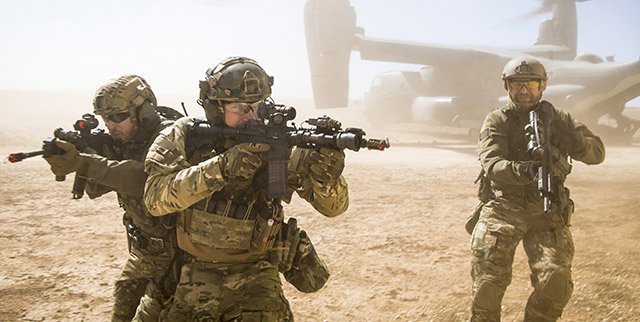
The Quiet Professionals
Special Forces are elite teams consisting of mature, intense, highly-trained operators. SF Operators receive specialized training in advanced weapons, language, demolitions, combat medicine, military free-fall, and advanced combat tactics. Today’s quiet professional operates in autonomous environments as the most trusted force in America’s Army.
The Ceremony
On March 3, 2023, President Joseph R. Biden, Jr., awarded the Medal of Honor to Colonel Paris D. Davis, United States Army, Retired, for conspicuous gallantry. Davis commanded American Special Forces as well as an inexperienced South Vietnamese company against a large North Vietnamese force June 17-18, 1965. His tactical leadership allowed the company to gain an advantage and surprise the enemy.


“...nearly 20 hours later — after that bugle first rang, Captain Davis saved — had saved each one of his fellow Americans. Every single one. Just as the story of Paris Davis did not begin on June 18th, 1965, it does not end there either. Captain Davis went on to become Colonel Davis, serving more than 25 years in our military and earning a PhD on top of that. He received the Silver Star, the Bronze Star, the Air Medal, the Purple Heart. And even after he hung up his uniform, the Colonel continued to serve the community, founding the Metro-Herald, a newspaper that focused on his local community and civil rights issues. ”
President Joseph R. Biden, Jr.,
White House Ceremony, March 3, 2023
RELATED STORIES FROM ARMY.MIL
5th Special Forces Group
The insignia and unit crest of the 61st Medical Battalion feature a red unicorn rampant on a green mound between two oak trees, with a snake entwined around each tree. Below the shield is a scroll bearing the Latin motto "Inest Clementia Forti.". he Motto (Inest Clementia Forti): Latin for "Mercy Is Inherent In The Brave," reflecting the compassionate nature of medical service paired with military courage.
The 5th Special Forces Group (Airborne) was officially activated Sept. 21, 1961, at Fort Bragg, N.C. A year later, elements of the 5th Special Forces Group began serving temporary duty tours in the Republic of Vietnam. Full deployment of the Group was completed in February 1965.
Units from within the group deployed from its operational base at Nha Trang, to the four military regions of Vietnam. Operational detachments established and manned camps at 254 different locations, to train and lead indigenous forces of the Civilian Irregular Defense Groups, and regular units of the Armed Forces of the Republic of Vietnam.
The 5th Special Forces Group (Airborne) also formed specialized units that conducted special reconnaissance and direct-action missions. Despite being one of the smallest units engaged in the Vietnam conflict, the Group's colors fly 20 campaign streamers. Soldiers from the group are among the most highly decorated warriors in the history of our nation.
To date, 17 Medals of Honor have been awarded (eight posthumously), to Soldiers in the group for actions in Vietnam.
The group was awarded the Presidential Unit Citation (Army) Vietnam 1966 to 1968, the Meritorious Unit Commendation (Army) Vietnam 1968; the Republic of Vietnam Cross of Gallantry with Palm,Vietnam 1964; and Republic of Vietnam Civil Action Honor Medal, 1st Class, Vietnam, 1968 to 1970.
On March 5, 1971, the colors of the 5th Special Forces Group (Airborne) were returned to Fort Bragg by a 94-man contingent led by then-Col. (Retired Maj. Gen.) Michael D. Healy, thereby terminating their official Vietnam service.
For more information about special operations in Vietnam:
Official Citation
The President of the United States of America, authorized by Act of Congress, March 3, 1863, has posthumously awarded in the name of Congress the Medal of Honor to
Colonel Paris D. Davis
United States Army
For conspicuous gallantry and intrepidity at the risk of his life above and beyond the call of duty:
Captain Paris D. Davis, Commander, Detachment A-321, 5th Special Forces Group (Airborne), 1st Special Forces, distinguished himself by acts of gallantry and intrepidity above and beyond the call of duty while serving as an advisor to the 883rd Regional Force Company, Army of the Republic of Vietnam, during combat operations against an armed enemy in the vicinity of Bồng Sơn, Republic of Vietnam on June 17th through 18th, 1965.
Captain Davis and three other U.S. Special Forces advisors accompanied the Vietnamese 883rd Regional Force Company on its first combat mission, a daring nighttime raid against a Viet Cong regional headquarters housing a superior enemy force.
Captain Davis's advice and leadership allowed the company to gain the tactical advantage, allowing it to surprise the unsuspecting enemy force and kill approximately 100 enemy soldiers. While returning from the successful raid, the regional force company was ambushed and sustained several casualties.
Captain Davis consistently exposed himself to the hostile armed — small arms fire to rally the inexperienced and disorganized company. He expertly directed both artillery and small arms fire, enabling other elements of the company to reach his position.
Although wounded in the leg, he aided in the evacuation of other wounded men in his unit, but refused medical evacuation himself. Following the arrival of air support, Captain Davis directed artillery fire within 30 meters of his own position in an attempt to halt the enemy’s advance.
Then, with complete disregard for his own life, he braved intense enemy fire to cross an open field to rescue his seriously wounded and immobilized team sergeant. While carrying the sergeant up the hill to a position of relative safety, Captain Davis was again wounded by enemy fire.
Despite two painful wounds, Captain Davis again refused medical evacuation, remained with the troops, fought bravely, and provided pivotal leadership and inspiration to the regional force company as they repelled several Viet Cong assaults on their position over a period of several hours.
When friendly reinforcements finally arrived, Captain Davis again refused medical evacuation until he had recovered a U.S. advisor under his command who had been wounded during the initial ambush and presumed dead.
While personally recovering the wounded soldier, he found him severely wounded but still clinging to life. Captain Davis directed the helicopter extraction of his wounded colleague not leaving the battlefield himself until after all friendly forces were recovered or medically evacuated.
Captain Davis's heroism and selflessness above and beyond the call of duty, at the risk of his own life, are in keeping with the highest traditions of military service and reflect great credit upon himself, his unit, and the United States Army.
President's Remarks
11:43 A.M. EST, March 3, 2023
THE PRESIDENT: Please, all — please be seated. I have to say at the outset — and I've had the great honor — and we have other Medal of Honor recipients here — and that I've been able to give one of those medals. And we have five here. But this, Mr. Secretary, may be the most consequential day since I've been President. This is an incredible man. I —
A hundred and fifty-eight years ago today, in the White — in this White House, President Lincoln was putting the final touches on his second Inaugural Address. And he wrote, “Let us strive on to finish the work we are in to bind up the nation's wounds and care for him who shall have borne the battle.”
Today, 58 years after he bore the battle, we honor a true hero of our nation: Colonel Paris Davis.
I've had a chance to get to talk to him a little bit. We talked on the phone. And he doesn't know it, but we're going to talk a lot more. (Laughter.) Incredible guy.
The Medal of Honor, created during Lincoln's presidency, is our country's highest military award, recognizing gallantry above and beyond the call of duty.
That word “gallantry” — it's not much used much these days. “Gallantry.” But I can think of no better word to describe Paris — to describe you. I really can't. “Gallantry.” And everyone here feels exactly the same way. That includes Secretary Austin and Secretary McDonough and Secretary of the Army Wormuth and the Vice Chairman Grady and General Mc- — McConville and Representative Beyer. Where's Representative Beyer. Thank you. Thank you for pushing this a little bit. Appreciate it. For joining us today. Now, as many of you know, Paris will be the first to tell you that he hates the word “I,” that it was his team who served and his team who sacrificed.
So, today, I'm truly honored to welcome one of those teammates: Ron Deese [sic] — Deis. Where's Ron? Ron. (Applause.) Thank you. He was the airborne spotter for that team. And — it was only a few days ago, right? (Laughter.)
I also want to thank the previous Medal of Honor recipients who are here, who have joined us today to recognize their brother in arms: Leroy Petry, William Swenson, Melvin Morris, Matthew Williams, and Earl Plumlee. Stand up, guys. (Applause.) You're looking at courage in the flesh.
And finally, Regan, Stephanie, Paris, you already know this, but your dad was a hero. But he didn't have to win this medal for you to know that. You knew it all along. You really did — didn't you? — when you were kids. You knew, growing up. And, you know — and, like you, I wish your brother Christopher was still with us to see your dad's final re- — finally recognize his story.
And, you know, it's a story that didn't just begin in the Vietne- — the Vietnamese village 58 years ago. Instead, picture Paris in 1956: the son of a Midwestern foundry worker starting his first year at Southern University in the heart of Louisiana. The college football team quickly noticed that Paris had the grit and the guts they needed on the team. So before long, Paris not only joined the team, but he was named All-American before this. He's a very slow learner, this guy. (Laughter.) I tell you what.
But off the field, Paris saw constant reminders that, to many — to many, he was less than an American and that, in the eyes of the law, he was less than a person. Signs on bars that read “whites only.” Seats on buses where — were off-limits for African Americans. Schools, streets, shops divided by segregation. Paris endured all of this and still chose to join his college ROTC unit, volunteering to serve a country that, in many places, still refused to serve people who looked like him.
Right away, it was clear Paris was a born warrior. He became an Army Ranger.
Then, he jumped at the chance to join the Green Berets, becoming one of the nation's first Black Special Forces officers. Paris linked [sic] — liked the Green Berets because they were elite. It wasn't just, as Paris once said, a “Joe here, Joe there.”
By the way, it didn't offend me you said, “Joe here, Joe there.” (Laughter.) You know what I mean. That — that didn't bother me.
But — but the Green Berets, like our country then, weren't free from discrimination either. People pulled Paris aside to warn him, “Are you sure you want to join? There aren't a lot of people like you — who look like you in this outfit.” Well, remember, this was only 14 years after President Truman desegregated our military. Only 14 years later. But Paris didn't listen to them. And thank God he didn't. Paris helped write the history of our nation. And this year, we celebrate the 75th anniversary of our first fully integrated armed forces and the name “Paris Davis” will still stand alongside the nation's pioneering heroes.
You know, in the early hours of June 18th, 1965, and his — Captain — then-Captain Davis and his team, with three other Green Berets, were wrapping up a job well done. And together, they'd just finished a 10-mile march through the night to support a company of South Vietnamese soldiers on their first combat mission: a raid against the Viet Cong, thick in the jungle of Bồng Sơn. The raid was a success.
But as the sun began to rise, the men heard that haunting sound ring out: a bugle. A bugle. A sure sign of a counterattack. Within minutes, the jungle lit up with enemy fire. Hundreds of Viet Cong began to swarm Captain Davis and his team, pinning them down in a rice paddy with no cover. Captain Davis rallied his team to fight back, getting so close to the enemy he was battling them hand to hand. Hours — this is the part that stuns me — hours into that fight, Captain heard — suddenly heard a sound worse than the bugle: his teammate crying out for help. His team sergeant had been shot badly in his foot and his leg, trapping him in the middle of the paddy.
And it got worse.
On the far side of the field, his weapons specialist was stuck in a cesspit after being temporarily knocked out by shrapnel. You know, and even further beyond him was his medic, who had been shot in the head. Captain Davis realized he was the last American standing. Without hesitation, he yelled, “I'm coming for you!” “I'm coming for you!” He called in friendly fire, and gave a little bit of cover to run out and rescue his team.
On his first attempt to get to team sergeant, Captain Davis was shot in the arm and had to turn back. Captain Davis waited for another window and sprinted back out again. But his team sergeant was stuck, and Captain Davis couldn't fully break him free before he had to return — had to return to cover. He didn't give up, though. That's not the Green Beret way.
For his third time, as enemy fire rained down on him, he ran out. Captain Davis freed his team sergeant, threw him over his shoulder, and started carrying up the hill to safety. Captain Davis got about halfway up the hill before a bullet pierced his leg. Then, in front of him, another Green Beret sergeant, who had just arrived to the battle to reinforce the team, was shot in the chest and now needed to be rescued as well.
Captain Davis limped up the hill with his team sergeant on his shoulder. He had been fighting for around 10 hours, but Captain Davis didn't hesitate. He went back down the hill to retrieve the reinforcement who had been just shot in the chest, all 240 pounds of him. Next, Captain Davis ran to his weapons specialist, who was struck [stuck] in that cesspit. Viet Cong fighters continued to spray gunfire across the field as Captain Davis threw his teammate a rope, pulled him out, and began to haul him up the hill as well.
But this time, the rescue helicopter — by this time, the rescue helicopter had landed. Captain Davis's commander gave him a direct order: “Get on board.” Davis's response was just as direct. “Sir,” he said, “I'm just not going to leave. I still have an American out there.” Unsure if he was still alive, Captain Davis began to plan how he would get his medic.
Just the day before, the medic had found out he was the — good news: He was a new father. His wife had given birth to their first child. Captain Davis was going to give him a chance to see his baby boy. He pinpointed the medic's position and began crawling toward him with gunfire and grenades still exploding around him. When he got there, the medic, still alive, asked him, “Am I going to die?” “Am I going to die?” Captain Davis responded, “Not before me.”
Still fending off the Viet Cong assailants, Captain Davis hauled his medic up the hill. And nearly 20 hours — nearly 20 hours later — after that bugle first rang, Captain Davis saved — had saved each one of his fellow Americans. Every single one.
Just as the story of Paris Davis did not begin on June 18th, 1965, it does not end there either. Captain Davis went on to become Colonel Davis, serving more than 25 years in our military and earning a PhD on top of that. He received the Silver Star, the Bronze Star, the Air Medal, the Purple Heart. And even after he hung up his uniform, the Captain [Colonel] continued to serve the community, founding the Metro-Herald, a newspaper that focused on his local community and civil rights issues.
I wish I could say that this story of Paris's sacrifice on that day in 19- — in 1965 was fully recognized and rewarded immediately. But sadly, we know they weren't. At the time Captain Davis returned from war, the country still battling segregation. He returned from Vrietnam [sic] — Vietnam to experience some of his fellow soldiers crossing to the other side of the street when they saw him in America.
And although the men who were with him on that June day immediately nominated Captain Davis to receive the Medal of Honor, somehow the paper- — the paperwork was never processed not just once, but twice. But you know what Captain [Colonel] Davis said after learning he would finally receive the Medal of Honor? Quote, “America was behind me.” “America was behind me.” He never lost faith, which I find astounding. He never stopped believing in the founding vision of our nation — the vision that Lincoln kept alive 158 years ago and a vision Paris fought to defend 58 years ago. This vision for a more perfect Union, one where all women and men are created equal.
You know, we're the most unique nation in the world. We're the only nation founded on an idea. Every other nation is founded based on a philosophy based on ethnicity, religion, whatever. An idea. And it's captured in: We hold these truths in be self-evident that all men and women are created equal, endowed by their creator with certain inalienable rights — life, liberty. We've never fully lived up to it, but we've never walked away from it. This is evidence we're still not going to walk away from it.
Look, folks, we never, ever walked away from our troops who dare all and give all to our nation. Paris, you are everything this medal means. I mean everything this medal means. And look, you're everything our generation aspired to be. And you are everything our nation is at our best: brave and big hearted, determined and devoted, selfless and steadfast. American. American.
And now, at long last, it is my great honor to ask Lieutenant Colonel Roe to read the citation.
(The official citation is read and Medal of Honor is presented.) (Applause.)
END 12:00 P.M. EST
Selflessness Beyond the Call of Duty
The following battle sketch depicts then-Captain Paris Davis's heroic actions during an assault on a vastly larger enemy force.
In May 1965, Davis sees overturned fuel truck on road. Davis is awarded a Soldier's Medal for heroism for saving the life of the driver by forcefully pulling him out of the truck just before it explodes.

Davis' raiding party halts, and he captures a sleeping enemy soldier, allowing discovery of enemy location and disposition.

Davis leads assault in the early morning at Bong Song, clearing an enemy headquarters hut. He is wounded in the forearm.

Reconstructed battle map of the battle of Bong Song, Vietnam, June 18, 1965.

Master Sgt. Billy Waugh is pinned down by sniper fire. Davis and John Reinberg rescue Waugh Under enemy gunfire. While rescuing Waugh, Davis is wounded again, this time in the leg.

As Billy Cole, Davis' commanding officer, arrives on the battlefield, Cole spots Davis carrying Waugh fireman-style. Noting Davis' wounds, Cole tells Davis to leave with the wounded.

Davis refuses until he can rescue the other wounded Soldier, Robert Brown, and get all of his men out of the area.

Davis continues holds an area for artillery and airstrikes, killing approximately 20 enemy soldiers. Davis is again wounded by grenade fragments.

The wounded Davis crawls for about 150 yards under enemy fire and finds Brown. Davis orders a MEDEVAC.

Davis drags Brown through a muddy scape, away from enemy gunfire and explosions.

Davis carries Brown to the helicopter for evacuation and remains on the battlefield until all of his men were safe.


President Joseph Biden prepares to bestow the Medal of Honor to retired U.S. Army Col. Paris D. Davis during a ceremony at the White House in Washington, D.C., March 3, 2023. Col. Davis was awarded the Medal of Honor for acts of gallantry and intrepidity above and beyond the call of duty while serving as a detachment commander with the 5th Special Forces Group (Airborne), 1st Special Forces, during combat operations against an armed enemy in the vicinity of Bong Son, Republic of Vietnam, on June 17-18, 1965. (U.S. Army photo by Bernardo Fuller).

President Joseph Biden bestows the Medal of Honor to retired U.S. Army Col. Paris D. Davis during a ceremony in the East Room of the White House in Washington, D.C., March 3, 2023. Col. Davis was awarded the Medal of Honor for acts of gallantry and intrepidity above and beyond the call of duty while serving as a detachment commander with the 5th Special Forces Group (Airborne), 1st Special Forces, during combat operations against an armed enemy in the vicinity of Bong Son, Republic of Vietnam, on June 17-18, 1965. (U.S. Army photo by Bernardo Fuller).


Retired U.S. Army Col. Paris D. Davis addresses the media just after receiving the Medal of Honor at the White House, March 3, 2023. Col. Davis was awarded the Medal of Honor for acts of gallantry and intrepidity above and beyond the call of duty while serving as a detachment commander with the 5th Special Forces Group (Airborne), 1st Special Forces, during combat operations against an armed enemy in the vicinity of Bong Son, Republic of Vietnam, on June 17-18, 1965. (U.S. Army photo by Bernardo Fuller).

Retired Army Col. Paris Davis leads the official party to Davis Medal of Honor Hall of Heroes Induction Ceremony at the Pentagon, Washington, D.C., March 6, 2023. Davis received the Medal of Honor for his acts of bravery as a commander during the Vietnam War. President Joe Biden presented the award to Davis during a ceremony at the White House March 3, 2023. (DoD photo by U.S. Air Force Tech. Sgt. Jack Sanders).

Medal of Honor recipient, retired U.S. Army Col. Paris Davis joined by his family and the Director of the Army Staff, Lt. Gen. Walter E. Piatt, during an engraving unveiling ceremony in his honor at the National Museum of the U.S. Army, Fort Belvoir, Va., Aug. 9, 2023. His name was permanently engraved in granite along the south wall of the Medal of Honor Garden to identify and honor him as one of the recipients of the nations highest award for valor. (U.S. Army photo by Bernardo Fuller).