MEDAL OF HONOR
Operation Enduring FreedomLive Webcast: Medal of Honor Ceremony
Watch the Medal of Honor ceremony live webcast, at
President will award the Medal of Honor to Staff Sergeant Ty Michael Carter for his heroic acts during the Operation Enduring Freedom.

Live Webcast: Hall of Heroes Induction
Watch the Hall of Heroes Induction Ceremony live webcast, at
The U.S. Army will induct Staff Sergeant Ty Michael Carter into the Pentagon's Hall of Heroes. The Pentagon ceremony will add Staff Sergeant Ty Michael Carter's name to the distinguished roster in the Hall of Heroes, the Defense Department's permanent display of record for all recipients of the Medal of Honor.

Staff Sergeant Ty Michael Carter

hometown
Spokane, Washington
Enlistment date
September 1999
Military Occupation (MOS)
19D Cavalry Scout
Unit
Bravo Troop, 3-61 Cavalry, 4th Brigade Combat Team, 4th Infantry Division
Deployments
Operation Enduring Freedom
Ty Michael Carter was born in Spokane, Washington in January 1980, soon after in 1981 his family would move to California's Bay Area. In 1991, his family moved back to Spokane where he graduated from North Central High School in 1998. Carter enlisted in the Marine Corps Oct. 13, 1998, and attended the Marine Corps Combat Engineer School. He later served in Okinawa, Japan as an intelligence clerk. Carter showed promise in weapons' marksmanship and was sent to Primary Marksmanship Instructor School in 1999. He served two short training deployments; one to San Clemente Island, California and the other to Egypt for Operation Bright Star. Carter was honorably discharged from the Marine Corps, Oct. 12, 2002.
After his enlistment, Carter enrolled in college and studied biology at Los Medonos Community College in California. After his first daughter's birth and some time traveling the United States, Carter realized he was destined for further service in the military.


Carter enlisted in the U.S. Army Jan. 3, 2008, to attend the Cavalry Scout Basic Training Course at Fort Knox, Kentucky In April 2008, he was sent to Fort Carson, Colorado to join 3rd Squadron, 61st Cavalry Regiment, 4th Infantry Brigade Combat Team, 4th Infantry Division. In May of 2009, Carter deployed for 12 months to Nuristan Province, Afghanistan. In October 2010, Carter was stationed at Fort Lewis, Washington and joined Alpha Troop, 8th Squadron, 1st Cavalry Regiment, 2nd Stryker Brigade Combat Team, 2nd Infantry Division. In May 2012, he deployed to Kandahar City, Afghanistan.
In addition to the Medal of Honor, Carter's military awards include the Purple Heart, the Meritorious Service Medal, the Army commendation Medal (with 4 oak leaf clusters), the Army Achievement Medal (with 2 oak leaf clusters), the Army Good Conduct Medal, the Navy/Marine Corps Good Conduct Medal, the National Defense Service Medal, the Afghanistan Campaign Medal (with two campaign stars), the Global War on Terrorism Service Medal, the Noncommissioned Officer Professional Development Ribbon (with numeral 2 device), the Army Service Ribbon, the Overseas Service Ribbon, the NATO Medal, the Combat Action Badge, the Expert Infantryman Badge, and the Air Assault Badge. He is also authorized to wear the Valorous Unit Award and the Meritorious Unit Commendation.
Carter left the Army as a staff sergeant in 2014.
 PHOTO: Army Staff Sgt. Ty Carter, a Medal of Honor recipient, poses for a photo with his family after throwing the ceremonial first pitch during the Seattle Mariners vs. Houston Astros game at Safeco Field in Seattle, Sept. 11, 2013. Photo courtesy of the Carter family.

UNDER INTENSE ENEMY FIRE
See a detailed slideshow presentation of the battle and view the combat teams immeasurable courage and uncommon valor defending the outpost.
The Battle
Oct. 3, 2009 | Outpost Keating in Kamdesh District, Nuristan Province, Afghanistan

4th Infantry Division”
The distinctive unit insignia of the 4th Infantry Division.
The 4th Division was organized at Camp Greene, North Carolina on November 17, 1917. The Roman numerals for four — IV — suggests the word ivy, from which the division adopts its insignia. The 4th Infantry Division motto is "Steadfast and Loyal". Read Full Unit Profile
On Oct. 3, 2009, many Soldiers distinguished themselves when more than 300 Anti-Afghan forces, or AAF, attempted to overrun Combat Outpost — COP — Keating, a company-sized outpost in Nuristan Province, Afghanistan. On that day, eight of the 53 members of B Troop, 3rd Squadron, 61st Cavalry Regiment, who defended the position were killed and more than 25 were injured.
Of these men, one Soldier's gallantry stood out. Without regard to his own safety, Spc. Ty Michael Carter proved himself time and time again. He resupplied ammunition to fighting positions, provided first aid to a battle buddy, killed enemy troops and valiantly risked his own life to save a fellow Soldier who was injured and pinned down by overwhelming enemy fire. He did all this while under heavy small arms and indirect fire that lasted more than six hours. Carter's actions of risking his life above and beyond the call of duty, while engaged in combat against the enemies of the United States, were heroic, make him a most deserving recipient of the Medal of Honor for his fearless and decisive actions that day.
COP Keating, situated at the bottom of a constricted, bowl-shaped valley at the confluence of the Kushtowz and Landay Sin rivers, was established in 2006 as a Provincial Reconstruction Team camp. It was built to extend the reach of the Afghan government and Coalition Forces into the remote Kamdesh District and to interdict al-Qaeda elements and other malign actors transiting the Hindu-Kush to attack points south. COP Keating was supported by Observation Post — OP — Fritsche, a platoon-sized position on high ground 1,500 meters to the south. Separated by rocky, broken ground and a sharp 500-meter rise in elevation, OP Fritsche could not provide visual or direct fire support, but could observe the northern high ground above COP Keating. OP Fritsche's 120mm mortar fire support covered areas along the river immediately to the south of the COP.
COP Keating and OP Fritsche were static, fortified positions, entirely reliant on air lines of communication, subject to frequent indirect fire and with little capacity to influence the small, ambivalent communities in the nearby villages of Urmol and Kamdesh. Two small contingents of Afghan National Army, or ANA, troops and Afghan Security Guards co-located with Coalition Forces at COP Keating and OP Fritsche, proved ineffective at building meaningful ties with either village. At the time, tribal and criminal networks could call on hundreds of local fighters from Kamdesh District even though it was comprised of fewer than 22,000 people. These networks shared little but their hostility to the intrusion of Coalition Forces and the Afghan government. To realign Coalition and Afghan government forces more effectively with population centers in pursuit of counterinsurgency objectives, on Oct. 1, 2009, the commander of the International Security Assistance Force ordered the COP and OP closed.
On Oct. 3, at 5:53 a.m., an interpreter approached the troop command post and notified Pfc. Jordan Wong, who had pulled duty that night, that the Urmol Police Chief had personally relayed a warning that 50 to 100 enemy fighters were presently staged in Urmol to attack COP Keating. Wong astutely logged the warning and notified the Sergeant of the Guard. At 5:59 a.m., six minutes after the warning had been received, the hills erupted.
The enemy engaged COP Keating and OP Fritsche with a coordinated, complex attack the magnitude and intensity of which had not been seen in the Kamdesh since Coalition Forces toppled the Taliban eight years earlier. At COP Keating, attackers fired from the creviced and overgrown high ground above all four sides of the combat outpost, initiating contact with rifles and Degtyaryov-Shpagin Large-Calibre, or DShK, heavy machine guns. The ANA guard positions suffered immediate casualties and collapsed. Ten to 15 Afghan Soldiers fled through the wire. The remainder abandoned their positions to U.S. occupied buildings in the western portion of the combat outpost, leaving the northeast corner undefended.
At the gun bursts, B Troop Soldiers jumped to reinforce guard posts throughout the compound. Staff Sgt. Justin T. Gallegos, Sgt. Bradley Larson, and Spc. Stephan L. Mace, raced to fortified High-Mobility Multi-Purpose Wheeled Vehicles, or Humvees, at the southern side that served as a battle position. The position overlooked Urmol and a series of wide, roughly graded switchbacks that climbed a steep ridgeline to the south, providing enemy forces a convenient infiltration route. Larson and Gallegos immediately engaged the enemy in the hills with the Humvee's .50 caliber machine gun and ground-mounted, belt-fed M240 machine guns, while Mace engaged the east with him M4 carbine.
Across the compound, Carter had just emerged from his barracks and sprinted 100 meters across open ground under concentrated fire to join the others at the southern battle position. Upon arriving, Carter gave two bags of M240 ammo to Gallegos and most of his M4 magazines to Mace.
Above the din of the assault, Gallegos alerted Carter that they needed lubricant for the .50 caliber and additional ammunition. With complete dedication to the task and at great risk to his life Carter ran the gauntlet a second time as enemy fire blossomed around him. Carter received two cans of lubricant from his platoon sergeant, Sgt. 1st Class Jonathan G. Hill, and then ran to the Ammunition Supply Point, or ASP, to collect ammunition. The doors were locked. Without hesitation, Carter shot off the hasps, secured additional M240 belts and weaved his way back to the Humvee Battle Position.
The enemy attack was unrelenting, the cacophony of gunfire deafening and the crew at the southern battle position quickly expended the additional M240 rounds. With suppression fire waning, the enemy fired a series of rocket-propelled grenades at the position which forced Gallegos, Mace and Carter to take cover in the Humvee. A PKM bullet struck Larson in his Kevlar helmet and he too ducked into the vehicle. At this point Sgt. Vernon W. Martin joined the team as well. Moments later three to four RPGs struck the vehicle carriage. One rocket detonated on the turret and destroyed the .50 caliber, spraying the interior with shrapnel. Larson, Martin and Carter were wounded.
Approximately a half hour into the fight, at 6:30 a.m., with both crew-served weapons disabled and the Humvee under heavy small-arms fire from an estimated 20 to 30 fighters on the high ground to the south and another 30 to 40 fighters attacking from Urmol, Gallegos decided to break contact and move north, employing bounding over-watch to link up with the remaining Soldiers of B Troop, near the tactical operations center, or TOC. Carter volunteered to stay with Larson and provide covering fire for the others as they attempted to bound back.
Carter and Larson left the vehicle and provided suppressing fire with their M4 carbines while their three colleagues began displacing. As he maneuvered his team, Gallegos was hit by machine gun fire from the direction of Urmol, killing him instantly. Martin was hit in the leg and scrambled beneath a nearby laundry trailer. RPG shrapnel wounded Mace, who managed to crawl to low ground 30 meters from the Humvee.
Amidst a punishing hail of gunfire, Larson and Carter returned to the shredded Humvee. Lurching across the compound in a second Humvee, Sgt. Joshua M. Hardt, Spc. Christopher T. Griffin and Pvt. Edward W. Faulkner Jr. reinforced the battle position. The new vehicle immediately encountered concentrated RPG fire from the southern high ground and a squad of enemy fighters that breached the combat outpost through the entry control point. Eight successive RPGs hit the Humvee, including a direct strike on the right passenger door that severely wounded Hardt and sprayed Griffin and Faulkner with shrapnel. Hardt evacuated the Humvee but was instantly cut down by PKM fire.
Recognizing the imminent threat from the enemy squad inside the wire, Carter and Larson engaged and swiftly killed two enemy combatants and wounded one. Their accurate fire under intense pressure forced the enemy into a hasty retreat and prevented them from overrunning several Soldiers pinned down in the nearby mortar pit. Griffin and Faulkner darted north toward the command post across the same open ground Carter had already traversed three times. Faulkner made it to safety, but Griffin was struck and killed instantly. Enemy fire set ablaze a number of buildings and acrid black and grey plumes of smoke curled from the valley against the sky.
With their M4 ammunition nearly exhausted, Carter again stepped from the Humvee to secure additional ammunition and check on whomever might be in the second Humvee. Crawling through the dust and gravel as intense volleys of enemy fire rained around him, Carter found the Humvee empty but grabbed an M249 light machine gun with a partial drum of ammunition and an M203 grenade launcher and crawled back to Larson. Realizing the drum had only 50 rounds left, Carter suggested they delink the ammunition and employ it in the M4s, so both men could continue to fight. Though each had less than a full magazine, Carter and Larson engaged the enemy with precision fire. Carter killed a two-man enemy RPG team and two additional fighters in the Urmol station. Wounded, outmanned and outgunned, Carter and Larson still suppressed the enemy's assault teams. Their accurate fire under extreme duress, with no margin for error, prevented the breach of COP Keating's vulnerable southern flank.
 PHOTO: View of one of the pockmarked armored Humvees at COP Keating. The men at LRAS-2 were busy firing their .50 cal. when an RPG round knocked the heavy machine gun off its mount and wounding Sergeant Vernon Martin seriously. Specialist Ty Carter ran 75 yards through a shower of bullets to reach the Humvee with more M240 ammunition, but that gun was no longer operational. U.S. Army photo.
Overhead, close air support and attack weapons teams hunted the hills, but the rocky overgrown slopes provided ample cover to the myriad enemy fighters. Nearly two hours into the fight, at approximately 7:30 a.m., Carter observed — from the passenger seat in the Humvee — Mace moving exposed toward low ground 30 meters off. Carter turned to Larson and said he wanted to attempt a rescue. Larson initially sought to deter Carter, stressing that “you're no good to Mace if you're dead.”
When Mace was struck with a new volley of gunfire and pleaded for help, Carter decided he had no choice but to try to reach his fellow Soldier. Knowing that he would almost certainly be killed, and with no regard for his personal safety, Carter jumped from the truck and sprinted forward to Mace. With small arms fire riddling the Humvee and the ground around him, Carter staunched Mace's bleeding and placed a tourniquet on his shattered leg. With enemy fire intensifying around him, Carter summoned the strength to lift Mace and carried him through the hail of bullets up to the rise and to the Humvee. Carter placed his fellow Soldier in the back seat of the damaged carriage and returned to the fight.
As their ammunition dwindled, Carter and Larson engaged the enemy with single, well-aimed shots. With inoperative radios and no contact with other B Troop Soldiers the pair grew concerned that the rest of COP Keating had been overrun. Recognizing that Mace needed immediate medical attention and the vital need for reconnaissance, Carter, with Larson's concurrence, headed toward the TOC along the same path on which Gallegos had been felled. Moving under Larson's covering fire, Carter ran down the declining grade and maneuvered back toward the command post. En route, Carter came across Gallegos and checked his vital signs, grimly determining his fellow trooper had been killed.
Carter found the sergeant's squad radio. Hearing traffic from others in B Troop, he turned around and made his way back to Larson. They called the command post and let them know they were alive but still pinned down. Fires now burned in most structures on the eastern side of the compound and it became apparent that enemy forces had penetrated the wire in at least two places. In response, the rest of B Troop had consolidated in a tight perimeter around the command post and surviving barracks. While Carter and Larson had warded off a third breach, Staff Sgt. Clinton L. Romesha and Hill had led a counterattack to retake a meeting hall and close the ECP. Romesha and Hill killed several enemy fighters that had penetrated the combat outpost and opened an evacuation route that was still exposed to RPG and machine gun fire. When Carter and Larson called and confirmed they had been isolated and a litter-urgent casualty, Hill's element established a base of fire to cover their withdrawal.
Carter climbed from the Humvee and dug through the debris of the two shattered vehicles to uncover a litter. Carter and Larson then carried Mace across 100 meters of open ground still being swept with sniper and machine gun fire. With Mace at the aid station, Carter reported to Hill and joined the fight with the platoon for the rest of the day. He served as a sniper providing accurate cover fire for the teams of Soldiers who were recovering the bodies of the fallen Soldiers.
Mace reached the aid station at approximately noon, nearly six hours after initial contact and approximately five hours after he was first wounded. Capt. Chris Cordova administered extraordinary trauma care, including a series of intravenous drips and six blood transfusions taken from the veins of the Soldiers in the troop, including his own.
The heavy firefights in the enclosed valley prevented a medical evacuation helicopter from touching down in the narrow landing zone until the cover of darkness. When the helicopter was able to land, Mace was immediately flown to Forward Operating Base Bostick and then on to Bagram Airfield. He succumbed to his wounds in the hospital despite the heroic efforts of his fellow Soldiers. About 12 hours after the initial attack, reinforcements finally arrived at the besieged combat outpost. A quick reaction force, or QRF, that had set down at OP Fritsche had hiked down the interminable switchbacks, killing two retreating enemies en route and linked up with the defenders of COP Keating. The command outpost had held, despite the unprecedented onslaught.
 PHOTO: Clockwise from top left: Spc. Ty Carter, Spc. Cody Floyd, Spc. Christopher T. Griffin, Sgt. Eric Harder, Sgt. John Francis, Staff Sgt. Kirk Birchfield, Sgt. Scott Potempa, Spc. Michael Scusa, Pvt. Edward Faulkner and Pfc. Daniel Rogers gather for a “thank you” photo at Combat Outpost Keating, August 2009, for the canned foods donated by Harder's mother and her friends. Soldiers had a very limited diet at the remote outpost, with hot food being rare. Courtesy photo.
In operations over the next several days, Coalition Forces killed one of the top regional sub-commanders affiliated with the Taliban, turning a potential defeat into a decisive victory for Coalition Forces in the contested Kamdesh. However, the outcome might have been very different without the valor of Carter and Larson. They held the southern flank and prevented a platoon-sized enemy element from penetrating the wire, linking up with the others and attacking the TOC at close quarters. Carter's and Larson's heroism bought the necessary time for multiple air assets to come on station and blunt the massive enemy attack.
Carter's remarkable acts of heroism and skill, which were vital to the defense of COP Keating, exemplify what it means to be an American hero. President John F. Kennedy said that “A nation reveals itself not only by the men it produces, but by the men it honors.” Carter's actions, which reflected great credit upon him, his unit, the United States Army and the United States of America, make him a most deserving recipient of the Medal of Honor.
"Staff Sgt. Carter's gallant actions were those of a man, a Soldier, who was physically and mentally strong and well prepared for combat. He elevated the needs of his team and nation above his own safety. His great humility and love for his fellow Soldiers are the hallmark of a true hero."
- Gen. John Campbell, Vice Chief of Staff of the Army
Hall of Heroes Induction, August 27, 2013
The Ceremony
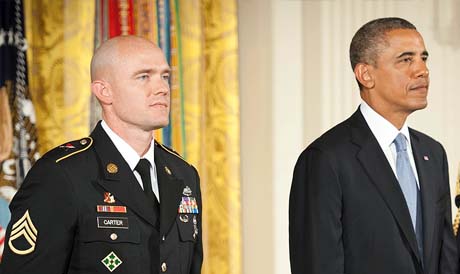
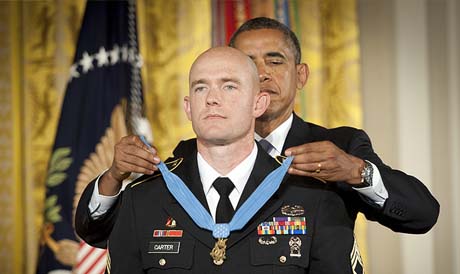
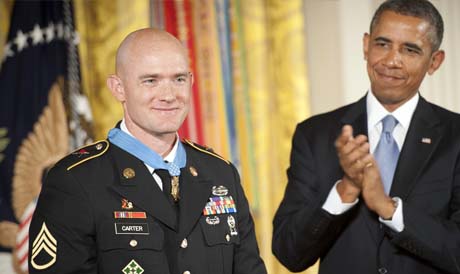
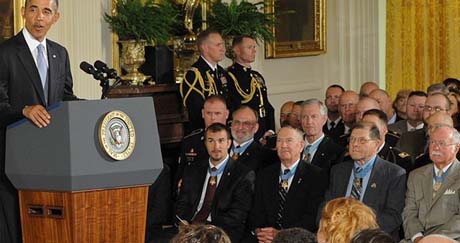
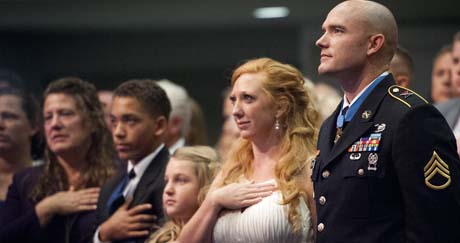
“...I will ask you, Ty, to never forget the difference that you made on that day. Because you helped turn back that attack, soldiers are alive today — like your battle buddy in that Humvee, Brad Larson, who told us, “I owe Ty my life.” Because you had the urge to serve others at whatever cost, so many Army families could welcome home their own sons. And because of you, Stephan's mother Vanessa, who joins us again today, is able to say “Ty brought Stephan to safety, which, in the end, gave him many more hours on this Earth. Stephan felt at peace.” And she added, in the words that speak for all of us, “I'm grateful to Ty more than words can describe.” That's something.”
President Barack Obama,
White House Medal of Honor Ceremony, August 26, 2013
RELATED STORIES FROM ARMY.MIL
2nd Battalion (Airborne), 503rd Infantry Regiment
“The Rock”
4th Infantry Division
Four green ivy leaves emerge from a small open central circle, with their stems connected and leaves pointing outward toward the corners of a square (or diamond-shaped field depending on the uniform era). The four leaves represent the division's numerical designation. They also create a visual pun: the Roman numeral for four is IV, which sounds like the word "ivy." Ivy traditionally symbolizes fidelity, loyalty, tenacity, and perseverance. This design earned the unit its famous nickname, the "Ivy Division."
The 4th Infantry Division’s nickname, “Ivy” Division, comes from the design of its shoulder patch, four green ivy leaves joined at the stem and opening at the four corners. Ivy leaves are symbolic of tenacity and fidelity, and are the basis of the division motto, “Steadfast and Loyal.” The word ivy is a play on the Roman numeral four, IV. The 4th Infantry Division has participated in World War I, World War II, Vietnam, Operation Iraqi Freedom/New Dawn and Operation Enduring Freedom.
In November 2002, the 4th Infantry Division assumed the division ready brigade mission and by January 2003, received orders to form a task force in support of Operation Iraqi Freedom, or OIF. The division began deploying in March 2003. Following a successful 12-month deployment, the division returned home to Fort Hood, Texas.
Shortly after its redeployment, the 4th Infantry Division again received orders to deploy in support of Operation Iraqi Freedom 2005-2007, to serve as the Multi-National Division Baghdad Headquarters, departing in November 2005 and returning in November 2006.
In January 2007, the 4th Infantry Division was called on again to serve as the Multi-National Division Baghdad (MND-B) Headquarters for OIF 07-09. In the succeeding months, the Soldiers of Ironhorse Division trained and prepared for 15 months of combat.
By December 2007, the division assumed the battle-space of Multi-National Division Baghdad for a second time. The Ironhorse Division met Army strategic objectives as MND-B by setting the stage for strategic decisions to be made by the president of the United States and the prime minister of Iraq. The steadfast and loyal Soldiers of the division achieved the lowest levels of attacks in the history of OIF, and the highest level of reconstruction and capacity building ever in Baghdad Province.
In July 2009, upon returning from deployment in support of Operation Iraqi Freedom, the 4th Infantry Division was re-stationed to Fort Carson, Colo., from Fort Hood, Texas.
In October 2010, the Ivy Division deployed to Iraq again in support of Operation New Dawn and served as the command for MND-North. Throughout operations in Iraq, 4th Infantry Division Soldiers served with pride and distinction, earning five campaign streamers.
With each of the brigades from the division serving in Afghanistan in support of Operation Enduring Freedom since May 2009, Ivy Soldiers continue to add to the proud history of the 4th Infantry Division. Today the 4th Infantry Division stands ready to bring the full spectrum of combat power to meet the nation’s call once again.
4th Brigade Combat Team - "Warrior Brigade"
 IMAGE: 4th Brigade Combat Team Insignia
The 4th Brigade Combat Team, 4th Infantry Division was first activated , Dec. 1, 1975, at Fort Carson, Colo., and deactivated in Germany, Sept. 15, 1984. It was reactivated at Fort Hood, Texas as one of the Army's first modular brigades December 16, 2004.
Less than one year from its inception, the 4th Brigade deployed with the 4th Infantry Division in support of Operation Iraqi Freedom III, fielding countless pieces of equipment and manning more than 4,000 Soldiers at an extraordinary pace. The 4th Brigade, the newest brigade in the Army, assumed responsibility of central and southern Baghdad and conducted continuous operations in some of the most dangerous neighborhoods in Iraq, to include Doura and Amerriyah. The Brigade redeployed to Fort Hood, Texas, in December 2006 after a successful combat tour.
On April 8, 2008, the 2nd Infantry Brigade Combat Team, 2nd Infantry Division donned the colors of the 4th Infantry Brigade Combat Team, 4th Infantry Division at Fort Carson, Colo., consolidating the two active battalions of the 12th Infantry Regiment for the first time since 1995. The 4th Infantry Brigade Combat Team continues to carry on the high standards, traditions, and lineage of the 12th Infantry Regiment.
The 12th Infantry Regiment was constituted May 3, 1861 and has fought valiantly in the Civil War, the Indian Wars, the Spanish-American War, the Philippine Insurrection, World War II (from Normandy to Berlin), and Vietnam. The 1st Battalion recently participated in Operation Iraqi Freedom 2006-2008, where it was widely recognized to be the most effective counter-insurgent force the Army had leveraged against Sunni extremists.
The Regiment has been awarded four Presidential Unit Citations, one for legendary heroism in World War II, and three for exceptional gallantry in the Republic of Vietnam. The Regiment has also earned four Valorous Unit Awards in recognition of its outstanding resolve in the Vietnamese highlands and Saigon. In addition, the Regiment was awarded the Belgian Fourragere for its performance in the Ardennes.
The 4th Brigade is composed of six battalions: 1st Battalion, 12th Infantry Regiment; 2d Battalion, 12th Infantry Regiment; 3rd Squadron, 61st Cavalry Regiment; 2d Battalion, 77th Field Artillery; 4th Special Troops Battalion; and 704th Support Battalion.
61st Cavalry Regiment Insignia
 IMAGE: 61st Cavalry Regiment Insignia
Description: A Gold color metal and enamel device 1 1/8 inches (2.86 cm) in diameter overall blazoned as follows: Per pale Gules and Argent, a pall Sable charged with ten mullets Or, three, three and four in pale at base, overall a rifle and a saber grips to base, saltirewise of the like and in chief a dagger point up of the last. Attached below the shield is a Black scroll inscribed “FORGING DESTINY” in Gold.
Symbolism:The black pall represents the unit’s military lineage to the 601st Tank Destroyer Battalion and the Regiment’s determination, strength and support to accomplish the unit’s military operations. The ten stars suggest the campaign participation during World War II. Red and white are the colors used for the Cavalry’s guidon. The crossed rifle and saber suggest the combined arms and the lineage of the major elements used to create the 61st Cavalry Regiment. The dagger symbolizes the unit’s military readiness, the early warriors and the dismounted reconnaissance troop.
Background:The distinctive unit insignia was approved on 14 December 2005.
Coat of Arms
Blazon:
Shield:
Per pale Gules and Argent, a pall Sable charged with ten mullets Or, three, three and four at base, overall a rifle and saber saltirewise of the like grips to base, the rifle muzzle and the saber handgrip, pommel and part of the blade edged Gules, in chief a dagger point up Proper.
Crest: From a wreath Argent and Gules, between a wreath consisting of a grapevine fructed in dexter and a palm frond in sinister Proper, a stylized mountain range Argent (Silver Gray) surmounted by a panther head affronté Sable garnished Or, eyed of the first and second, crushing in its mouth a tank of the third garnished of the fourth.
Motto: FORGING DESTINY.
Symbolism: Shield: Red and gold are the colors traditionally used by Cavalry units. The black pall represents the unit’s military lineage to the 601st Tank Destroyer Battalion and the Regiment’s determination, strength and support to accomplish the unit’s military operations. The ten stars suggest the campaign participation during World War II. Red and white are the colors used for the Cavalry’s guidon. The crossed rifle and saber suggest the combined arms and the lineage of the major elements used to create the 61st Cavalry Regiment. The dagger symbolizes the unit’s military readiness, the early warriors and the dismounted reconnaissance troop.
Crest: The wreath, consisting of a grapevine and palm branch refers to the citation awarded the unit for campaigns in Colmar and Tunisia. The stylized mountain signifies the strength and steadfastness of the Regiment. The panther crushing the tank, adapted from the Tank Destroyer shoulder sleeve insignia, recalls the unit’s history.
Background: The coat of arms was approved on 14 December 2005.
Official Citation
The President of the United States of America, authorized by Act of Congress, March 3, 1863, has posthumously awarded in the name of Congress the Medal of Honor to
Staff Sergeant Ty Michael Carter
United States Army
For conspicuous gallantry and intrepidity at the risk of his life above and beyond the call of duty:
Specialist Ty M. Carter distinguished himself by acts of gallantry and intrepidity at the risk of his life above and beyond the call of duty while serving as a Scout with Bravo Troop, 3d Squadron, 61st Cavalry Regiment, 4th Brigade Combat Team, 4th Infantry Division, during combat operations against an armed enemy in Kamdesh District, Nuristan Province, Afghanistan on October 3, 2009. On that morning, Specialist Carter and his comrades awakened to an attack of an estimated 300 enemy fighters occupying the high ground on all four sides of Combat Outpost Keating, employing concentrated fire from recoilless rifles, rocket propelled grenades, anti-aircraft machine guns, mortars and small arms fire. Specialist Carter reinforced a forward battle position, ran twice through a 100 meter gauntlet of enemy fire to resupply ammunition and voluntarily remained there to defend the isolated position. Armed with only an M4 carbine rifle, Specialist Carter placed accurate, deadly fire on the enemy, beating back the assault force and preventing the position from being overrun, over the course of several hours. With complete disregard for his own safety and in spite of his own wounds, he ran through a hail of enemy rocket propelled grenade and machine gun fire to rescue a critically wounded comrade who had been pinned down in an exposed position. Specialist Carter rendered life extending first aid and carried the Soldier to cover. On his own initiative, Specialist Carter again maneuvered through enemy fire to check on a fallen Soldier and recovered the squad’s radio, which allowed them to coordinate their evacuation with fellow Soldiers. With teammates providing covering fire, Specialist Carter assisted in moving the wounded Soldier 100 meters through withering enemy fire to the aid station and before returning to the fight. Specialist Carter’s heroic actions and tactical skill were critical to the defense of Combat Outpost Keating, preventing the enemy from capturing the position and saving the lives of his fellow Soldiers. Specialist Ty M. Carter’s extraordinary heroism and selflessness above and beyond the call of duty are in keeping with the highest traditions of military service and reflect great credit upon himself, Bravo Troop, 3d Squadron, 61st Cavalry Regiment, 4th Brigade Combat Team, 4th Infantry Division and the United States Army
President's Remarks
Time: 2:23 P.M. EDT
THE PRESIDENT: Good afternoon, everybody. Please be seated. Welcome to the White House. Actually, I should say welcome back. Many of you joined us earlier this year when we presented the Medal of Honor to Clint Romesha for his actions in the very same battle that we remember today.
Clint could not be here. He's engaged this week in a cause that is very close to all of our hearts -- and that's ending homelessness among our veterans. But we are honored to welcome back some of the men who fought that day -- at Combat Outpost Keating, members of Black Knight Troop -- and the Gold Star families of those who gave their lives that day.
As these soldiers and families will tell you, they're a family, forged in battle and loss and love. So today is something of a reunion. And we come together again, with gratitude and pride, to bestow the Medal of Honor on a second member of this family -- Staff Sergeant Ty Carter.
As always, we're joined by many distinguished guests, and we welcome you all. Today, I want to focus on our most distinguished guests -- more than 40 members of Ty's family; your parents, Mark, Paula; and stepmom, Barbara; your wife, Shannon, who you call “the CEO” of your family. You're a wise man. I've got the same arrangement. (Laughter.) Your beautiful children -- 14-year-old Jayden; 8-year-old Madison, in her new dress, and she was telling me about her new room as we walked over here -- (laughter) -- and 9-month-old Sehara, for whom we will try to make this brief because we don't know how long the Cheerios will last. (Laughter.)
Before they came, Ty said he was hoping to take his children around Washington to show them the sights and the history. But, Jayden, Madison, if you want to know what makes our country truly great, if you want to know what a true American hero looks like, then you don't have too look far. You just have to look at your dad. Because today, he's the sight we've come to see. Your dad inspires us, just like all those big monuments and memorials do.
For this is a historic day -- the first time in nearly half a century, since the Vietnam War, that we've been able to present the Medal of Honor to two survivors of the same battle. Indeed, when we paid tribute to Clint Romesha earlier this year, we recalled how he and his team provided the cover that allowed three wounded Americans -- pinned down in a Humvee -- to make their escape. The Medal we present today, the soldier that we honor -- Ty Carter -- is the story of what happened in that Humvee. It's the story of what our troops do for each other.
As some of you may recall, COP Keating was not just one of the most remote outposts in Afghanistan, it was also one of the most vulnerable -- on low ground, deep in a valley, surrounded by towering mountains. When soldiers like Ty arrived, they couldn't believe it. They said it was like being in a fishbowl -- easy targets for enemies in the hills above. And as dawn broke that October morning, with Ty and most of our troops still in their bunks, their worst fears became a reality.
Fifty-three American soldiers were suddenly surrounded by more than 300 Taliban fighters. The outpost was being slammed from every direction -- machine gunfire, rocket-propelled grenades, mortars, sniper fire. It was chaos -- the blizzard of bullets and steel -- into which Ty ran, not once or twice, or even a few times, but perhaps 10 times. And in so doing he displayed the essence of true heroism -- “not the urge to surpass all others at whatever cost, but the urge to serve others at whatever cost.”
Ty jumped out of bed, put on his boots and his helmet and his Kevlar vest, grabbed some ammo and he ran -- into bullets coming down like rain, for a hundred meters -- to resupply his comrades out in that Humvee. When they needed more, he ran back, blasted the locks off supply rooms and sprinted yet again -- dodging explosions, darting between craters -- back to the Humvee.
The ferocious fire forced them inside. And so it was that five American soldiers -- including Ty and Specialist Stephan Mace -- found themselves trapped in that Humvee, the tires flat, RPGs pouring in, peppering them with shrapnel, threatening to break through the armor of their vehicle. And, worst of all, Taliban fighters were penetrating the camp. The choice, it seemed, was simple -- stay and die, or make a run for it.
So once more, Ty stepped out into the barrage, and along with Sergeant Brad Larson, he laid down fire, providing cover for the other three -- including Stephan -- as they dashed for safety. But in those hellish moments, one man went down, and then another. And Stephan disappeared into the dust and smoke. Back in that Humvee, Ty and Brad held out, for hours; rolling down the window, just a crack, taking a shot, over and over; holding the line, preventing that outpost from being completely overrun. Ty would later say, “We weren't going to surrender.” We were going to fight “to the last round.” And then they saw him -- their buddy, Stephan -- on the ground, wounded, about 30 yards away.
When the moment was right, Ty stepped out again and ran to Stephan, and applying a tourniquet to one of his legs, bandaging the other, tending to his wounds, grabbing a tree branch to splint his ankle. And if you are left with just one image from that day, let it be this: Ty Carter bending over, picking up Stephan Mace, cradling him in his arms, and carrying him -- through all those bullets -- and getting him back to that Humvee.
And then Ty stepped out again -- recovering a radio, finally making contact with the rest of the troop, and they came up with a plan. As Clint Romesha and his team provided cover, these three soldiers made their escape -- Ty, Brad carrying Stephan on a stretcher, through the chaos, delivering Stephan to the medics.
And the battle was still not over, so Ty returned to the fight. With much of the outpost on fire, the flames bearing down on the aid station, with so many wounded inside, Ty stepped out, one last time, exposing himself to enemy fire; grabbed a chainsaw, cut down a burning tree, saved the aid station, and helped to rally his troop as they fought, yard by yard. They pushed the enemy back. Our soldiers retook their camp.
Now, Ty says, ”This award is not mine alone.” The battle that day, he will say, was “one team in one fight,” and everyone “did what we could do to keep each other alive.” And some of these men are with us again. And I have to repeat this because they're among the most highly decorated units of this entire war: 37 Army Commendation Medals, 27 Purple Hearts, 18 Bronze Stars for their valor, nine Silver Stars for their gallantry.
So, soldiers of COP Keating, please stand. (Applause.)
Today, we also remember once more the eight extraordinary soldiers who gave their last full measure of devotion -- some of whom spent their final moments trying to rescue Ty and the others in that Humvee. And we stand with their families, who remind us how far the heartbreak ripples: Five wives -- widows -- who honor their husbands. Seven boys and girls who honor their dad. At least 17 parents -- mothers and fathers, stepmoms and stepdads -- who honor their son. Some 18 siblings who honor their brother. Long after this war is over, these families will still need our love and support -- for all the years to come.
And I would ask the COP Keating families to stand and be recognized, please. (Applause.)
Finally, as we honor Ty's courage on the battlefield, I want to recognize his courage in the other battle he has fought. Ty has spoken openly -- with honesty and extraordinary eloquence -- about his struggle with Post-Traumatic Stress -- the flashbacks, the nightmares, the anxiety, the heartache that makes it sometimes almost impossible to get through a day. And he's urged us to remember another soldier from COP Keating who suffered, too, who eventually lost his own life back home, and who we remember today for his service in Afghanistan that day -- Private Ed Faulkner, Jr.
At first, like a lot of troops, Ty resisted seeking help. But with the support of the Army, the encouragement of his commanders, and most importantly, the love of Shannon and the kids, Ty got help. The pain of that day, I think Ty understands, and we can only imagine, may never fully go away. But Ty stands before us as a loving husband, a devoted father, an exemplary soldier who even redeployed to Afghanistan.
So now he wants to help other troops in their own recovery. And it is absolutely critical for us to work with brave young men like Ty to put an end to any stigma that keeps more folks from seeking help. So let me say it as clearly as I can to any of our troops or veterans who are watching and struggling: Look at this man. Look at this soldier. Look at this warrior. He's as tough as they come. And if he can find the courage and the strength, to not only seek help, but also to speak out about it, to take care of himself and to stay strong, then so can you. So can you.
And as you summon that strength, our nation needs to keep summoning the commitment and the resources to make sure we're there when you reach out. Because nobody should ever suffer alone. And no one should ever die waiting for the mental health care they need. That's unacceptable. And all of us have to do better than we're doing.
As Ty knows, part of the healing is facing the sources of pain. As we prepare for the reading of the citation, I will ask you, Ty, to never forget the difference that you made on that day. Because you helped turn back that attack, soldiers are alive today -- like your battle buddy in that Humvee, Brad Larson, who told us, “I owe Ty my life.” Because you had the urge to serve others at whatever cost, so many Army families could welcome home their own sons. And because of you, Stephan's mother Vanessa, who joins us again today, is able to say “Ty brought Stephan to safety, which, in the end, gave him many more hours on this Earth. Stephan felt at peace.” And she added, in the words that speak for all of us, “I'm grateful to Ty more than words can describe.” That's something.
God bless you, Ty Carter, and the soldiers of the Black Knight Troop. God bless all our men and women in uniform. God bless the United States of America.
And with that, I would like to have the citation read.
MILITARY AIDE: The President of the United States of America, authorized by Act of Congress, March 3, 1863, has awarded in the name of Congress the Medal of Honor to Specialist Ty M. Carter, United States Army, for conspicuous gallantry and intrepidity at the risk of his life above and beyond the call of duty.
Specialist Ty M. Carter distinguished himself by acts of gallantry and intrepidity at the risk of his life above and beyond the call of duty while serving as a Scout with Bravo Troop, 3rd Squadron, 61st Cavalry Regiment, 4th Brigade Combat Team, 4th Infantry Division during combat operations against an armed enemy in Kamdesh District, Nuristan Province, Afghanistan on October 3, 2009.
On that morning, Specialist Carter and his comrades awakened to an attack of an estimated 300 enemy fighters occupying the high ground on all four sides of Combat Outpost Keating, employing concentrated fire from recoilless rifles, rocket propelled grenades, anti-aircraft machine guns, mortars and small arms fire.
Specialist Carter reinforced a forward battle position, ran twice through a 100-meter gauntlet of enemy fire to resupply ammunition, and voluntarily remained there to defend the isolated position. Armed with only an M4 carbine rifle, Specialist Carter placed accurate, deadly fire on the enemy, beating back the assault force and preventing the position from being overrun over the course of several hours. With complete disregard for his own safety and in spite of his own wounds, he ran through a hail of enemy rocket propelled grenade and machine gunfire to rescue a critically wounded comrade who had been pinned down in an exposed position. Specialist Carter rendered life-extending first aid and carried the soldier to cover.
On his own initiative, Specialist Carter again maneuvered through enemy fire to check on a fallen soldier and recovered the squad's radio, which allowed them to coordinate their evacuation with fellow Soldiers. With teammates providing covering fire, Specialist Carter assisted in moving the wounded soldier 100 meters through withering enemy fire to the aid station and before returning to the fight.
Specialist Carter's heroic actions and tactical skill were critical to the defense of Combat Outpost Keating, preventing the enemy from capturing the position and saving the lives of his fellow soldiers. Specialist Ty M. Carter's extraordinary heroism and selflessness above and beyond the call of duty are in keeping with the highest traditions of the military service and reflect great credit upon himself, Bravo Troop, 3rd Squadron, 61st Cavalry Regiment, 4th Brigade Combat Team, 4th Infantry Division and the United States Army.
(The President bestows the Medal of Honor.) (Applause.)
THE PRESIDENT: Well, thank you very much, everybody. I hope you all enjoy the reception. I want to not only thank Ty, but once again thank his extraordinary family, thank his unit, and thank all of you for us being able to acknowledge the extraordinary sacrifices that our men and women in uniform make every single day. And Ty is representative of exactly the kind of people and the quality of people who are serving us. We are grateful to them.
God bless you all. God bless America. Thank you. (Applause.)
END 2:45 P.M. EDT
(Editor's Note: The remarks above represent the president's prepared remarks as taken directly from: http://www.whitehouse.gov/the-press-office/2013/08/26/remarks-president-presentation-medal-honor-staff-sergeant-ty-m-carter)
Hall of Heroes Induction
CEREMONY REMARKS | August 27, 2013
UNDER SECRETARY OF THE ARMY
Dr. Joseph Westphal
UNDER SECRETARY OF THE ARMY
Under Secretary Westphal:Well, good afternoon everybody. Ty how you doing?
Secretary Carter great to be with you here today. My battle buddy, Vice (Chief of Staff of the Army Gen. John Campbell), great job, good words. Medal of Honor recipients, thanks for being here. You honor us by your presence. We are deeply grateful for all you have done and continue to do for our country.
So, you’ve seen him on TV a little bit, but I want to take just a couple of minutes to more formally introduce him to you. Shannon, Jayden, Madison, and Sehara, can you all stand up so they can see you? She has been the perfect baby. I’m telling you, she’s awesome, and two other people I’d like to stand up and introduce you to them -- his dad Mark, and his mother Paula. And I separated the sister out -- Amber, she needs to get a little special attention. And we know there’s a lot of family members who came from all over -- a lot of uncles and aunts, cousins -- and, we thank you for being here today.
As the Vice said, through Ty and his act of gallantry, we also honor the bravery and valor and call of duty of those who gave their last measure of devotion and service to their country. On October 3rd, 2009, at Combat Outpost Keating, eight men lost their lives. They are with us today in thought and prayer.
Staff Sgt. Justin Gallegos; I believe his former wife, friend and son Amanda and MacAiden are here today. Can you stand up if you are here. Sgt. Joshua Kirk; his widow Megan and daughter Kensington, and mother Bernadette, are you here today? Sgt. Michael Scusa; his mother Cynthia and his brother John, are you here today? Sgt. Christian Griffin, his mother Carrie, Carrie are you here today? Spc. Stephan Mace; his mother Vanessa, his father Larry, his brother Bradley and his stepfather Richard, are you all here today? Staff Sgt. Vernon Martin, Sgt. Joshua Hardt, and Pfc. Kevin Thomson’s families could not be here with us today, but we extend to them our thanks, and let them know they are in our thoughts and prayers as well.
Private Edwin Faulkner’s mother and father, Sharon and Edwin Faulkner, are here today. The Vice mentioned Private Faulkner. Private Faulkner’s death from substance abuse scars us all His struggle with post-traumatic stress shows us all too well how those wounds take their toll on our Soldiers. No words or deeds are sufficient, or will ever be sufficient, to measure up to the sacrifices of your loved ones, and we are honored by your presence today.
For Ty Carter on that day in October when things appeared their very darkest, his thought on his family and his daughter in particular, were going through his mind. This impulse to think of your family in a Soldier’s most trying moments, becomes one of the certain things worth fighting for. There may be many reasons for joining the Army, but ultimately, on that battlefield, you serve to protect your country and your family. It was why Sergeant Carter joined the Army, to find an honorable life of meaning for himself and for his daughter. It was why Captain Ben Keating, whose name is forever linked with the battle of October 3rd, 2009, wrote to his father that his commitment to family was what compelled him to serve.
There’s another definition of family; that has meaning to men and women who have served in the Army and dangerous places far away. That is the instant brotherhood that is found in shared hardship.
In his great work about Soldiers in World War II, Stephen Ambrose, wrote about how Soldiers came together from all walks of life and from all parts of America to train and go to war. He writes, “the result of these shared experiences was a closeness unknown to all outsiders. Comrades are closer than friends, closer than brothers, their trust and knowledge of each other is total. Men are true comrades only when each is ready to give up his life for the other without reflection or without the thought of personal loss.”
Ty, you and Bravo Troop stand on the shoulders of those Soldiers Ambrose wrote about. Those Soldiers were Easy Company, 506 Parachute Regiment, 101st Airborne Division, who fought in World War II. You also stand on the shoulders of countless others who fought in that war, in Korea, in Vietnam, and our current conflicts. Their sacrifice and patriotism lives in your DNA. Future Soldiers will have to stand on your shoulders and we know they will stand strong and victorious.
In your words, Sergeant Carter, and I got this from one of your video tapes, “the Army and the pleasure and pride to serve and protect my loved ones, my family and my friends, is one of the greatest feelings that I have ever had, and I will maintain as long as they let me live.” So Ty, you have a sense of purpose now that will drive you to help others who have suffered the wounds of war. It takes the same courage that you showed on that day of battle to seek ways to heal. Leadership, loyalty, (and) character are abundant in you. The love and companionship of your family will strengthen and heal you. Your fellow Soldiers will need you, and you will need them. Like those men here today wearing the Medal of Honor, you will be part of a band of brothers that continues to inspire us all.
God bless you Sergeant Ty Carter. God bless you.
(Editor's Note: The remarks above represent the Under Secretary of the Army's prepared remarks as taken directly from: https://www.army.mil/article/110111)
VICE CHIEF OF STAFF OF THE ARMY
General John F. Campbell
VICE CHIEF OF STAFF OF THE ARMY
General Campbell: Good afternoon. On behalf of Gen. Ray Odierno, our 38th Chief of Staff of the Army, I am honored to have the opportunity to participate in this ceremony.
Today, we pay tribute to an American who placed himself in the thick of the fight -- again and again and again. In so doing, he has earned our nation's highest military decoration, the Medal of Honor. Yesterday, for a brief, national moment, a warrior was held up to the American people as an example of the embodiment of our highest ideals, and President Obama said he was "the essence of true heroism." We are extraordinarily proud of this hero -- Staff Sergeant Ty Carter.
Thank you all for attending the ceremony to pay tribute to Staff Sergeant Ty Carter as he joins the ranks of America's greatest heroes. The Hall of Heroes stands adjacent to the main entrance to the Pentagon and is hallowed ground reserved to memorialize our nation's warriors who have demonstrated conspicuous gallantry above and beyond the call of duty. As the first of three speakers, I have the distinct honor to welcome our distinguished guests; Honorable Ashton B. Carter, deputy secretary of Defense; Honorable Joseph W. Weshphal, the under secretary of the Army, fellow flag officers and SESes, and Sergeant Major of the Army Ray Chandler. A special welcome to Staff Sergeant Carter's family: his wife Shannon and their three children Jayden, Madison, and Sehara; his mother and father, Paula and Mark Carter; his step mother, Barbara Carter; his mother-in-law, Barbara Derby and husband Roy Biener; and his sister Amber Carter. This family's love and devotion undoubtedly contributed to the strength that Ty displayed at Combat Outpost Keating. Welcome to Washington, D.C., and the Pentagon. I hope you enjoy your time here.
I would also like to recognize the Medal of Honor recipients who have joined us here today. As the president mentioned yesterday this is the first time in nearly half a century -- since Vietnam -- we have had two surviving Medal of Honor recipients from the same battle, and is further evidence of the intensity of the fight at COP Keating.
General George C. Marshall, said of medals, "It is impossible for the nation to compensate for the services of a fighting man. There is no pay scale that is high enough to buy the services of a single Soldier even during a few minutes of the agony of combat, the physical miseries of the campaign." Well, Staff Sergeant Ty Carter and the men of Blacknight Troop, 3d Squadron, 61st Cavalry Regiment, 4th Infantry Division endured the agony of combat for over twelve hours. They lost eight of their brothers, and this medal cannot compensate for the sacrifice of these brave men.
Will the men of Blacknight Troop, 3-61 Cav. please stand to be recognized? Thank you for your service.
Of course we will never forget the service of the eight soldiers who made the ultimate sacrifice on that fateful day. We remember: Pfc. Kevin Thomson, Sergeant Michael Scusa, Sergeant Joshua Kirk, Sergeant Christopher Griffin, Staff Sergeant Justin Gallegos, Staff Sergeant Vernon Martin, Sergeant Joshua Hardt, and Specialist Stephan Mace. We also remember Private Edward Faulkner Jr., who died after returning from Afghanistan and enduring a difficult struggle with post-traumatic stress. Thank you to the Gold Star Families who are here today. The strength of our nation is our Army, the strength of our Army is our Soldiers, and the strength of our Soldiers is our families.
I said I would talk of the battle. By now you all know this incredible tale. The president recounted it in detail yesterday. On October 3rd, 2009, Staff Sergeant Ty Carter awoke to a previously unseen volume of fire coming from the high ground surrounding the COP, a remote outpost occupied by the 53 men of Black Knight Troop. Only this morning was different, as an estimated 300 Taliban fighters fired recoilless rifles, rocket-propelled grenades, mortars, machine guns and small arms at the COP. Staff Sergeant Carter's responsibility that day was to support the guard positions, and in this capacity he twice sprinted through a barrage of fire to resupply ammunition and to fight alongside his desperately outnumbered comrades. He moved into the open a third and fourth time to rescue a critically wounded teammate, render first aid, and carry him to safety. He again moved through withering fire to check on a fellow Soldier and to secure a radio that later proved critical to saving the isolated team. He fought fearlessly and inspired those around him throughout that brutal day of combat.
As the president noted, this battle and these men represent one of the most highly decorated units of the entire war -- 37 Army Commendation Medals, 27 Purple Hearts, 18 Bronze Stars for valor, and nine Silver Stars for gallantry -- and now two Medals of Honor.
Staff Sergeant Carter's gallant actions were those of a man, a Soldier, who was physically and mentally strong and well prepared for combat. He elevated the needs of his team and nation above his own safety. His great humility and love for his fellow Soldiers are the hallmark of a true hero. When he heard he was going to receive the Medal of Honor, Staff Sergeant Carter said, "It didn't even faze me. When you have lost family, you just don't think about it." He just felt sad, remembering the sacrifice his brothers made. For Staff Sergeant Carter, it was never about the glory, it was about his buddies, his fellow warriors.
Ty Carter has endured multiple combat tours and all of the challenges associated with recovering from those experiences. The extraordinary resiliency and strength both sergeant Carter and his wife Shannon have displayed in overcoming psychological wounds further demonstrates the great value of team Carter to this nation. Staff Sergeant Carter calls Shannon his foundation and the reason he serves, and she has played an essential role helping him recover from the trauma of combat. Thank you Shannon, for your service. You too are a true patriot.
Staff Sergeant Carter, I want to thank you for your service and bravery. Your commitment to your fellow Soldiers, for your gallantry in battle, and your resilience in recovering. You are a living example, a reminder to America that there are heroes, modern heroes, who live and walk among us -- heroes who are still fighting and dying to protect us every day. By honoring you, we honor those who fought and died by your side, those who fight today to defend American values, and our sons and daughters who will defend our great nation in battles yet to come. We remain as part of something special -- the greatest army in the world -- and because of men like Staff Sergeant Ty Carter will always remain Army Strong!
Thank you.
(Editor's Note: The remarks above represent the Vice Chief of Staff's prepared remarks as taken directly from: www.army.mil/article/110112)
Sub Page Example
Lorem Ipsum Plurum
Lorem ipsum dolor sit amet tortor feugiat curabitur aliquam donec sed luctus consectetur molestie ultrices. Platea facilisis tellus justo lobortis duis augue faucibus. Morbi mattis luctus convallis praesent viverra egestas lobortis. Elementum do arcu convallis euismod egestas et nunc. Id at mi non senectus nunc maecenas nisl incididunt vitae iaculis duis aliquam risus.
Nunc vivamus pharetra consequat nullam turpis justo dictumst risus habitasse porta cursus tincidunt. Dui nulla purus eros porta pretium tortor eget sollicitudin. Imperdiet tempor fermentum justo feugiat mauris vestibulum purus venenatis. Iaculis pretium volutpat imperdiet dui sagittis non urna habitasse ultrices. Morbi etiam morbi augue ornare malesuada bibendum arcu netus.
Facilisis mollis bibendum arcu morbi venenatis pretium vitae dui mollis. Euismod dui semper tristique risus nullam vestibulum gravida nullam scelerisque imperdiet quis pretium. Lacus sodales donec orci dapibus eu fringilla duis euismod aenean etiam incididunt posuere netus. Vestibulum eros leo ullamcorper augue dictumst egestas vestibulum incididunt porttitor hendrerit interdum. Aliquam senectus tortor donec sagittis nibh consequat duis mollis a tortor netus elementum scelerisque dolore.


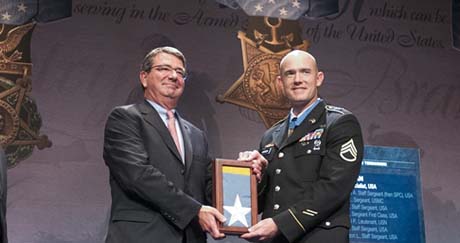
Staff Sgt. Ty Michael Carter being presented with the Medal of Honor Flag by Deputy Secretary of Defense Ashton B. Carter during his induction ceremony into the Hall of Heroes at the Pentagon, Aug. 27, 2013. From left to right stand Under Secretary Westphal, Deputy Secretary of Defense Ashton B. Carter, Staff Sgt. Ty Carter and wife Shannon Carter. U.S. Army photo by Staff Sgt. Bernardo Fuller.