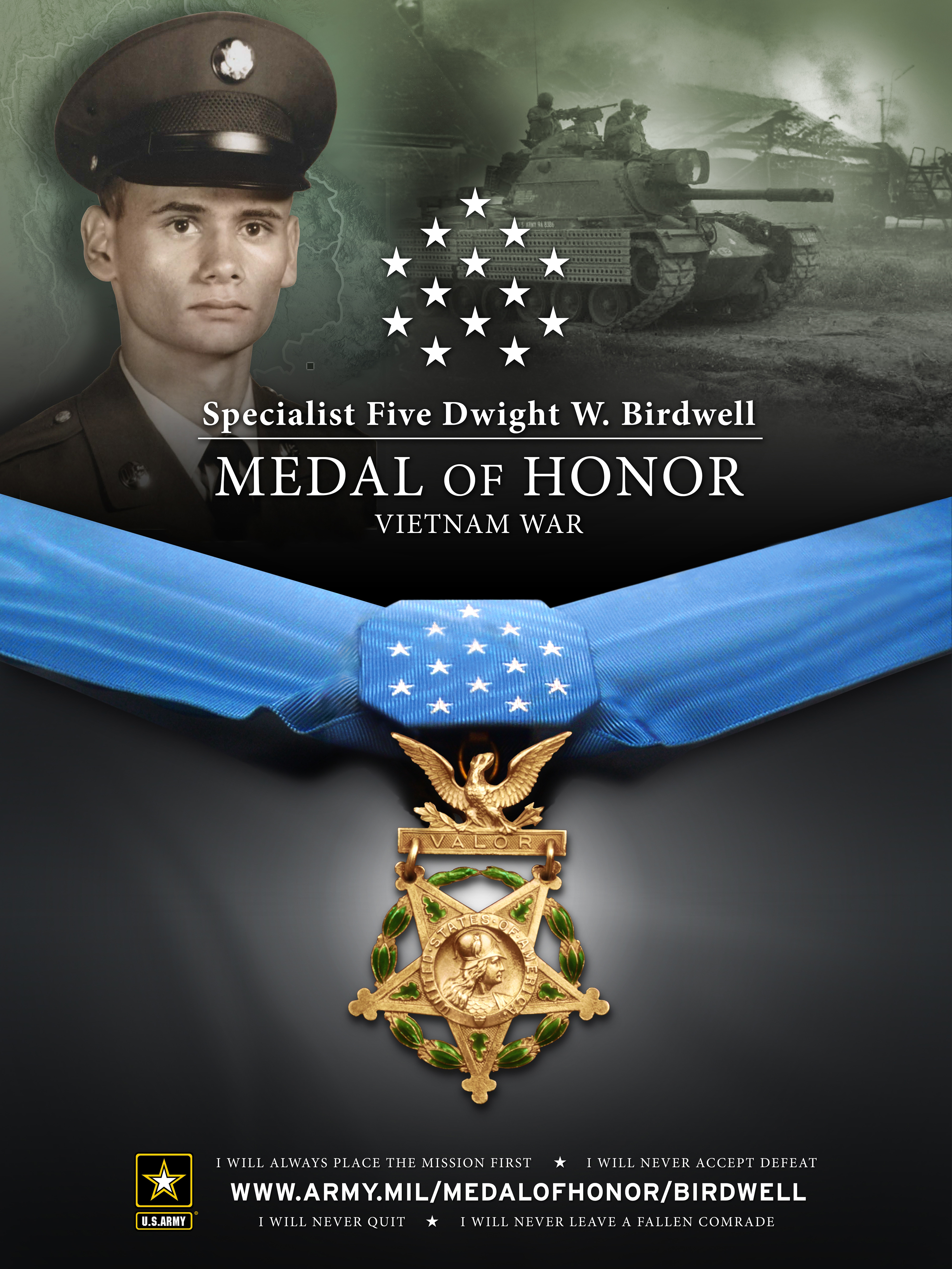
MEDAL OF HONOR
Vietnam WarSpecialist Five Dwight W. Birdwell
hometown
Bell, Oklahoma
Enlistment date
May 1966
Military Occupation (MOS)
Armored Crewman (11E)
Unit
3rd Squadron, 4th Cavalry Regiment, 25th Infantry Division
Deployments
Vietnam War (1967)
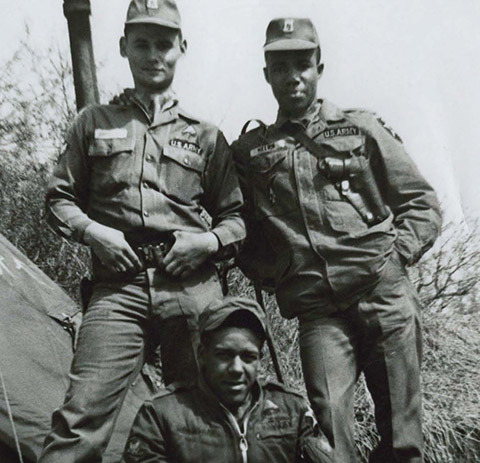
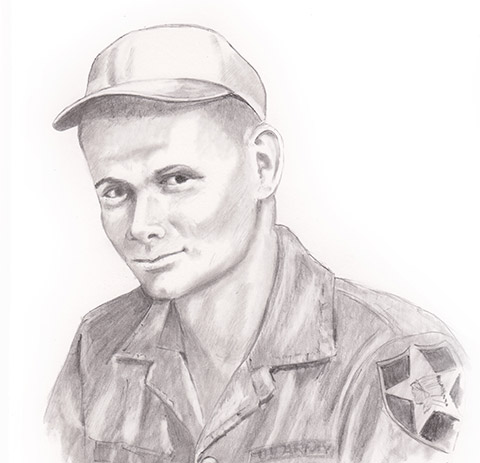
PHOTO: Photo sketch of Spc. 5 Dwight Birdwell from his time with 2nd Infantry Division, July 1967. (Photo by Dwight Birdwell).
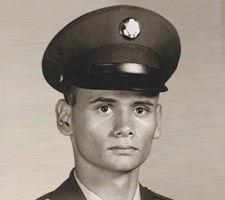
Dwight W. Birdwell was born in Amarillo, Texas, on Jan. 19, 1948. He grew up in the small, predominantly Cherokee Indian community of Bell in Adair County, Oklahoma. He attended Bell Grade School, and graduated from Stilwell High School in 1966. A citizen of the Cherokee Nation, he entered the Army on May 24, 1966, and earned two Silver Stars, a Bronze Star for meritorious service and two Purple Hearts.
Birdwell was assigned to Troop C, 3rd Squadron, 4th Cavalry, 25th Infantry Division. He received the first Silver Star for heroism on Jan. 31, 1968, when his unit raced to defend Tan Son Nhut Air Base, which was under attack during the Tet Offensive. Cavalry Troop C was the first American ground unit from outside the airbase to respond to the attack. When Birdwell's tank commander was seriously wounded, Birdwell took command and placed intense fire on the enemy until his ammunition was expended. He then retrieved an M-60 machine gun and continued firing at the enemy until the weapon was damaged by enemy fire, which also wounded Birdwell. With disregard for his own safety, he ran through a hail of enemy fire to get more ammunition for his men from other damaged vehicles.
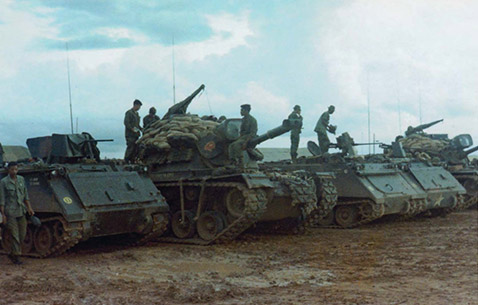
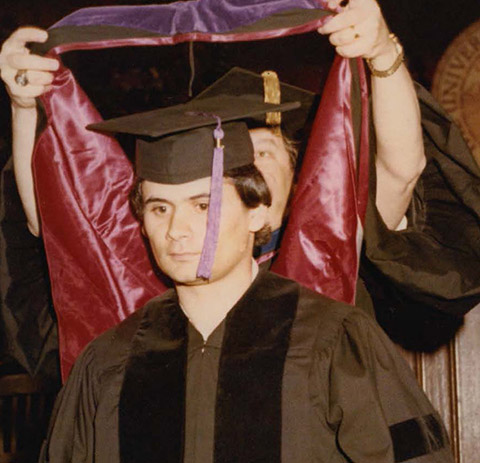
PHOTO: Dwight Birdwell graduates from the University of Oklahoma School of Law, Norman, Oklahoma, May, 1967. (Photo courtesy of Dwight Birdwell)"
On the night of July 4, 1968, he again risked his life to rescue more Americans, some of them wounded, who were stranded in a battle zone in an enemy-occupied village. Seeing a damaged Army personnel carrier, he exposed himself to heavy enemy fire while loading all of the wounded and evacuating them to safety. He then went back into the village to rescue more Americans, for which he was awarded his second Silver Star for bravery.
Birdwell returned home in December 1968. He attended Northeastern State University, and then the University of Oklahoma School of Law, graduating in 1976. He and his wife of 53 years have two children and two grandchildren.
Birdwell was a member of the Judicial Appeals Tribunal (Supreme Court) of the Cherokee Nation from 1987 to 1999, serving as its chief justice from 1995 to 1996 and 1998 to 1999. He is now a practicing attorney in Oklahoma City. For a number of years he served on the Cherokee Nation Judicial Appeals Tribunal.
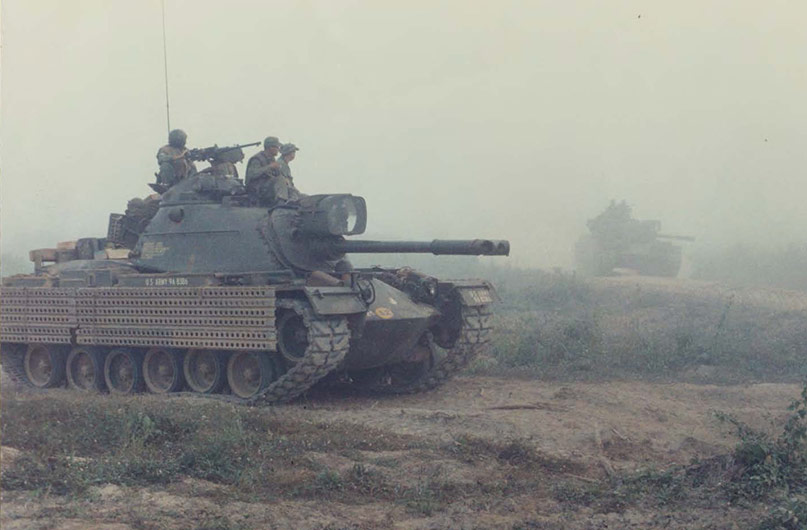
PHOTO: Soldiers assigned to the 3rd Cavalry Regiment, 4th Cavalry Division ride an M-48A3 tank while deployed to Vietnam 1968. (Photo courtesy of Dwight Birdwell).
The Battle
Jan. 31, 1968 | Republic of Vietnam
The 25th Infantry Division
Spc. 5 Dwight W. Birdwell distinguished himself by acts of gallantry and intrepidity above and beyond the call of duty while serving with Troop C, 3rd Squadron, 4th Cavalry, 25th Infantry Division, in the Republic of Vietnam on Jan. 31, 1968.
On this date, a large enemy element initiated an assault on the Tan Son Nhut Airbase near Saigon. Birdwell’s unit bore the brunt of the initial attack, which resulted in the disabling or destruction of many of the unit’s vehicles and the incapacitation of his tank commander.
Birdwell, under heavy enemy small-arms fire, moved the tank commander to a place of safety and assumed control of the vehicle. Realizing his tank was the first line of defense for the troop, he used its cannon, machine gun and his rifle to place effective fire on the enemy force.
From the exposed position of the tank commander’s hatch, Birdwell engaged the enemy with machine gun fire and provided situation reports to his squadron commander until the communications system became damaged due to enemy fire. After having expended all of his ammunition, Birdwell dismounted and maneuvered to his squadron commander’s helicopter, which had been downed by enemy fire, and retrieved two machine guns and ammunition, with which he and a comrade suppressed the enemy.
When his machine gun was hit by enemy fire and exploded, resulting in wounds to his face and torso, Birdwell refused evacuation and moved amongst the disabled vehicles and defensive positions, collecting ammunition to distribute to the remaining defenders. While under harassing fire, Birdwell led a small group of defenders past the enemy force and personally engaged the enemy with hand grenades, which disrupted their assault until reinforcements arrived. Upon receiving reinforcement, Birdwell aided in evacuating the wounded until he was ordered to seek attention for his wounds.
Throughout the entire engagement, Birdwell repeatedly placed himself in extreme danger to protect his team and to defeat the enemy. His extraordinary heroism and selflessness beyond the call of duty were in keeping with the highest traditions of military service and reflect great credit upon himself, his unit and the United States Army.
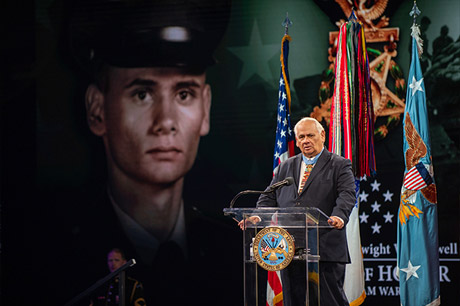
The Ceremony
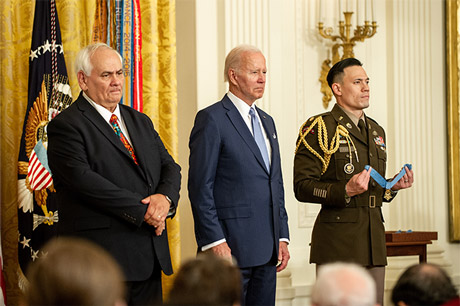
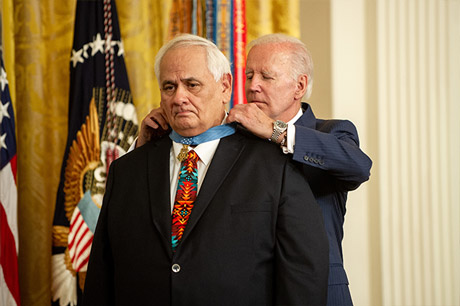
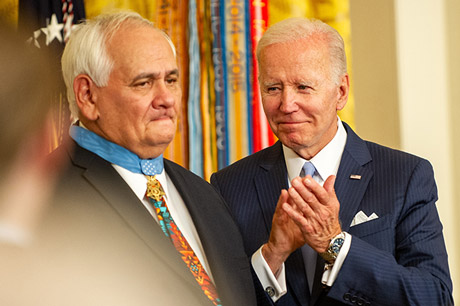
“He used the tank's cannon. He used the tank's machine gun. He used his personal rifle. He sustained fire, drove back the attackers, and created a place of relative safety for injured men behind the tank to take cover. He provided battlefield updates to his commanders until the enemy shot the communication system right off of his helmet.”
President Joseph R. Biden Jr.,
White House Medal of Honor Ceremony, July 5, 2022
RELATED STORIES FROM ARMY.MIL
The 25th Infantry Division
The 25th Infantry Division was formed on Oct. 1, 1941, at Schofield Barracks, Hawaii. Its lineage can be traced to the Hawaiian Division, which defended Hawaii from 1921 to 1941. The division received its baptism by fire when Japanese forces attacked Oahu on Dec. 7, 1941. In November 1942, the 25th ID deployed into action against the Japanese in the Solomon Islands, where it earned the nickname “Tropic Lightning” due to its superior performance. The division also took part in the liberation of the Philippines, landing on the island of Luzon in January 1945, and fought for 165 days without rest. After World War II, Tropic Lightning performed occupation duty in Japan.
In the summer of 1950, the 25th ID was called to action in South Korea against communist aggression. Tropic Lightning deployed from Japan and immediately began operations to defend the city of Pusan. The 25th ID returned home to Hawaii in October 1954, after 12 years abroad, with the freedom of South Korea preserved.
In December 1965 Tropic Lightning answered another call to fight against communism and deployed to fight in the Vietnam War. It was initially thought, that the terrain of Vietnam would preclude the use of armored cavalry in Vietnam, but early successes using mounted operations in the Vietnamese highlands by Troop C, 3rd Squadron, 4th Cavalry, as well as successes in the area northwest of Saigon known as the III Corps Tactical Zone by the 1st Squadron, 4th Cavalry, 1st ID and then the 3rd Squadron, 4th Cavalry, 25th ID, convinced commanders that given their mobility and firepower, armored cavalry along with tank and mechanized infantry units supported by air cavalry could be very effective against Viet Cong and North Vietnamese forces.
The organization of the 25th ID changed in 1985 when it was selected to reorganize into a light infantry formation. In 1995, the division headquarters, along with the 2nd and 3rd Brigades, were sent to Haiti as part of Operation Uphold Democracy. The 25th ID continued peacekeeping missions into the 21st century when 1,000 Tropic Lightning Soldiers deployed to Bosnia-Herzegovina from April to September 2002 as part of Stabilization Force XI. Division Soldiers took part in mine-clearing operations, reconstruction and the destruction of weapons turned in by civilians to help Bosnia- Herzegovina rebuild after a devastating civil war.
At the dawn of the 21st century, the 25th ID was thrust into its fourth war. In 2004, Tropic Lightning deployed in support of the Global War on Terrorism. Like the insurgents the division fought in the Vietnam War, the enemy avoided open battle and blended into the population. When the 2nd Brigade Combat Team deployed to northern Iraq in January 2004, it engaged insurgent forces and helped rebuild local security and government institutions. In September of that same year, the 1st Brigade, newly transformed into a Stryker Brigade Combat Team, departed Fort Lewis, Washington, for Iraq’s Ninewa Province. The culmination of their deployments occurred in January 2005, when both BCTs supported free elections for all Iraqis. The 2nd BCT returned home in March 2005, followed by the 1st BCT in September.
In March 2004, the division headquarters, along with the 3rd Brigade Combat Team, Division Artillery, 25th Aviation Brigade, and Division Support Command, deployed to Afghanistan. Soldiers of Tropic Lightning engaged in combat operations against Al-Qaeda and Taliban forces, while also helping to rebuild a country ravaged by decades of war. The climax of their deployments occurred during the summer of 2007, when Task Force Lightning and the 4th BCT dealt the enemy a severe blow in a series of offensives as part of the “The Surge.” The actions by Tropic Lightning units during this critical period decreased violence and gave local authorities the ability to reestablish effective governance, which set Iraq on the road to stability. By October 2007, all Hawaii-based Task Force Lightning units returned to Schofield Barracks, and the 4th BCT returned to Alaska by December.
From 2008 until early 2013, brigades from the 25th ID supported Operations in Iraq and Afghanistan. Missions included fighting and defeating enemy forces, as well as preparing local security and governance institutions to one day stand on their own.
In recent years, the division headquarters and its Hawaii-based BCTs have returned to their traditional role as guardian of the Pacific, partnering with allied nations to maintain capabilities and strengthen relationships. Personnel exchanges and exercises with numerous countries along the Pacific Rim demonstrate the division’s commitment to working with regional military forces.
In 2014, Tropic Lightning began participation in Pacific Pathways, a program designed to further reinforce relationships with partner countries in Asia and the Pacific. During Pacific Pathways, American Soldiers participate in a series of exercises in rapid succession, moving from country to country. Tropic Lightning units from all brigades and the division headquarters have taken part in Pacific Pathways, conducting training with Soldiers from countries throughout Asia and the Pacific. That same year, Tropic Lightning opened a Jungle Operations Training Center, the first such school in the Army since the closing of the old Jungle Warfare School at Fort Sherman in the Panama Canal Zone.
For over seven decades, the 25th ID has fought in some of the most important conflicts of the 20th and early 21st centuries. From the jungles of the Solomons and Vietnam, to the mountains of Korea and Afghanistan, to the deserts of Iraq, Soldiers of Tropic Lightning have fought for freedom throughout the world, and remain “Ready to Strike – Anywhere, Anytime.”
Official Citation
The President of the United States of America, authorized by Act of Congress, March 3, 1863, has posthumously awarded in the name of Congress the Medal of Honor to
Specialist Five Dwight W. Birdwell
United States Army
For conspicuous gallantry and intrepidity at the risk of his life above and beyond the call of duty:
Specialist Five Dwight W. Birdwell distinguished himself by acts of gallantry and intrepidity above and beyond the call of duty while serving with C Troop, 3d Squadron, 4th Cavalry, 25th Infantry Division in the Republic of Vietnam on 31 January, 1968.
On this date, C Troop was ordered to move south to help repel an enemy attack on Tan Son Nhut Airbase. As the C Troop column of tanks and armored personnel carriers approached the west gate of Tan Son Nhut Airbase, it came under intense enemy fire from a building to its right.
Unbeknown to C Troop, it had driven directly into an enemy force consisting of three battalions.
The column tried to push through the initial attack but the lead tank, crippled by a rocket-propelled grenade explosion, was blocking the way forward.
C Troop immediately came under heavy enemy fire from both sides of the road. Specialist Five Birdwell, upon seeing that his tank commander was wounded by enemy fire, immediately went to his aid.
Under intense enemy fire, he lowered the injured tank commander to the ground, and moved him to safety.
Specialist Five Birdwell then, with complete disregard for his own safety, mounted the tank and assumed the tank commander's position.
Standing in the tank commander's hatch with the upper half of his body exposed to heavy enemy fire, Specialist Five Birdwell used the tank's .50 caliber machine gun and 90mm main gun to suppress the enemy attack.
With the ammunition for the 90mm main gun exhausted, he continued to fire the .50 caliber machine gun until it overheated.
At this point, Specialist Five Birdwell, rather than abandoning his position, continued to engage the enemy with his M-16 rifle, sometimes exposing his entire body to enemy fire in order to engage the enemy from a better vantage point.
After giving one M-60 and ammunition to a fellow soldier, he remounted his tank and used the other M-60 to again engage the enemy. Specialist Five Birdwell continued to engage the enemy with complete disregard for his own safety until the M-60 he was firing was hit by enemy fire.
Specialist Five Birdwell, now wounded in the face, neck, chest, and arms, dismounted the tank but refused to be medically evacuated. Instead, Specialist Five Birdwell, under enemy fire, rallied fellow soldiers to advance toward the front of the armored column where they set up a defensive position by a large tree.
From this position, he and the other soldiers engaged the enemy with M-16 fire and grenades.
As the enemy fire lessened, Specialist Five Birdwell gathered ammunition from disabled vehicles and helped wounded soldiers move to safer positions. His leadership and tenacity under fire inspired the other C Troop soldiers to continue fighting against the superior enemy force, and directly contributed to the enemy's ultimate defeat.
Specialist Five Birdwell's extraordinary heroism and selflessness above and beyond the call of duty were in keeping with the highest traditions of military service and reflect great credit upon himself, his unit, and the United States Army.
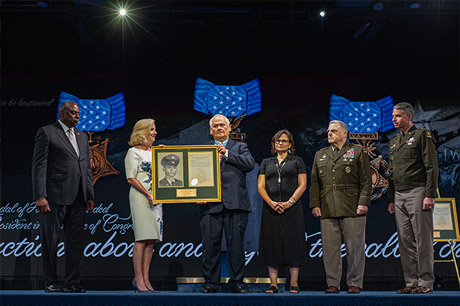
Secretary of the Army Christine Wormuth presents a photo and citation to Medal of Honor recipient former Army Spc. Five Dwight W. Birdwell, in a ceremony in which Birdwell and five others were inducted into the Pentagon Hall of Heroes, at Joint Base Myer-Henderson Hall, Va., July 6, 2022. (U.S. Army photo by Sgt. Henry Villarama).
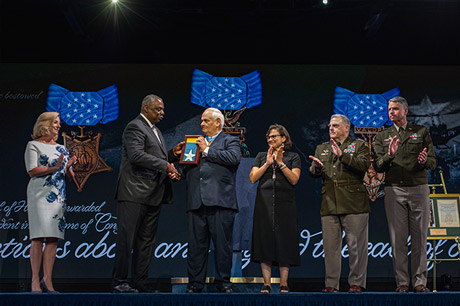
Secretary of Defense Lloyd J. Austin III presents the Medal of Honor flag to former Army Spc. Five Dwight W. Birdwell, in a ceremony in which Birdwell and five other Medal of Honor recipients were inducted into the Pentagon Hall of Heroes, at Joint Base Myer-Henderson Hall, Va., July 6, 2022. (U.S. Army photo by Sgt. Henry Villarama).