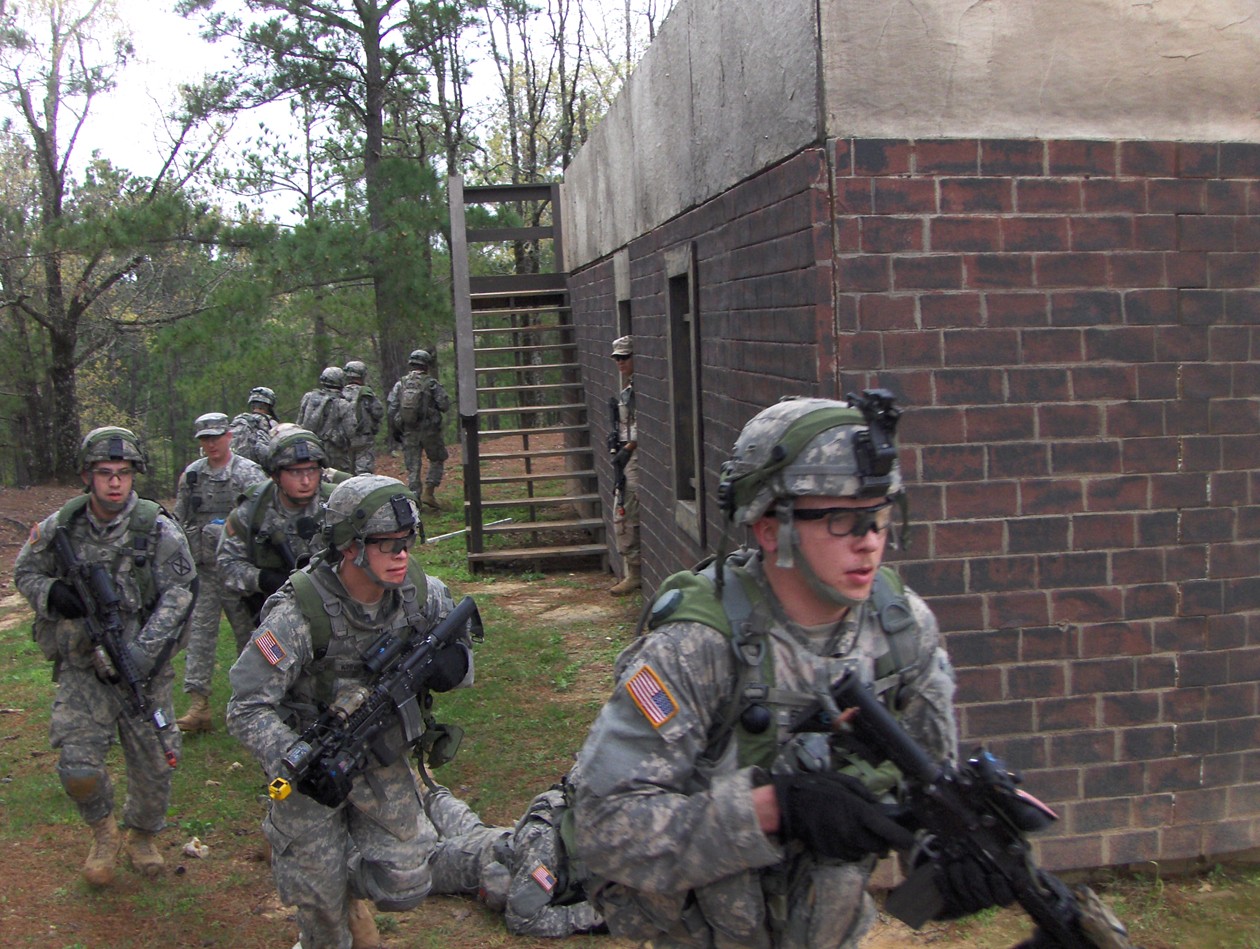
FORT POLK, La. -- The "Barbarians" of B Company, 2nd Battalion, 14th Infantry Regiment, 2nd Brigade Combat Team, 10th Mountain Division (LI), conducted their first situational training exercise recently at the Army's premier training destination, Fort Polk, La., home of the Joint Readiness Training Center.
JRTC strives to make training as realistic as possible for visiting units. During STX training March 13, and a culminating force-on-force exercise, units faced real opposition forces while working with Afghan National Army actors.
Current host nation personnel are employed to support the JRTC mission as Pashtu-speaking interpreters and realistic village role players. Soldiers who are stationed at Fort Polk are tasked with playing OPFOR and providing additional ANA forces.
For his first rotational STX mission, Capt. Jake Reidel, B Company commander, was tasked with re-occupying a previously overrun and abandoned combat outpost. His company included an attachment from B Company, 109th Military Intelligence Battalion and 2-14 Infantry's Reconnaissance Platoon with scout and sniper elements led by 1st Lt. Curtis Ballard.
In the predawn hours, Soldiers continued preparations for an enemy OPFOR attack. Sandbags were packed, towers were manned, and obstacles emplaced. Looking through the green tube of night vision goggles, Sgt. Dylan Mcelhinne, a team leader with 3rd Platoon, 3rd Squad, readied his section of perimeter security.
In soft whispers he explained, "Most defensive positions were already pretty good when we reoccupied the (combat outpost), but we have been making constant improvements."
Quiet but deliberate orders to remain vigilant and report movement could be heard during security checks.
During the night, Scouts were tasked to execute reconnaissance and surveillance patrols outside the protection of the COP walls. Ballard ordered his men to provide the COP with early warning of an impending attack.
Under the cover of darkness, Staff Sgt. Partyka, sniper squad leader, led his team into the brush to execute the mission. The approaching OPFOR were cut off by the team's effective M-110 semiautomatic sniper rifle fire in conjunction with mortar fire, abruptly ending the fragile peace of the night. Shortly after, OPFOR initiated their attack with a simulated vehicle-borne improvised explosive device, in addition to several waves of attackers.
As the morning fight continued, casualties were assessed by JRTC observer controller personnel. First Sgt. Bobby Hanvy of B Company organized the medical evacuation process. Medics worked diligently to evaluate and treat friendly casualties, preparing them for evacuation from the battlefield. After security had been regained, Hanvy led the MEDEVAC convoy to an open green field adjacent to the COP in order to establish a helicopter landing zone.
In the end, medevac helicopters were not allowed to fly due to low visibility, but the mission did not stop. Hanvy and the OCTs (observer controller trainers) took advantage of the extra time to thoroughly walk through HLZ procedures with the junior Soldiers.
Lt. Col. Sean Bernabe, 2-14 Infantry commander, was on site for the duration of the attack. He was overall pleased with the level of performance of his Soldiers, as well as the value of the training.
"The great thing about an environment like JRTC is that not only did the company get great training in the defense, but the integration of (host national) partners, attachments and assets really helps build the skills in order to establish those partnerships downrange," referring to a future deployment.
He went on to praise the OCT teams who referee the training on site.
"The OCTs did very well," he said. "They let the company learn their own lessons and solve problems on their own, but also injected valuable advice when needed."
The "Barbarians" and the rest of 2-14 Infantry deployed to JRTC at the beginning of March for a month of world-class instruction and realistic force-on-force training. As the STX lanes begin, Soldiers are beginning to experience some of the replicated stressors of combat. Every stage of training is meticulously designed to critique units at every level.
The intent of 2-14 Infantry training at JRTC is to identify and correct shortcomings to minimize casualties in combat. The Golden Dragons are constantly training and ready to deploy anywhere and any time the United States needs them.
Social Sharing