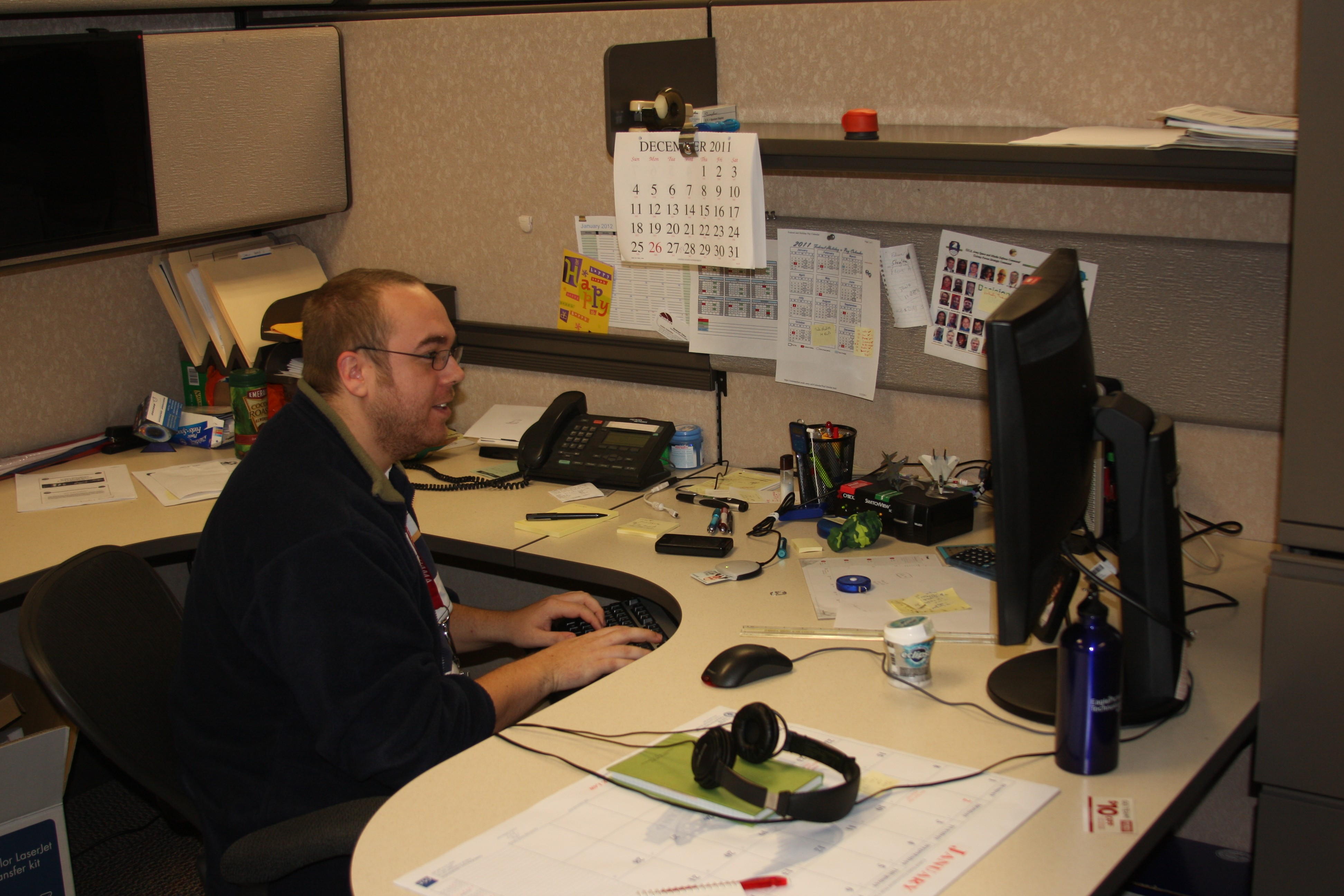
REDSTONE ARSENAL, Ala. - Today's beginner could be tomorrow's leader.
For the past 10 years, the U.S. Army Space and Missile Defense Command/Army Forces Strategic Command has leveraged the Department of the Army Intern Program to help groom the leaders of tomorrow and help guide them to a brighter future.
"The DA Intern Program has been an overwhelming success at SMDC," said Paul A. Page, SMDC Future Warfare Center, Decision Support Directorate, Studies and Analysis Division chief. "An excellent example is the Studies and Analysis Division which has four employees who graduated from the DA Intern Program and one other who will complete the program in December 2012. These five employees represents approximately 40 percent of the Studies and Analysis Division's workforce and are leading studies that enable key Department of Defense, Army and SMDC decisions.
"The USASMDC/ARSTRAT Future Warfare Center, Decision Support Directorate will continue utilizing the DA Intern Program as it provides an infusion of innovative employees who will continue to advance this command into the 21st century," he added.
One intern in the program spoke of how he enjoys the chance to learn, as well as better himself personally and professionally.
"I applied here because it was an internship in my field," said Ivens Jean, a current intern with the Decision Support Directorate Models and Simulation Division. "It was also a good entry-level position and it was a chance to move from Florida, where I had always been, and see another part of the country.
"I have only been here for about a month but so far it has been a great learning experience, and I look forward to learning more every day," he added.
Dr. Steve Pierce, FWC Decision Support Directorate director, began bringing in DA interns in 2001, a time at which DoD was focused on work force draw downs, to build the SMDC FWC workforce and expand Studies and Analysis Division core competencies. Pierce indicated that the technical skill sets the interns have brought to SMDC have been a benefit for the command the warfighter.
"The DA Intern Program provides the necessary training while SMDC is responsible for providing challenging projects and studies," Pierce said.
"Interns are brought in at the GS-07 level and spend two years in a program that exposes them to the online/in-class and on-the-job training needed to develop the appropriate skill sets necessary to execute the functions of key SMDC positions," he continued. "The Army pays the intern's salary during the two year program with the sponsoring activity picking up the salary responsibilities upon graduation.
"DA interns receive a promotion at the end of year one (to a GS-09) and graduate as GS-11s at the end of year two," Pierce added. "This benefits SMDC in that it provides a training platform for new hires who, once graduated from the program, produce mid-grade employees that can satisfy critical functions in support of the warfighter."
Pierce emphasized that the goal is to develop motivated, competent government employees for the Army.
"I inform the interns throughout the process that we will have a position for them if they successfully complete the program," Pierce said. "But if they want to pursue another area of work in DoD, I will assist in finding them a position outside the Decision Support Directorate."
Another intern talked about how the workforce has helped him as he has become part of the SMDC family.
"The intern program here is nice," said Orrin "Bo" Hatch, a current intern. "I am getting a lot of experience so that is nice. It helped me get my foot in the door, and I am receiving a lot of on-the-job-experience, so that is good.
"At the end of the program, I am guaranteed a job, so that is also a bonus," he added. "For someone looking at SMDC and the intern program, it is absolutely a great place to come to. Everyone here is professional, nice and have made my time here an enjoyable experience, and that is very important to me. People are helpful and go out of their way to help the interns."
Page talked about the importance of the intern program at SMDC and its importance to the command.
"The intern program has become very important to SMDC over the last 10 years," Page said. "It has enabled the command to hire against 'hard to fill' slots such as operations research and systems analysts positions. Over the years, it has been continually difficult to fill these vacancies with experienced and qualified candidates with operational analysis backgrounds.
"The intern program has provided the platform to hire and train individuals to conduct the operational studies needed to support the current and future ground warfighter," he continued. "Also, the DA Intern Program has been an instrument used to expand the SMDC core competencies. For example, the Studies and Analysis Division has used the DA Intern Program to expand core competencies including execution of models and simulation, experimental design, statistical analysis, and cost-benefit analysis.
"Finally, the intern program is an excellent way to infuse new talent into an aging government workforce," Page added. "This will mitigate potential negative impacts to key mission requirements as large numbers of the current workforce reach retirement age."
A former intern who has become a full-time civil servant, talked about the experiences she gained and how her early days have made her a more well-rounded employee.
"I thought the intern program here was a great experience because I didn't come from a military background so it gave me a chance to incorporate the training along with the job duties to get into my role and position here," said Holly Thorne, an intern from September 2008-2010. "So far, working here at SMDC has been a great experience. I have learned a lot and it has been very enlightening. For someone thinking about joining the SMDC intern program, I highly recommend it."
Page told how the interns ultimately support the warfighters as they accomplish their mission across the globe.
"The Studies and Analysis Division is focused on determining the military utility of space, missile defense, high altitude, and cyber systems, as well as the associated Concepts of Operation for the current and future ground warfighter," Page said. "Operational analysis is conducted using multiple techniques to include qualitative approaches such as tabletop wargames and map exercises and quantitative analysis that often utilizes complex models and simulation environments.
"Specifically, the Studies and Analysis Division has ensured that all DA interns are trained in analytical and statistical analysis techniques," he continued. "Also, all interns are trained to execute models and simulation environments necessary to support operational analysis requirements. All of these areas are key to supporting the warfighter.
"Additionally, other divisions within the Decision Support Directorate, to include the Models and Simulation and Information and Computational Engineering divisions, are utilizing the DA Intern Program to develop employees who will address their key missions in support of the warfighter," Page added.
A former intern spoke about how the program helped him move from one career field to his current one at SMDC, and how the intern program gave him a unique opportunity to serve his nation.
"The intern program was a great entry-level way for me to get into government service," said Steve Toler, an intern from October 2003-2005. "I was a high school math teacher and saw it as a great opportunity to join the civil service and start on a career while serving my country.
"The intern program here is a great way for a college student or another interested person to see if government service is for them," he added. "I have heard several horror stories from other intern programs but the one here is fantastic and it has been very good to me and to others I have spoken with."
Social Sharing