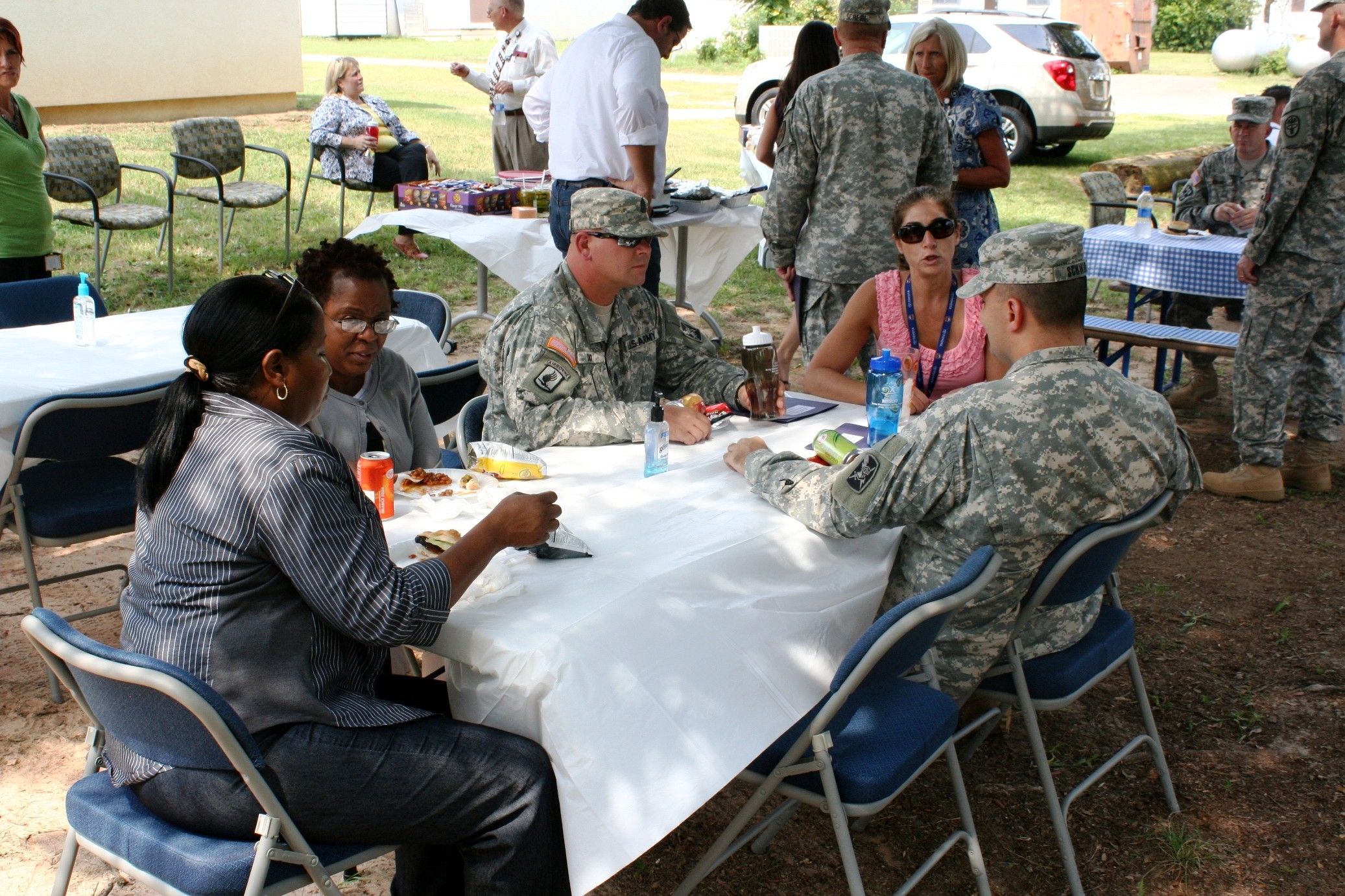
FORT GORDON, Ga. -- The Fort Gordon Army Substance Abuse Program hosted a barbecue event designed to recognize unit leaders for their outstanding support of servicemembers and the ASAP program. Here, unit leaders fellowship with staff members from t... VIEW ORIGINAL
FORT GORDON, Ga. -- Servicemembers that are secretly dealing with personal issues are often reluctant to reveal those problems to others and seek help. When an individual is given the opportunity to get help, whether the decision was their own or an intervention, it is important that they have the support of those around them -- including their unit leaders -- to ensure a successful recovery.
The Fort Gordon Army Substance Abuse Program hosted a barbecue event designed to recognize unit leaders for their outstanding support of servicemembers and the ASAP program.
"Each year we find a way to say thank you to our military leaders for their amazing support of our programs and the care they show for their troops," said Cindy Armstrong, Clinical Program Manager. "They often do not realize just how appreciative we are. Despite their demanding schedules, our leaders are always willing to provide their time and energy in support of what we do -- and we are thankful for that.
The event included food, games, awards and giveaways -- but it also included important information involving the ASAP program. Unit leaders were updated by program directors and brief seminars provided them with knowledge about substances. A representative from the Criminal Investigation Division provided information about the latest drug trends designer drugs - such as Spice and Bath Salts -- and energy drinks.
"These designer drugs are a growing trend throughout the country, especially among servicemembers, and it is a dangerous problem. These substances are sold in stores and difficult to detect," said Michael Almeter, ASAP Counselor. "One of our goals today was to provide these leaders with knowledge so that they are better prepared to identify the problem within their units."
The event also provided an opportunity for officials on both sides to interact in a more relaxed setting and build stronger relations.
"It was nice to finally put a face to some of these leaders. We have many phone conversations and memos are exchanged, but we don't get much face time," mused Tara Ford-Rhones, ASAP Counselor. "Not all units have leaders as helpful and enthusiastic as the officials here, and we are very grateful for that support."
Such support is vital in the successful treatment of a servicemember, Almeter said.
"It is extremely important that leaders not view ASAP and similar programs as a punishment or a threat, but as a tool," he said. "These individuals have overcome an obstacle simply by coming forward; if their experience is a negative one then they might regret the decision to seek help and the condition may worsen."
Social Sharing