


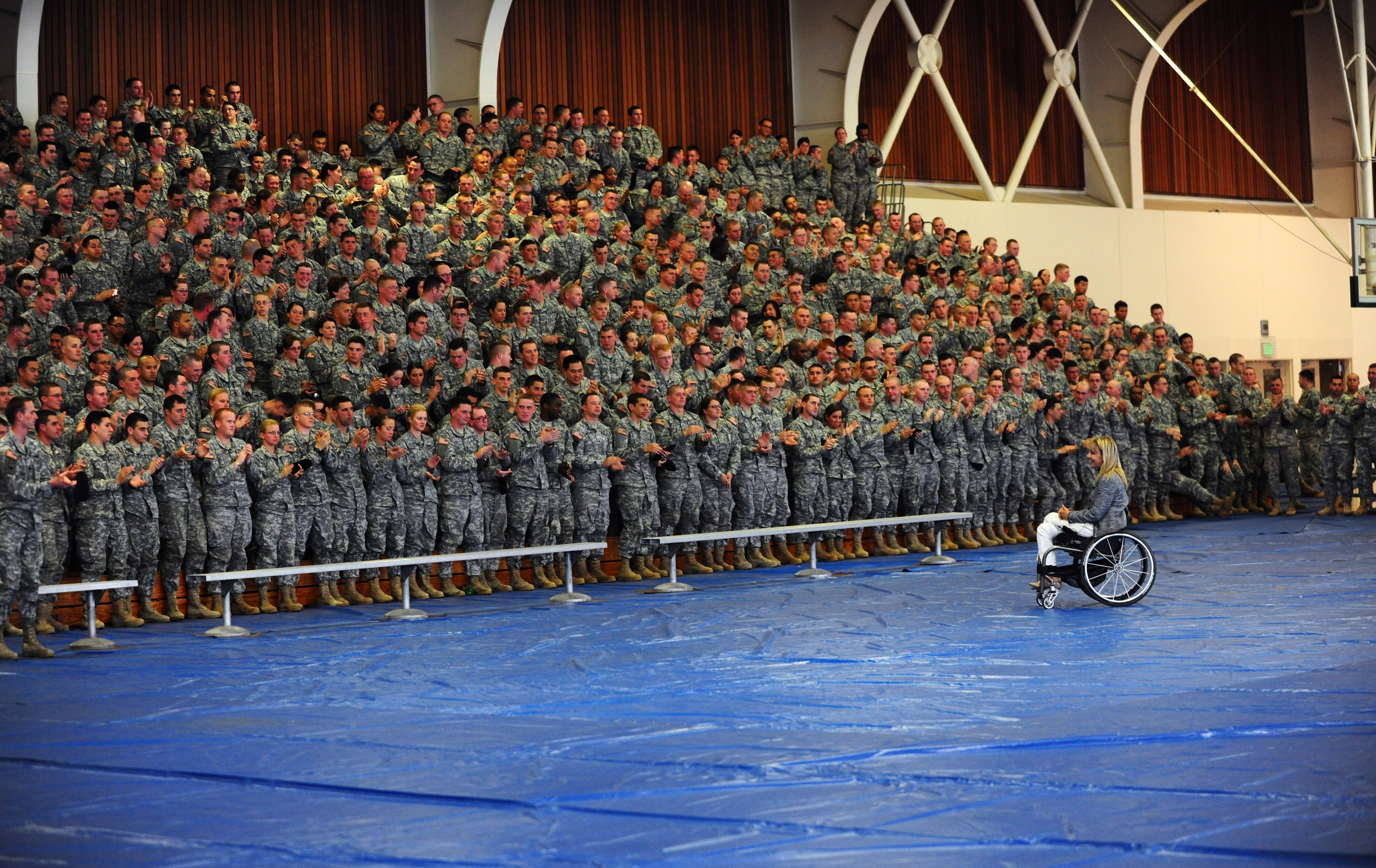
PRESIDIO OF MONTEREY, Calif. - As part of the Presidio’s 2011 Safety Awareness Day Event May 27, guest speaker Kelly Narowski gave three presentations throughout the day to accommodate the roughly 3,500 service members who attend the Defense Language Institute Foreign Language Center.
Narowski’s focus is on how high-risk driving behavior can have a lifelong effect on a person and others. She speaks from experience.
Narowski, an Army wife, was paralyzed from the chest down during a vehicle accident involving alcohol and in which she was not wearing a seat belt.
Before heading out to a jazz festival on the beach one afternoon, Narowski stopped by her friend Heather’s house.
Heather already had six to eight martinis by the time she arrived, Narowski said.
“I wasn’t a drinker. I was a bit of a health fanatic,” said Narowski, who was 25 at the time, graduated college two months earlier and had just moved to Santa Barbara. “But I decided to have two drinks with her that day.”
After Heather declared she had too much to drink, Narowski took the wheel of Heather’s Jeep Wrangler to drive them along California’s Highway 1 to a concert on a beach.
The trip from the passenger seat to the driver’s seat was her last walk. Narowski neglected to fasten her seat belt, while her friend remembered to buckle up.
“We were in deep conversation. Here I am with two drinks in my system, and I’m with someone who’s had a lot to drink, and I’m on a curvy mountain road " a dangerous road " and I’m in an unfamiliar vehicle and now we’re talking. Kind of a recipe for disaster,” she said.
Narowski turned the wheel to the right, and the Jeep went left and hit the guard rail.
“My body was pushed very, very hard into the steering wheel, and I broke my ribs, collarbone, (and) my lungs were collapsed and full of blood,” she said.
The Jeep collided with the guard rail a second time, sending Narowski flying inside the car until she ended up in the backseat.
“My body flew around the Jeep like a ragdoll, and it ended up in the backseat, and my body was going 70 miles an hour,” she said.
The friend walked away from the accident. Narowski didn’t.
Narowski shattered her T6 vertebrae.
“It exploded like a grenade. My spinal cord was stretched like a piece of taffy, and I was paralyzed from the chest down forever from that moment in time on,” she said.
“That’s the difference between a seat belt and no seat belt,” she said. Narowski spent the next month in an intensive care unit having eight painful surgeries because of her actions, or inactions.
During one of her surgeries to drain the fluid from her lungs, she was given the wrong anesthetic. It paralyzed her movement, but not her ability to feel.
“I could feel that surgery. I could feel them working on my lungs that whole time, and I couldn’t tell them to stop. I’ll never forget that. And that kind of trauma and that kind of hardship is a direct result of what I did to myself in a car making stupid choices,” she said.
Narowski went into rehabilitation to learn to live life as a wheelchair user.
An Army wife since 2005, Narowski left behind a nine-year stint as a travel agent to devote herself full-time to help keep Soldiers and others safe as a professional speaker, and has given speeches and safety briefings to service members and other groups around the country. The safety educator pulled no punches as she hurled statistics and medical facts about the brain and spinal cord at Soldiers.
“Think of your seat belt as your body armor,” she said. Narowski rattled off names of celebrities who died because they were not wearing seat belts " singer Lisa Lopes, Derrick Thomas of the Kansas City Chiefs and Princess Diana.
From seat belts she moved on to “the nation’s most commonly committed violent crime” " drinking and driving. The combination costs the nation $50 billion a year, Narowski said.
Reminding Soldiers that a vehicle can be a 2,000-pound weapon, Narowski encouraged them to plan social activities to include a designated driver when alcohol is to be consumed. A drunken driver killed Los Angeles Angels baseball player Nick Adenhart and two of his friends in 2009 and caused severe disability in a fourth, she noted.
“I’d rather have my inconvenient life in this wheelchair than be sitting in prison thinking about the three people I’d killed,” said Narowski.
“The number one cause of all car crashes is not paying attention,” Narowski said. She mentioned cognitive distractions such as talking on the phone (even a hands-free model), texting, picking up something from the floor and driving while drowsy.
“Talking on a cell phone [while driving] is the same as being drunk,” she said.
Encouraging Soldiers to use their common sense, Narowski told them speed-limit signs are posted for a reason. “A lot of science goes into determining the safe speed for a road.”
Narowski learned that the hard way. Although she got five speeding tickets in six years, she “didn’t get it,” she said. “I’ll pay for it forever.”
As a Soldier, you are a high-quality person, she said. “It would be a needless waste if something happens to you on the road.”
(Article based on ones by Kathryn C. Weigel and Katherine Rosario.)
Social Sharing