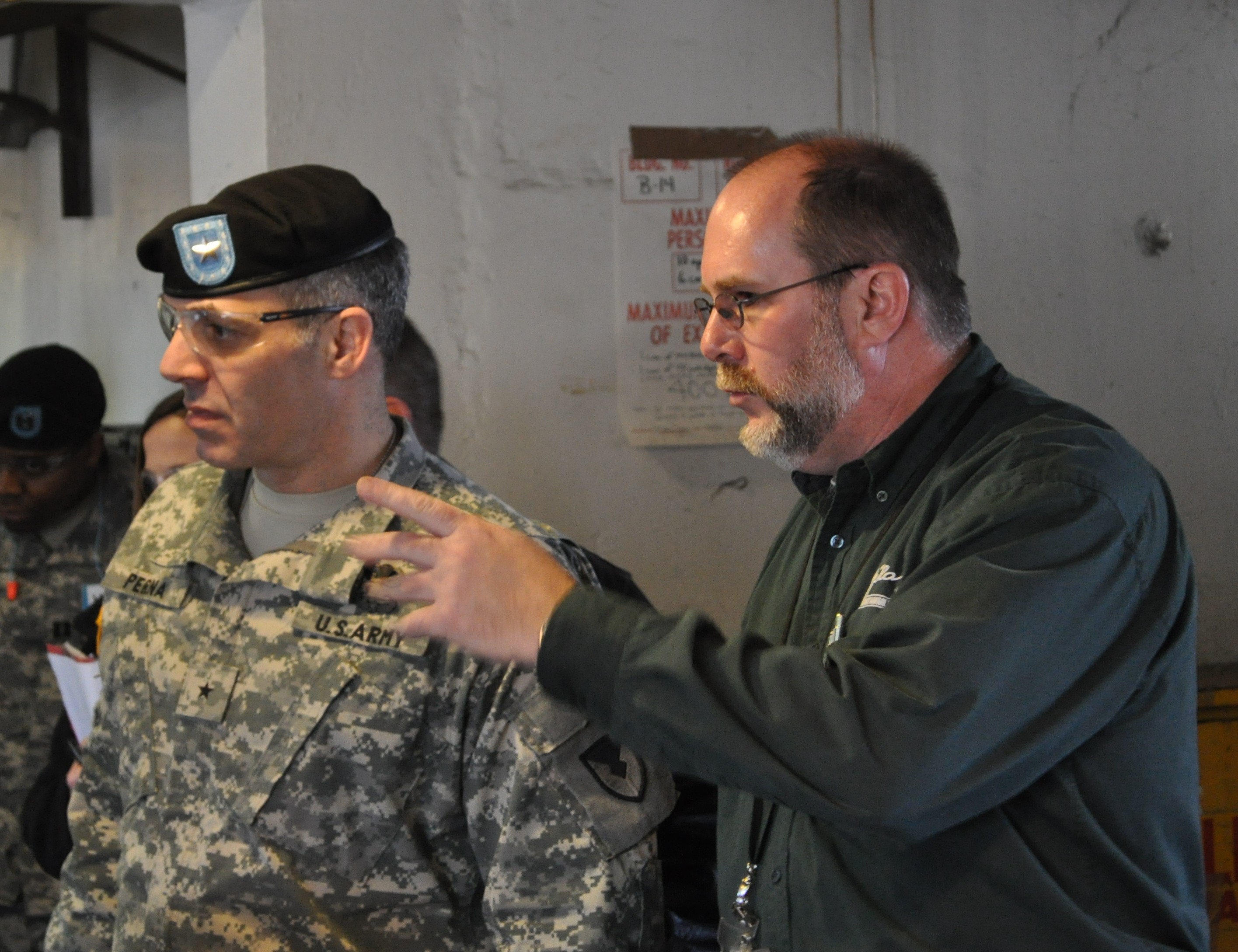

MILAN, Tenn. - The new year had the employees of Milan Army Ammunition Plant seeing stars, but not because of fireworks. During the first week of the new calendar year, MLAAP hosted not one, but two one-star generals at the Milan plant.
On Jan. 4, 2011, Brig. Gen. Gustave Perna, commanding general for Joint Munitions Command and the Joint Munitions and Lethality Life Cycle Management Command, arrived at MLAAP, a subordinate installation of JMC, for his first visit to the Tennessee plant. The next day, MLAAP had the opportunity to welcome Brig. Gen. Jonathan Maddux, the program executive officer for ammunition, for informational briefings and a plant tour.
Perna commended the Milan staff on the great work that they do, along with all of JMC.
"I have served three tours in Iraq...Not once have I had a problem getting ammunition. I have been saved more than one time by a 40mm round shot over my head," Perna declared.
During his one-day visit, which was filled with introductions, information, and inquiries, Perna received briefings both from American Ordnance, the operating contractor at MLAAP, and from the government staff. These briefings included information about the plant's current operations, the current contract with AO, and the plant's products and capabilities.
The commanding general addressed the group and outlined his top ten priorities for his command. He explained the importance of modernization and of the warm base.
Perna explained, "[When it comes to ammunition] we want as much as we want of it, when we want it."
Perna referenced the corporate world, explaining that typical businesses experience milder and more-predictable fluctuations in supply and demand.
"The Army is looking for a solution to the ups and downs in the demand for ammunition," Perna said. He explained that the ammunition industrial base must be ready for the next contingency, even as the current wars are drawing down.
Perna also received a briefing on the Environmental Assessment conducted at MLAAP. Because the 2008 contract with AO incorporated that company's proposal to consolidate production operations from Milan AAP to Iowa AAP, the Army and AO were required to assess the impact of those changes to the environment at each plant. Leaders from both AO and the government staff presented the issues raised by the EA process. Perna indicated that he would continue to work toward the best solution.
In addition to the positive results observed down-range, Perna emphasized the value of best practices. He expressed his desire to identify these and allow sharing among all JMC installations. Through best practices, Perna explained, universal improvement can be realized.
At the conclusion of the presentations, Lt. Col. Maria Eoff, Milan commander, along with her staff, hosted Perna on a plant-wide tour through several production lines. Through walking presentations by MLAAP's quality assurance team, Perna learned about the equipment and processes utilized at Milan, including MLAAP-specific production of the 40mm high explosive and the Spider grenades.
Perna concluded his visit on a positive note. He acknowledged that results take time, but he encouraged the staff to be diligent. Perna also reinforced his commitment to partnership.
Perna repeated to the staff, "I need you to help me help you."
Maddux began his visit by sitting down with an intimate group of plant leaders to discuss the conditions of the contract and of the workforce at MLAAP. The general received briefings on the current command's structure and functions, the operating contractor's structure and functions, and an update on the current BRAC and modernization projects.
During the presentations, the government staff expressed concerns about work-loading efforts, especially concerning BRAC capabilities received at MLAAP, which may require prove-out to validate the capability of the production line. Likewise, AO leaders expressed their concerns about delays in contract execution. In response, Maddux requested more detail about the workload needs and capabilities addressed by the government personnel. Maddux also requested further documentation from AO regarding contract delays.
Following the presentations, Eoff, along with members of the government staff, led Maddux on a plant tour which focused on the BRAC and modernization efforts in several production areas, as well as the test range. One of the modernization efforts involves an upgraded deluge system that increases worker safety while decreasing the amount of water expended.
The perspective MLAAP gained from both generals is broad.
The message: The Army is moving toward change; the priority should be preparedness. Modernization and optimization will facilitate this preparedness while maintaining the current quality and safety expected of the workforce. Through this vision-this paradigm shift-today's Army will become tomorrow's standard for effectiveness and efficiency.
Social Sharing