
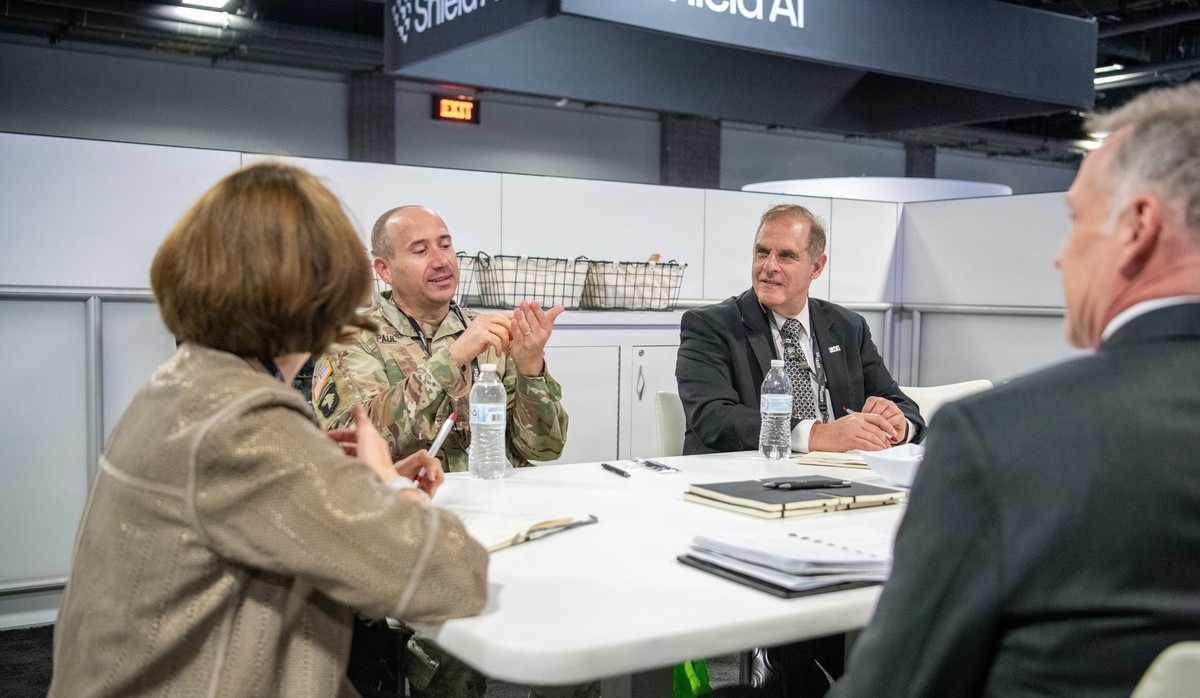


The Association of the United States Army (AUSA) Annual Meeting and Exposition brought together Soldiers, Army Civilians, and industry partners and professionals on October 12–14, in Washington, DC.
Reports from AUSA indicate that approximately 45,000 people attended the event, including 25 Chiefs of the Army and 30 officials from ally and partner countries. Meeting participants were able to visit over 750 exhibit booths and the first-ever outdoor exhibit at AUSA.
The annual meeting provides opportunities to exchange ideas, explore emerging technologies and strengthen partnerships to support Army modernization.
This year’s theme, “America’s Army: The Foundation of the Joint Force,” was reflected in the strong attendance throughout the Walter E. Washington Convention Center’s meeting rooms, session spaces, social gatherings and exhibit halls.
CPE ES2 leaders, including COL Matt Paul, Ms. Miranda Coleman, Mr. Billy McCain, Mr. Reg Shuford, COL Melvin Mitchell, COL LJ Freeland and Mr. Doug Haskin, met with industry representatives to discuss technology priorities and acquisition opportunities aimed at improving Soldiers’ capabilities. Recurring themes — super intelligence (SI), Army Open Solicitation (AOS) and cloud technologies — emerged, which highlighted the importance of responsible innovation, effective collaboration between the Army and industry, and integrated digital services.
Industry discussions focused heavily on SI. Representatives expressed interest in supporting the Army’s exploration of SI solutions, emphasizing the potential for advanced capabilities to address complex challenges and improve mission effectiveness.
As these technologies continue to evolve, responsible implementation remains essential. Army and industry leaders discussed anticipating potential risks, establishing appropriate safeguards and ensuring emerging capabilities are well governed, safe and effective. New technologies must align with the needs of Soldiers and the Civilian workforce. Collaboration with industry can help the Army evaluate potential applications, understand limitations and develop solutions that deliver meaningful operational value.
Meeting participants also discussed cloud services and their role in supporting Soldiers and enabling more efficient Army operations. Cloud-based systems support a range of everyday personnel and operational functions, including in- and out-processing, ordering parts while in the field, checking pay information, and recording fitness test results. As one attendee noted, “we’re now looking at many systems, all of which need integration and sustainment.”
These digital services are essential to the Army’s ability to deliver information and resources where they are needed.
A more robust and integrated cloud environment could potentially accelerate decision-making, reduce the digital burden on Soldiers and help ensure information remains consistent across connected systems.
Industry representatives expressed interest in learning more about the Army’s cloud priorities and contributing to future capabilities. One AUSA attendee mentioned the benefits of “creating an ecosystem that manages all applications users access.”
Continued engagement with industry will help connect industry expertise with Army requirements and support the development of more seamless digital services.
The Army Open Solicitation (AOS) process provides engagement with industry, and Army representatives reminded industry that “AOS is the primary instrument for contracting with the Army.”
Improving awareness of available contracting pathways, such as AOS, allows the Army to connect mission needs with industry capabilities and encourages broader participation to solve operational challenges.
The enthusiasm demonstrated by industry partners throughout AUSA underscored the value of sustained government-industry collaboration. Events like AUSA provide opportunities for Army representatives and industry partners to discuss emerging requirements, exchange technical expertise and identify technologies that could help address Army challenges.
The conversations at AUSA reinforced a central principle: modernization is most effective when it begins with the needs of the Soldier. By combining industry innovation with Army expertise and end-user feedback, the Army can continue advancing capabilities that strengthen readiness and support the joint force.
Social Sharing