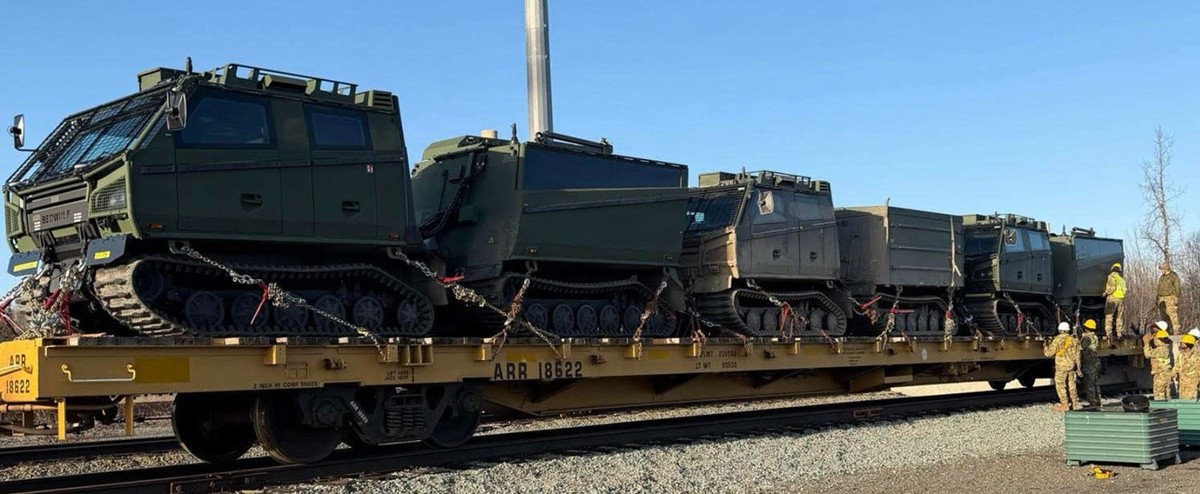
JOINT BASE ELMENDORF-RICHARDSON, Alaska. More than 350 miles of highway separate the 11th Airborne Division's two primary installations in Alaska. Another 100 miles separate Fort Wainwright from Donnelly Training Area, where Soldiers conduct large-scale combat training. Across this vast operational environment, equivalent of driving from New York City to Richmond, Va, the Arctic Angels have made distance, extreme weather and unforgiving terrain part of how they train, move and sustain lethal combat power.
The 11th Airborne Division operates across a geographically dispersed footprint, with formations stationed in southern Alaska at Joint Base Elmendorf-Richardson (JBER) to interior Alaska at Fort Wainwright. Moving equipment, supplies and personnel between these locations requires coordination across hundreds of miles of isolated highways. While other formations may encounter extreme and austere conditions during deployments, the Arctic Angels operate in them year-round, building the experience and logistical capabilities necessary to fight and win in the world's most demanding environments.
Even the approximately 100-mile movement between Fort Wainwright and Donnelly Training Area demonstrates the demands of Arctic operations. During winter, a drive that would otherwise be routine can take more than three hours as Soldiers navigate snow covered highways, limited visibility and temperatures falling below minus 40 degrees Fahrenheit. These conditions demand disciplined planning, equipment readiness and the ability to adapt while maintaining the operational tempo required to accomplish the mission.
The activation of the 11th Airborne Division Sustainment Brigade (Arctic) in October 2026 further strengthened the division's ability to synchronize sustainment operations across Alaska. The brigade coordinates transportation, maintenance and logistical support to ensure combat formations have the resources required to train, deploy and fight. Its mission directly supports the division's ability to project lethal combat power across vast distances.
“Distance doesn't limit our ability to fight. It reinforces the importance of endurance to enable the Division,” said Col. George Plys, commander, 11th Airborne Division Sustainment Brigade. “Whether moving equipment 350 miles between installations or supporting Soldiers in the field, our mission is to ensure the Arctic Angels have what they need to maintain momentum and deliver lethal combat power.”
An established capability supporting these efforts is the Polar Express, an overland transportation operation connecting JBER and Fort Wainwright. By maximizing the use of this transportation network, the division can consolidate equipment movements, synchronize logistical requirements and efficiently move critical resources between its geographically separated formations. This allows combat units to remain focused on training and readiness while leveraging coordinated sustainment capabilities.
Complementing ground transportation, the division's Arctic Aviation Command provides another means of moving personnel, equipment and supplies across Alaska's vast terrain. Through rotary-wing aviation capabilities, the division can extend its operational reach, support maneuver forces and move critical resources where missions require them. The integration of ground and air transportation provides commanders with multiple options to position and sustain combat power across the Arctic.
"Our mission goes beyond moving Soldiers and equipment. We enable the division to rapidly position combat power, sustain momentum and maintain the advantage over any adversary. In the Arctic, aviation is a critical component of how we fight and win." said Col. James Polk, commander, 11th Airborne Division Arctic Aviation Command.
These capabilities are especially important during major training exercises at Donnelly Training Area, where equipment originating at JBER may travel more than 450 miles before reaching its destination. Whether moving resources by ground or air, the division routinely executes logistical operations across distances and conditions that demand proficiency, adaptability and disciplined execution.
For the 11th Airborne Division, sustainment is a combat multiplier. Every piece of equipment delivered, every aircraft employed and every supply movement coordinated contributes to generating and maintaining lethal combat power. The combined capabilities of the Division Sustainment Brigade, Arctic Aviation Command and established transportation networks like the Polar Express allow the Arctic Angels to maintain momentum and extend their operational reach.
Distance and extreme conditions do not define the division's limitations. They define the environment in which the Arctic Angels train to dominate. Through integrated sustainment and aviation capabilities, the 11th Airborne Division continues to demonstrate its ability to move, fight and sustain combat power across the Arctic, ensuring its formations remain ready to deploy, engage and destroy the enemy wherever called upon.
Social Sharing