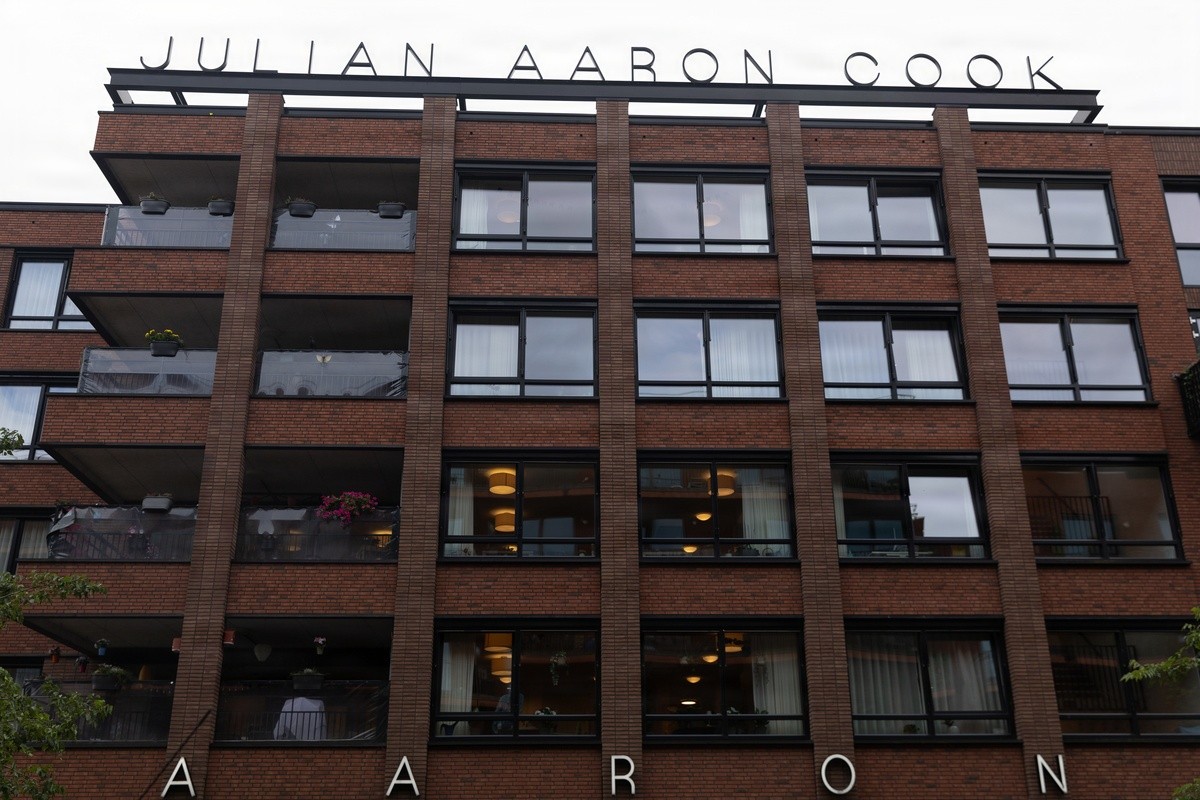

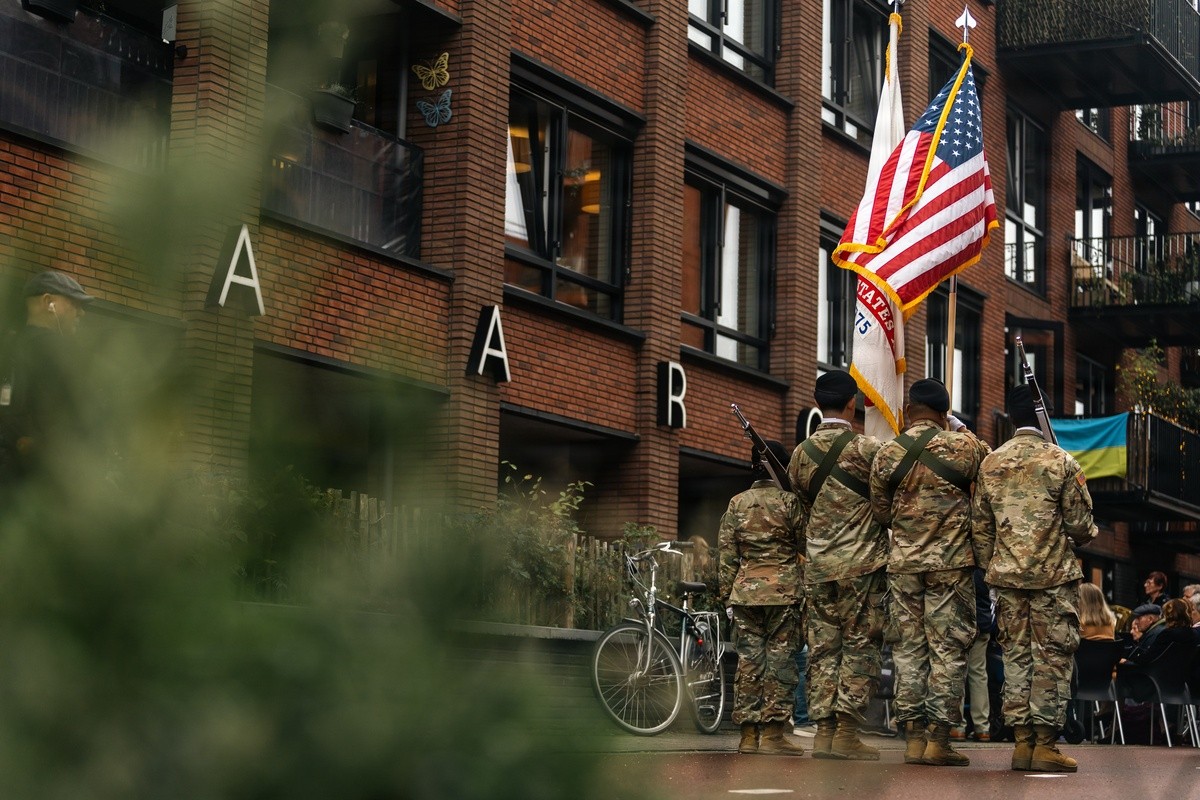

NIJMEGEN, Netherlands — More than 80 years after American paratroopers crossed the Waal River under heavy Nazi fire, the name of one of the officers who led them stands tall on a residential building in the city they helped liberate.
In 2022 a residential building in Nijmegen was named after U.S. Army Maj. Julian Aaron Cook, commander of 3rd Battalion, 504th Parachute Infantry Regiment, 82nd Airborne Division, in recognition of his role in the Waal River crossing and the Soldiers who fought alongside him.
However, according to Maj. Cook’s son, James Cook, the name on the building was never meant to honor his father alone.
“When I was here two years ago, I suggested that my father's name on this building was not meant to just give honor to him,” Cook said during the annual commemoration ceremony. “Rather, it was to honor those that he was with that he commanded.”
Those Soldiers were the men of the 3rd Battalion, 504th PIR, along with engineers from Company C, 307th Airborne Engineer Battalion, who crossed the Waal River on Sept. 20, 1944, as part of Operation Market Garden.
For Nijmegen, the crossing still remains tied directly to the liberation of the city to this day.
“We built this a few years ago,” said Jan Van Der Meer, CEO of the local public housing company that operates the building. “It’s near the heroic crossing American soldiers did during the Second World War to conquer the bridge across the Waal river on the north side.”
The building provides apartments for elderly and disabled residents. Out of the thousands of homes operated by the housing company throughout Nijmegen, this one sits on a place where the history of the city and the United States still lives.
“We have 16,000 houses in Nijmegen,” Meer said. “But this one has a lot of history. That’s why we want to commemorate the Soldiers with this building.”
For Cook, remembering his father means remembering the men who followed him.
Maj. Cook took command of the 3rd Battalion after its previous commander, Lt. Col. Freeman, returned to the United States. At the time of his assumption, the men of the unit knew very little about their new commander.
In England, the men had developed another impression of him.
“The men characterized my father as an extreme disciplinarian,” Cook said.
Maj. Cook’s strict approach did little to win the trust of his new Soldiers at first. Cook recalled how his father dealt with Soldiers who left their posts without passes and how he would lecture non-commissioned officers during training.
He also told them that he would not always be upfront with them when it came to how they would fight, saying they needed to be prepared to improvise and change their tactics when they encountered enemy resistance.
“This resulted in them not trusting him,” Cook said. “They took him not being upfront to mean he would be back in the rear, sometimes called a ramp away from the fighting.”
Then they reached the Waal river on September 20th, 1944.
“He disproved that when he was the first man in the first boat to cross the river,” Cook said.
Maj. Cook would remain exposed to enemy fire as the crossing continued.
“He would help boats pull boats ashore,” Cook said. “He would also help give first aid to the men who were wounded. He would also stay in touch with the men who were fighting and going forward to help them coordinate their attacks.”
The men who had questioned their commander’s willingness to fight alongside them saw him doing exactly that.
“He was exposing himself to constant enemy fire,” said Cook. “This action on shore earned their trust and their respect.”
What happened after the battle stayed with Maj Cook.
Cook recalled an account documented by historian Frank van Lunteren, in which Maj. Cook described what happened in the days following the crossing.
“The thing that touched me most, was that for the next couple of days, many of the NCOs came up, shook my hand, and some, with traces of tears in their eyes, saluted me and then walked away,” Maj. Cook had written.
“It was their way of taking back the dirty remarks about him not sticking with them up front in combat,” Cook said. “From that day on, he never had any disciplinary problems with that unit.”
For Cook, that story is part of what the building’s name represents.
“I would suggest that confidence and trust are key essentials to any kind of leadership,” Cook said. “It is a two-way street, not only for the men, but for those who are attempting to lead them.”
That history now exists alongside the everyday life of Nijmegen.
Residents will enter and leave the building, visitors will pass it and neighbors will see the Cook name without necessarily knowing the story behind it.
The building is one of several ways Nijmegen continues to preserve that history. The Waal crossing itself remains part of the city’s landscape, while ceremonies and commemorations continue to bring Dutch and American communities together around the events of 1944.
“For us, it's a very important operation, the crossing, because at that moment, we were liberated by the American soldiers from the Nazi occupier,” Meer said. “It's a very important place in our history.”
“It's all about liberty and freedom,” Meer said, “and we have to conquer this every day because it's not guaranteed. And to do that, we have to commemorate the past.”
The relationship between the Netherlands and the United States did not end when the fighting ended.
The building’s name gives that relationship a physical place in the community.
“That is why I suggest that the tribute for this building is not just for Dad, but it's for them,” Cook said.
The name on the building belongs to one officer, but the history it carries belongs to the Soldiers who crossed the Waal river, the people of Nijmegen who were liberated, and the generations that have continued to remember what happened there.
Social Sharing