1 / 10
Walter Hamers, Friendship Albany Nijmegen public relations, Anja Adriaans, founder and chair of FAN, Dr. Bertine Lahuis, Chair of Radboud University Medical Center Executive Board, and Chloe Gavin, daughter of U.S. Army Maj. Gen. James M. Gavin (left to right) pose together at the commemoration ceremony at Radboud University Medical Center in Nijmegen, Netherlands, Sept. 18, 2026. The commemoration celebrated the sister city connection between Albany and Nijmegen and recognized the post-war aid Maj. Gen. James M. Gavin provided to the city of Nijmegen. As the United States marks 250 years of independence, Operation Market Garden commemorations offer a living example of the long relationship between Americans and the Dutch. From Dutch trade and support during the American Revolution, symbolized by the First Salute at St. Eustatius in 1776, to American and Allied forces fighting together in the Netherlands in 1944, that history continues today through communities that preserve the memory of those who served and through an enduring U.S.-Dutch partnership. (U.S. Army photo by Sarah Ridenour)
(Photo Credit: Sarah Ridenour)View original2 / 10
Anja Adriaans, founder and chairlady of Friendship Albany Nijmegen, gives a presentation about U.S. Army Maj. Gen. James M. Gavin during the commemoration at Radboud University Medical Center in Nijmegen, Netherlands, Sept. 18, 2026. The commemoration celebrated the sister city connection between Albany and Nijmegen and recognized the post-war aid Maj. Gen. James M. Gavin provided to the city of Nijmegen. As the United States marks 250 years of independence, Operation Market Garden commemorations offer a living example of the long relationship between Americans and the Dutch. From Dutch trade and support during the American Revolution, symbolized by the First Salute at St. Eustatius in 1776, to American and Allied forces fighting together in the Netherlands in 1944, that history continues today through communities that preserve the memory of those who served and through an enduring U.S.-Dutch partnership. (U.S. Army photo by Sarah Ridenour)
(Photo Credit: Sarah Ridenour)View original3 / 10
Anja Adriaans, founder and chairlady of Friendship Albany Nijmegen, introduces Rebecca Hanna, daughter of retired U.S. Army Capt. Roy Merrill Hanna Jr., to Charlotte Brand, alderman of Nijmegen during the commemoration at Radboud University Medical Center in Nijmegen, Netherlands, Sept. 18, 2026. The commemoration celebrated the sister city connection between Albany and Nijmegen and recognized the post-war aid Maj. Gen. James M. Gavin provided to the city of Nijmegen. As the United States marks 250 years of independence, Operation Market Garden commemorations offer a living example of the long relationship between Americans and the Dutch. From Dutch trade and support during the American Revolution, symbolized by the First Salute at St. Eustatius in 1776, to American and Allied forces fighting together in the Netherlands in 1944, that history continues today through communities that preserve the memory of those who served and through an enduring U.S.-Dutch partnership. (U.S. Army photo by Sarah Ridenour)
(Photo Credit: Sarah Ridenour)View original4 / 10
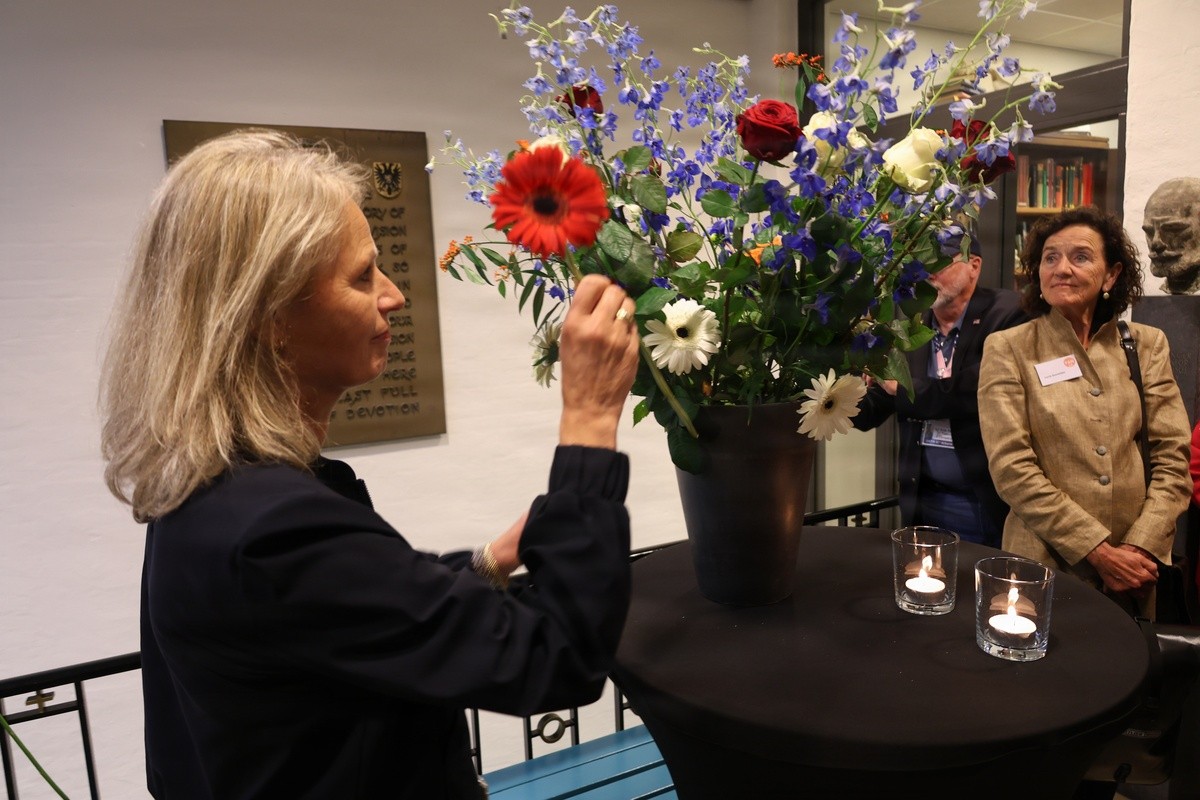
Bertine Lahuis, chair of the Executive Board of Radboud University Medical Center, places a flower into a memorial arrangement honoring the U.S. Army’s 82nd Airborne Division during the commemoration at Radboud University Medical Center in Nijmegen, Netherlands, Sept. 18, 2026. The commemoration celebrated the sister city connection between Albany and Nijmegen and recognized the post-war aid Maj. Gen. James M. Gavin provided to the city of Nijmegen. As the United States marks 250 years of independence, Operation Market Garden commemorations offer a living example of the long relationship between Americans and the Dutch. From Dutch trade and support during the American Revolution, symbolized by the First Salute at St. Eustatius in 1776, to American and Allied forces fighting together in the Netherlands in 1944, that history continues today through communities that preserve the memory of those who served and through an enduring U.S.-Dutch partnership. (U.S. Army photo by Sgt. Griffin Payne)
(Photo Credit: Sgt. Griffin Payne)View original5 / 10
Participants carry flowers toward Radboud University Medical Center during the commemoration in Nijmegen, Netherlands, Sept. 18, 2026. The commemoration celebrated the sister city connection between Albany and Nijmegen and recognized the post-war aid Maj. Gen. James M. Gavin provided to the city of Nijmegen. As the United States marks 250 years of independence, Operation Market Garden commemorations offer a living example of the long relationship between Americans and the Dutch. From Dutch trade and support during the American Revolution, symbolized by the First Salute at St. Eustatius in 1776, to American and Allied forces fighting together in the Netherlands in 1944, that history continues today through communities that preserve the memory of those who served and through an enduring U.S.-Dutch partnership. (U.S. Army photo by Sgt. Griffin)
(Photo Credit: Sgt. Griffin Payne)View original6 / 10
Chloe Gavin, left, and Charlotte Brand, alderman of the city of Nijmegen, carry flowers through Radboud University Medical Center during the commemoration honoring the U.S. Army’s 82nd Airborne Division in Nijmegen, Netherlands, Sept. 18, 2026. The commemoration celebrated the sister city connection between Albany and Nijmegen and recognized the post-war aid Maj. Gen. James M. Gavin provided to the city of Nijmegen. As the United States marks 250 years of independence, Operation Market Garden commemorations offer a living example of the long relationship between Americans and the Dutch. From Dutch trade and support during the American Revolution, symbolized by the First Salute at St. Eustatius in 1776, to American and Allied forces fighting together in the Netherlands in 1944, that history continues today through communities that preserve the memory of those who served and through an enduring U.S.-Dutch partnership. (U.S. Army photo by Sgt. Griffin Payne)
(Photo Credit: Sgt. Griffin Payne)View original7 / 10
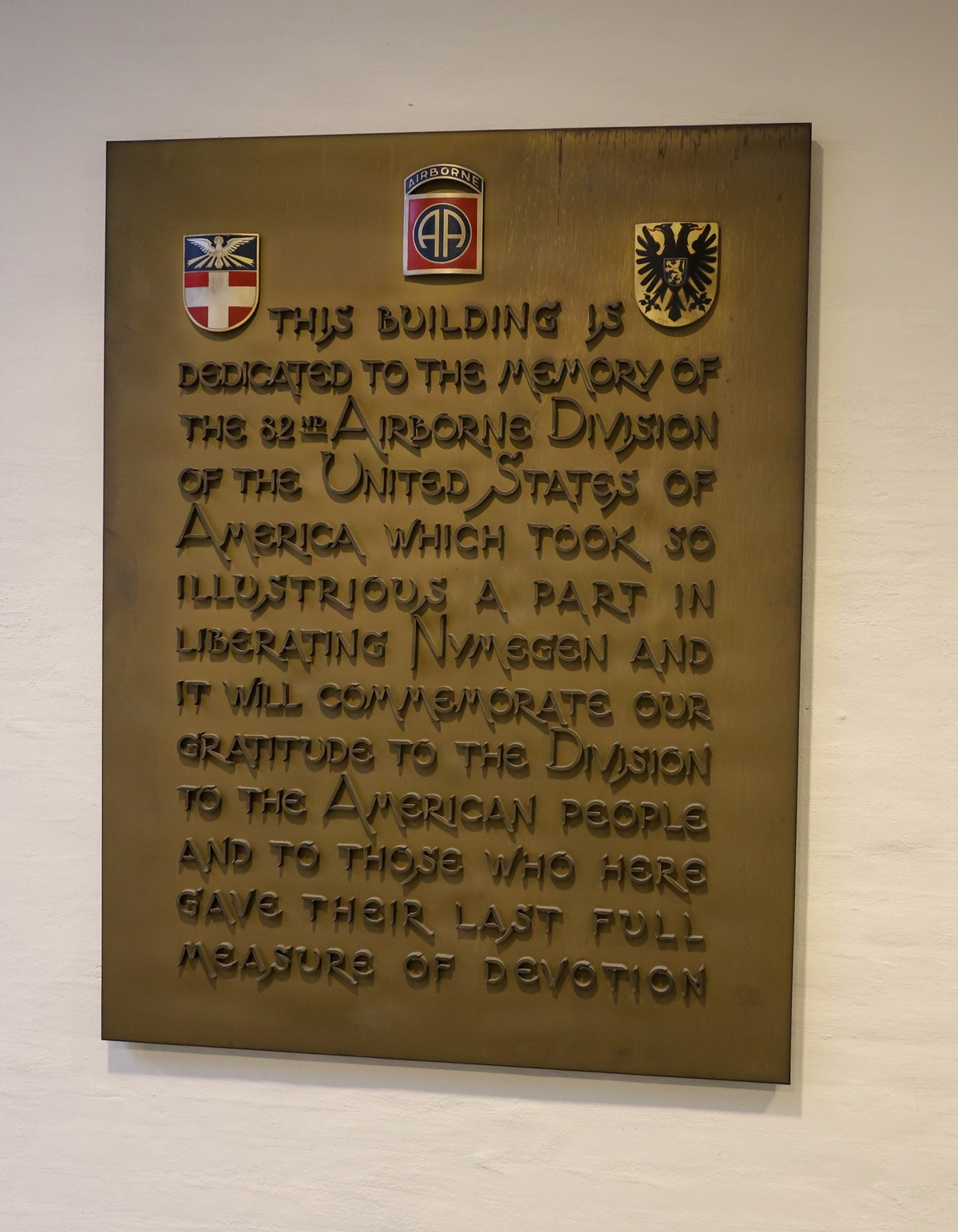
A memorial plaque inside Radboud University Medical Center honors the U.S. Army’s 82nd Airborne Division for its role in the liberation of Nijmegen and commemorates the division, the American people and those who gave their lives during World War II in Nijmegen, Netherlands, Sept. 18, 2026. The commemoration celebrated the sister city connection between Albany and Nijmegen and recognized the post-war aid Maj. Gen. James M. Gavin provided to the city of Nijmegen. As the United States marks 250 years of independence, Operation Market Garden commemorations offer a living example of the long relationship between Americans and the Dutch. From Dutch trade and support during the American Revolution, symbolized by the First Salute at St. Eustatius in 1776, to American and Allied forces fighting together in the Netherlands in 1944, that history continues today through communities that preserve the memory of those who served and through an enduring U.S.-Dutch partnership. (U.S. Army photo by Sgt. Griffin Payne)
(Photo Credit: Sgt. Griffin Payne)View original8 / 10
U.S. Army Capt. Daniel Robert Shaw, a logistics officer assigned to the 21st Theater Sustainment Command, delivers remarks during the commemoration honoring the U.S. Army’s 82nd Airborne Division at Radboud University Medical Center in Nijmegen, Netherlands, Sept. 18, 2026. The commemoration celebrated the sister city connection between Albany and Nijmegen and recognized the post-war aid Maj. Gen. James M. Gavin provided to the city of Nijmegen. As the United States marks 250 years of independence, Operation Market Garden commemorations offer a living example of the long relationship between Americans and the Dutch. From Dutch trade and support during the American Revolution, symbolized by the First Salute at St. Eustatius in 1776, to American and Allied forces fighting together in the Netherlands in 1944, that history continues today through communities that preserve the memory of those who served and through an enduring U.S.-Dutch partnership. (U.S. Army photo by Sgt. Griffin Payne)
(Photo Credit: Sgt. Griffin Payne)View original9 / 10
Attendees of the commemoration ceremony at Radboud University Medical Center have a moment of silence near the memorial plaque inside Radboud University Medical Center, honoring the U.S. Army’s 82nd Airborne Division for its role in the liberation of Nijmegen and commemorating the division, the American people, and those who gave their lives during World War II in Nijmegen, Netherlands, Sept. 18, 2026. The commemoration celebrated the sister city connection between Albany and Nijmegen and recognized the post-war aid Maj. Gen. James M. Gavin provided to the city of Nijmegen. As the United States marks 250 years of independence, Operation Market Garden commemorations offer a living example of the long relationship between Americans and the Dutch. From Dutch trade and support during the American Revolution, symbolized by the First Salute at St. Eustatius in 1776, to American and Allied forces fighting together in the Netherlands in 1944, that history continues today through communities that preserve the memory of those who served and through an enduring U.S.-Dutch partnership. (U.S. Army photo by Sarah Ridenour)
(Photo Credit: Sarah Ridenour)View original10 / 10
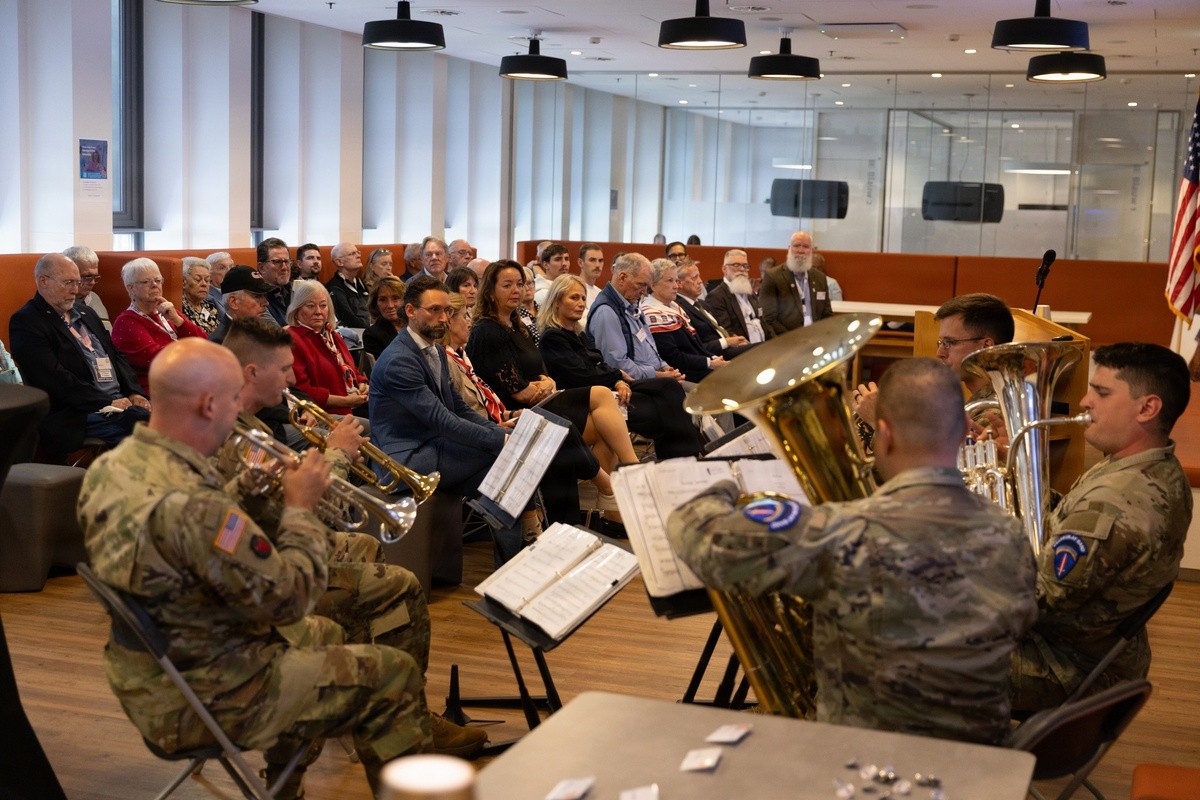
Attendees of the commemoration at Radboud University Medical Center watch as U.S. Army Soldiers assigned to the U.S. Army Europe and Africa Band perform in Nijmegen, Netherlands, Sept. 18, 2026. The commemoration celebrated the sister city connection between Albany and Nijmegen and recognized the post-war aid Maj. Gen. James M. Gavin provided to the city of Nijmegen. As the United States marks 250 years of independence, Operation Market Garden commemorations offer a living example of the long relationship between Americans and the Dutch. From Dutch trade and support during the American Revolution, symbolized by the First Salute at St. Eustatius in 1776, to American and Allied forces fighting together in the Netherlands in 1944, that history continues today through communities that preserve the memory of those who served and through an enduring U.S.-Dutch partnership. (U.S. Army photo by Sarah Ridenour)
(Photo Credit: Sarah Ridenour)View original
NIJMEGEN, Netherlands — U.S. Army Maj. Gen. James M. Gavin arrived near Nijmegen in September 1944 commanding the 82nd Airborne Division during Operation Market Garden. After the fighting ended, he continued his relationship with the Dutch city and helped turn a connection forged during war into one centered on reconstruction, education and friendship.
Allied forces launched Operation Market Garden Sept. 17, 1944, to secure critical bridges and terrain through the Netherlands. Gavin’s 82nd Airborne Division operated around Nijmegen and Groesbeek. On Sept. 20, paratroopers of the 504th Parachute Infantry Regiment crossed the Waal River with support from airborne engineers as Allied forces fought to capture Nijmegen’s bridges.
For Anja Adriaans, founder and chair of Friendship Albany Nijmegen, Gavin’s contribution to the city did not end with liberation. “General Gavin did two amazing things for the city of Nijmegen,” Adriaans said. “They liberated the city, and then they felt, well, we need to help. We want to help.”
Gavin returned to Nijmegen after the war and saw that liberation had only started the city’s long recovery. “Gavin came back in ’46 and ’47 after the liberation of our city, Nijmegen, and he said, ‘This city needs help,’” said Walter Hamers, Adriaans’ husband and an adviser to the FAN board.
Gavin looked across the Atlantic for help and found a natural connection in Albany, New York. Dutch settlers established Fort Orange in 1624 near what later became Albany, and that Dutch heritage gave Gavin a connection between the American city and Nijmegen. Residents throughout Albany joined the effort. Schools, churches, Scouts and civic organizations collected clothing, supplies and building materials for Nijmegen.
In 1947, Albany residents sent approximately 300 tons of aid to Nijmegen. The relief effort strengthened a connection between the cities that continues today. “That started a sister city connection,” Adriaans said.
Charlotte Brand, alderman of Nijmegen, said the people of Nijmegen faced another challenge after they gained their freedom. “Winning a war is one thing. Building peace is another,” Brand said. “Liberation can happen in a day. Reconstruction takes decades. And rebuilding a society takes even longer.”
Catholic University Nijmegen, now Radboud University, stood at the center of that reconstruction. The university opened in 1923 and endured years of occupation and war. In 1943, Rector Magnificus Bernard Hermesdorf refused to present students with a declaration of loyalty demanded by the German occupying authorities, and university leaders closed the institution rather than comply.
After the war, university leaders began rebuilding. Gavin supported that effort while he also helped connect Nijmegen with Albany. In 1946, supporters created the American Committee to Aid the University of Nijmegen to raise money and assistance for the university’s reconstruction, and historical records list Gavin among its members.
“After the war, he remained committed to Nijmegen,” Brand said. “He helped bring American support to our city, support that included food, clothing and building materials, but also support for the university and the rebuilding of our community.”
Adriaans said Gavin considered education an important part of Nijmegen’s recovery. “They wanted to help the University of Nijmegen to restore, and that is why General Gavin stepped in a committee to aid the Catholic University of Nijmegen,” Adriaans said.
Gavin also valued education for personal reasons. His daughter, Chloe Gavin, said her father’s own experiences shaped his desire to give other people opportunities to learn.
American veterans supported that goal. Money raised by American veterans contributed to the construction of the university’s medical faculty building, and supporters in the United States sent approximately 30,000 books to replenish the university library.
“One powerful example of that reconstruction is what is now Radboud University Medical Center,” Brand said. “It was building a future: a place for healthcare, education, and research, where new generations could learn, heal, and contribute to society.”
In 2026, Radboud University Medical Center marks 75 years of medical education and 70 years of academic hospital care. Bertine Lahuis, chair of the Executive Board of Radboud University Medical Center, connected those milestones to the opportunities that followed liberation. “The liberation created the conditions for rebuilding, for growth, and for investing in knowledge, healthcare and education,” Lahuis said.
Lahuis said the medical center provides a lasting example of what grew from that postwar cooperation. “After the liberation, the seeds were planted for a lasting friendship between Nijmegen and Albany,” Lahuis said. “The people of Albany made an important contribution to the reconstruction of our city, enabling the university to continue to grow and, ultimately, allowing the medical faculty and university hospital of the past to develop into the university medical center we are today.”
For local student Wesley Koster, the legacy of liberation remains visible in the opportunities students have today.
"Because of the liberation, we can study freely. During the war, our future looked dim. We are very thankful to live in freedom and have the opportunity to study," Koster said
A plaque inside Radboudumc commemorates the 82nd Airborne Division and its connection to the university. The memorial links the Soldiers who fought around Nijmegen with the institution that American veterans later helped support.
More than eight decades after Gavin arrived near Nijmegen as a Soldier, his connection to the city reaches far beyond the battlefield. Americans and Dutch citizens continue crossing the Atlantic, students continue learning from their shared history, and Radboud University Medical Center continues educating, researching and caring for patients.
Liberation brought Americans and the people of Nijmegen together. What they built afterward gave that relationship a future.
This article is informational only, and mention of non-governmental organizations does not imply endorsement by the Department of the Army, Department of War, or federal government.






Social Sharing