1 / 2
U.S. Army Lt. Gen. Matthew W. McFarlane, commanding general of I Corps, left, Japan Ground Self-Defense Force Lt. Gen. Seiji Toriumi, commanding general of Western Army, center left, U.S. Marine Corps Lt. Gen. Benjamin T. Watson, commanding general of III Marine Expeditionary Force, center right, and JGSDF Gen. Masayoshi Arai, Chief of Staff for the JGSDF, observe bilateral operational capabilities during Exercise Yama Sakura 91 at JGSDF Camp Kengun, Kumamoto, Japan, Sept. 6, 2026. As a part of U.S. Army Pacific Operation Pathways, Yama Sakura 91 is the largest and most complex forward U.S. Army, Marine Corps. Australian and Japan Command Post exercise to date. Participants from the Japan Ground Self-Defense Force train together with Soldiers of the U.S. Army I Corps, 11th Airborne Division, III Marine Expeditionary Force, U.S. Army Japan, U.S. Army Reserve and Army National Guard in a Joint environment. The goal of the exercise is to strengthen multi-domain and cross-domain interoperability and readiness between the U.S.-Japan alliance to ensure a free and open Indo-Pacific. (U.S. Marine Corps photo by Staff Sgt. Jackson Ricker) (This photo has been altered for security purposes.)
(Photo Credit: Staff Sgt. Jackson Ricker)View original2 / 2
U.S., Australian, and Japan Ground Self Defense Force service members have a group discussion, Camp Kengun, Japan, Dec. 5, 2024. Service members from the U.S., Australia, and JGSDF participate in a trilateral Non-Commissioned Officer meet and greet as part of a cultural exchange during YamaSakura 87. These engagements underscore the shared commitment to fostering goodwill, enhancing cultural understanding, and increase civil support for the trilateral forces participating in Yama Sakura 87. (U.S. Marine Corps photo by Lance Cpl. Giovanni Navarrette)
(Photo Credit: Lance Cpl. Giovanni Navarrette)View original
CAMP ASAKA, Japan – Yama Sakura 91 concluded Sept. 10, 2026, at Camp Asaka as three nations completed the annual trilateral command post exercise. The United States, Japan and Australia spent the last two weeks working shoulder-to-shoulder to increase interoperability across the forces to maintain the security of the Pacific region.
Yama Sakura 91 included participants from U.S. Army Pacific, U.S. Army Japan, I Corps, 11th Airborne Division, 593rd Corps Sustainment Command, III Marine Expeditionary Force, Japan Ground Self Defense Force’s Ground Component Command, Training Evaluation Research and Development Command, Northern Army and Western Army, as well as the 1st (Australian) Division.
“This iteration of Yama Sakura marks a historic milestone. It has brought together Japanese, Australian, and U.S. Service Members, and we have demonstrated the strength of our trilateral alliance in a very real way,” said U.S. Army Lt. Gen. Matthew McFarlane, commanding general of I Corps. “This deep collaboration reflects our growing commitment to regional stability and our collective resolve to face emerging challenges. We stand stronger together.”
1 / 2
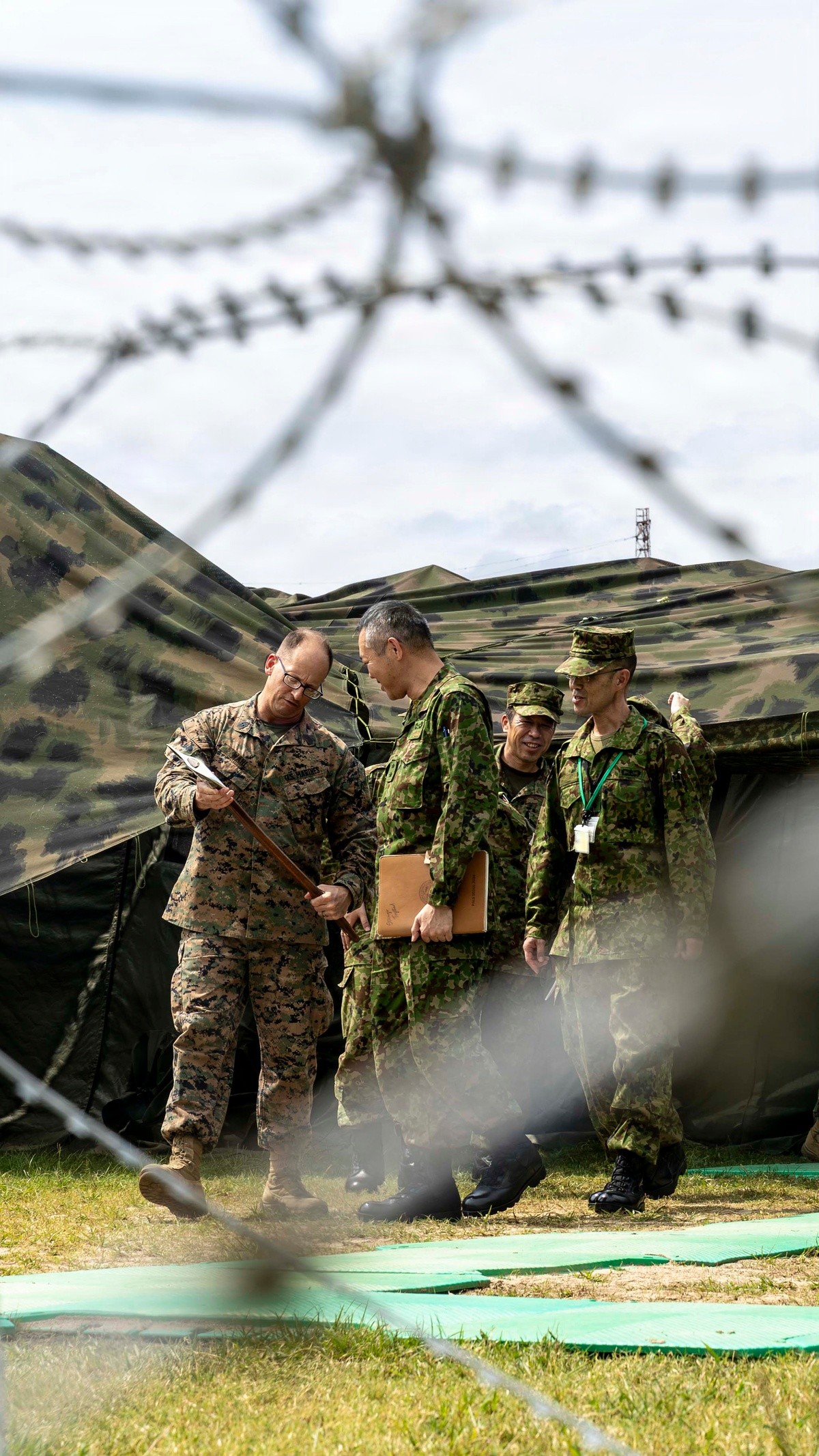
U.S. Marine Corps Master Gunnery Sgt. Shaun Wahl, the operations chief with 3rd Marine Expeditionary Brigade, left, shows a personal memento to Japan Ground Self-Defense Force Maj. Gen. Hajime Kitajima, chief of staff Western Army Headquarters, at the III Marine Expeditionary Force forward command and control tent during Exercise Yama Sakura 91 at JGSDF Camp Kengun, Kumamoto, Japan, Sept. 7, 2026. As a part of U.S. Army Pacific Operation Pathways, Yama Sakura 91 is the largest and most complex forward U.S. Army, Marine Corps, Australian and Japan Command Post exercise to date. Participants from the Japan Ground Self-Defense Force train together with Soldiers of the U.S. Army I Corps, 11th Airborne Division, III Marine Expeditionary Force, U.S. Army Japan, U.S. Army Reserve and Army National Guard in a Joint environment. The goal of the exercise is to strengthen multi-domain and cross-domain interoperability and readiness between the U.S.-Japan alliance to ensure a free and open Indo-Pacific. Wahl is a native of South Carolina. (U.S. Marine Corps photo by Staff Sgt. Jackson Ricker) (This photo has been altered for security purposes.)
(Photo Credit: Staff Sgt. Jackson Ricker)View original2 / 2
U.S. Marine Corps Maj. Jovanie Martinez, a senior watch officer with III Marine Expeditionary Force, shakes hands with Lt. Gen. Benjamin T. Watson, commanding general of III MEF, during Exercise Yama Sakura 91 at Japan Ground Self-Defense Force Camp Kengun, Kumamoto, Japan, Sept. 6, 2026. As a part of U.S. Army Pacific Operation Pathways, Yama Sakura 91 is the largest and most complex forward U.S. Army, Marine Corps. Australian and Japan Command Post exercise to date. Participants from the Japan Ground Self-Defense Force train together with Soldiers of the U.S. Army I Corps, 11th Airborne Division, III Marine Expeditionary Force, U.S. Army Japan, U.S. Army Reserve and Army National Guard in a Joint environment. The goal of the exercise is to strengthen multi-domain and cross-domain interoperability and readiness between the U.S.-Japan alliance to ensure a free and open Indo-Pacific. Martinez is a native of Florida. (U.S. Marine Corps photo by Staff Sgt. Jackson Ricker)
(Photo Credit: Staff Sgt. Jackson Ricker)View original
Yama Sakura 91, held Sept. 2-10, took place across Japan, from the Island of Okinawa to military bases around Tokyo, Hokkaido, Kumamoto and even included participants working at Joint Base Lewis-McCord, Washington.
The main objective of the 46th iteration of Yama Sakura was to enhance American, Australian and Japanese combat readiness and cohesiveness while strengthening trilateral and joint relationships, while demonstrating a shared resolve to support the security interests of allies and partners in the Pacific region.
“This is crucial in driving progress in our interoperability efforts: human, procedural and technical,” said McFarlane. “Yama Sakura allows us to get a large-scale training repetition and build trust across our people, members of the multinational force. It allows us to integrate systems that help us all see, sense and defeat threats as a joint or multinational force.”
As the largest Yama Sakura to date, more than 6,000 personnel from the three countries participated in the command post exercise, training to better understand each other’s tactics and procedures in the defense of Japan.
1 / 2
U.S. Army Lt. Col. Jennie Brown, 11th Airborne Division surgeon, conducts medical planning during Exercise Yama Sakura 91 at Camp Higashi-Chitose, Japan, Sept. 9, 2026. Brown supports medical readiness, casualty care planning and coordination designed to ensure U.S., Japanese and Australian forces can effectively integrate medical support during combined operations.
(Photo Credit: Courtesy)View original2 / 2
CAMP ASAKA, JAPAN - Japan Ground Self Defense Force Soldiers salute the Australian, Japanese and U.S. flags during a flag raising ceremony for Exercise Yama Sakura 91 at Camp Asaka, Japan, Sept. 3, 2026. YS 91 is an annual multilateral CPX hosted by JGSDF and conducted in multiple locations throughout Japan. YS 91 is designed to enhance U.S., Japan and multinational partner combat readiness and interoperability while strengthening multinational relationships and demonstrating U.S. resolve to support the security interests of friends and allies in the region. (U.S. Navy photo by Mass Communication Specialist 2nd Class Christian Kibler)
(Photo Credit: Petty Officer 2nd Class Christian Kibler)View original
“We worked to solidify joint coordination procedures that leverage the respective capabilities of the three nations,” said JGSDF Lt. Gen. Makoto Endo, commanding general of Japanese GCC. “This effort covered areas such as anti-landing operations, including targeting, sustainment, and joint counterattacks, and the protection of the civilian population. Through this process, we were able to deepen coordination procedures aligning the JGSDF’s Cross-Domain Operations, the U.S. Army’s Multi-Domain Operations and the U.S. Marine Corps’ Expeditionary Advanced Base Operations.”
Since its inception in 1982, Yama Sakura has served as a vital platform for the U.S. and Japan to enhance their trilateral planning, coordination, and interoperability. With Australia participating for 5 years now, the exercise has evolved into a crucial trilateral forum, reinforcing a shared commitment to maintaining peace and stability in the Indo-Pacific region. Through Yama Sakura 91, I Corps along with III Marine Expeditionary Force reinforced their dedication to building combat-credible partnerships, vital for deterring aggression and promoting stability alongside allies.
1 / 2
CAMP ASAKA, JAPAN - Japan Ground Self Defense Force Soldiers raise the Australian flag during a flag raising ceremony for Exercise Yama Sakura 91 at Camp Asaka, Japan, Sept. 3, 2026. YS 91 is an annual multilateral CPX hosted by JGSDF and conducted in multiple locations throughout Japan. YS 91 is designed to enhance U.S., Japan and multinational partner combat readiness and interoperability while strengthening multinational relationships and demonstrating U.S. resolve to support the security interests of friends and allies in the region. (U.S. Navy photo by Mass Communication Specialist 2nd Class Christian Kibler)
(Photo Credit: Petty Officer 2nd Class Christian Kibler)View original2 / 2
U.S. Army Lt. Gen. Matthew W. McFarlane visits Yama Sukara 91 exercise at camp Higasi-Chitose, Sept 8, 2026. Yama Sakura is a trilateral exercise between the U.S. Army Pacific, Japan Ground Self-Defense Force and Australian Army to build communication, coordination and plans to improve combat readiness. (U.S. Army National Guard Photo by Sherald McAulay)
(Photo Credit: Sgt. Sherald McAulay)View original
“On behalf of America’s First Corps, I offer my deepest gratitude to every participant who contributed to making Yama Sakura 91 an extraordinary success,” said McFarlane. “This exercise has been far more than a multinational training opportunity. It has been an integrated rehearsal that has allowed us to enhance our operational capabilities. It is a powerful testament to our enduring partnership, alliance, and friendship.”
The closing ceremony included a coin presentation to service members for their exemplary work and an exchange of mementos between leaders that signified a stronger bond and forces more capable and ready than ever before.
“We promoted mutual understanding and, I believe, succeeded in building even stronger bonds of trust,” Endo said in his concluding remarks.




Social Sharing