


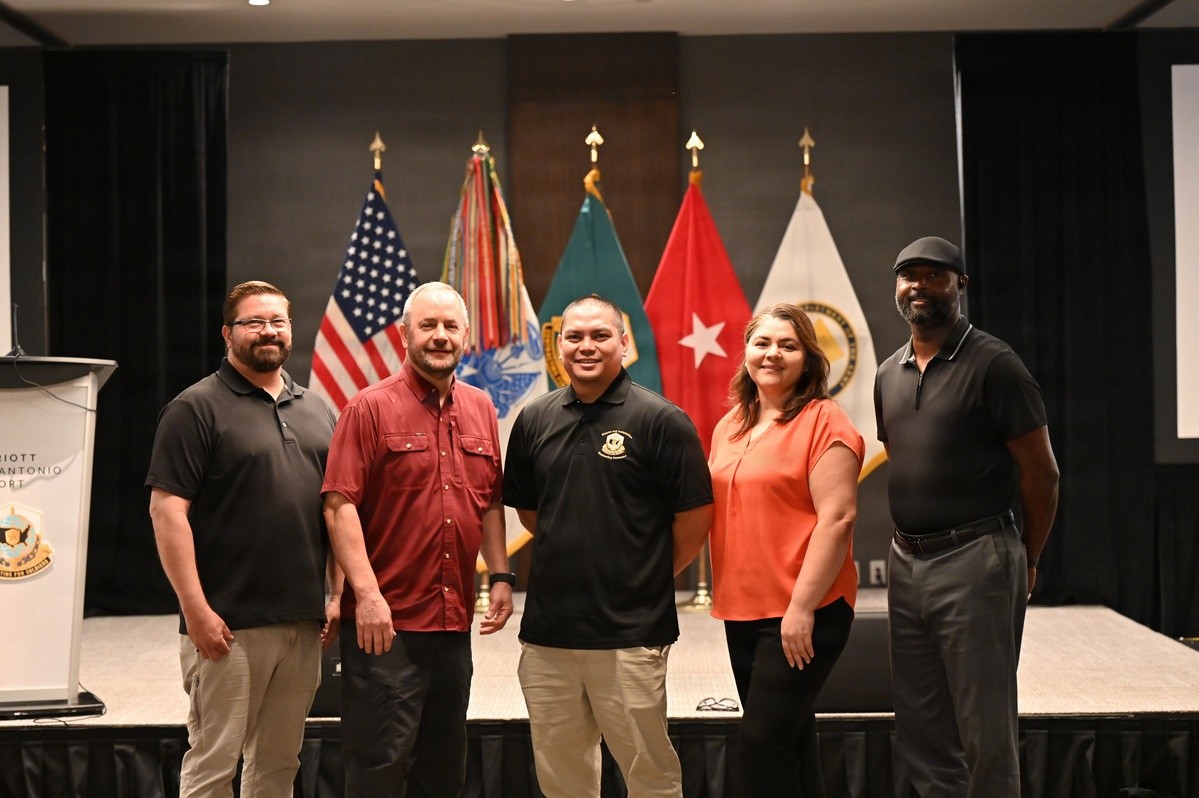
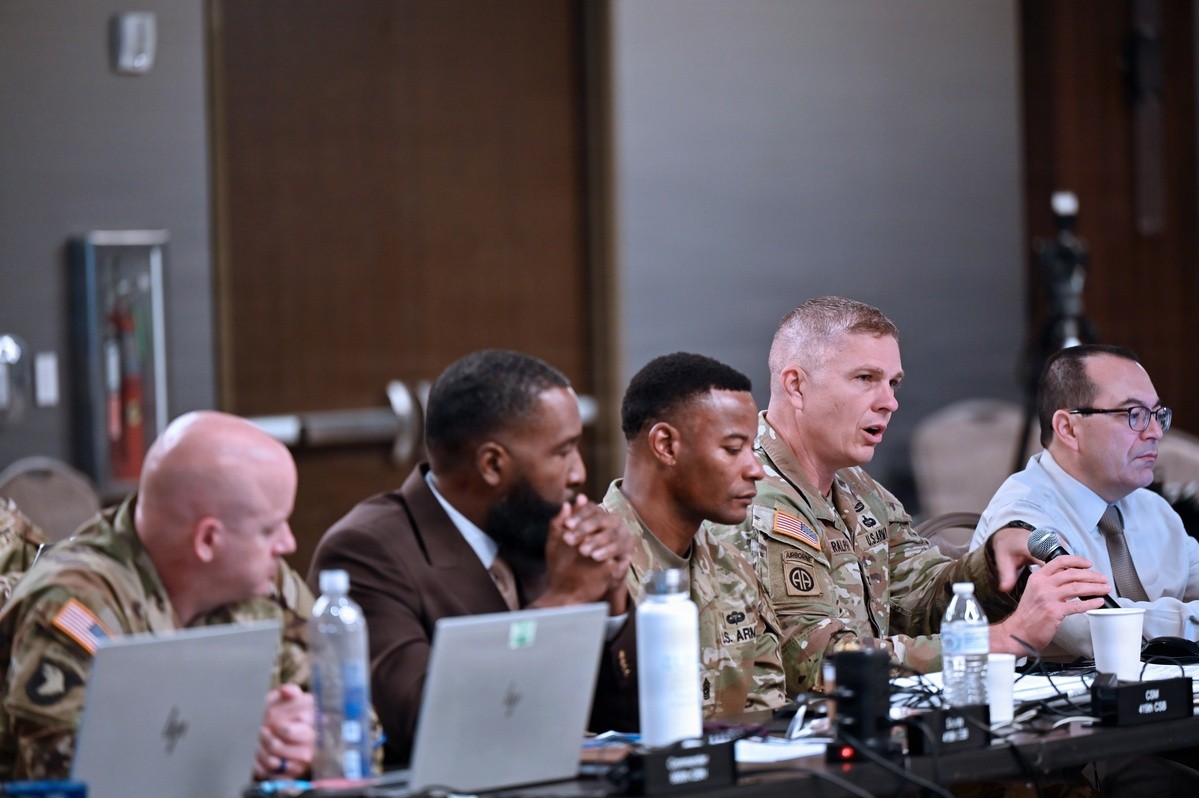


JOINT BASE SAN ANTONIO, FORT SAM HOUSTON, Texas — Senior contracting leaders from across the Mission and Installation Contracting Command (MICC) gathered in San Antonio, Texas, Aug. 25-28 to share operational lessons that strengthen Army readiness and examine how the command will adapt and thrive as the Army transforms.
The fiscal year 2026 Senior Contracting Officials and Directors Acquisition Training (SDAT) was hosted by the MICC Command Group, Brig. Gen. Freddy Adams, Clay Cole and Command Sgt. Maj. JennyAnne Bright. The event brought together nearly 80 primary staff, contracting support brigade (CSB), field directorate office (FDO) and battalion leaders under the theme, “Contracting at the Edge: Leading Change in a Time of Transformation.”
The event marked the first time since 2024 that MICC leaders down to the battalion level gathered in person for the annual training. Budget and transformation complications resulted in an abbreviated event in 2025 with attendance limited to CSB and FDO leaders. The abbreviated event set the groundwork for this full SDAT.
Adams opened the first day of this year’s training by challenging leaders from the MICC’s three CSB’s, two FDOs, nine battalions and 34 MICC offices to examine how the contracting enterprise must adapt to support an Army preparing to operate in increasingly complex environments.
“We are at a very interesting inflection point,” Adams said. “We are moving away from an environment that is structured and predictable, and our Army is moving into a time where we have to operate in multi-domains and contested environments. [The environment] is causing our Army to change and we have to change along with it. We have to change the way we operate, we have to change the way we organize and we have to change the way we execute.”
The commanding general asked leaders to ground discussions and any insights from training throughout the week in the recently launched 2026-2027 MICC Campaign Plan and the command’s stated priorities of Forging Elite Talent, Delivering Contracting Solutions at the Speed of Relevance and Innovating to Dominate.
“It is not often that we get all of the leaders of the brain trust together in one location,” Adams said. “I ask you to look around at the leaders here in this room, they are really the vanguard of our Army’s acquisition enterprise; you are the touchpoints. You are the point where our Soldiers’ needs are first communicated, and you are the ones who enable them to have the tools that they need to fight, survive and win in this operational environment.”
Bright, as the MICC command sergeant major and senior enlisted advisor to the commanding general, encouraged leaders to connect what they learned throughout the week to the campaign plan while sharing practices that could benefit the broader enterprise.
“I know these four days are going to be fast and furious,” Bright said, “but take the time to share your best practices, the things that you all are doing in your areas of responsibility, to share those best practices so we can use them as well.”
Bright also provided a detailed brief on the development, first iteration and way ahead for the MICC Launch Program, a professional development initiative recently conducted in a hybrid environment for 32 of the command’s newest 51C contracting noncommissioned officers.
While the command team’s opening remarks established the desired strategic framework for the SDAT, the contracting support brigade leaders and staff set the right tone as they shared best practices they have seen in their formations. Most of day one included detailed briefs from the 410th CSB, 418th CSB and 419th CSB on their lessons learned and best practices in fiscal year 2026 and upcoming transformation initiatives planned in fiscal year 2027.
The second day shifted from the command’s strategic framework to its people, organizational readiness and the operational demands facing contracting formations. MICC staff representatives addressed manning, organizational structure, staffing and administrative considerations associated with transformation, including workforce flexibilities, performance standards, staffing management and the legal framework for workforce accountability.
Working lunch sessions hosted separately by Adams, Cole and Bright provided additional opportunities for direct engagement between senior leaders and participants. Cole emphasized the value of bringing the geographically dispersed command together and developing professional relationships that extend beyond the annual training.
“This is an excellent time for you guys to socialize and get to know one another and make good contacts,” Cole said. “Don’t be afraid to call your peers. All of you have experiences and expertise in certain areas that somebody else may need to tap into, and sometimes it just helps to call someone.”
Following the working sessions, Cole served as the senior member of a panel discussion hosted by Col. Randy Garcia, MICC chief of staff. Centered on developing the modern contracting professional beyond compliance and into the role of strategic business adviser, other panelists Col. Douglas Ralph, 419th CSB commander and Latosha McCoy, director of the MICC FDO-Fort Eustis. Cole told attendees that he has already seen a lot of positive changes headed in the right direction towards the command’s vision of being the Army’s unrivaled contracting arsenal.
“I do appreciate what you have done, what you continue to do, and what you will continue to do in the future,” Cole said. “This command will grow, it will be better—and it will be better because of you.”
The remainder of the day moved the discussion closer to the operational edge, as the theme suggested. Ralph and other leaders from the 419th Contracting Support Brigade discussed contracting in contested environments, including operations supporting U.S. Central Command, U.S. European Command and U.S. Special Operations Command. The 418th Contracting Support Brigade, led by Col. Kizzy Danser, addressed large-scale mobilization operations, mobilization force generation installations, relief-in-place practices designed to sustain mission momentum and lessons learned from Ukraine related to rapid procurement.
On the third day, technology and innovative acquisition approaches took center stage. Gino Magnifico, Army Contracting Command chief information officer, led a half-day session featuring information and demonstrations on artificial intelligence capabilities currently available or under development for contracting professionals. The discussion also reinforced a broader message from command leaders that innovation extends beyond artificial intelligence and can include processes, practices and locally developed solutions with potential application across the MICC enterprise.
The afternoon shifted from emerging technology to acquisition authorities and contracting solutions. The MICC Contracting Operations (CONOPS) Directorate, led by Terry Lazenby, provided updates on Other Transaction Authorities (OTAs), associated regulatory requirements and ways contracting professionals can put OTAs into action to meet operational requirements.
The CONOPS team used recent MICC accomplishments to illustrate practical innovation applications, including Fort Polk Rotational Unit Billeting Area (RUBA), Barracks Resilience through Industrialized Construction (BRIC) at Joint Base Myer-Henderson Hall, several renovation projects in support of campus-style dining, future Soldier housing initiatives including the Rapid Unaccompanied Soldier Housing (RUSH) Program and Facilities, Operations, Readiness, Growth and Experience (FORGE) I and II initiatives.
The FDO-Fort Eustis team also led a discussion on how contracting professionals may identify Small Business Innovation Research (SBIR) Phase I and Phase II efforts with potential application to MICC Phase III requirements.
Adams reminded attendees that the changing environment requires contracting leaders to challenge established processes while exploring acquisition approaches that can deliver capabilities more quickly.
“I want us to challenge our current assumptions about how we operate and how we execute, because that’s what our Army demands,” Adams said. “I want to exploit these opportunities because we have to go faster, our Army senior leaders tell us that all the time. But I will tell you this: We are delivering for our Army.”
Led by MICC operations planners, the fourth and final day turned the focus from receiving information to assessing the training during a formal after action review and shaping future iterations of the SDAT. For over an hour, participants identified what worked well over the previous days and recommended improvements for future senior leader training.
Suggestions included providing more structured opportunities for organizations below the brigade and directorate level to share best practices and incorporating scenario-based exercises that would allow leaders to work through operational contracting problem sets before presenting their approaches to senior leaders. There was also a suggestion to balance enterprise-level information sharing from the structured training with more collaborative, hands-on problem-solving activities that give leaders opportunities to apply contracting authorities and capabilities against current, real-world operational requirements that may be difficult to effectively solve in a less collaborative environment.
For Ralph, the opportunity to bring leaders together from each of his battalions was among the event’s most valuable outcomes.
“This is the first opportunity I’ve had to bring all of my leaders together in two years,” Ralph said. “The face-to-face discussions, coordination and professional relationships we build here are invaluable; that is what is most important to me. SDAT gives us a chance to learn from one another and take those lessons back to our formations.”
The event concluded with an awards and recognition ceremony hosted by the MICC command team before Adams reiterated the need to carry the exchange of ideas and lessons learned beyond the four-day event.
“The MICC is an organization that is focused on solving the Army’s problems,” Adams said. “It is due to the collective insight and perspective of the folks here [at the SDAT] that’s going to make us even better.”
Adams, Cole and Bright thanked the staff who planned and conducted the SDAT and the leaders for their active participation, transparency, willingness to have difficult discussions and working hard throughout the week.
“The work doesn’t end here,” Adams said, “so I challenge each of you to go out to your formations to talk about our strategic campaign, our lines of effort and how we’re going to be aligned in delivering those outcomes.”
He reminded attendees that everything they do, including the SDAT, is to ensure the command is the most capable and best equipped to expertly manage the command’s core mission of delivering decisive contracting solutions when and where they are needed most.
“Why we do it is so that our Soldiers, our warfighters have the capability they need to never engage in a fair fight.”
Planning has already begun for the 2027 SDAT. Visit army.mil/micc to learn more about the MICC.
About the MICC
The Mission and Installation Contracting Command is a one-star subordinate command of the Army Contracting Command and the Army Materiel Command. MICC Soldiers, Civilians and contractors take pride in their mission to support Soldiers and their families across the theater of operations by delivering decisive contracting solutions across the theater of operations, equipping America’s Soldiers with what they need to dominate on the battlefield, sustaining readiness at home and pioneering the capabilities for the Army of tomorrow. Headquartered at Joint Base San Antonio-Fort Sam Houston, Texas, the MICC comprises nearly 1,500 Soldiers and Civilian employees assigned across the theater of operations. MICC contracts are vital in feeding more than 260,000 Soldiers every day, providing daily base operations support services at installations, preparing more than 100,000 conventional force members annually, facilitating training for more than 100,000 students each year, and maintaining more than 14.4 million acres of land and 170,000 structures. To learn more about the Mission and Installation Contracting Command, visit the MICC homepage or view the MICC Fact Sheet.
Social Sharing