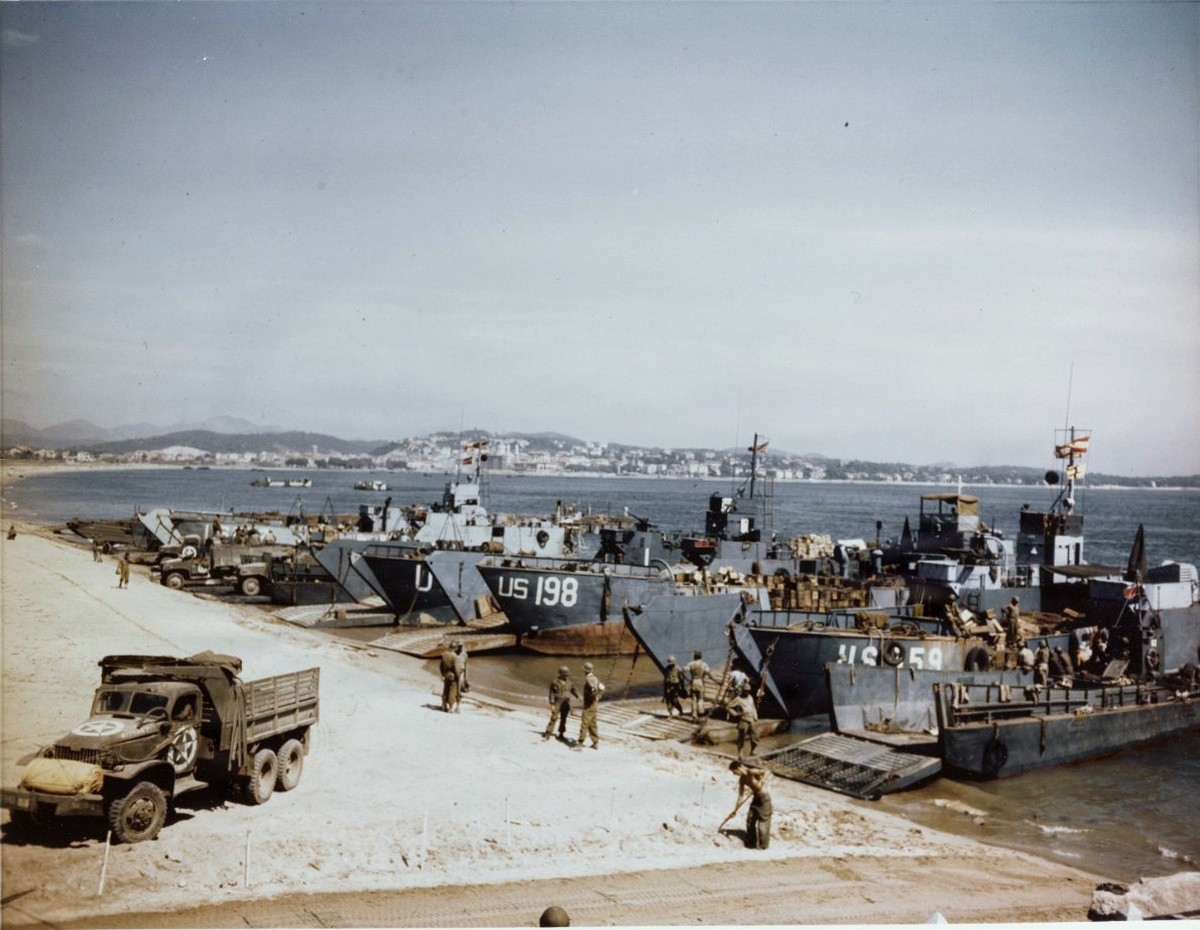

One of the most complex events of World War II, Operation DRAGOON (initially called Operation ANVIL), the Allied invasion of Nazi-occupied Southern France.
Originally planned to coincide with the Normandy landings in June 1944, challenges with gathering sufficient Landing Craft and other critical enablers pushed back the operation until mid-August 1944.
The goal of Operation DRAGOON was to secure the vital ports on the French Mediterranean coast and increase pressure on the German forces by opening another front.
Despite the success of the Normandy landings over two months previously, the Allies were experiencing significant challenges in moving supplies forward thanks to German sabotage of the port of Cherbourg, France, along with damage to the Norman Road and Rail networks.
Beginning Aug. 15, 1944, after some preliminary commando operations by the U.S.-Canadian Special Service Force and French Commandos, the U.S. VI Corps landed on the beaches of the Côte d'Azur under the shield of a large naval task force, followed by several divisions of the French Army.
The seaborne assaults were preceded by an airborne assault by the 1st Airborne Task Force landing in the River Argens valley around the area of Le Muy with the objective of preventing German reinforcements from reaching the landing beaches.
Quickly overwhelming the German opposition, the Allied forces were quickly able to secure the lodgment and push deeper into France and eventually southern Germany.
Though referred to as the ‘Champagne Campaign’ by some historians, the exploits of the Allied forces of Operation DRAGOON are an outstanding example of large, scale Coalition warfare.
Blessed with more advantageous terrain than what was faced by their comrades in the Norman countryside, what would eventually become U.S. 7th Army under Lt. Gen. Alexander Patch, who would play a critical role in the destruction of the German war machine and liberation of Western Europe.
For military planners and sustainment professionals, there are a myriad of relevant lessons that can be drawn both from the planning and execution of the invasion, along with the follow-on campaign into the south of France.For additional information on this event and sustainment in global conflict, see:
(Center for Military History) - campaign summary - Southern France - https://history.army.mil/Portals/143/Images/Publications/Publication%20By%20Title%20Images/C%20Img/campaigns-wwii/pdf/36.pdf
(National WW2 Museum) - article - https://www.nationalww2museum.org/war/articles/operation-dragoon-invasion-southern-france
(War on the Rocks) - article - https://warontherocks.com/recalling-the-other-supreme-allied-operation-of-1944/
(Naval History & Heritage Command) - resource page - https://www.history.navy.mil/browse-by-topic/wars-conflicts-and-operations/world-war-ii/1944/operation-dragoon.html
Social Sharing