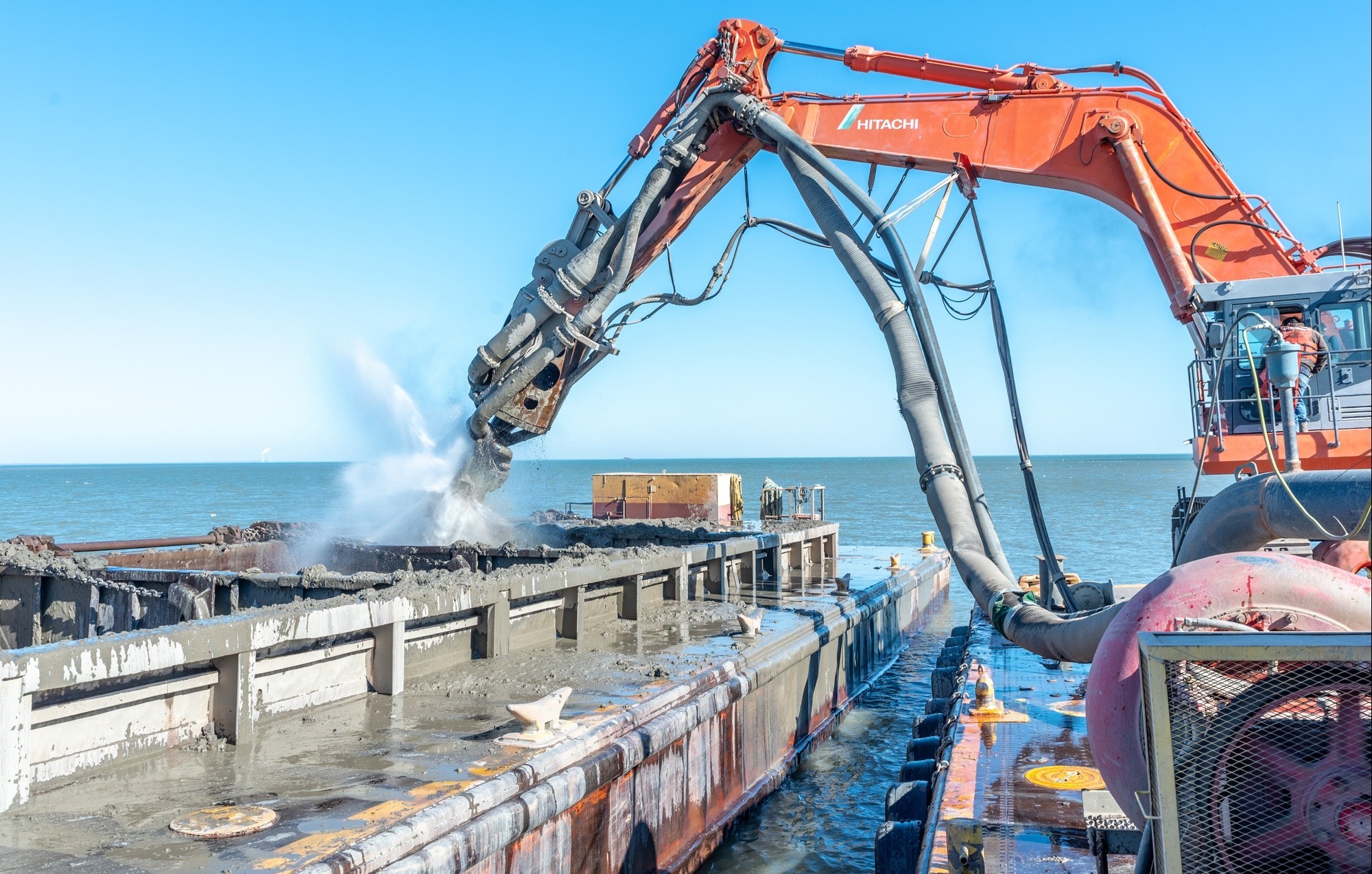
The U.S. Army Corps of Engineers, Buffalo District and its contractor Michigan-based Ryba Marine Construction Company will begin the largest dredging operation on the Great Lakes this fall.
This year’s dredging of Toledo Harbor’s federal navigation channel – which requires the largest quantity of material to be dredged from any Great Lakes harbor – is part of a two-year contract totaling $11.1 million, and ensures accessible depths for large vessels, the continued flow of commodities across the Great Lakes, and the economic viability of United States waterways.
- Dredging will focus on the full length of the Maumee River federal navigation channel, removing approximately 750,000 cubic yards.
- Work is scheduled to start in September.
- Toledo Harbor handles 11 million tons of cargo annually and supports 2,822 jobs.
- Photos available here.
“Maintaining the operation of ports like Toledo is a core part of our mission and essential to more than $1 billion in annual economic impact,” said Lt. Col. Aaron Anderson, commander of the Buffalo District. “As the largest single dredging operation on the Great Lakes, our work here does more than just clear a navigation channel – it sustains people’s livelihoods, supports their communities, and powers the regional and national economy.”
Dredging will focus on the full length of the Maumee River federal navigation channel, from the turning basin upstream to the mouth of the river at Maumee Bay. Work is scheduled to take place from September through December.
A total of approximately 750,000 cubic yards is contracted to be dredged and placed into confined disposal facilities operated by the U.S. Army Corps of Engineers and the Toledo-Lucas County Port Authority.
Dredging of Toledo Harbor is scheduled to be conducted by USACE every year, based on need and the availability of funding. This year’s dredging is being conducted under a $5.3 million task order issued on August 6, marking the first year of the two-year contract. The second task order is expected to be issued in 2027 for $5.8 million.
Toledo Harbor is a deep draft commercial harbor which handled 11 million tons of cargo, including iron ore (53%), coal & lignite (22%), and petroleum coke (3%) in 2023. Waterborne transportation facilitated by the harbor supports $801.8 million in business revenue, 2,822 direct, indirect, and induced jobs, and $237.3 million in labor income to the transportation sector.
Operation, maintenance and dredging of harbors like Toledo by USACE is critical to the economy of Ohio, the Great Lakes region, and the United States.
Photos available at: https://www.flickr.com/photos/buffalousace/albums/72157716854515061
The Buffalo District delivers world class engineering solutions to the Great Lakes Region, the Army and the Nation in order to ensure national security, environmental sustainability, water resource management, and emergency assistance during peace and war.
Social Sharing