


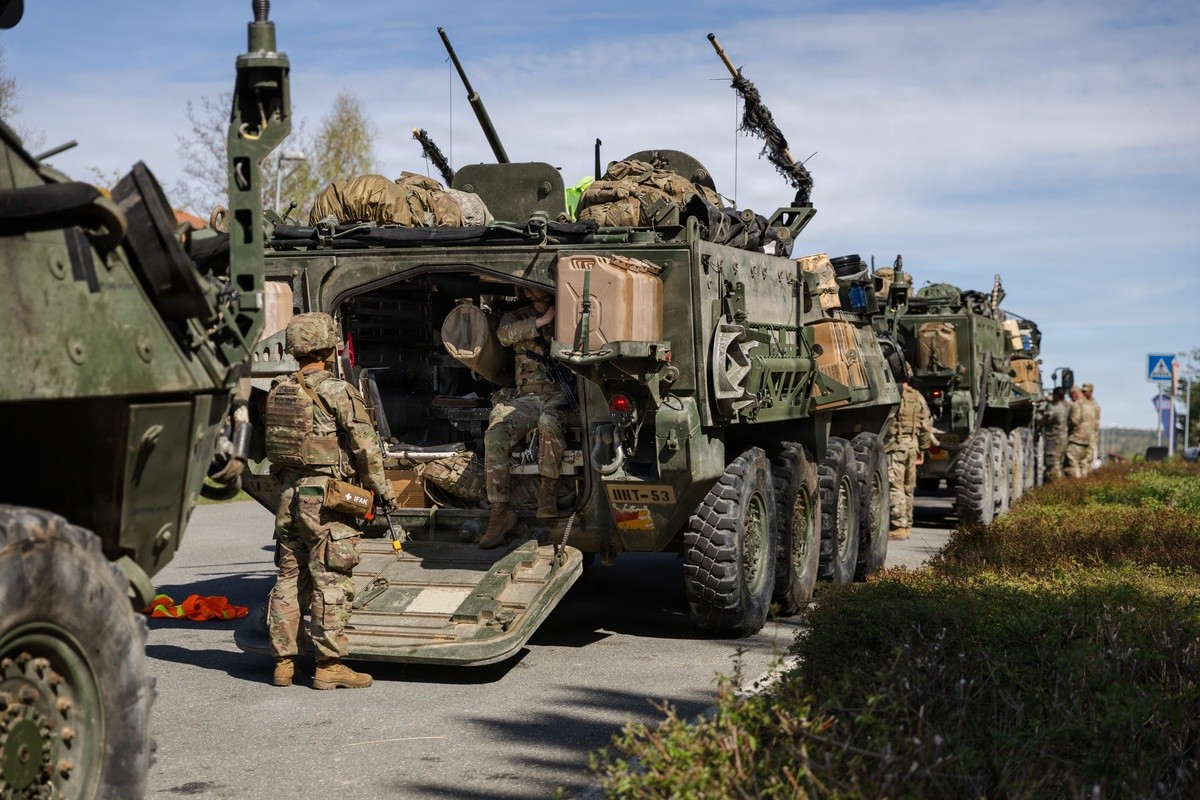
“We are going to drive there and drive back. It’s training.”
— COL Donald Neal Jr., Commanding Officer, 2nd Cavalry Regiment
The task carried implications well beyond a routine road march. The guidance was clear and unambiguous that this movement was not a transportation requirement or a convenience. It was training.
The distance — more than 1,400 kilometers/870 miles over four days for a formation of 396 vehicles — was not the surprise. It was everything the mileage implied: continuous movement across multiple jurisdictions, host-nation coordination, recovery and maintenance planning at scale, fuel and life support synchronized to the hour, convoy discipline under fatigue, and the uncomfortable truth that many formations never stress their movement-and-sustainment systems hard enough in training to discover where they break.
This article captures practical lessons learned from planning and executing a multi-day tactical road march with a sustainment lens. It focuses on the non-negotiables that made the movement possible: deliberate staff estimates, movement control, motor transport fundamentals, host-nation integration, and the sustainment battle rhythm that kept the formation moving.
Are We Actually Ready to Move?
The first and most uncomfortable question during planning was simple. Are we really ready to move. Units train gunnery, ranges, and field problems with intensity, while movement is often treated as an administrative task squeezed between other events. A multi-day road march quickly exposes that assumption and forces leaders to assess readiness in ways routine training does not.
Movement makes readiness transparent. Equipment readiness is no longer theoretical, and driver qualification programs are tested in real conditions. During execution, equipment readiness initially reported at 88% was quickly revealed to be closer to 79% during initial movement. Most vehicle breakdowns occurred before the formation reached the first Convoy Support Center (CSC) Level 1. Leaders also gained a clear picture of whether operators were properly trained and whether crews understood tactical road march battle drills.
Sustaining a multi-day tactical movement is vastly more complex than a simple road march to a local range. Multi-day movement depends on a network of CSCs and host-nation support to maintain tempo. Fuel distribution, border crossing coordination, recovery assets, medical support, communications, and movement permissions all become critical enablers. This has clear implications for readiness. Units must validate equipment readiness through extended movement rather than static reporting and must deliberately stress driver programs beyond licensing requirements. Rehearsing convoy battle drills, conducting longer movements under realistic conditions, and integrating maintenance and recovery early in training allow leaders to identify readiness gaps before they become operational failures.
Planning Movement as an Operation
A long-distance convoy depends on a network rather than a single route. CSCs and host-nation support enable fuel distribution, recovery, medical coverage, communications, and movement permissions. A single weak node within this network can halt the entire formation. Time becomes a consumable during extended movement as border checks, rest halts, breakdowns, and refuel windows compete against the movement timeline while driver duty limits and scheduled access to routes restrict flexibility. When the mission is to reposition combat power, sustainment and movement control become the decisive effort. The entire operation thus converges on a single problem statement: how to arrive ready and preserve combat power for the fight.
For that reason, the road march was planned as an operation rather than a convoy. The staff applied a deliberate planning process and incorporated all warfighting functions early. A key component of this process was leveraging data analytics to predict potential equipment breakdowns and pre-position resources. Specifically, the staff used Army Vantage to assess baseline fleet readiness while separately analyzing historical breakdown data. We visualized these inputs using a custom Power BI dashboard that served as our maintenance common operational picture (COP). Crucially, this COP provided predictive capabilities by cross-referencing faults against current parts availability, allowing us to accurately forecast which equipment could be repaired within a 24- to 48-hour window. Because continuous network connectivity could not be guaranteed, we planned for disconnected Global Combat Support System–Army operations. Faults and work orders were captured offline and synchronized once serials regained connectivity at a CSC. Capitalizing on this predictability, automotive clerks picked Class IX directly from our in-transit Combat Authorized Stockage List at the CSCs, and we facilitated the movement of those parts forward to the repair teams, regenerating combat power on the move. Planning was iterative and supported by continuous dialogue with stakeholders and echelons above brigade. The regiment coordinated throughout plan development with the 21st Theater Sustainment Command, V Corps, host-nation authorities, local police and traffic control agencies, and supporting sustainment units. These were not single coordination events but repeated touch points as assumptions were refined and the plan matured.
Early engagement with host-nation partners began with the submission of a formal statement of requirements. This document articulated convoy size, movement timelines, sustainment needs, and support requirements, which enabled collaborative planning rather than last-minute coordination. Host-nation partners helped identify viable locations for CSCs, refuel points, staging areas, and traffic control measures. As requirements evolved, the statement of requirements was refined and revalidated through continued coordination. Without this sustained engagement and shared understanding, establishing the CSC network would have been significantly more difficult and would have placed movement tempo at risk.
To focus planning, the staff framed movement around five critical questions that guided both preparation and execution:
- What must arrive, where, and when? Arrival effects were defined before route planning and included required personnel and vehicles by serial, classes of supply needed on arrival, required readiness posture, and security and sensitive items controls.
- What constraints govern movement? Constraints included driver licensing and rest cycles, vehicle and hazardous material restrictions, bridge classifications, communications coverage, and host-nation requirements such as permits, escorts, and staging locations.
- Where can the convoy stop while maintaining momentum? Halts were planned as deliberate support areas rather than ad hoc stops. Each location required space for staging and recovery, a fuel concept, medical coverage, security, and communications for convoy leadership.
- How do we recover and continue movement? Recovery planning focused on disciplined maintenance, controlled halts, and clear criteria for repair, tow, or cross-loading to prevent minor faults from halting the formation.
- Who owns movement control across areas of responsibility and the common operating picture? Clear ownership of movement control ensured serials remained coordinated, deconflicted, and supported across shared routes and multiple support nodes.
This planning framework allowed leaders to manage time, resources, and risk while preserving freedom of movement throughout the operation.
Fatigue Is a Convoy Killer
The most dangerous moments during the road march were rarely associated with steep grades or urban congestion. Risk increased late in the movement window when fatigue accumulated, attention declined, and spacing discipline eroded. These conditions created opportunities for minor errors to escalate into accidents, vehicle damage, or extended recovery actions.
Fatigue mitigation was treated as a deliberate sustainment task rather than a safety afterthought. The convoy plan enforced structured stops at CSC Level 1 locations every two hours to enable driver and truck commander swaps, hydration, and vehicle checks. Planned rest periods at CSC Level 2 locations provided longer recovery windows that aligned with refueling, maintenance, and life support operations. These pauses preserved alertness and reduced errors while sustaining movement tempo.
Vehicle commanders played a critical role in managing fatigue at the vehicle level. In addition to navigation and convoy discipline, they monitored driver alertness, maintained spacing, and intervened when conditions degraded. Leaders reinforced a command climate in which safety concerns could be raised without hesitation. Fatigue management proved essential to sustaining momentum since fatigue degrades decision making, increases accidents, and creates cascading maintenance and recovery requirements that threaten overall mission success.
Executing Battle Drills and Maintaining Command and Control
Execution during a multi-day road march is defined by how well a unit executes battle drills and maintains command and control across dispersed serials. Equipment failures, vehicle accidents, and external disruptions are likely during extended movement. What determines success is not the absence of incidents, but the unit’s ability to respond quickly, control the situation, and continue movement. To support this, the regiment produced standardized battle drill reference cards and route books for every vehicle crew. These tools provided clear actions for common incidents and ensured crews understood routes, reporting requirements, and actions at designated control points.
Battle drills were rehearsed and executed to address a range of incidents, including vehicle breakdowns, accidents, and route disruptions. Initial response relied on internal assets positioned forward with each serial to secure the site, assess the situation, and prevent secondary incidents. Recovery operations were conducted using organic recovery assets whenever possible. When incidents required movement off designated routes or involved civilian infrastructure, emergency movement requests were coordinated with host-nation authorities before execution. To preserve convoy tempo, commercial line haul and troop transport trailers were positioned behind movement elements. These assets enabled not mission-capable equipment and their operators to continue movement to the destination while recovery actions remained focused at the point of incident.
Command and control enabled effective execution of these battle drills. Movement control teams were positioned at CSC locations and served as key nodes for reporting and coordination. These teams provided timely updates to the regimental operations cell and shared situational awareness with higher headquarters and external partners, including 21st Theater Sustainment Command, V Corps, and host-nation traffic control agencies. This structure allowed leaders to synchronize response actions, adjust movement windows, and manage risk across the formation. Disciplined battle drills, enabled by simple reference tools and effective command and control, ensured the convoy continued to move despite friction and unforeseen events.
Long Movements Reveal Real Readiness
A 1,400-kilometer/870-mile, four-day tactical road march is not just endurance. It is a readiness event that pressures every sustainment function simultaneously. The key lesson was simple: units do not get good at movement by intending to move — they get good by planning movement like an operation, rehearsing sustainment as the main effort, and building a battle rhythm that survives friction.
For formations preparing for large-scale combat operations, operational reach begins with the ability to reposition combat power reliably. The long road march is not a distraction from readiness — it is one of the clearest ways to measure it.
--------------------
MAJ Austin Faulkner is the support operations officer for the 2nd Cavalry Regiment and formerly the sustainment senior analyst at the Joint Multinational Readiness Center. He has a Master of Business Administration degree from East Carolina University and a Master of Operational Studies degree from the U.S. Army Command and General Staff College.
CPT Elijah Lapid is the transportation officer for 2nd Cavalry Regiment’s support operations (SPO) section. He previously served as the SPO transportation and operations officer for 16th Combat Aviation Brigade, where he coordinated support for multiple Pacific Pathways exercises within U.S. Indo-Pacific Command. He is a graduate of the Ordnance Basic Officer Leaders Course and Logistics Captains Career Course. He holds a Bachelor of Arts degree in urban public policy and planning from the University of California Irvine.
--------------------
This article was published in the summer 2026 edition of Army Sustainment Professional Bulletin.
RELATED LINKS
Army Sustainment on Line of Departure
--------------------------------------------------------------------------------------------
Social Sharing