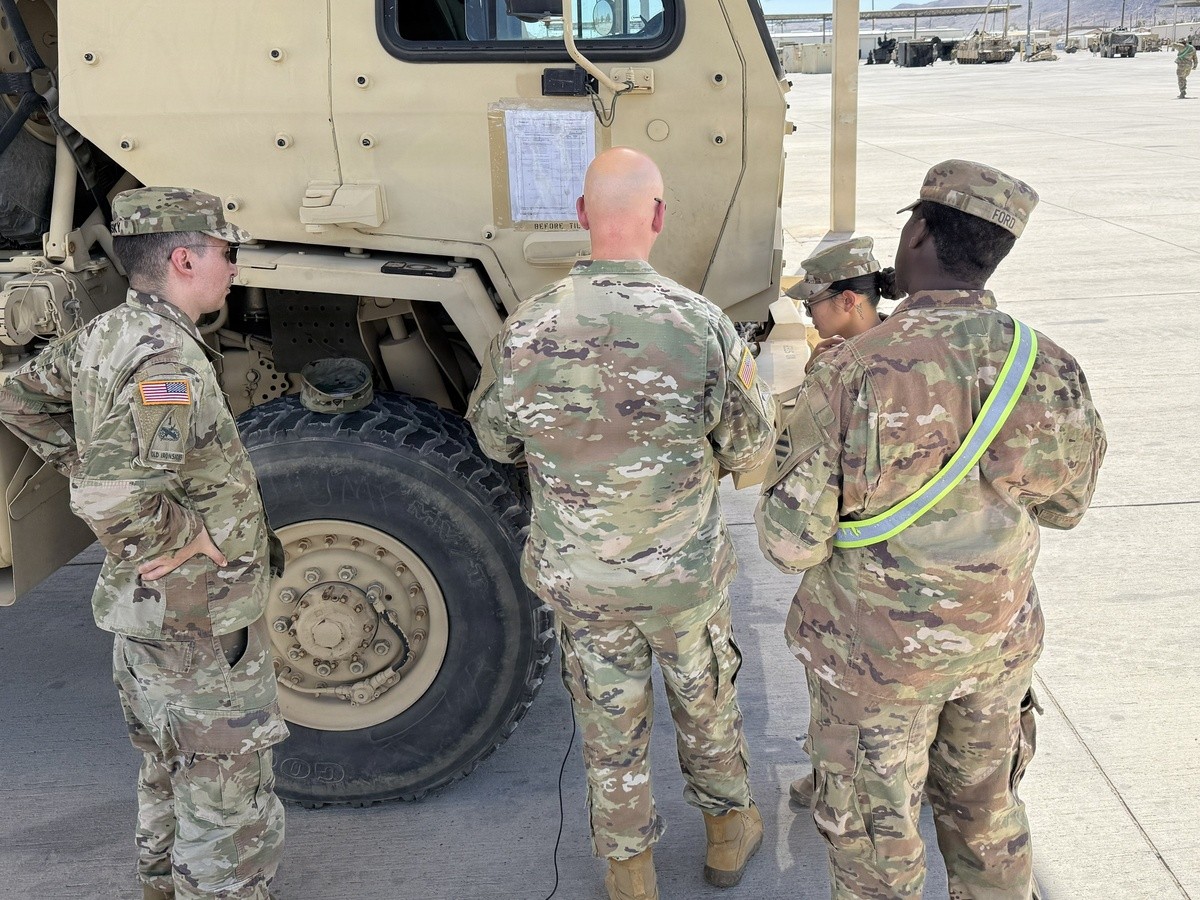
FORT IRWIN, Calif. — From May 30 to June 3, the U.S. Army Communications-Electronics Command Integrated Logistics Support Center Artificial Intelligence-Assisted Maintenance team traveled to the National Training Center to support a Combat Training Center rotation, demonstrating the AIAM tool’s capabilities to Soldiers at the motor pool as they prepared their equipment for the field.
This collective training event was designed to test a Brigade Combat Team and its enablers under realistically simulated and stressful combat conditions, complete with an opposing force consisting of Soldiers from another unit. Rather than rely upon lengthy technical manuals during this scenario, Soldiers would have AIAM for maintenance purposes.
The visit to NTC was the latest in an ongoing campaign of Soldier outreach by the AIAM team. In addition to in-person engagements with units across the Army, the team conducts virtual demonstrations multiple times each week over Microsoft Teams, walking Soldiers and unit leadership through the tool’s capabilities. The goal remains consistent: ensure Soldiers know that AIAM exists, understand how it fits into their day-to-day maintenance work, and have an opportunity to ask questions in real time.
AIAM is the first stage of a three-stage field support process. The tool provides Soldiers with 24/7 access to expert troubleshooting, digitized technical manuals, and step-by-step guidance across five workflows: General Query, Operation, Maintenance, Troubleshooting, and Preventive Maintenance Checks and Services. If AIAM cannot resolve a Soldier’s issue, the ticket is escalated to an on-call Logistics Assistance Representative, who has access to the full work ticket history and attempts to troubleshoot the issue remotely. If the LAR cannot resolve the issue remotely via telemaintenance, direct boots-on-the-ground support is required.
At Fort Irwin, the AIAM team set up a device running AIAM at a motor pool supporting the 2nd Armored Brigade Combat Team, 3rd Infantry Division, who were participating in the rotation. CECOM ILSC team members Chief Warrant Officer 4 Lou Gerber and Chief Warrant Officer 3 Justin Kasky walked Soldiers through the tool’s workflows as the unit’s maintainers worked on their assigned equipment. Maintainers who participated in the demonstration came away especially impressed with AIAM’s integration with the Global Combat Support System-Army. Specialists at NTC signed into the application, pulled equipment information from a tactical vehicle’s data plate, and began their own interactive sessions.
The PMCS workflow, which auto-presents inspection items by interval and produces an editable DA Form 5988-E, drew particular interest. “It’s going to streamline a lot of things that, in 2026, should no longer be done on paper,” Kasky noted. Even as the AIAM team continued to gather feedback in the field, its developers were laying the groundwork for the tool’s next set of capabilities — a reminder that AIAM actively adapts to Soldier and unit needs.
One feature currently in development is known as Battleshort. In combat conditions, where a Soldier may not have time to work through a guided AI workflow before getting expert eyes on a problem, Battleshort skips the initial AIAM step entirely and escalates the ticket directly to a LAR, who then has the full conversation context and a clear indication of the situation’s severity. The feature acknowledges that telemaintenance is not one-size-fits-all and that the time required to walk through a guided workflow is itself a battlefield variable.
On the development side, the AIAM team now operates an internal dashboard called Insights, which delivers a Large Language Model-generated, prioritized rundown of the issues flagged across the user base. Concerns that directly affect Soldiers, most notably errors or omissions in the technical manuals that AIAM draws from, surface quickly. Over time, this gives AIAM a second function beyond its day-to-day role as a maintenance assistant, as the tool will help the Army identify and correct errors that have lived inside technical manuals for decades.
The team has also streamlined the process by which new technical manuals are ingested into AIAM, sharply reducing the human input required to onboard a new system without removing the human-in-the-loop oversight that keeps the tool 100 percent accurate. Features tied to the Army’s Organic Industrial Base modernization are next in the development pipeline.
Each engagement, whether at a forward motor pool or over a Teams call, gives the AIAM team a sharper picture of how Soldiers actually work and expands the list of improvements to bring back to the development team. From there, they can deliver long-awaited functionality directly into the hands of the warfighter.
Social Sharing