
PARIS — U.S. Army air defenders from the 10th Army Air and Missile Defense Command highlighted the Eastern Flank Deterrence Initiative and the need for faster military innovation during a presentation at the Association of the United States Army’s Speakers Corner on the opening day of Eurosatory 2026.
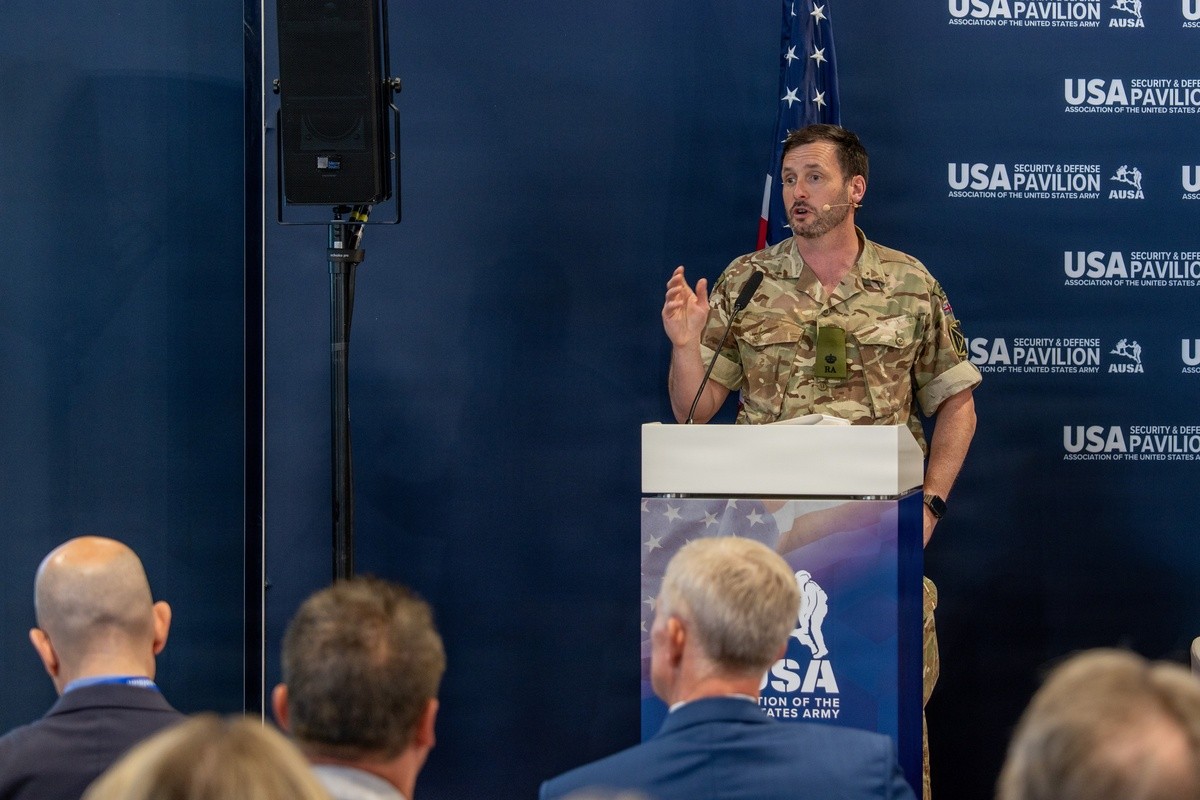
U.S. Army Col. Tom Noble, deputy commanding officer of the 10th Army Air and Missile Defense Command, and British Army Maj. Ben Johnston, a G-5 plans officer and U.K. exchange officer with the command, spoke to an audience of military leaders, allies, partners, and defense industry representatives about what it takes to adapt at the pace of the modern battlefield.
Their message was direct: New technology matters, but only if it can be integrated, tested, and delivered to Soldiers quickly enough to make a difference.

“One of our most acute challenges here is simple to state: Are the assumptions behind our plans and the resources that we’ve committed to them still valid against the enemy and how they actually choose to fight?” Noble said.
The presentation, titled “Innovation at the Edge: Operationalizing the Eastern Flank Deterrence Initiative,” focused on how the Army, NATO allies, and industry can better connect sensors, shooters, networks, and decision-makers across the alliance.
Eurosatory, held June 15-19 at the Nord Villepinte Exhibition Center, is one of the world’s largest defense and security trade shows, bringing together military organizations, government officials, and industry representatives from around the world. For air defenders assigned to the 10th AAMDC, the venue provided an opportunity to explain what is needed from industry and why speed, interoperability, and practical field testing matter.
Noble said current conflicts are showing how quickly adversaries adapt and how rapidly assumptions can be overtaken by battlefield realities.

“This risk is not theoretical,” Noble said. “It’s actually playing out currently in multiple theaters where adversaries are using conflict as a live incubator to refine their capabilities on a daily basis.”
He pointed to saturation attacks, drone swarms, ballistic missiles, and cruise missiles as examples of threats that are forcing air defenders to think differently about magazine depth, sensor integration, and engagement authority.
In Ukraine, he said, the transparent battlefield has reinforced the vulnerability of static assets, the value of passive defense, and the importance of rapid innovation at the forward edge.
“This is a warning that we must begin to outpace their adaptation just as quickly as they are,” Noble said. “We cannot wait for the next conflict to absorb these lessons. We must act now.”

The Eastern Flank Deterrence Initiative, or EFDI, is designed to help meet that challenge. The initiative focuses on strengthening deterrence along NATO’s eastern flank by integrating uncrewed systems, live data, mission command networks, and layered defenses to help allied forces see first, decide faster, and strike with scalable effects.
For 10th AAMDC, that concept is tied directly to its role in Europe and Africa. The command coordinates, executes, and sustains combined and joint integrated air and missile defense operations across the U.S. European Command and U.S. Africa Command areas of responsibility. Noble said the command’s position between the air and land domains, and between U.S., NATO, allied, and partner forces, gives it a unique vantage point for identifying operational gaps and helping refine emerging capabilities.
Johnston said the challenge is not simply acquiring new systems. It is making sure those systems can work together across nations, formations, and domains.

“Joint is hard, multinational is much harder,” Johnston said. “When you think about an alliance framework, not just language, but also technical standards and all the other standards that are not quite met by nation to nation, that in itself provides a big challenge.”
Johnston said EFDI is built around decision dominance, the land contribution to deterrence, acquiring required capabilities, sustaining the force, and interoperability. Those goals require more than isolated platforms or one-off solutions. They require networks that can move data quickly enough to support real decisions at the tactical edge.
“Multi-domain is now, it’s not next,” Johnston said. “It’s not a future concept; it’s a current operating environment.”
He said integrated networks, open architecture systems, and data-sharing across allies and partners are essential to making EFDI work. Without them, units may have advanced sensors or effectors but still lack the ability to connect the right information to the Soldier or system that needs it.
“To integrate, we require open architecture systems,” Johnston said. “The days of proprietary firewalls can no longer be sustained, and we must be able to ingest all-domain data in real time.”
One example is Digital Shield, an effort that brings U.S. Soldiers, allied forces, and civilian defense contractors together to evaluate emerging counter-unmanned aerial system technologies and integrate them into operational networks. Johnston described Digital Shield as a mechanism for closing gaps between sensors, data, and short-range air defense systems.
“The original concept was a way of moving data faster from various sensors into the right effector,” Johnston said.
He said the effort is intended to pull commercial counter-drone systems into a scalable, single integrated air picture that supports EFDI. The goal is not simply to test equipment, but to understand whether it can function inside a larger network.
Project Flytrap and Project Bullfrog are also part of that broader experimentation ecosystem. Project Flytrap has brought together military units, procurement officials, and commercial vendors to test counter-drone technologies against realistic threats. Project Bullfrog, led by the 52nd Air Defense Artillery Brigade, has provided another path for assessing emerging technologies and gathering direct feedback from air defenders.
Johnston said these efforts matter because they give Soldiers a way to validate technology before it is treated as a solution.
“Capabilities are tools,” Johnston said. “A capability sitting in isolation is not a solution. Integration and networking are the areas that deliver the most effect.”

That distinction was central to the discussion. New drones, sensors, radars, interceptors, and software tools may help close gaps, but only when they are tied into a broader architecture that supports command and control, targetable data, and disciplined engagement decisions.
The question for industry, Noble said, is how to help military units test, refine, and field useful systems faster.
“The greatest thing that you can do is keep building new capabilities out there for us to test,” Noble said in response to an audience question. “Just today, I’ve only been here for about four hours and I’ve seen so many great and new ideas that are out there that I would love to see at Bullfrog, at Flytrap, at Digital Shield.”

Noble said the command is looking for capabilities that can be tested, validated, and moved to the warfighter, whether for use in the U.S. European Command theater or in other operational environments.
Johnston said industry’s role is not limited to producing equipment. It also includes being willing to adapt, integrate, and respond to operational feedback.
“We would never be able to achieve that fusion of data without the proactiveness of our industry partners,” Johnston said. “The ability of industry to produce great kits, but also to show the adaptability to work with us as a team sport,” is essential.
The presentation ended with five imperatives: integrate, proliferate, disperse and deceive, sustain, and interoperate. For Johnston, those words describe what allied forces and industry must do together to build a force that can survive and win in a contested environment.
For Noble, the discussion reflected a larger reality for air defenders in Europe. The threat is adapting quickly, and deterrence depends on whether the alliance can adapt faster.
EFDI, Digital Shield, Project Bullfrog, and the Flytrap series are not separate efforts, he said. They are ways to connect battlefield lessons, industry innovation, and Soldier feedback into capabilities that can strengthen NATO’s eastern flank.
The goal is practical: give Soldiers at the edge what they need to detect threats, make decisions, and act before an adversary can impose its will.
As U.S. forces and NATO allies and partners continue to strengthen deterrence across Europe, Noble and Johnston made clear that innovation is not a future requirement. It is already underway in Europe, where Soldiers, allies, partners, and industry are testing practical capabilities that can strengthen deterrence in theater and support operations around the globe.
Social Sharing