
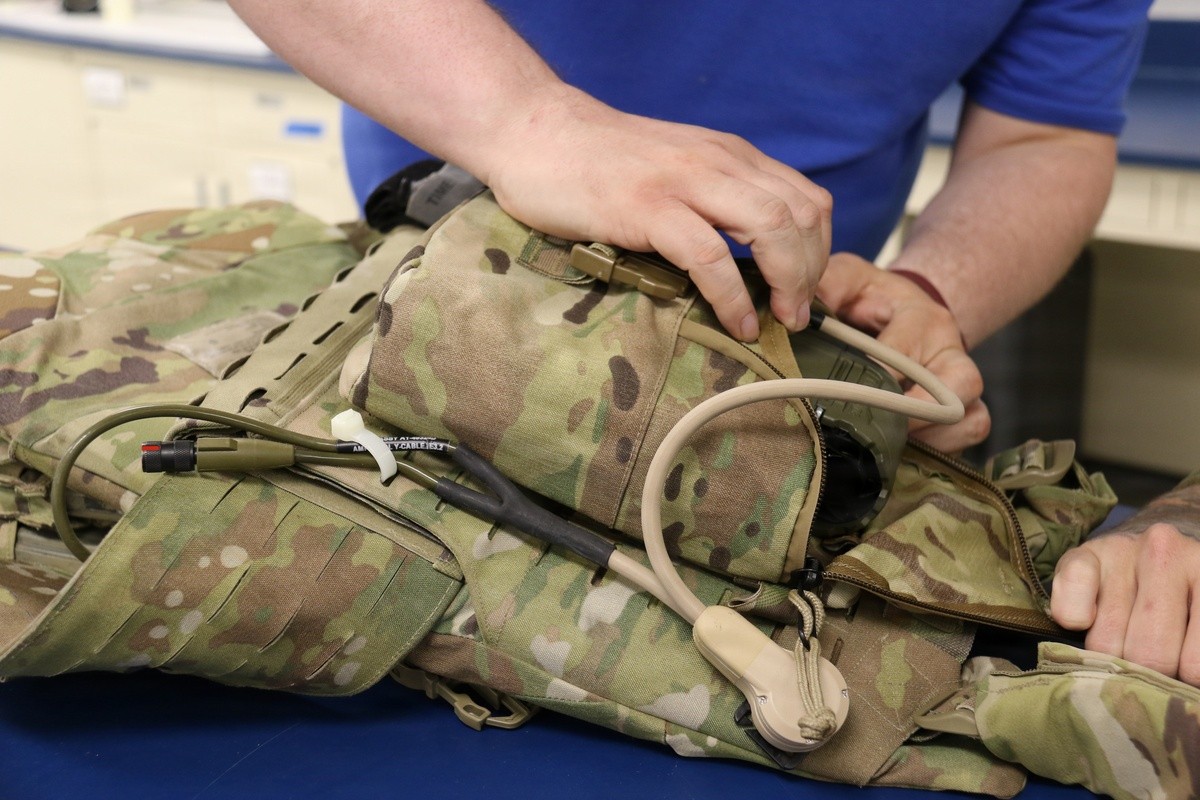

ABERDEEN PROVING GROUND, Md. (June 10, 2026) — The energy demand from Soldier’s electronic devices continually grows as the Army develops more advanced tech to meet demands of today’s battlefields. Researchers are exploring quieter, wearable power systems as part of multiple projects to power Soldiers.
The Army’s Command, Control, Communications, Computers, Cyber, Intelligence, Surveillance and Reconnaissance (C5ISR) Center leads this effort to reduce the number and weight of batteries that Soldiers carry over extended missions. Army scientists and engineers are developing the Soldier Wearable Power Generator 2.0, which weighs less than 3 pounds and fits into a rucksack.
“Adding methanol water to the system enables on-the-move charging of electronics while reducing logistics re-supply issues. The SWPG goal is to allow multiple days of operations while powering an average load of Soldier-worn and -carried electronics,” said C5ISR Center research engineer Dr. Richard Scenna. “A Soldier would save about 20 pounds of battery weight.”
The SWPG is one component of the Center’s R&D initiatives to deliver greater power technology to Soldiers.
“The C5ISR Center’s efforts across a diverse team of mechanical, chemical and electrochemical subject-matter experts is a force multiplier for advancing the Army’s tactical power solutions,” said C5ISR Center Director Beth Ferry. “It creates a complete picture of the technical challenges, such as power demand and integration. Our S&T expertise enables us to share and understand Soldier feedback, preferences and challenges to quickly transition research into advanced solutions.”


In recent years, subject-matter experts have worked with industry to improve the prototype’s performance while reducing the weight, size and noise level based on Soldier feedback during limited user test events for the system’s form, fit and function. Researchers will continue Soldier testing of the devices and are in close communication with an Airborne Division to be the first to demonstrate this new capability.
Initial research focused on integrating early SWPG prototypes to charge the thin, flexible Conformal Wearable Battery that Soldiers wear on their vests as a central power source for radios, night-vision devices, weapons and more, Scenna said. An emerging R&D focus area is charging uncrewed aircraft systems, which are growing rapidly in the scale and importance of modern warfare. To keep large numbers of UAS batteries charged across a wide variety of combat conditions and scenarios, integrating wearable power systems is a viable solution.
“In the past, power generation was limited to loud diesel generators located in the rear echelon to avoid giving away Soldiers’ positions,” Scenna said. “With the advent of new, advanced equipment that Soldiers need to carry, power is now required at the front, which requires a new type of mobile power generation technology to avoid detection.”
——————————
The U.S. Army Command, Control, Communications, Computers, Cyber, Intelligence, Surveillance and Reconnaissance Center is the Army’s applied research and advanced technology development center for C5ISR capabilities. As the Army’s primary integrator of C5ISR technologies and systems, DEVCOM C5ISR Center supports our networked Warfighters by identifying, developing, maturing, and rapidly integrating innovative technologies to drive continuous transformation.
DEVCOM C5ISR Center is an asset of the U.S. Army Combat Capabilities Development Command. DEVCOM is the Futures and Concepts Command’s leader and integrator within a global ecosystem of scientific exploration and technological innovation. DEVCOM expertise spans seven major competency areas to provide integrated research, development, analysis and engineering support to the Army and Department of War. From rockets to robots, drones to dozers, and aviation to artillery, DEVCOM innovation is at the core of the combat capabilities American Warfighters need to win on the battlefield of the future. For more information, visit c5isrcenter.devcom.army.mil.
Social Sharing