VIEW ORIGINAL
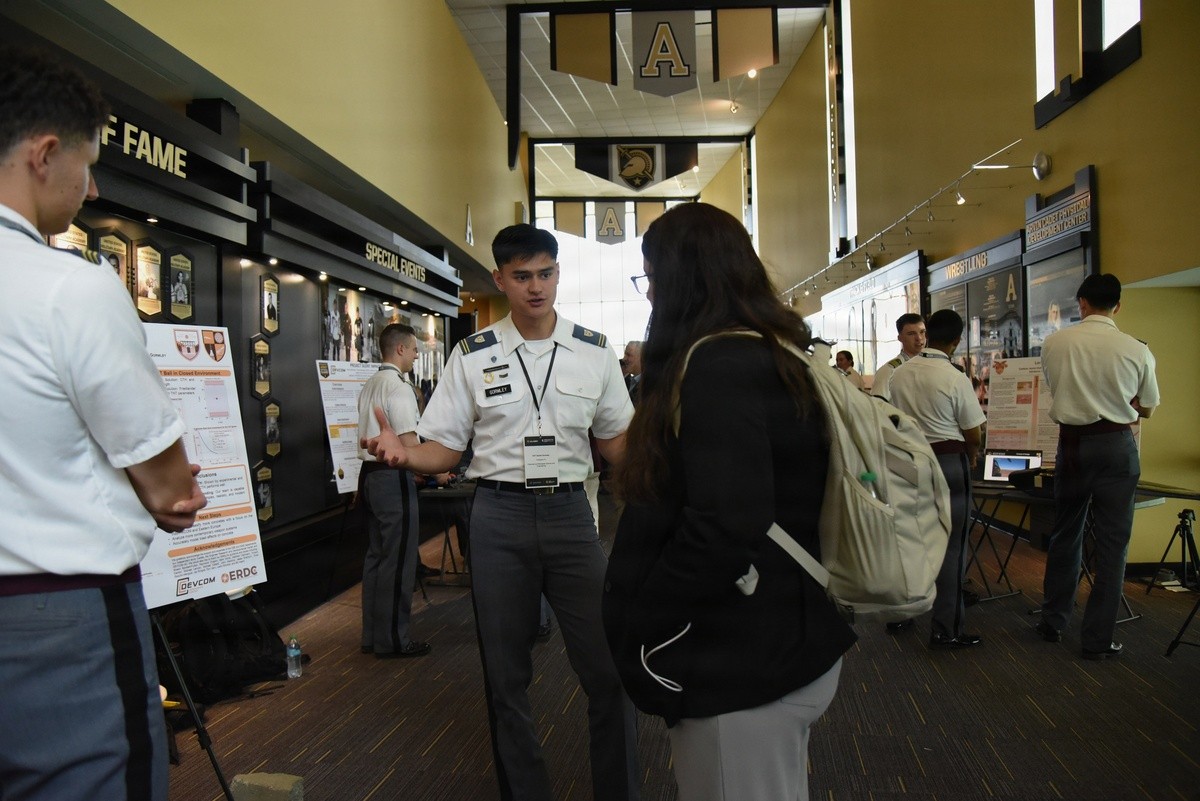
WEST POINT, N.Y. - Several of the U.S. Army Combat Capabilities Development Command (DEVCOM) Armaments Center’s leadership were on hand to review capstone projects by United States Military Academy (USMA) cadets during the Projects Day Research Symposium on Thursday, April 23.
USMA, with whom the Armaments Center has a very close relationship, prepares the next generation of Army leadership for tomorrow’s battlefield; through their capstones, cadets show what they have learned and will bring to the table in the future. The two entities frequently collaborate, offering one another their expertise and engineering capabilities.
Armaments Center representatives, including Director Chris Grassano, and Munitions Engineering and Technology Center Executive Director Anthony Sebasto, spent the day in the Mechanical and Aerospace Engineering (MAE) department. Armaments Center leadership listened to project out-briefs and engaged in one-on-one conversations with cadets later in the afternoon.
The Armaments Center sponsored four projects this year, all of which were collaborative efforts with the MAE. The first was a universal mounting solution which could allow the newly fielded M250 Automatic Rifle to mount atop the ubiquitous M192 tripod, which would lessen the need for a brand-new tripod. Cadets Noah Winters, Cleavon Zhu, Trae Stewart and Catriona Gilmore worked on this initiative, overseen by Maj. Matthew Crocker and Cpt. Travis Chewning-Kulick.
The second sponsored venture sought to design an inert or non-hazardous grenade munition that can be dropped from an unmanned aircraft system during operator and soldier training exercises. It was presented by cadets Matthew Tewolde, Beatriz De Los Heros De Uriarte, and Colby Basalyga, and was advised by Col. Margaret Nowicki. The Massachusetts National Guard, Nowicki said, both submitted the topic and provided additional sponsorship.
The third initiative was to design and test protective structures with hardwoods and/or cross laminated timbers capable of withstanding direct and indirect munitions. Cadets Eric Lusskin, Dylan Liskey, Chris Perera, and Ty Ezell worked on this effort, which was advised by Nathaniel Helminiak, Ph.D, Joseph Hanus, Ph.D, and Eric Williamson, Ph.D. This effort received additional recognition from the Engineer Research and Development Center, which offered the cadets mentorship.
The last project sought to design a glider that is air deployable, delivers a munition, and can travel long distances while carrying sizable loads. Jamin Hofmann, William Saunders, Blake Edwards, and Ty Trotter saw the concept through, with Lt. Col. Drew Curriston, and Cpt. Natalie Basnight serving as advisors.
Lisa Sassaman, a data scientist with the Innovation and Strategic Relationships Office, noted that attendees were deeply impressed by the cadets’ caliber of research, and that the event underscored the robust partnership between USMA and the Armaments Center. The two parties, she added, recently signed a Memorandum of Agreement, assuring that Picatinny and West Point will continue their close relationship for years to come.
According to Curriston, audiences were curious throughout the day, and his cadets received excellent feedback, along with several potential design modifications to consider. Their projects will be available for next year’s cadets to continue, and to facilitate this, students are creating continuity binders to store all completed work so future capstone teams can easily pick up where they left off.
“We want to express our appreciation for those at Picatinny; these projects mean more when our cadets are able to brief experts throughout the year and work hand-in-hand with engineers - it’s quite meaningful,” said Curriston.
According to Nowicki, her cadets’ capstone was born of a request by the Massachusetts National Guard to design an inert munition which could be dropped from a great height and land in a predictable spot without drifting and would be harmless if it struck someone. Already, several parties have found potential uses for this, and the National Guard, she said, hopes to take this technology even further.
Helminiak gave his thanks to Armaments Center representatives and leadership for attending. He celebrated his cadets for their work, and expressed confidence that the insights gained could benefit not just the military, but civilians as well through increased resistance to natural disasters.
Chewning-Kulick praised his cadets for presenting an intuitive design which fulfilled all engineering specifications and solved the problem at hand.
"The energy (in the room) started out as formal, but quickly became interactive as questions came in. There was clear interest in the project, and the audience was asking thoughtful questions,” said Cadet Winters. “That shift made it easier to connect and explain the project in a more practical way. We tried to match that energy by keeping the presentation clear and engaging.”
Social Sharing