
William Robert Dudley never expected to end up in Alaska. But at 25, the young meteorologist finds himself working at the U.S. Army Arctic Regions Test Center (ARTC) in Fort Greely, a place that has shaped him in ways he never imagined.
Early life
Born and raised in East Lansing, Michigan, Dudley grew up surrounded by family. His grandparents, aunts, and uncles all lived in the same neighborhood. He is the oldest of three children: his sister Annie, 23, graduated from Michigan State and lives in Columbus, Ohio, where she works as a consultant/planner, while his brother Peter, 21, is a sophomore at the University of Notre Dame studying chemical engineering. His parents, Bill and Karen, still live in the family home. His mother works at UPS, and his father is a landlord who owns several rental properties. During summer breaks and weekends, Dudley and Peter helped their dad manage those properties—shoveling snow, cutting grass, removing broken appliances, painting, and maintaining and repairing the plumbing systems.
Dudley's paternal grandfather, an Air Force pilot captain and instructor during World War II, may have planted an early seed for military service. But it was the weather that truly captured Dudley's imagination as a young kid.
He graduated from Lansing Catholic High School in 2019, where he played football and lacrosse. He also played the trumpet in the school band. He loved high school for its great teachers and even better friends—and he made even more memories at Central Michigan University (CMU) in Mount Pleasant, where he also played intramural basketball.
A weather calling
In May 2023, Dudley graduated from CMU with a bachelor's degree in meteorology and a minor in mathematics. CMU is known for having one of the best meteorology programs in the country, meeting the rigorous standards of the National Weather Service. In college, he became the on-air meteorologist for the university's award-winning student broadcasting program, "News Central," a half-hour nightly news show produced entirely by students. He also joined the Student Chapter of the American Meteorological Society. Additionally, he interned with the National Weather Service and served as a Virtual Student Federal Service intern with the Department of State, working remotely with his project mentor, Mr. Lou Fintor, to support outreach and recruitment goals.
The turning point came during his senior year. Three U.S. Air Force meteorologists spoke to his class about meteorology in the military, and one of his meteorology professors encouraged him to pursue work with the U.S. Army Test and Evaluation Command’s (ATEC) ARTC. That advice, combined with his internship experience, solidified his decision to become a full-time meteorologist.
Far from home
In January 2024, Dudley moved from East Lansing to Delta Junction, Alaska—a small, isolated community of fewer than a thousand residents. The closest city with a hospital or airport is Fairbanks, a hundred miles away. During the winter, Delta Junction receives only three hours of daylight, and temperatures can plunge as low as -60°F. The members of the Fort Greely community are famously known as "rugged professionals"—a testament to the unforgiving nature of the Alaskan landscape. ARTC sits on the lee side of the majestic Alaska Range.
When he first broke the news to his friends back in Michigan, they were shocked and tried to talk him out of relocating to the middle of the Alaskan wilderness, over a thousand miles from home. But Dudley was undeterred—even as the challenges began piling up.
Upon arriving at Fort Greely, he didn't have his vehicle and had to wait a full month for it to arrive. He had also left behind everyone he loved. Unfamiliar with the area and without transportation, he had to trust his ARTC teammates completely. Fortunately, he wasn’t afraid of change. For the first time in his life, he had to live on his own, work a full-time job, make new friends, adapt to a completely new environment—and most difficult of all, learn how to be away from the family he grew up with and the lifelong friends he had made.
He doubts he would have made it without the kindness of his teammates. His supervisor made sure he had a ride to and from work while he waited for his vehicle. Without them, he would have been stranded thousands of miles from home in the middle of an Alaskan winter with no way to get to the grocery store or to work. When his vehicle finally arrived, it wouldn't start due to the extreme cold. One of his coworkers fixed that, too. Dudley remains forever grateful to a group of people who welcomed a virtual stranger into their lives.
He calls back home daily to reconnect with family and friends, and through this challenge, he learned so much about who he is and what he's capable of accomplishing. So far, his biggest obstacle in life has been learning to adjust to Delta Junction—but he couldn't have mastered it without his ARTC teammates and the love and support from family and friends back home.
The Arctic meteorology mission
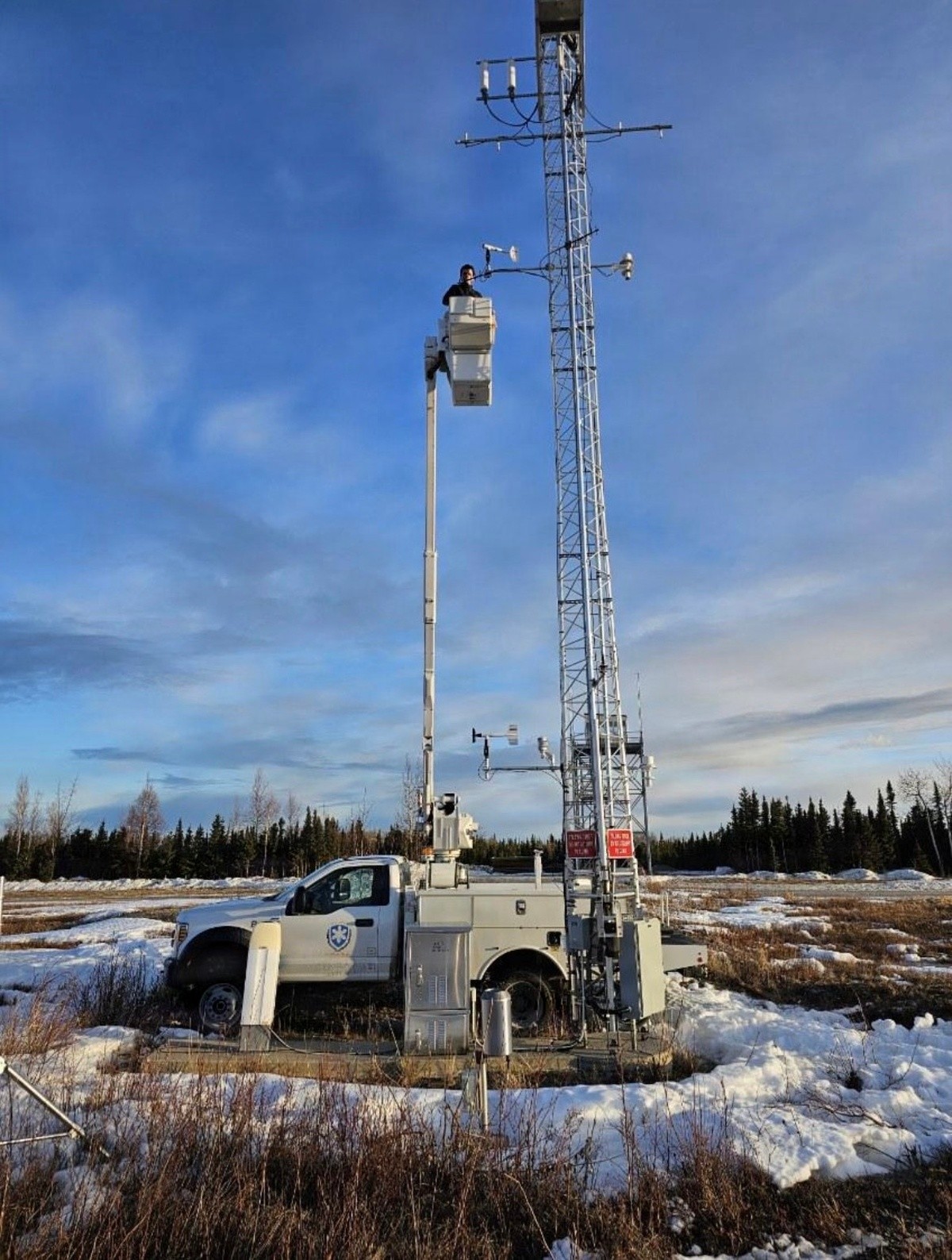
Since arriving, Dudley has learned how to accurately forecast weather in the Arctic, the most challenging and data-sparse region in the world. He has also mastered the complexities of the specific "microclimates" around Fort Greely. A microclimate is a small, localized area where the weather, temperature, or humidity significantly differs from the larger surrounding region. During winter test season, most of his time is spent in the office creating forecasts or outside launching weather balloons and collecting data from towers. Summer months are spent fixing, repairing, and maintaining ARTC’s meteorological equipment. Additionally, the summer provides great opportunities to conduct cutting-edge meteorological projects and to strengthen ARTC’s partnerships with the Arctic meteorology and oceanography community.
Dudley is passionate about weather and severe storms, and he holds a strong professional conviction. In an age of weather apps, powerful computing, and machine learning, he believes the profession of meteorology is becoming undervalued. But he argues that meteorologists are more important than ever. First, no matter how advanced computing becomes, weather models will always have biases and errors that compound over time. It takes a trained meteorologist to account for those variances and to create an accurate forecast using radar, satellites, and weather balloons. Second, a meteorologist's ability to communicate is critically important. A weather forecaster's job is not just to predict the weather but to inform the public.
At ARTC, test officers need to know exactly how cold it will get and when, so they can test equipment in the most brutal Arctic conditions. Elsewhere, meteorologists at the National Weather Service, on television, and in the private sector communicate critical information about wildfires and hurricanes—which areas should be evacuated—and they provide timely data for airlines, airports, state Department of Transportation offices, and utility companies to position snowplows and trucks ahead of severe weather. All of this is done to keep people safe.
Dudley notes that meteorology is a critical tactical factor for Soldiers on the ground. Knowing the weather can mean the difference between mission success and catastrophic failure. Conditions on the ground affect everything from sniper visibility to flight paths. Meteorologists provide unit commanders with "operational battlespace visualization"—a living map of where the environment helps and where it hurts. Without that, a sniper might miss, a medevac helicopter might fail to lift off, or a chemical cloud could drift directly into the path of Soldiers in the field.

The road ahead
With so many accomplishments so far, what's next for Dudley? He says he has a keen interest in deploying with the Expeditionary Civilian Workforce—an opportunity he didn't know existed until attending an ATEC town hall. He has also volunteered to train on the Cold Weather All-Terrain Vehicle system to master arctic mobility, to visit the permafrost tunnel, and to assist with radar maintenance.
The Permafrost Tunnel in Fox, Alaska—about ten miles north of Fairbanks—is a one-of-a-kind laboratory where scientists study the impact permafrost has on the Arctic. This man-made warren of passages carved into a hillside serves as a natural museum of the Ice Age and an important piece of climate research infrastructure. Since permafrost thaws when exposed, the tunnel is refrigerated year-round.
The original goal of the tunnel was to study the suitability of permafrost as a subterranean bunker, but it has since expanded to include engineering, biology, archaeology, climate, and rare earth mineral research. Understanding permafrost is critical, as most of the land in the Arctic is permafrost. It determines what can be built and where, the ease of movement, and how it can be leveraged in a tactical environment.
Freedom in the wilderness
When he's not working, Dudley enjoys driving the Denali Highway, the original route to Denali National Park. It remains much as it was in the old days—a long dirt road across the span of the Alaska Range. He says it's one of the few places where he has felt truly free. Along the drive are rivers to cross, hills and mountains to climb, potholes to dodge, and a long, narrow wooden-planked bridge. A few lodges offer lunch along the way; his favorite is the McLaren River Lodge. The highway is also a great access point for venturing into the wilderness.
Dudley, a self-professed avid Detroit Lions and Pistons fan, has a can-do attitude and constantly pushes himself out of his comfort zone. In his spare time, he exercises, golfs, and climbs mountains—so far, he has climbed Donnelly Dome. He also deep-sea fishes, preferably in the Gulf of Alaska or the Prince William Sound off the coast of Alaska. Since moving to Alaska, he has also gained an interest in dog sledding. But one of his life-long dreams is to one day follow in the footsteps of his dad, grandfather, and uncle and earn his pilot's license.
The long, sometimes treacherous trek to Fairbanks for necessities has definitely taught him patience. The dark, cold winters and the lack of a vibrant social scene have also increased a tolerance he didn't know he had. Dudley says he wants to take a deeper dive into developing even more patience so he can learn to see the bigger picture from other people’s perspectives—specifically, their issues and concerns. He also believes every person should learn how to live on their own, preferably far away from where they grew up.
Dudley is grateful to live and work in one of the most awe-inspiring places in the world. He credits both of his parents for encouraging him to be his best self, to give back to others, and to work hard for his goals. His mother showed him how to be there for others; his father showed him how to carve out his own path.
But no one has influenced him more than the best friends who have passed away. He names Danny Bath, Miles Gibson, and Rocco Wharff as some of his greatest sources of inspiration. He credits their memory for motivating him to excel and to do great things—all in their honor.
Social Sharing