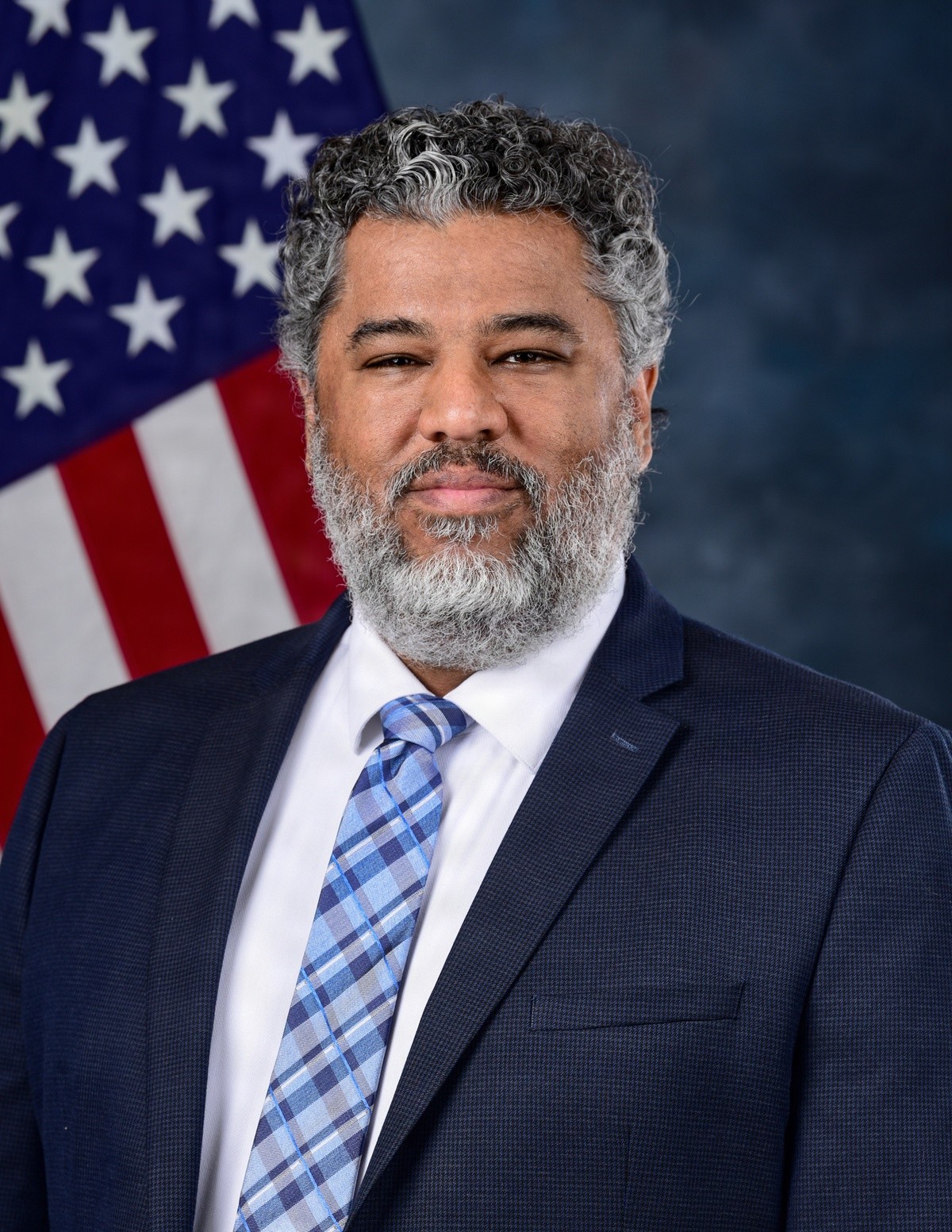
Maluki Montgomery, a computer scientist with the U.S. Army Communications-Electronics Command’s Army Software & Innovation Center. VIEW ORIGINAL
FORT LEE, Va. — Maluki (Ma-luh-kai) Montgomery, a computer scientist with the U.S. Army Communications-Electronics Command’s Army Software & Innovation Center, has worked on several high-profile CECOM projects like AI Flow and AI-Assisted Maintenance, or AIAM, and My Army Post App, or MAPA.
“I switch projects a lot depending on what the priorities are,” he said. “I have to constantly learn new technologies rapidly to meet different requirements."
A few years ago, Montgomery worked with data scientist Frank Frisby and his team to create the AI application AI Flow. The application is an agentic service that provides users with tailored AI solutions to fit specific needs and missions. It is now available to all Common Access Card users.
“We were looking at the options, and there were no good options right within our space within the Army,” he said. “I partnered with him to help bring that project to life, scale it out, deploy it, secure it, build all the infrastructure, things like that.”
Montgomery also worked on sustaining MAPA, originally developed by the Army Software Factory. This free mobile app connects Army communities with information about their installation. The Army wanted to deploy it across all installations and make it an official program of record, so it was transferred to ASIC, Montgomery explained.
“[That project] had a lot of visibility and had a lot of risk also because at the time, there was no one in our organization that had experience with mobile applications, building them, sustaining them,” he said. “I kind of got pulled in late, I would say. It was a very aggressive timeline where the Army Software Factory had a firm date on the wall, where they could no longer work on the app.”
Over the last 30 days, MAPA has increased adoption to approximately 86,000 active users.
In another high-profile project, Montgomery teamed with the CECOM Integrated Logistics Support Center lead for AIAM, Sean Murphy. AIAM is an AI-driven tool that provides Soldiers with expert-level maintenance support 24/7. Montgomery and his team started working with CECOM ILSC on this project a year ago. One of ILSC’s major focus areas is tech manuals. Originally, Montgomery and CECOM ILSC developed AIAM out of AI Flow.
“Having an AI tool makes it easier to pinpoint the information, instead of having to scroll through pages of a PDF,” Montgomery said. “It was kind of an iterative process, where it started out using the out-of-the-box functionality within AI Flow. Sean Murphy and his team quickly realized there were a lot of enhancements that could be made to make the user experience better. That is how AIAM was born.”
Montgomery said ILSC had the experience and the intimate understanding of how the information in a tech manual was consumed and presented to users, and his team provided assistance by helping them with some of the AI elements and infrastructure to help them build that initial version of AIAM and get it out to users.
Recently, Montgomery helped CECOM ILSC deploy AIAM to Next Generation Command and Control for the Ivy Sting V test event, a U.S. Army exercise conducted by the 4th Infantry Division.
“That was a learning experience. That was a short window of time that required a lot of learning,” he said. “NGC2 is the next generation tactical computing end app platform for how the Army will fight wars moving forward.”
Adapting to new technology
Montgomery, who is originally from Portland, Oregon, majored in electrical and computer engineering at Lafayette College at Easton, Pennsylvania. Montgomery said he has always been interested in computers since he was 12 years old and received a used Commodore 128, an 8-bit home computer.
“I guess I have been curious about how things work, even outside of computers. I was always hands on,” he said. “When you are young, you don’t really know what you are doing, so I would try to take it apart to try to fix it. I would take my TV apart, my bicycle. You won’t know until you try.”
Montgomery began his civilian career as a CECOM intern in 2003 at Fort Lee, Virginia. He has worked on a full range of systems, having different roles and various levels of responsibility within the organization.
“The biggest thing that I have come back to over my career is being open-minded and being willing to continuously learn,” Montgomery said.
Being able to adapt easily has helped Montgomery embrace AI.
“AI has been the biggest change that has impacted me, impacted this field. It has been interesting,” he said. “I very much like to lean into things. I know there is a lot of uncertainty and concern about how AI will impact different fields, and computer scientists are probably hit the hardest right now because so much of AI is focused on automating the software development process. It is a strategic focus for big AI companies right now. We are seeing our field change.”
Montgomery advises people not to “put their head in the sand” by doing things the way it has always been done. Lately, he has been leaning into using AI coding tools.
“It is another case of acquiring a new skill,” he said. “You still need to be a skillful driver of any of the coding tools. The same software engineering tools still apply; you must follow them. You are using a tool that helps you move through all those steps much quicker.”
Serving the country
Montgomery said what he enjoys most about his job is solving hard problems and seeing the impact of his work. That is what keeps him motivated, and knowing his skill will impact the warfighter.
“I feel like I am doing my part for the country,” he said. “I feel like I am doing my part for the Soldier, which feels meaningful. It is worthwhile to spend your life doing.”
Social Sharing