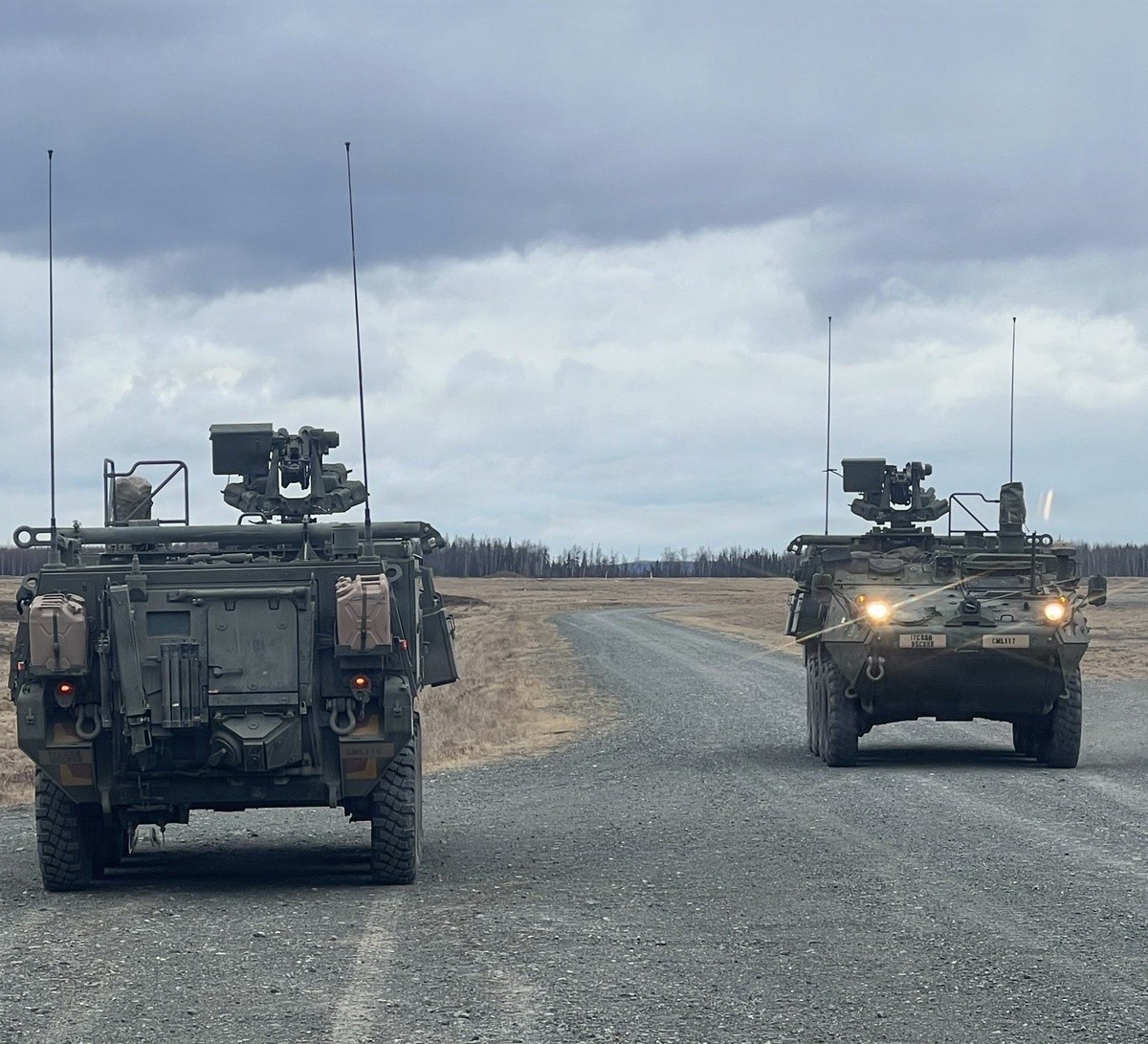

JOINT BASE ELMENDORF-RICHARDSON, Alaska – The Army’s only Arctic-capable chemical company, the 95th Chemical Company “Arctic Dragons,” recently demonstrated its combat readiness by qualifying all four of its Stryker Nuclear, Biological, Chemical Reconnaissance Vehicle (NBCRV) crews during a live-fire gunnery at Richardson Training Area, April 30 to May 4.
Operating under the 17th Combat Sustainment Support Battalion, Arctic Support Command (Provisional), 11th Airborne Division, 1st Platoon “Thundercats” executed gunnery tables culminating in Table VI qualification. Each NBCRV, a Stryker platform equipped with a .50-caliber M2 machine gun mounted on a remote weapons system, was crewed by a driver and vehicle commander for the event.
“Our crews spent a week in practical and classroom training, followed by written and hands-on assessments before moving to simulator training,” said 1st Lt. Christopher Doyle, platoon leader. “We used both the embedded NBCRV trainer and a simulator on loan from the JBER Training Support Center to ensure everyone was proficient before we hit the range.”
The gunnery included day and night live-fire scenarios, with crews engaging targets from 500 to 1,400 meters. Scenarios ranged from offensive maneuvers, bounding from battle positions, to defensive engagements from defilade, and included degraded and CBRN-specific engagements to simulate real-world battlefield conditions.
“Gunnery is a true stress test of our crews and a great opportunity for them to refine tactical competency under realistic combat conditions,” Doyle said. “Synchronization and cohesion between our drivers and vehicle commanders is vital. Clear, concise commands during offensive engagements maximize our ability to engage targets quickly and accurately.”
The 1st Platoon, 95th Chemical Company is the only Arctic NBCRV platoon in the U.S. Army, and its mission is critical to the division and the Indo-Pacific area of responsibility.
“The company’s mission is to provide CBRN reconnaissance, surveillance and decontamination support to the division, anywhere in the INDOPACOM area during large-scale combat operations,” said Capt. Gusmao, company commander. “While the use of chemical weapons has declined in recent years, adversaries continue to modernize biological and nuclear capabilities. Our company remains focused on providing critical CBRN support and flexibility to maneuver commanders.”
Doyle emphasized the importance of gunnery proficiency for chemical Soldiers. “Just as a paratrooper needs to be proficient with their assigned weapon, our NBCRV crews must be able to fight and win from a mounted platform. On the modern battlefield, we may be called to conduct reconnaissance or sample collection in contested environments, sometimes ahead of the main force. Our ability to engage and defeat threats is essential to our mission.”
Maintaining qualified crews is essential for the deployability of the unit, Doyle added. “As a part of the 11th Airborne Division, we have to be ready to provide expeditionary deployment support wherever and whenever we're called.”
The company’s internal training program also certified master gunners and vehicle crew evaluators, ensuring high standards and effective after-action reviews for every crew iteration.
“Gunnery demonstrates the 95th Chemical Company’s commitment to our mission through tactical expertise, leadership, and crew competence under combat conditions,” Doyle said. “We’re proving to the Army and the public that we can fight through any obstacle as we execute our mission.”
Social Sharing