
CAMP HERKUS, Lithuania — U.S. Army Pvt. 1st Class David Trowbridge steadies a soldering iron over a small circuit board, building components for a drone he and his fellow Soldiers will soon test in the field. Across the workspace, Spc. Titirrel Braynen watches a radar screen as a small quadcopter drifts through the system’s detection range; an unassuming aircraft that represents one of the fastest-growing threats on today’s battlefield.
Together, they are part of a unit that is redefining how the Eastern Flank Deterrence Initiative develops and tests air defense technology; in real training environments by the Soldiers who will actually use it.
The Soldiers serve in the 5th Battalion, 4th Air Defense Artillery Regiment’s Tactics, Innovation and Experimentation, or T.I.E., Battery, under 52nd Air Defense Artillery Brigade, 10th Army Air and Missile Defense Command. The unit is the first of its kind in Europe, built specifically to accelerate experimentation and integrate new technology directly from the field into Army formations.
“T.I.E. Battery was founded as a forward-thinking air defense formation to rise to the challenge of transformation in contact,” said 1st Lt. Jake Licht, commander of T.I.E. Battery. “Our mission is to capture lessons from the battlefield and bring them directly into training.”
At its core, the battery is designed to close a long-standing gap in modernization by rapidly identifying what works and what doesn’t in the field. Then figuring out how to make it work better in real time training.
“Before this, there wasn’t a dedicated formation focused on innovation and experimentation at this level,” Licht said. “By committing Soldiers to that mission, we’re able to rapidly integrate new capabilities and make the force more ready.”
Unlike traditional acquisition processes that rely heavily on controlled testing environments, T.I.E. Battery brings systems directly into field conditions across Europe. Equipment is tested in the forests of Poland and Romania, adverse weather of the Baltic States, and live training scenarios that reflect the realities of modern warfare.
“The systems need to be really field-tested and challenged, rather than in a controlled environment,” said 2nd Lt. Owen Hintz, a platoon leader in the Tactical Platoon. “At the end of the day, it’s not me operating the system—it’s the junior enlisted Soldiers. It has to be them who decide if it works.”

That trust in junior Soldiers is central to how the unit operates. When vendors bring new systems to the formation, they are not only briefing officers—they are briefing the Soldiers who will ultimately evaluate the equipment.
“A lot of the times they have the junior Soldiers picking the equipment out,” Trowbridge said. “We get to talk to them [the vendors] first, test the equipment, and give our opinion before anything moves forward.”
That responsibility has turned many of the Soldiers into more than operators. They have become builders, technicians, and experimenters. They put the vendors equipment through the ringer and only what works comes out the other side.
Within the Innovation Platoon, one of the two platoons in the T.I.E. Battery, Soldiers are learning to design and construct drones from the ground up, using 3D printing, soldering, basic coding, and commercial off-the-shelf electronics to better understand the systems they are testing and how to fix them in the field.

“We’ve really decided that making our own drones was better,” Trowbridge said. “3D printing the bodies and learning how to solder and build the components gives us the understanding of how everything works if we ever need it in combat.”
Much of that work is driven by the growing threat of small unmanned aerial systems, which have become increasingly common in modern conflicts.
“Our battery has a big focus on drones right now because of what we’re seeing around the world,” Licht said. “In places like Ukraine, the Middle East, and the Indo-Pacific, the drone threat is something we’ve never seen before.”
To address that challenge, Soldiers are testing new sensors, radar systems, and low-cost interceptor technologies designed to detect and defeat small aerial targets more effectively.
Braynen, a SGT Stout gunner, described the challenge posed by potential drone swarms attack.
They are in Lithuania for Flytrap 5.0 testing a new 30mm proximity round for the SGT Stout and other Mobile Fire Team vehicles using the new Echo Shield to track the drones, Braynen said.
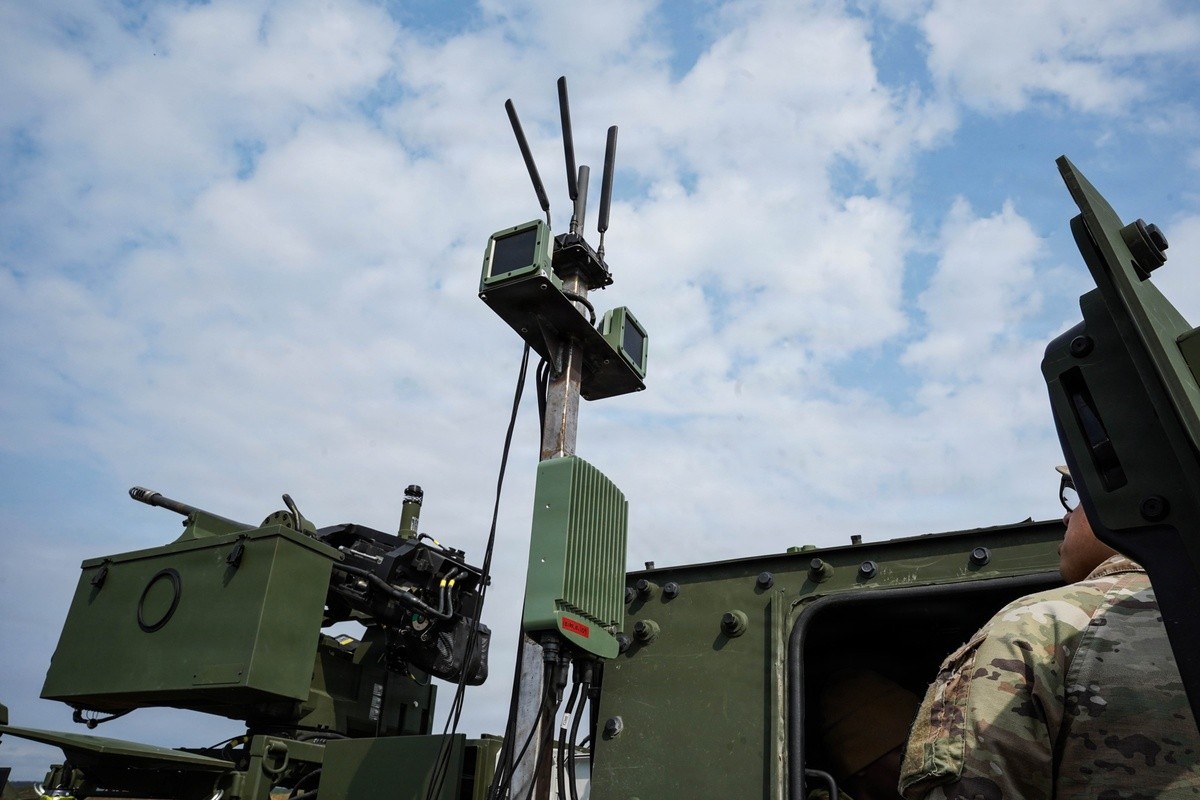
“With this ammunition, instead of just one maybe getting hit, you’ve got a much higher chance of multiple target being affected,” he said. “It makes it a lot easier, especially on the gunner.”
Beyond testing equipment, T.I.E. Battery Soldiers also work directly with maneuver units, helping integrate air defense capabilities into broader battlefield operations. They serve as technical advisors, translating complex systems into practical battlefield application for infantry and cavalry units.
“We get hands-on with these systems and become experts,” Hintz said. “Then we can go out and help other units understand how to use them effectively.”
Hintz continued, because his team is highly experienced with various air defense technologies, they serve as mentors to maneuver units, like infantry. Even though those units are experts in ground combat, they often have zero background in air defense. The T.I.E. Battery Soldiers bridge that gap by teaching these infantrymen how to think and operate like air defenders.
Even with that advisory role, the focus remains grounded in the Soldiers themselves—the people closest to the equipment and closest to the fight.
“It puts the power back in the hands of the Soldiers,” Hintz said. “At the end of the day, they’re the ones who are going to use these systems, so their input matters most.”

For Trowbridge and Braynen, that responsibility carries weight. They understand that the systems they test today could shape the Army’s air defense capabilities for years to come.
“We’re trying to pave the way for future air defenders,” Braynen said. “Not just for air defense, but for the Army as a whole.”
As the Army continues to adapt to a battlefield increasingly defined by speed, drones, and rapidly evolving threats, T.I.E. Battery represents a shift in how innovation happens—driven less by distance from the fight, and more by those standing closest to it.
“We’re the ones actually boots on the ground testing the equipment,” Braynen said. “That’s why they care about our opinion so much.”
Social Sharing