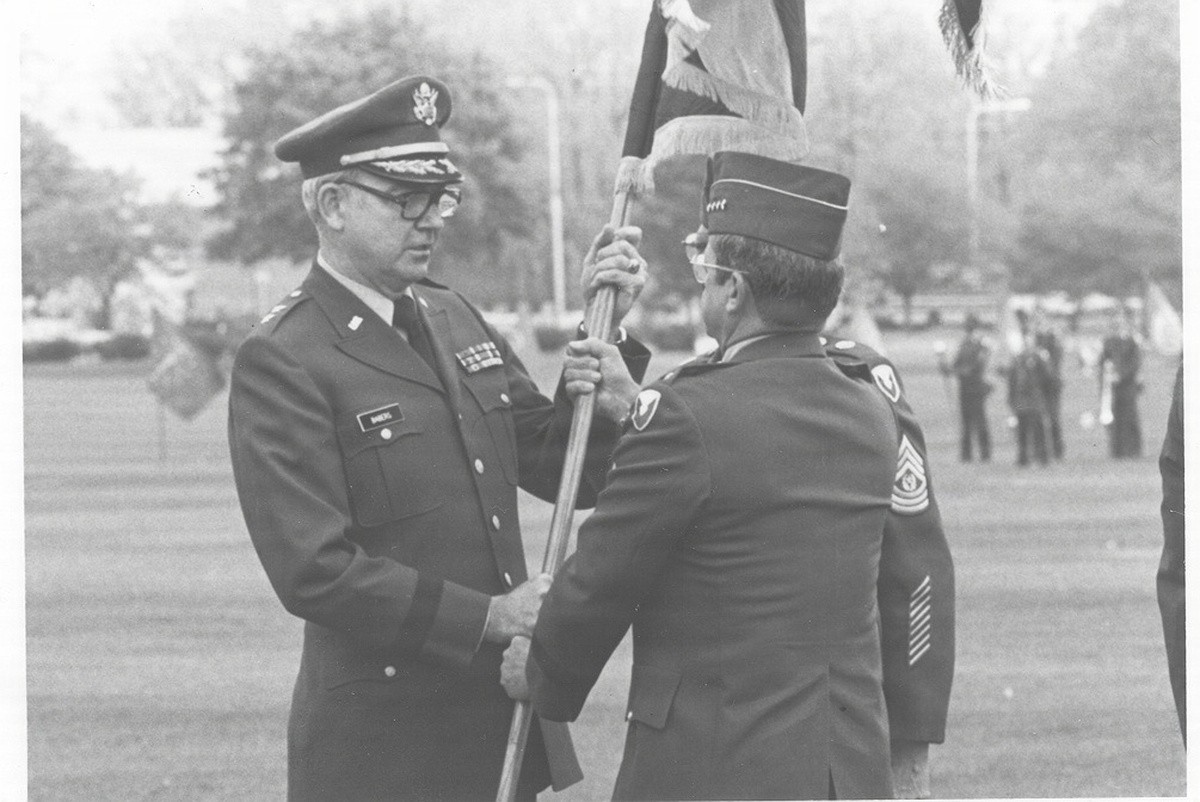
May 1, 2026, marks the 45th birthday of the Communications-Electronics Command (CECOM). Throughout its history, responsibilities and organizations have been gained and lost, but the mission of supporting C5ISR readiness for Soldiers remains unchanged.
CECOM traces its roots to the Army’s establishment of Fort Monmouth, New Jersey as a Signal Training Camp in 1917. The installation earned a reputation as the “Home of the Signal Corps” with Chief Signal Officer activities such as the Signal Corps Laboratories and Signal Corps School located at the fort.
Army reorganizations in 1962 meant that Signal Corps activities at Fort Monmouth would be split amongst the Continental Army Command, the newly formed Combat Development Command, and Army Materiel Command. As of August 1, 1962, Fort Monmouth was no longer a Signal Corps installation but an installation of AMC and its newly organized subordinate component, the U.S. Army Electronics Command (ECOM).
ECOM assumed responsibility for oversight of the Army organizations charged with the development, procurement, and support of Army signal materiel. These organizations included, most notably, the Signal Corps Laboratories and the Signal Materiel Support Agency at Fort Monmouth (where ECOM had its headquarters), and the Signal Supply Agency in Philadelphia, Pennsylvania. Specifically, the new command was responsible for research, design, development, product, and maintenance engineering, industrial mobilization planning, new equipment training, wholesale inventory management, supply control, and technical assistance to users of Army commodities involving communications, electronic warfare, combat surveillance, automatic data processing, radar, and meteorological materiel.
ECOM was relatively short-lived. The Secretary of the Army established the Army Materiel Acquisition Review Committee (AMARC) to improve the Army's materiel acquisition procedures. The committee’s report, released in April 1974, summarized that the Army’s commodity command structure, with its emphasis on "readiness," limited the Army's flexibility and impeded the acquisition process. The committee recommended that research and development functions be separated from "readiness" functions.
AMARC established a two-for-one split for most major subordinate commands of AMC. For ECOM, though, it proposed the establishment of four new organizations: the Communications-Electronics Materiel Readiness Command (CERCOM), the Communications Research and Development Command (CORADCOM), the Electronics Research and Development Command (ERADCOM), and the Avionics Research and Development Activity (AVRADA), a component of the new Aviation Research and Development Command. AMARC soon failed. Reassessment of the changes begun in August 1980 concluded that while the emphasis on R&D had increased as desired, there was also excessive duplication of effort. AMC combined CERCOM and CORADCOM to form the new Communications-Electronics Command, effective May 1, 1981. CECOM was headquartered at Fort Monmouth, New Jersey.
A new Software Development and Support Center came into being as part of the CECOM R&D Center in October 1984. The CECOM Software Engineering Directorate (SED) gained significant new assets and missions between 1996 and 1997. The directorate was elevated to a center and officially became the CECOM Software Engineering Center (SEC) on October 1, 1997. The SEC was renamed in January 2026 to the Army Software & Innovation Center (ASIC). ASIC is the premier organization providing rapid delivery of modern full-stack and Low Code / No Code software, DevSecOps - Platform, rapid electromagnetic warfare reprogramming, artificial intelligence, and operational readiness support to Soldiers, Portfolio Acquisition Executives, Capability Program Executives, Program Managers, and other government organizations
The Defense Reorganization Act of 1986 required the restructuring of the Army’s organization for acquiring materiel. The Department of the Army created the Army Acquisition Executive and the Program Executive Offices in fiscal year 1987. The creation of the AAE/PEO removed the Headquarters Army Materiel Command and its major subordinate commands from acquisition-related decision making and review processes.
CECOM supported three of the newly created PEOs: PEO Communications Systems (PEO COMM), PEO Command and Control Systems (PEO CCS), and PEO Intelligence and Electronic Warfare Systems (PEO IEWS). Fiscal year 1988 represented the first full year that the PEO functioned as separate organizations. Today, CECOM continues to support the newly designated Capability Program Executives which replaced PEOs, specifically CPE Command and Control Information Network (C2IN) and CPE Intelligence and Spectrum Warfare (ISW).
The reorganization of the acquisition processes spurred the CECOM commander to create a CECOM Logistics and Readiness Center (LRC) to integrate all the command’s logistics and readiness elements based on support to the weapon system and the Soldier, rather than on a functional basis. The LRC was provisionally established on November 10, 1987. The LRC was renamed by the CECOM commander as the Integrated Logistics Support Center (ILSC) August 1, 2016. Today, the ILSC mission supports warfighters by delivering premier logistics expertise and innovative solutions, ensuring mission readiness by integrating C5ISR-M capabilities across all domains.
The U.S. Army Information Systems Engineering Command (USAISEC) at Fort Huachuca, Arizona was realigned as a subordinate command of CECOM as of October 1, 1996. USAISEC provides systems engineering, installation, integration, implementation, and evaluation support for communications and information technology systems worldwide providing capabilities to Army organizations, combatant commanders, DoW agencies, and federal agencies in support of the warfighter. USAISEC engineers high priority strategic and operational C5ISR solutions to enable Army Digital Transformation.
AMC assigned CECOM control of Tobyhanna Army Depot (TYAD) in Pennsylvania on November 1, 1997. The TYAD mission has expanded to provide advanced manufacturing capabilities in support of the Army’s mission. TYAD provides world-class logistics support for C5ISR systems across the Army and joint forces, including sustainment, overhaul and repair, fabrication and manufacturing, and engineering design and development.
The research and development mission which had been a major function of CECOM since 1981 was realigned when the AMC commander directed the establishment of a Research, Development, and Engineering Command (RDECOM). RDECOM stood up, provisionally, on October 1, 2002. The mission of this new command was to field technologies that sustained America’s Army as the premier land force in the world. Operational control of the MSC R&D activities (such as the CECOM Research, Development, and Engineering Center) transferred to RDECOM effective May 1, 2003. The command became official on March 1, 2004, when the Department of the Army approved the RDECOM concept plan. The CECOM Research, Development, and Engineering Center (CECOM RDEC) became the RDECOM Communications-Electronics Research, Development, and Engineering Center (RDECOM CERDEC). Today, those capabilities rest in the Combat Capabilities and Development Command (DEVCOM) C5ISR Center, under the Transformation and Training Command (T2COM).
CECOM assumed control of the Central Technical Support Facility (CTSF) at Fort Hood, Texas, on July 9, 2007. The CTSF served as one of the Army's premier testing Centers of Excellence for ensuring system compliance with DoD net-centric concepts and directives. The U.S. Army's Central Technical Support Facility officially cased its colors on April 28, 2025, marking its deactivation after over 29 years of service. The facility specialized in ensuring equipment interoperability and secure data sharing for Soldiers, with its closure representing a shift toward modern digital testing methods.
The CECOM flag departed Fort Monmouth for Aberdeen Proving Ground, Maryland, on September 10, 2010, per a 2005 Base Realignment and Closure Commission decision. The CECOM colors were uncased at the CECOM Headquarters on the new C4ISR Campus at Aberdeen Proving Ground, Maryland in October 2010.
In 2020, the U.S. Army Medical Logistics Command (AMLC) underwent a significant structural change, transitioning to become a subordinate command under CECOM. This realignment, which began in mid-2020, aimed to leverage CECOM’s expertise to enhance medical materiel readiness, improve supply chain efficiencies, and better support the warfighter. AMLC is the Army's primary medical logistics and sustainment command, responsible for managing the global supply chain and medical materiel readiness across the total force. Embracing its role as the life-cycle management command for medical materiel, CECOM ILSC added the new Medical Systems Directorate to its portfolio on October 1, 2025.
Today, CECOM, and its five major subordinate commands, ASIC, ILSC, ISEC, TYAD, and AMLC, is the Army’s one-stop shop for Command, Control, Communications, Computers, Cyber, Intelligence, Surveillance and Reconnaissance and medical sustainment, seamlessly integrating advanced software solutions, cyber protection, AI-powered logistics, forward repair capabilities, and critical medical logistics ensuring operational readiness from the digital domain to the battlefield.
Social Sharing