
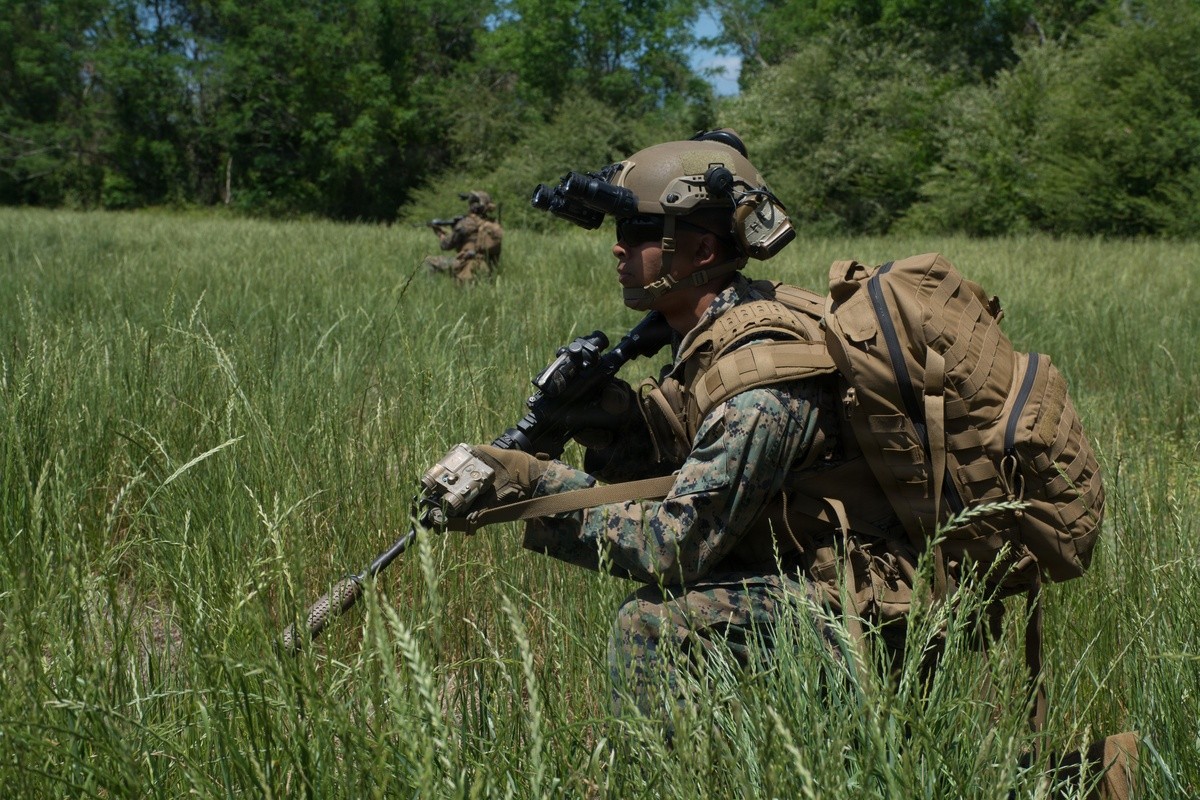

FORT RUCKER, Ala. — U.S. Marines preparing for a deployment descended on a Fort Rucker training field to rescue Soldiers role-playing as the crew of a downed helicopter April 16.
The exercise, known as a Tactical Recovery of Aircraft and Personnel (TRAP), was executed by the 24th Marine Expeditionary Unit (MEU) at Fort Rucker training field outside of Louisville Ala. The training relied on logistical and role-playing support from Army personnel, providing a unique opportunity for the two services to work together.

Army planners from the Aviation Center of Excellence (AVCOE) coordinated with the MEU to arrange for training locations and personnel. "We had a lot of conversations... to make sure that the Marine Corps had everything that they needed so it was a successful exercise," said Capt. Annette Gonzales, a logistics officer from AVCOE. "Being able to conduct these kind of exercises and work together with the Marine Corps, and the Army, it's really important."

The scenario involved a platoon of Marines searching for three Soldiers representing the crew of a crashed UH-60 Blackhawk helicopter. For the Army participants, it was a practical application of their own survival training and a look at inter-service cooperation.
"A lot of our fighting will be joint, if not all of it," said 1st Lt. Walter Harper, an Army flight student who played one of the downed aviators. "Being able to harness those capabilities through ground, air, [and] sea, between forces... it's the way forward for future fighting and I think that's extremely important for us to be practicing here today."
After the Marines located and secured the role-players, they were flown to Fort Rucker’s “Dustoff” medical training facility and released, to be replaced by some specialized training dummies. There, Army training staff oversaw the Marine medical teams as they practiced treating simulated injuries on the life-like mannequins, providing evaluation and feedback.
For the Marines, the exercise was a critical test of their ability to conduct long-range missions in unfamiliar terrain ahead of a deployment.

"It's easy to simulate, hey, you're going in the backyard," said Marine Capt. Griffin McCurren, the assistant air officer for the 24th MEU. "But [it's another thing] to actually... put boots on the ground, you know, hundreds of miles away... and really having to strain that command and control structure."
He added that working with the Army adds a significant layer of realism. "When it comes to personnel recovery, we're ready to do that for any American air crew or joint force partner. So I think the fact that they're Army adds so much more realism to it."

Upon completing the training event, the Marines returned to their base at Camp Lejeune, NC.
Social Sharing