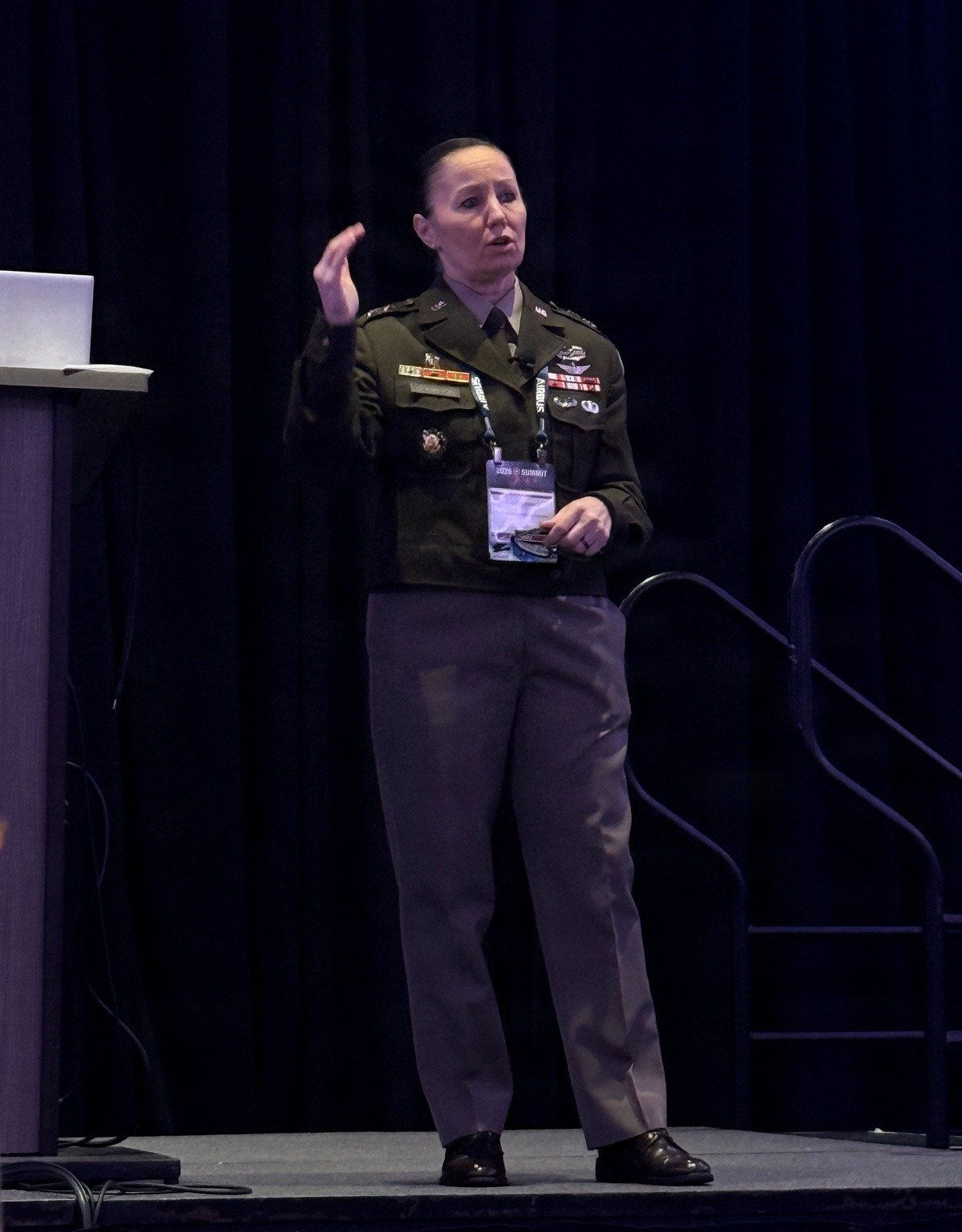
Maj. Gen. Lori Robinson, commanding general of the U.S. Army Aviation and Missile Command, emphasized sustainment, readiness and modernization during remarks to Army National Guard aviation personnel at the Army Aviation Association of America Warfighting Summit.
Speaking candidly, Robinson acknowledged the complexity of current challenges while underscoring the Army’s focus on prioritizing resources.
“I don’t know that anyone will always have a great answer for every one of your questions,” Robinson said. “But we are working toward taking every dollar we have and putting it in the right spot. Where we put our dollars matters.”
Robinson highlighted ongoing aviation restructuring efforts and the deliberate pace required to balance modernization with readiness. While some units have pushed for faster transitions, she said the Army is working to avoid disruption.
“We don’t want this to be a chaotic transformation,” she said. “We’re trying to make sure the platforms that divest do so along a timeline that makes sense for the entire Army.”
A key theme of Robinson’s remarks was sustainment of legacy aircraft, particularly the UH-60 Black Hawk fleet.
She stressed the importance of maintaining aircraft through the end of their service life.
“Until their last day, we are going to sustain it properly,” she said.
Robinson also pointed to a broader effort to strengthen the Army’s organic industrial base, including depots and National Guard aviation support facilities.
“There is a realization that we have underinvested in the organic industrial base,” she said. “There is a willingness and a desire to modernize it so it can sustain the platforms we have over the long term.”
She encouraged a more global approach to supply chains, noting the widespread use of Black Hawk aircraft beyond the Army.
“If we only think about supply inside the Army, we limit ourselves,” Robinson said. “There are Black Hawks all over the world, and we need to think more broadly about how we sustain them.”
She noted that while supply shortages exist, maintenance factors often have a greater impact on readiness.
“We see maintenance as a significant driver,” Robinson said. “Time spent working on aircraft and the tools available to maintainers matter.”
To address these issues, Robinson said AMCOM is working to improve digital maintenance systems and tools, including aviation maintenance software and data integration across the force.
“We are not going back to paper logbooks,” she said. “We are going to invest in the systems we have and make them better.”
Looking ahead, Robinson outlined preparations for the Army’s Future Long-Range Assault Aircraft, designated MV-75 Cheyenne II, emphasizing the need to adapt sustainment systems for new technologies.
“We’re trying to learn every lesson we can now to buy down risk,” she said. “This platform is different — from composite materials to digital engineering — and we have to be ready to support it.”
Robinson concluded by reinforcing the importance of balancing modernization with sustainment across the aviation enterprise.
“When we talk about sustainment, it’s not just parts,” she said. “It’s the entire lifecycle of the platform — modernization, maintenance and readiness. That’s what keeps the force flying.”
Social Sharing