FORT BELVOIR, Va. -- Army leadership, industry partners and members of the defense community gathered in Huntsville, Ala., from March 24-26, 2026, to attend The Association of the United States Army’s 2026 Global Force Symposium & Exposition.
The theme this year was Delivering Victory: Leveraging the Army's Industrial Might. Attendees examined how the Army is achieving ongoing transformation through acquisition innovation, operational experimentation and cross-domain collaboration.
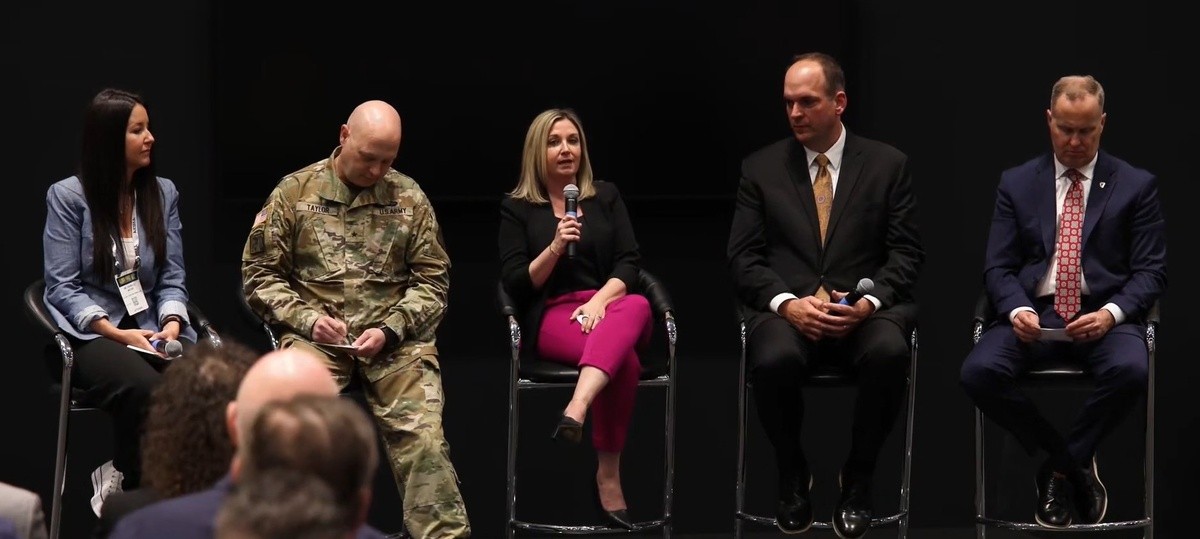
The panel on day 2, Warrior’s Corner - Acquisition at Speed—Filling Gaps and Cutting Red Tape, focused on acquisition innovation, reducing bureaucracy and filling capability gaps. Panelists spoke about the various ways in which industry can partner with the Army. Panelists included:
- Ms. Miranda Coleman, Acting Capability Program Executive, Enterprise Software and Services, United States Army
- Mr. Richard A. Martin, Assistant Deputy Chief of Staff, Supply Chain Management, G-3, United States Army Materiel Command
- Ms. Danielle M. Moyer, Executive Director, United States Army Contracting Command - Aberdeen Proving Ground
- Mr. Nicholaus H. Saacks, Deputy to the Commanding General, United States Army Communications-Electronics Command
- Brig. Gen. Shane Taylor, Capability Program Executive, Command and Control Information Network, United States Army
Army Open Solicitation
Moyer began the session by speaking about the Army Open Solicitation (AOS), a continuously open contracting vehicle designed to solicit and receive innovative technology submissions from across industry. She said that when industry representatives see a capability gap, they can submit a solution on AOS and the United States Army Contracting Command will review the solution.
AOS enables the Army to rapidly acquire and deliver innovative solutions to the Soldier using commercial technology and research and development solutions.
Public-Private Partnerships
Moyer noted that the Army uses public-private partnerships, a tool that combines public oversight with private sector efficiency. Public-private partnerships allow the government to be a subcontractor to a prime contractor, and Saaks added that they give the contractor an opportunity to develop a product in the DevSecOps environment. The contractor inherits the security that is already in the environment, allowing solution development to move faster.
Bailment Agreements
If companies have a new capability that they want to get into the hands of Soldiers to test, they do not have to wait for a solicitation. Moyer explained that the Army uses bailment agreements, which allow industry to give the Army its product to use at the company’s own risk. The Army will provide feedback on the product, and it will be up to the company to implement the Army’s recommendations.
Enterprise Contracts
Enterprise contracts are another innovative solution that creates a more direct method for industry to get their products in front of interested parties. Moyer noted how phenomenal enterprise contracts are because they “help streamline negotiations between the Army and industry.” Rates, rights and agreements have already been predetermined.
There are 40 enterprise contracts in queue, and 16 have been implemented so far. Moyer added that if a vendor proposes something new, then they should try to leverage something that already exists somewhere else in the Army. “Leverage what we have or what we’re already using,” she said. Brig. Gen. Taylor added, “We are interested in what you’re good at. We’re interested in your core competencies and what makes you unique.”
Within CPE ES2, Coleman spoke about a more modular contracting approach. In the past, CPE ES2 issued large solicitations for programs that took years to deliver. Now, Coleman said, “we are breaking up those requirements into smaller chunks and putting out smaller calls for solutions.” This will enable CPE ES2 to deliver those capabilities quicker and, as software changes and emerges, “we have the opportunity to select the best option for the capabilities.”
Coleman said that these modernized contracting methods have “been a great approach for our teams.” Enterprise contracts have allowed CPE ES2 to field software and work with users faster, delivering the capabilities they need.
Like the other panelists, Coleman observed that sometimes “industry sees our gaps better than we do because our teams are very close to the product. When we get feedback from industry, we can see innovations from the industry’s perspective.”
Martin added that industry “can tell us where we might have a problem and can help with solutions.” CPE ES2 teams can work with industry to help identify problems and create solutions. “Adaptability is key because it keeps us and industry focused on gaps,” Martin said.
CPE ES2 wants to change how the organization forecasts. Normally, the organization puts out a two-year forecast, but Coleman wants her team to rethink that process. She wants to bring in industry to show them current capabilities.
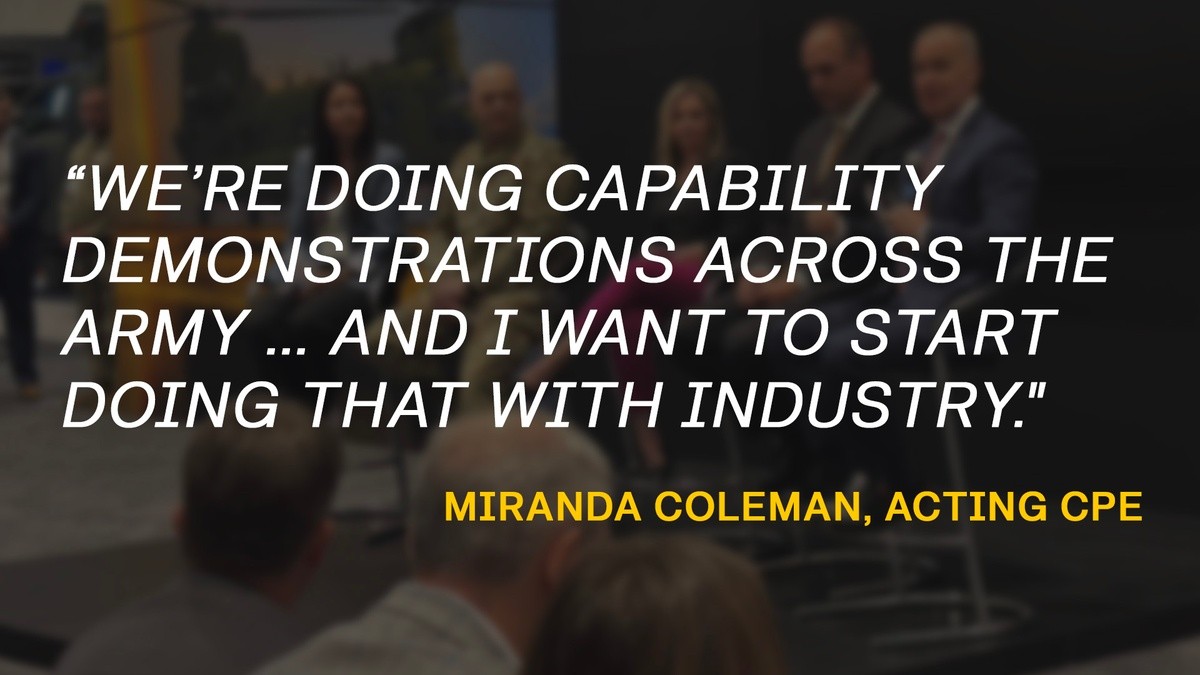
“We’re doing capability demonstrations so that internal Army teams can see the capabilities that we are delivering to Soldiers,” Coleman said. “I want to start doing that with industry. It’s important for us to showcase our software and how that software is changing Soldiers’ lives.”
Software can make Solders’ lives easier, but CPE ES2 teams don’t want to ignore the digital burden. Coleman said that we ask Soldiers to input data into systems that we are not automating yet. “We think that we are making their days easier, but sometimes we’re not. We want to figure out how to streamline daily tasks so that we aren’t collecting data to have at a higher level; that automation takes the digital burden off the Soldier.”
Alleviating the digital burden and identifying innovative approaches to acquisitions will enable Soldiers to maintain focus on their daily responsibilities and overarching mission objectives.
Social Sharing