

ADELPHI, Md. – Army partnerships with university researchers can unlock academia’s potential for supporting America’s industrial growth and warfighter readiness.
The U.S. Army Combat Capabilities Development Command, known as DEVCOM, Army Research Laboratory is positioned as the scientific nexus between academia, industry and the Army. ARL harnesses the expertise of Army researchers and the creative energy of enterprising external partners to inspire the creation of new technologies.
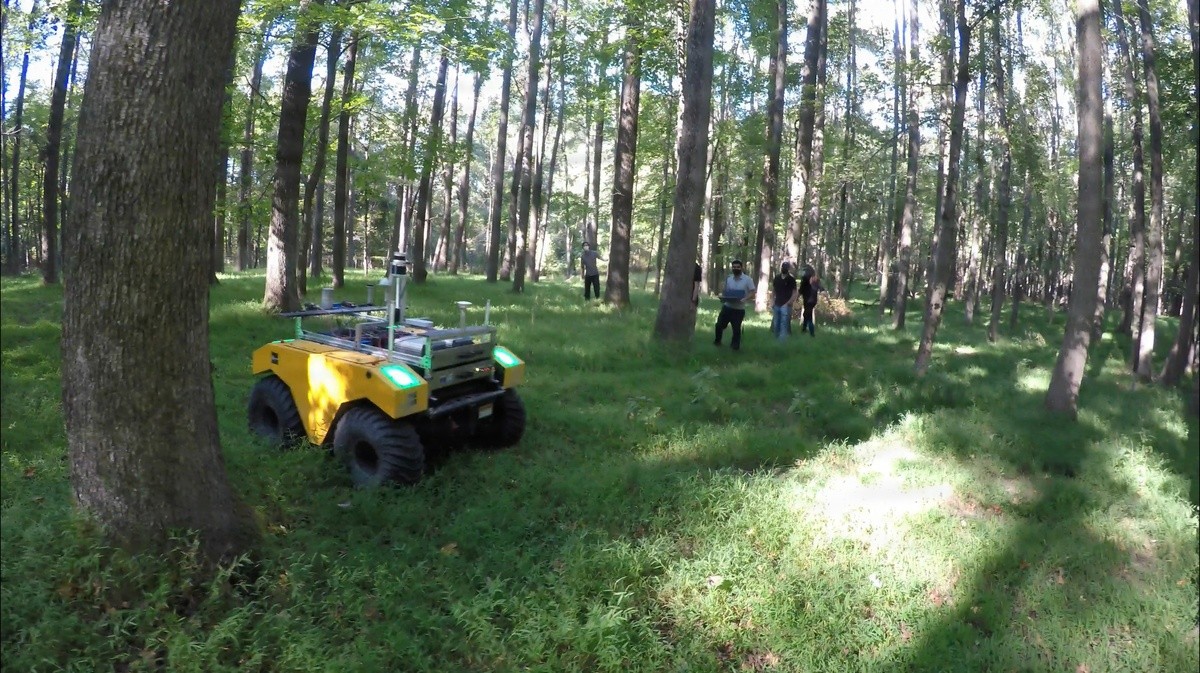
As an example, autonomy researcher Dr. Byron Boots began his partnership with ARL while he was an assistant professor before he transformed his research on self-driving robotic vehicles into a tech startup called Overland AI.
Boots collaborated with ARL for years on fundamental research relevant to the Army’s biggest challenges in autonomous navigation in rugged and unpredictable terrains.
In 2022, Boots co-founded Overland AI, a university spinoff dedicated to developing ground autonomy solutions and other robotic capabilities for defense. Three years later, his company showcased its latest technology as part of Project Convergence Capstone 5, the Army’s premier technology experimentation event.
“We approached Byron in 2018 at an IEEE conference where he was showcasing his machine learning research on small radio-controlled cars,” said Dr. Ethan Stump, ARL autonomy scientist. “We saw how relevant his work could be for Army off-road autonomy, so we invited him to work with us to apply his research on military unmanned ground vehicles, and he agreed.”
This example showcases how academia and industry, and especially small businesses, can benefit from conducting fundamental research with ARL to help transition Army-relevant research into commercial ventures.
For years, ARL worked closely with the Defense Advanced Research Projects Agency, or DARPA, to spearhead the advancement of off-road autonomous driving research in industry and academia. Boots was one of the many university researchers to whom ARL introduced a range of terrain scenarios that Army ground vehicles would have to maneuver in real life.
“In the Army, the ground is complicated and offers a lot of environmental threats,” Stump said. “We exposed Byron and his students to terrain-relevant challenges through datasets and experiments, and we tackled these challenging terrains together.”
As a research partner, Boots was also able to leverage ARL’s collection of advanced sensor and software capabilities for autonomous maneuver. With this resource, ARL’s academic partners working on artificial intelligence technologies can concentrate on fundamental research in their area of specialty without worrying about having the right scientific equipment for performance tests and field trials.
“In academia, you’re often limited by what your grad students can pull together, while a lot of available autonomy software for commercial applications make assumptions that don’t always hold in Army environments, such as the existence of infrastructure like roads,” Stump said. “Our software is specialized to allow for experimenting in Army-relevant environments and acts as a good foundation for supporting research that can capitalize on all the investments that the Army has made.”
In 2023, Boots commented on the fundamental nature of ARL’s role after his team won first place in the initial rounds of DARPA’s Robotic Autonomy in Complex Environments with Resiliency competition.
“ARL has often led the way, introducing difficult off-road autonomy challenges and funding basic exploratory research on perception, planning and control,” Boots said. “Our DARPA RACER team has built on this work, with the high pace of…DARPA research serving as a catalyst to mature the more basic research into a working TRL 5-6 prototype.”
With another industry partner now more poised to support the Army’s specific needs, ARL continues to strengthen its ties with other university collaborators in the hopes of transforming more leading minds in academia into mission-informed innovators ready to deliver technological solutions for the warfighter.
“This collaboration is an example of how ARL can help both the Army and universities better understand the gaps in operational ground autonomy,” Stump said. “Our successes showed that it is possible to solve these difficult Army-relevant problems. We are always looking for partners like Byron to help move Army capability forward from scientific research to actual technologies.”
━━━━━━━━━━━━━━━━━━━━━━━
DEVCOM ARL is the Army’s sole fundamental research laboratory serving as the nexus of science between the military, academia and industry. Operating under U.S. Army Futures Command and the U.S. Army Transformation and Training Command, ARL executes globally recognized research to accelerate delivery of war-winning, disruptive technologies for tomorrow’s Army.
For information, visit the Army Research Laboratory website.
Social Sharing