1 / 9Show Caption +Hide Caption –
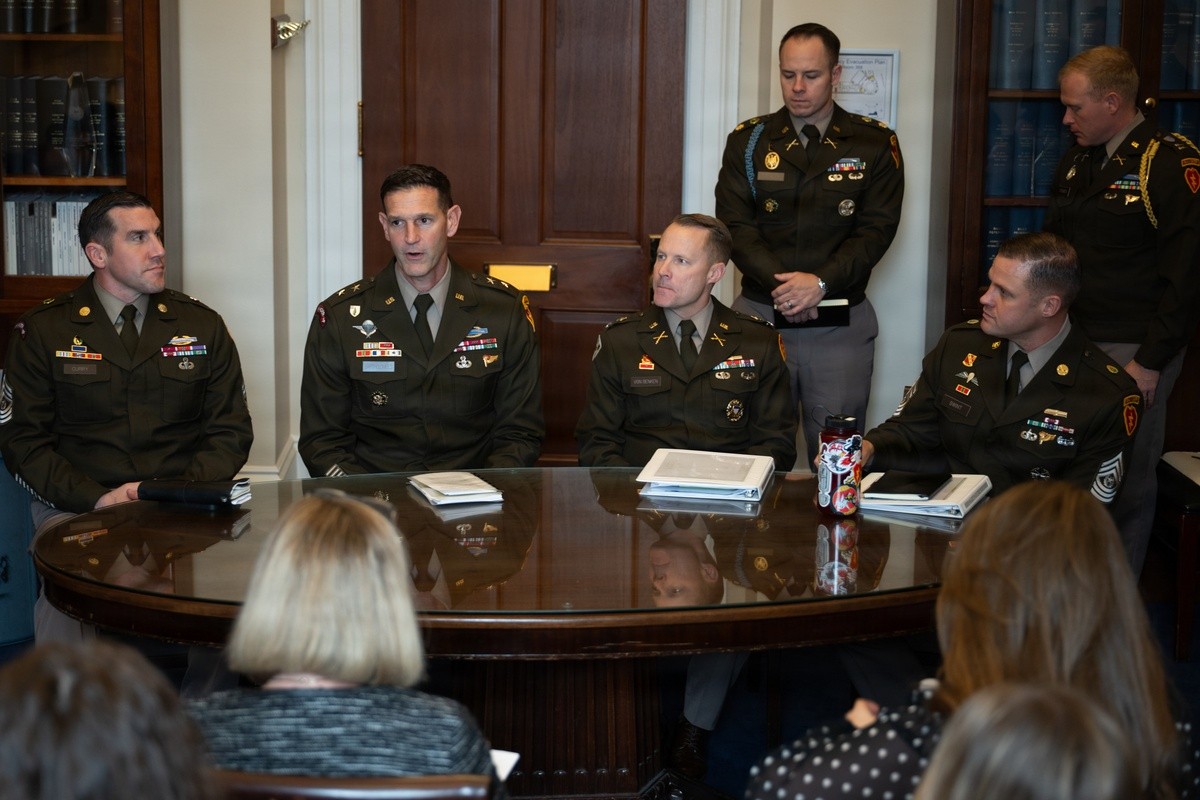
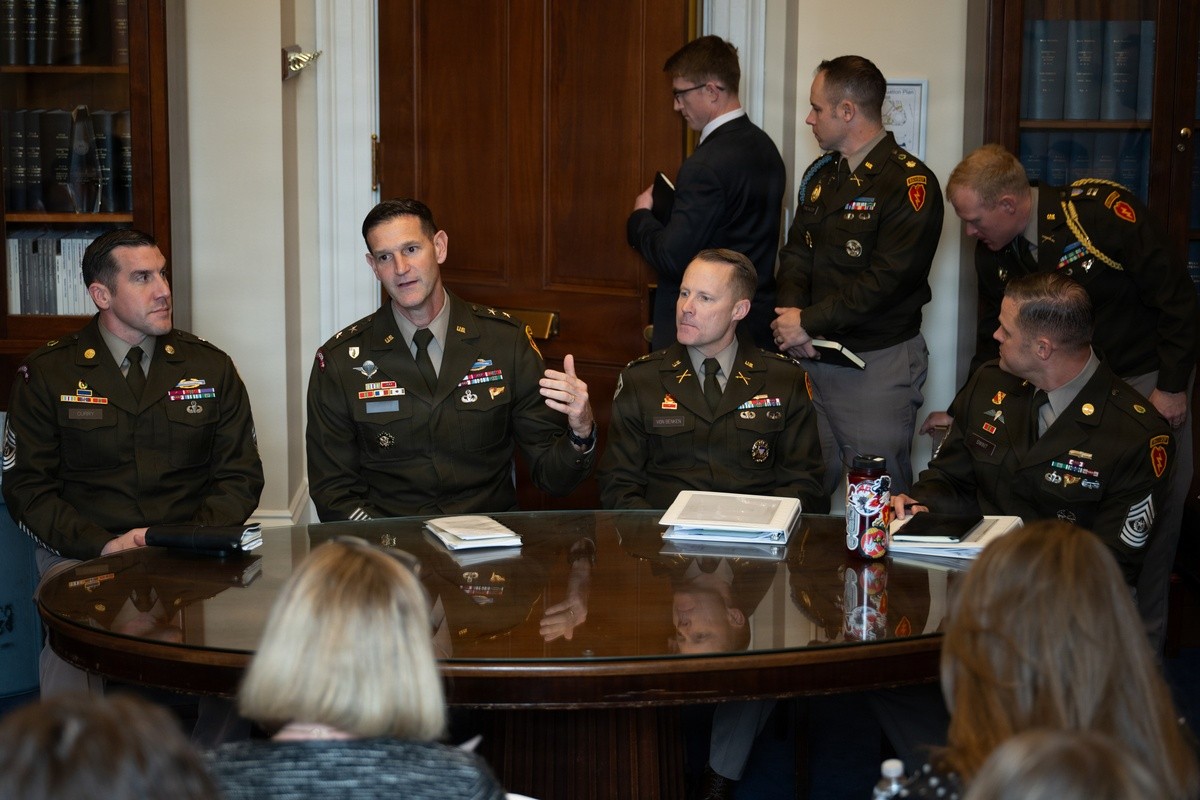
U.S. Army Maj. Gen. James Bartholomees, commanding general, 25th Infantry Division (25ID), and Col. Daniel J. Von Benken, commander, 25ID Artillery, discuss 25ID’s transformation efforts at the Army Current Operations Engagement Tour (ACOET), Cannon House Office Building, Washington, D.C., March 25, 2026. 25ID is accelerating Army transformation in the Indo-Pacific by integrating long-range fires, unmanned systems and networked sensing capabilities to operate effectively across diverse environments. (U.S. Army photo by Sgt. Tien Dat Ngo)
(Photo Credit: Sgt. Tien-Dat Ngo)VIEW ORIGINAL2 / 9Show Caption +Hide Caption –
U.S. Army Maj. Gen. James Bartholomees, commanding general, 25th Infantry Division (25ID), discusses 25ID’s transformation efforts at the Army Current Operations Engagement Tour (ACOET), Cannon House Office Building, Washington, D.C., March 25, 2026. 25ID is accelerating Army transformation in the Indo-Pacific by integrating long-range fires, unmanned systems and networked sensing capabilities to operate effectively across diverse environments. (U.S. Army photo by Sgt. Tien Dat Ngo)
(Photo Credit: Sgt. Tien-Dat Ngo)VIEW ORIGINAL3 / 9Show Caption +Hide Caption –
25th Infantry Division (25ID) command team discusses 25ID’s transformation efforts at the Army Current Operations Engagement Tour (ACOET), Cannon House Office Building, Washington, D.C., March 25, 2026. 25ID is accelerating Army transformation in the Indo-Pacific by integrating long-range fires, unmanned systems and networked sensing capabilities to operate effectively across diverse environments. (U.S. Army photo by Sgt. Tien Dat Ngo)
(Photo Credit: Sgt. Tien-Dat Ngo)VIEW ORIGINAL4 / 9Show Caption +Hide Caption –
25th Infantry Division (25ID) command team discusses 25ID’s transformation efforts at the Army Current Operations Engagement Tour (ACOET), Cannon House Office Building, Washington, D.C., March 25, 2026. 25ID is accelerating Army transformation in the Indo-Pacific by integrating long-range fires, unmanned systems and networked sensing capabilities to operate effectively across diverse environments. (U.S. Army photo by Sgt. Tien Dat Ngo)
(Photo Credit: Sgt. Tien-Dat Ngo)VIEW ORIGINAL5 / 9Show Caption +Hide Caption –
25th Infantry Division (25ID) command team discusses 25ID’s transformation efforts at the Army Current Operations Engagement Tour (ACOET), Cannon House Office Building, Washington, D.C., March 25, 2026. 25ID is accelerating Army transformation in the Indo-Pacific by integrating long-range fires, unmanned systems and networked sensing capabilities to operate effectively across diverse environments. (U.S. Army photo by Sgt. Tien Dat Ngo)
(Photo Credit: Sgt. Tien-Dat Ngo)VIEW ORIGINAL6 / 9Show Caption +Hide Caption –
25th Infantry Division (25ID) command team discusses 25ID’s transformation efforts at the Army Current Operations Engagement Tour (ACOET), Cannon House Office Building, Washington, D.C., March 25, 2026. 25ID is accelerating Army transformation in the Indo-Pacific by integrating long-range fires, unmanned systems and networked sensing capabilities to operate effectively across diverse environments. (U.S. Army photo by Sgt. Tien Dat Ngo)
(Photo Credit: Sgt. Tien-Dat Ngo)VIEW ORIGINAL7 / 9Show Caption +Hide Caption –
U.S. Army Maj. Gen. James Bartholomees, commanding general, 25th Infantry Division (25ID), and Col. Daniel J. Von Benken, commander, 25ID Artillery, discuss 25ID’s transformation efforts at the Army Current Operations Engagement Tour (ACOET), Cannon House Office Building, Washington, D.C., March 25, 2026. 25ID is accelerating Army transformation in the Indo-Pacific by integrating long-range fires, unmanned systems and networked sensing capabilities to operate effectively across diverse environments. (U.S. Army photo by Sgt. Tien Dat Ngo)
(Photo Credit: Sgt. Tien-Dat Ngo)VIEW ORIGINAL8 / 9Show Caption +Hide Caption –
U.S. Army Command Sgt. Maj. Sean Swint, 25th Infantry Division (25ID) Artillery, discusses 25ID’s transformation efforts at the Army Current Operations Engagement Tour (ACOET), Cannon House Office Building, Washington, D.C., March 25, 2026. 25ID is accelerating Army transformation in the Indo-Pacific by integrating long-range fires, unmanned systems and networked sensing capabilities to operate effectively across diverse environments. (U.S. Army photo by Sgt. Tien Dat Ngo)
(Photo Credit: Sgt. Tien-Dat Ngo)VIEW ORIGINAL9 / 9Show Caption +Hide Caption –
U.S. Army Maj. Gen. James Bartholomees, commanding general, 25th Infantry Division (25ID), discuss 25ID’s transformation efforts at the Army Current Operations Engagement Tour (ACOET), Cannon House Office Building, Washington, D.C., March 25, 2026. 25ID is accelerating Army transformation in the Indo-Pacific by integrating long-range fires, unmanned systems and networked sensing capabilities to operate effectively across diverse environments. (U.S. Army photo by Sgt. Tien Dat Ngo)
(Photo Credit: Sgt. Tien-Dat Ngo)VIEW ORIGINAL
WASHINGTON — The 25th Infantry Division is accelerating Army transformation in the Indo-Pacific by integrating long-range fires, unmanned systems and networked sensing capabilities to operate effectively across diverse environments.
Maj. Gen. James Bartholomees, commanding general of the 25th Infantry Division, said the division has focused its transformation efforts on enabling forces to “see, sense and strike at distance,” particularly in complex environments such as the Philippines.
Under Division Artillery (DIVARTY), the division transitioned from traditional cannon-based formations to long-range precision fires, significantly increasing its ability to strike across extended distances. Within months, units fielded High Mobility Artillery Rocket Systems, or HIMARS, to support distributed operations.
“In about 180 days, we went from a towed cannon battalion to a long-range fires battalion with 16 HIMARS weapon systems,” said Col. Daniel Von Benken, division artillery commander. “We can now do the things that we said we needed to do.”
1 / 2Show Caption +Hide Caption –
A U.S. Army Forward Observer with the 25th Infantry Division Artillery uses the Next Generation Command and Control prototype to send a digital fire mission from an observation post during Lightning Surge 2 at Schofield Barracks, Hawaii, Feb. 25, 2026. This action represents the "first mile" of the digital kill chain, where soldiers use new technology to instantly transmit target data instead of relying on voice commands over a radio. This soldier-led feedback is helping the Army build more effective and intuitive capabilities for the future fight.
(Photo Credit: U.S. Army photo by Lt. Col. Hayden Howell)VIEW ORIGINAL2 / 2Show Caption +Hide Caption –
High Mobility Artillery Rocket System (HIMARS) launchers assigned to the 25th Infantry Division are staged on the flight line after being unloaded from a U.S. Air Force C-5 Galaxy at Joint Base Pearl Harbor-Hickam, July 14, 2025. This transformation enhances the division's Long-Range Precision Fires capability and strengthens its lethality and warfighting readiness to ensure a Free and Open Indo-Pacific.
(Photo Credit: U.S. Army photo by Spc. Taylor Gray)VIEW ORIGINAL
Leaders said HIMARS provides a common launcher capable of firing a variety of munitions, allowing units to adapt to evolving operational requirements. This includes integration with emerging capabilities such as the Precision Strike Missile, or PrSM, designed to extend the Army’s long-range strike capacity.
“The benefit of the HIMARS is its capability — it’s a common launcher system,” Bartholomees said. “As we build more munitions over time, it provides a range of options so we can strike at a variety of distances.”
The transformation also included reorganizing personnel and creating new formations to integrate emerging technologies. Under DIVARTY, units repurposed Soldiers from traditional artillery roles into new capabilities, including formations focused on loitering munitions and one-way attack drones.
“So much like we repurposed a cannon battalion into a HIMARS battalion, we took a lot of our folks and created what’s called a Launched Effects battery,” Von Benken said. “That formation allows us to integrate loitering munitions and one-way attack drones to fill gaps between our capabilities.”
1 / 2Show Caption +Hide Caption –
A U.S. Army Soldier from A Battery, 5th Battalion, 3rd Field Artillery Regiment, 1st Multi Domain Task Force, conducts training on Pohakuloa Training Grounds, Hawaii, Nov. 4, 2022. Leaders across the joint force observed the M142 HIMARS during the Joint Pacific Multinational Readiness Center to enhance shared understanding of combined capabilities.
(Photo Credit: U.S. Army photo by Pfc. Mariah Aguilar)VIEW ORIGINAL2 / 2Show Caption +Hide Caption –
U.S. Army M142 HIMARS from A Battery, 5th Battalion, 3rd Field Artillery Regiment, 1st Multi Domain Task Force, conducts training on Pohakuloa Training Grounds, Hawaii, Nov. 7, 2022. Leaders across the joint force observed live fire from the M142 HIMARS during the Joint Pacific Multinational Readiness Center to enhance shared understanding of combined capabilities.
(Photo Credit: U.S. Army photo by Pfc. Mariah Aguilar)VIEW ORIGINAL
These systems complement long-range fires by providing additional options in contested environments, particularly during early contact with enemy forces.
“It’s not just about getting a rocket launcher into position,” Von Benken said. “It’s about how we fill those gaps with other types of munitions so the first time we make contact with an enemy force, it’s not a fighter jet.”
Leaders said experimentation has been critical to integrating these capabilities, allowing Soldiers to test emerging technologies and provide direct feedback to developers and acquisition professionals.
“They bring it out to us and we have to teach Soldiers how to use it,” said Command Sgt. Maj. John Curry, senior enlisted leader. “Those young Soldiers are testing it to see does this work for the person who’s actually going to use it.”
Capabilities that prove effective are then incorporated into training and multinational exercises across the Indo-Pacific, including operations in the Philippines, where U.S. forces train alongside regional partners in realistic environments.
“We walk them out to the Philippines on our campaign, while we use it in our campaigning exercises,” Curry said. “Our multinational partners are seeing what is possible inside of their own footprint.”
On June 16, 2024 3d Multi-Domain Task Force and 1-181 Field Artillery Regiment of the Tennessee National Guard employed the U.S. Army Autonomous Multi-Domain Launcher (AML) and the Precision Strike Missile (PrSM) as part of the Valiant Shield 24 Combined Joint SINKEX. The AML and PrSm engaged a maritime target alongside other joint assets during the SINKEX. The VS24 SINKEX is the first employment of both the AML and the PrSM outside of the U.S and is a significant milestone in the Army’s continuing development of long-range fires capabilities.
(Photo Credit: U.S. Army photo by Sgt. Perla Alfaro)VIEW ORIGINAL
Leaders said forward positioning and sustainment remain central to enabling operations across the region’s vast distances, with efforts focused on improving access, infrastructure and the ability to employ capabilities within theater.
“What we’re asking for is the ability to use, procure or build these capabilities in theater,” Curry said.
DIVARTY’s role in synchronizing fires, sensors and emerging technologies across the division has been central to the transformation effort. Leaders said integrating sensing capabilities such as radar, electronic warfare and intelligence systems with long-range fires enables a broader approach to targeting across dispersed formations.
“As we modernize, strike is important, but the sensing aspect is just as critical,” Von Benken said. “We are building the ability to see and sense at distance to enable those effects.”
Leaders said the pace of transformation has been enabled by flexible funding and rapid experimentation, allowing the division to adapt to emerging technologies and operational demands.
“Without the flexibility to do what we just described, we would not be able to move to the best technology,” Bartholomees said. “The technology is moving so fast that the old system will not work.”
Officials said the division’s efforts reflect how the Army is evolving to operate in the Indo-Pacific, where integrated fires, unmanned systems and networked capabilities are required to support distributed operations.
Bartholomees stated that continued experimentation with Soldiers, industry and partners will remain essential as the Army refines capabilities for future operations in the region.




Social Sharing