
REDSTONE ARSENAL, Ala. – At a pivotal moment in national defense transformation, Army Materiel Command is spearheading a revolutionary approach to military construction, repair and maintenance projects. Under legacy construction processes, projects are taking too long and often result in being over budget. As part of a Secretary of the Army-directed initiative to embrace commercial construction best business practices and innovative contracting methods, AMC is ensuring faster, more efficient delivery of critical facilities to support the warfighter.
For decades, military construction and repair projects have relied on traditional, often cumbersome processes that are costly and inflexible. Conventional contracting under the Federal Acquisition Regulation frequently results in lengthy timelines and limited opportunities for innovation. These legacy methods struggle to keep pace with rapidly evolving mission needs and emerging technologies, creating gaps in readiness and capability.
Recognizing these challenges, AMC is actively transforming its approach by embracing streamlined contracting mechanisms and commercial best practices that get better, faster results. Such methods have been used across the military services, but AMC is leading the Army in bringing these initiatives to bear under one program.
This includes transitioning from a traditional design-bid-build process to a more efficient design-build to budget model, similar to one successfully used by the Federal Bureau of Investigation. The FBI leveraged partnerships with private industry to design and build facilities at its Redstone Arsenal campus, using design-build contracts to manage budgets effectively. This combines the design and construction into one contract, saving money since integrating design and construction minimizes change orders and communication gaps.
“Our focus is simple: to execute construction and repair projects sooner, faster and cheaper,” said Lt. Gen. Gavin Lawrence, AMC’s deputy commanding general. “Our primary goal is to accelerate the delivery of new technologies and facilities to our warfighters.”
The FORGE program, which stands for Facilities, Operations, Readiness, Growth and Experience, is a key AMC initiative which exemplifies this commitment. FORGE represents a collection of small, very different construction projects — for example, barracks repair-by-replacement, generator replacement at a Child Development Center or a new secret compartmentalized facility for a headquarters building — all bundled under the same contract.
Similarly, the construction of a new rotational unit billeting area, or RUBA, at Fort Polk, Lousiana, using 3D-printing technology will support expeditionary and temporary mission requirements. RUBA provides specialized, temporary living quarters designed to accommodate military personnel during training rotations. The intent is to bridge the gap between garrison and field environments for service members. Both FORGE and RUBA leverage innovative technologies and contracting methods to accelerate modernization efforts and deliver timely capabilities.
To further streamline military construction MILCON, and repair and maintenance, R&M, delivery, AMC is contracting architectural-engineering firms under both FORGE and RUBA to manage projects from design concept through construction, cradle to grave. This shifts project and construction management responsibilities from traditional government organizations like the Department of Public Works and U.S. Army Corps of Engineers to experienced commercial firms, enabling faster decision-making and more efficient execution.
One hallmark example of this innovation is a recent Fort Bliss barracks project, where AMC utilized 3D-printing technology to construct three barracks buildings, at 5,500 square feet each, in less time and at a lower cost than traditional construction methods. This rapid, cost-effective approach highlights the promise of integrating commercial construction advances into military projects.

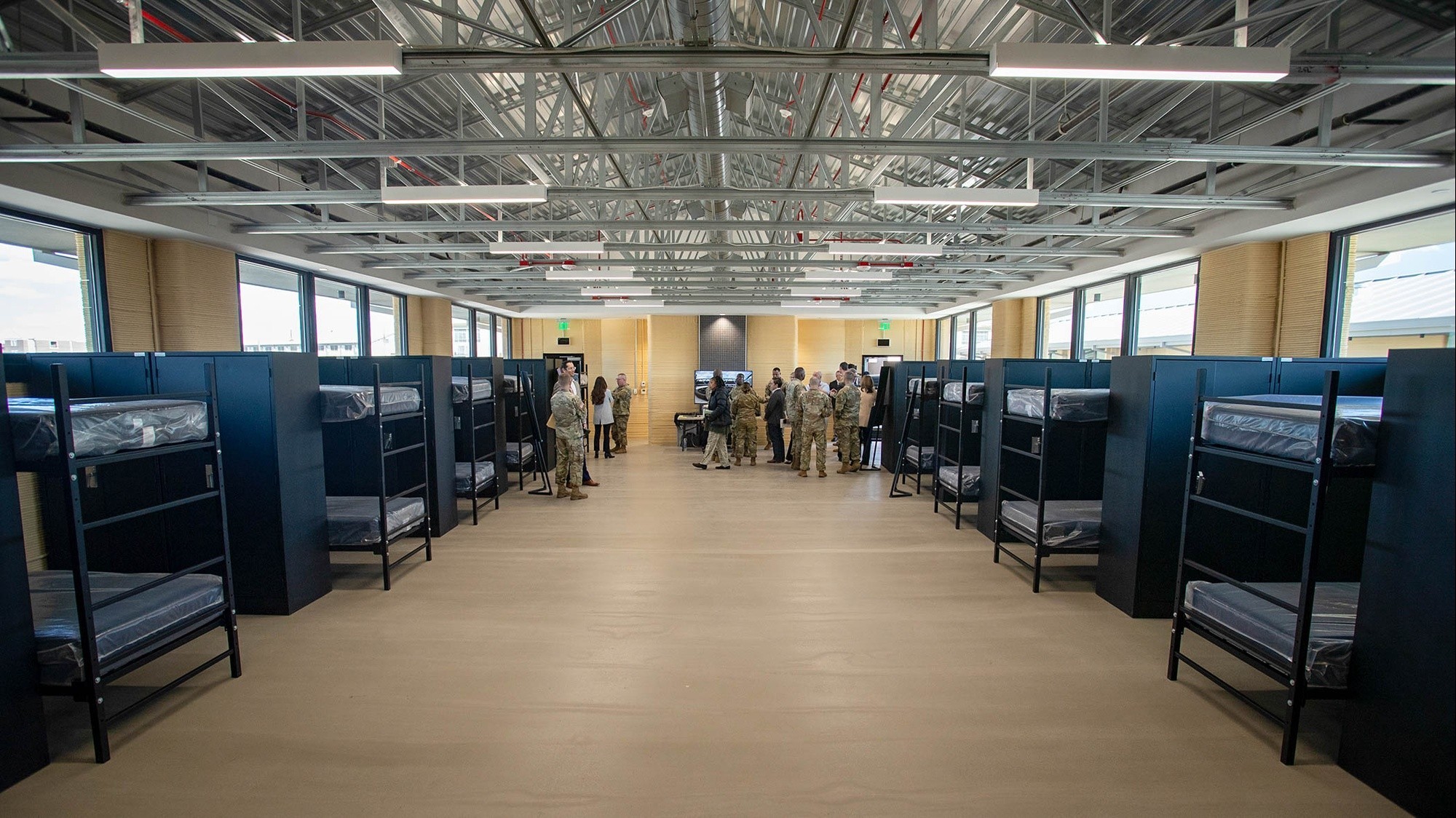
AMC is also looking at other cutting-edge construction methods to improve MILCON and R&M projects. Modular building techniques, which involve offsite prefabrication and rapid onsite assembly, help shorten construction timelines, reduce base disruptions and ensure consistent quality across multiple sites. Fabric tension buildings, which are lightweight, durable and quickly deployable structures, offer flexible, weather-resistant solutions ideal for expeditionary missions and temporary facilities. Together, these innovations demonstrate AMC’s commitment to leveraging diverse, advanced construction technologies to meet evolving Army infrastructure needs.

Central to FORGE and RUBA’s success is the use of other transaction authorities. Unlike traditional federal acquisition regulations, OTAs allow AMC to use more commercial-like terms and conditions, which offer flexibility, reduce bureaucracy and substantially shorten the acquisition process.
“We were able to reduce the procurement cycle from receipt-of-requirement to contract award in 29 days,” said Brig. Gen. Freddy Adams, commander of Mission and Installation Contracting Command. “Our standard models could take us up to 183 to 299 days. That means we’re moving 90 percent faster.”
The success of OTAs has been demonstrated in other government initiatives, such as Operation Warp Speed, where rapid innovation and delivery were paramount. AMC is now applying those lessons to MILCON and R&M projects, fostering partnerships with small businesses, research institutions and non-traditional contractors to infuse fresh ideas and innovative solutions into Army construction.
In addition to physical construction innovations, AMC is advancing the use of data-driven tools to automate the Army Facility Investment Plan and streamline project approvals, ensuring faster, more transparent decision-making throughout the MILCON and R&M lifecycle.
Army leaders emphasize the importance of early engagement with industry partners, encouraging collaboration that breaks down traditional barriers and expedites delivery. The message is clear: start earlier, move faster and be smarter in how the Army builds and maintains the infrastructure that supports its mission.
“These initiatives are crucial for the future of our Army,” Lawrence said. “It’s not just a concept; it’s a pathway to revolutionizing how we think about contracting and construction for Army facilities. We are committed to improving the way we do business.”
As AMC continues to advance these efforts, the Army stands poised to modernize its facilities and enhance warfighter readiness through a construction model that blends military precision with commercial efficiency. The FORGE and RUBA initiatives are not just transforming how the Army builds – they are forging a new path for innovation, partnership, and operational excellence in military construction.
Social Sharing