
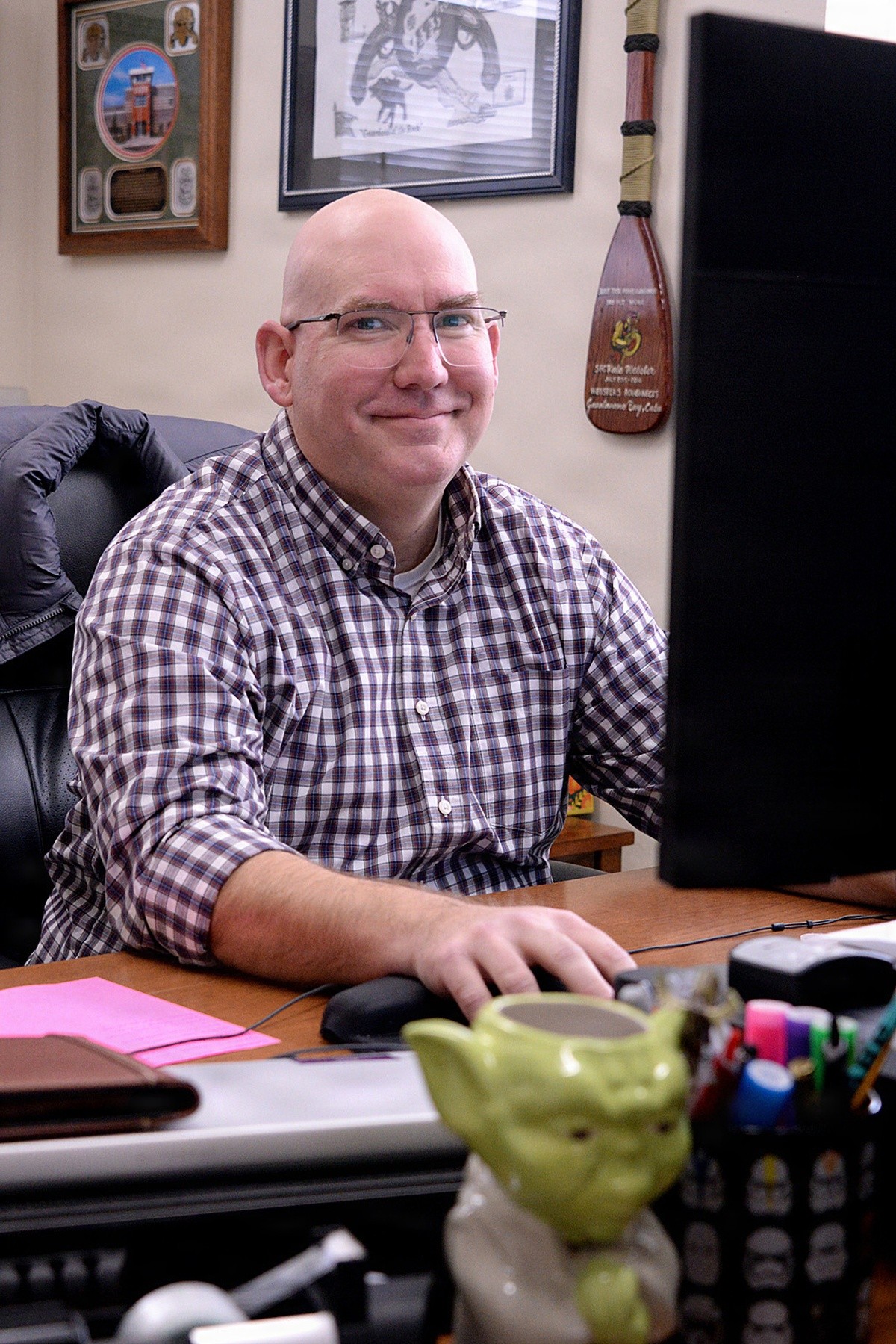
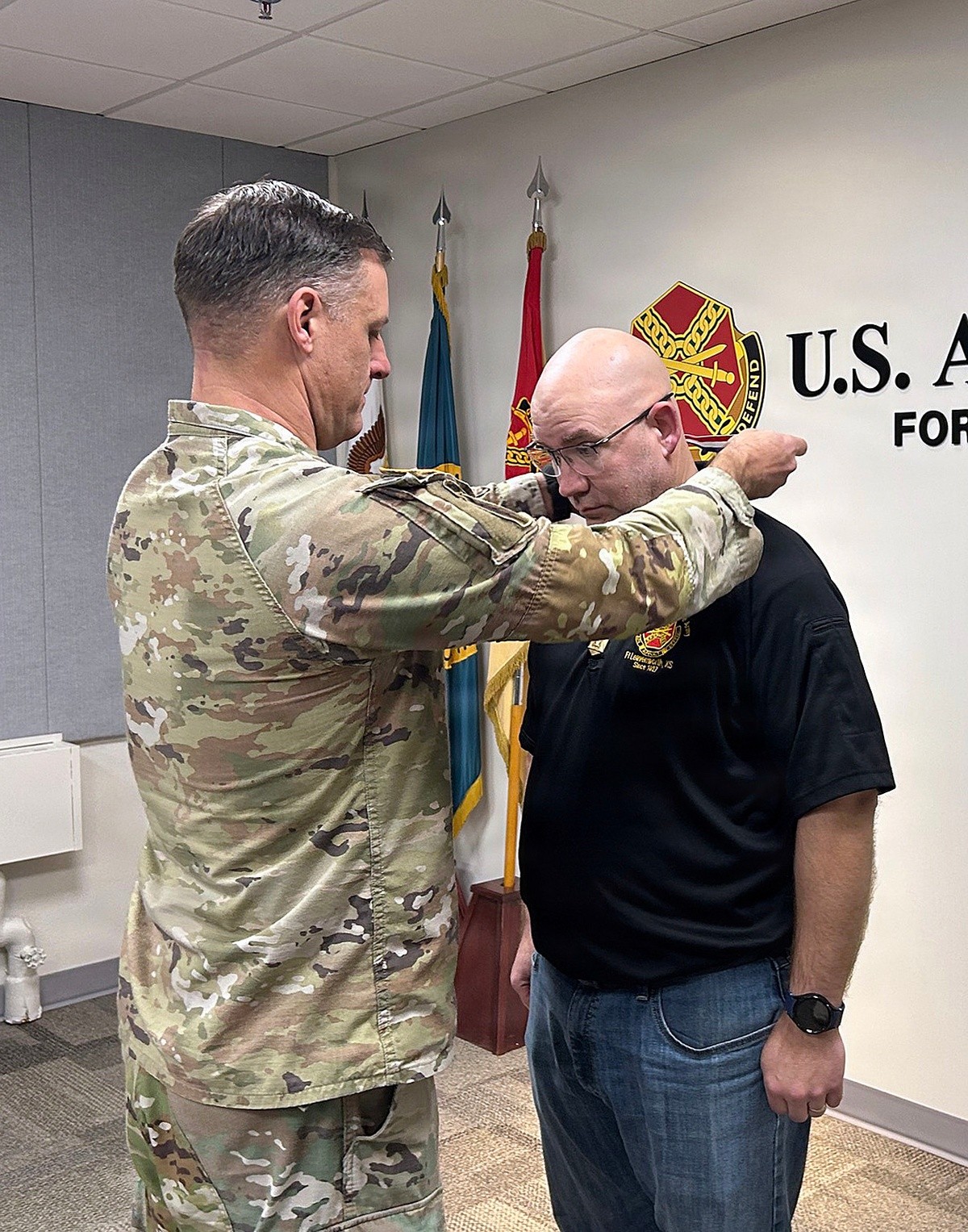
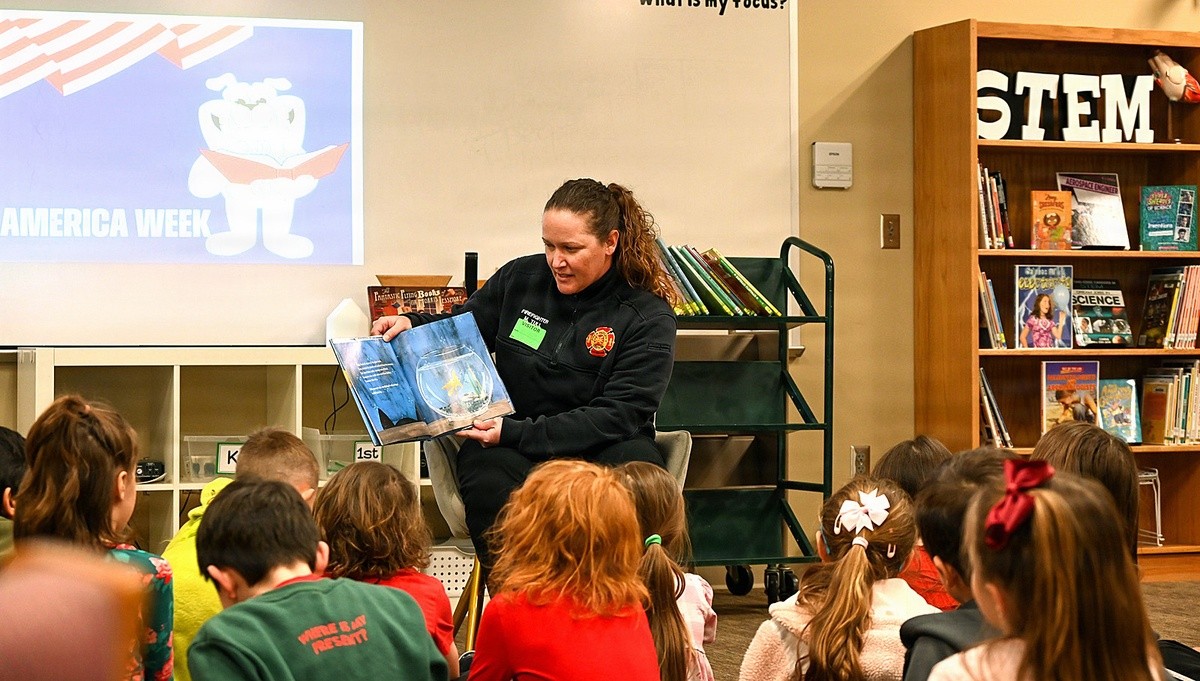
FORT LEAVENWORTH, Kansas — Kale Webster, Equal Employment Opportunity complaints manager, has been named the 2025 Fort Leavenworth Garrison Professional of the Year, and Melissa Tull, Fort Leavenworth Fire and Emergency Services firefighter, has been named the 2025 Fort Leavenworth Garrison Supply Professional of the Year.
Professional of the Year
Webster was initially recognized as the first quarter professional. Sean Bergosh, Garrison Public Affairs Office, was recognized as the second-quarter professional; Matt Gill, Directorate of Plans, Training, Mobilization and Security, was recognized as the third-quarter professional; and Brandon Miles, Directorate of Emergency Services, as the fourth-quarter professional.
Webster was nominated by EEO Manager Brian Ash, who noted that Webster exceeds standards, going above and beyond.
“It is my humble opinion, without a doubt, Mr. Webster deserves this award, as without him the entire reasonable accommodation process and restructure would have suffered more sanctions and fines due to improper processing, resulting in a detrimental hit on many installations’ budgets and possible failure of mission,” Ash wrote in the nomination.
Over the past year, Webster has been responsible for the duties of his previous job as the disability program manager, overseeing the reasonable accommodations process until the position was refilled, as well as the duties of his current job as the EEO complaints manager. He oversees all EEO complaints, whether he or a co-worker are processing the complaint, and makes sure legally required timelines are met.
“All EEO complaints are required by federal law to be attempted to be resolved informally. The intent is for things to be resolved at the lowest possible level, so we do that here in our office,” he said. “We're neutral third parties. We don't advocate for the person making complaints or for management that responds to complaints, we just facilitate the process.”
Webster said the EEO office cannot advise or determine if a complaint should be made, or if discrimination has occurred, but rather EEO provides education through quarterly training for the workforce and can also provide resource referrals, when relevant.
Webster said the EEO process helps ensure that the workplace is a respectful environment for all employees.
“I understand that, unfortunately, people's biases can influence their behavior and their decisions that they make in the workplace, and that's why our program is so important, because it does occur, even though it shouldn't, it still does,” he said. “We want to make sure that everyone is treated respectfully, and that's why our process exists.”
Revamping the ReasonableAccommodation Tracker
Webster was also asked to serve on a panel to restructure the Reasonable Accommodation Tracker, an Armywide web-based platform to log reasonable accommodation requests, decision deadlines, equipment needed, costs and more.
“It was an outdated program that, in my opinion, had never really allowed us to capture the things that we needed to capture,” Webster said. “Being the boots on the ground representative, the people that were going to be the end user of the program, I feel like I was able to provide some much needed perspective on what those of us who are going to use this program needed it to do, and the features that needed to exist in it that didn't previously.”
He said with the previous system, employees’ reasonable accommodation information was only accessible to disability program managers at their immediate installation, but now program managers are able to see if an accommodation exists at someone’s home station, making it easy to shift that accommodation to a new installation in the case of a move or while that person is TDY at another post, such as to attend the Army Management Staff College, instead of completely starting over.
“So, there may be an Army employee at, say, Fort Belvoir, (Virginia), who is coming to Fort Leavenworth, and they may need a specific reasonable accommodation while they're physically here,” he said, giving a service animal accommodation as an example. “Well, if they already have an existing accommodation for a service animal, that makes it that much easier for us to streamline with that approval locally. Under the old system, we were not able to see anything outside of just us.”
Webster said he enjoys the education and training aspect of his job, both with employees and managers, letting them know what is available and possible.
“More often than not, we are able to find something to assist the employee, and the Army as the employer, for that employee to be successful in their job,” he said. “It is rooted in law. There are times I've had to tell managers, ‘You may not like this, but the law says they're entitled to an accommodation; you're going to accommodate them,’ or ‘Hey, employee, you are entitled to an accommodation under the law, don't be afraid to advocate for yourself or request something that you need to be successful at your job.’ Because if there isn't an accommodation in place and you are, say, slipping up in your job duties, you're still subject to potential discipline or a less than great performance evaluation. … The book answer is ‘this many minutes’ that this task is completed, but because of a diagnosed legitimate disability, ‘employee needs an extra little bit of time to accomplish that task.’
“Without that accommodation in place, you could have an employee who could potentially face performance issues and performance counseling because they're not achieving the standard. … So that's why we are so encouraging for folks to request an accommodation if they feel they need one.”
Examples of reasonable accommodations include having LED or no overhead light instead of fluorescent lighting in an office for a migraine sufferer, or someone using noise cancelling headphones if he/she has adverse reactions to loud noises.
In addition to helping improve the tracking system and helping employees advocate for their needs, Webster assists with everything EEO-related as the EEO complaints manager.
“The workplace is for everybody, not for the most dominant personality in the room, so if there's EEO issues at play, then we get involved.”
Webster said some people come to EEO who actually need to be connected with another resource if the discrimination doesn’t involve one of the protected classes of race, color, religion, national origin, age (40 or older), sex (including related medical conditions such as pregnancy), physical or mental disability, genetic information and reprisal or retaliation.
“If it's not EEO issues, there are other complaints and grievance processes that we can educate people on to address that.”
Webster described EEO’s mission as “supporting the civilians who support the mission” to help resolve issues in the workplace.
Webster retired from the Army as a sergeant first class after 20 years as a corrections and detention specialist, with most of his military career spent at Fort Leavenworth. He then worked as a county jail security manager, university EEO investigator and parole analyst before joining the EEO team in 2022. He said as heavy as the EEO job can be, he truly enjoys the work.
“I struggled when I retired from the Army finding work that felt like it had a purpose. I mean, a lot of soldiers when they retire, they feel kind of lost because they're not doing anything that they feel is important,” he said. “I need something of substance. My job needs to feel like I'm making a difference, so I'm grateful that I got an opportunity to come work in the EEO office.”
Screening awards
Every award — time-off awards, cash awards, Meritorious Civilian Service Awards, etc. — are first vetted through the EEO office before they are awarded. Webster is one of three EEO employees who ensure that local award recipients do not have EEO complaints against them or other such issues.
“Anytime an Army civilian is submitted for an award, it has to be screened both by EEO and (the Civilian Human Resources Agency) for anything that would preclude an individual from being eligible to receive an award. Every single award is required to be routed through our office,” Webster said, noting that when performance awards are being issued is a particularly busy time. “So that in and of itself can be a fairly heavy lift. … I may get a spreadsheet that's got 400 employees on it. It takes a bit to go through those names and say whether or not … it's in keeping with the best interests of the Army to award this person or not award this person.”
To contact the EEO office, e-mail usarmy.leavenworth.id-training.mbx.eeo@army.mil.
Supply Professional of the Year
The Garrison Supply Excellence Award program acknowledges the contributions of employees who demonstrate excellence in unit-level, and directly support, supply programs.
Fort Leavenworth Garrison Supply Professional of the Year Melissa Tull, Fort Leavenworth Fire and Emergency Services firefighter, was initially recognized as the third-quarter supply excellence professional. Tull’s co-workers, Aaron Dennis and Nicholas Egan, also with Fort Leavenworth Fire and Emergency Services, were recognized in the first and second quarters. No one was selected for the fourth quarter.
Tull was nominated by Fire Chief Marshall Fiedler, who said she has demonstrated exceptional dedication, and cited an inventory and inspection undertaking conducted by Tull and her team of more than $200,000 worth of firefighters’ protective gear.
“This meticulous effort established a clear baseline — replacing the previous, unreliable equipment with an accurate and up-to-date inventory record,” Fiedler wrote in the nomination. “All gear and equipment that did not meet stringent OSHA standards were removed from service. The team’s efforts also identified used equipment that can be re-issued. Through her efforts, more than 14 sets of used gear were cleaned, sanitized and placed back in service, creating a cost avoidance of $72,000. This inventory process also corrected discrepancies in the program, and now all personal protective gear is 100 percent accounted for and perfectly in compliance with National Fire Protection Association codes.”
Tull said she started the inventory project when she was on light duty after a surgery, doing data entry for gear that needed to be entered. Each firefighter is issued two sets of bunker gear — the coat, pants, hood, helmet, gloves and boots a firefighter wears for protection.
“There's just a lot of (gear), and there was a lot coming in at the time, so a lot of it just needed entered and organized in there,” she said, noting that the data entry included logging waist lengths, inseams, serial numbers and more information so that everything was accounted for, ready for reissue or disposed of if the gear was expired and no longer as effective as it should be.
As a firefighter, Tull primarily responds to medical emergency calls, as well as the occasional fire, including the middle-of-the-night fully engulfed fire that destroyed the abandoned Trustee Unit in December. Tull cited the life-saving rescue of a worker in 2011, when part of the Old U.S. Disciplinary Barracks complex collapsed during a major renovation, as one of the most memorable experiences in her 17-year career with the Fort Leavenworth Fire Department.
“It was a fast response,” she said about that day, having been across the street at Station No. 1 at the time of the accident. “We heard it happen, and it sounded bad so we … were already in our gear ready before they even dispatched it.”
When the wall collapsed, bricks and wet cement covered a worker in the basement.
“We were basically digging everything off of him. It was teamwork, from initially dispatch and then law enforcement. … The workers themselves, they were all helping because they had to hold up sheets of plywood just so more stuff wouldn't fall on us so we could get to him,” said Tull, noting that whoever had gotten to the injured man first had cleared away enough of the wet cement and debris for him to have an airway. “It was a quick response, and we had a lot of people that day to help.”
Tull, who also works part-time for Atchison County Emergency Medical Services in her hometown of Atchison, Kansas, started with Fort Leavenworth Fire and Emergency Services as a dispatcher, then moved into an on-the-job-training position to become a firefighter.
“I originally just wanted to help people for a career, but once I started doing dispatch, I wanted to do more,” she said.
Tull said firefighters work 48-hour shifts, then have three consecutive nights to be home with family. She said she prefers the 48-72 schedule better than the previous day-on, day-off schedule, noting, though, that when they receive a lot of calls overnight, that second day can be tiring.
Child Passenger Safety Technician
Tull serves as a Child Passenger Safety Technician for the Fort Leavenworth Fire Department’s Child Safety Car Seat Program.
“(Tull) … provided instruction to parents and caregivers on the correct use of child restraint systems, including car seats, booster seats and seat belts,” Fiedler wrote in the nomination. “She has played a leading role in educating active-duty Army personnel, international officers and enlisted families on proper child safety practices, ensuring their children are secured appropriately during vehicle transport.”
Tull, who also serves as a CPR instructor for the department, took her initial Child Passenger Safety Technician class while working part time as an emergency room technician at Children’s Mercy Hospital in Kansas City, Missouri, several years ago. She later gleaned information about the existing Fort Riley, Kansas, program when she was encouraged to pursue the project during an inspector class with the FLFD.
“Through her leadership and advocacy, Fort Leavenworth attained designation by the Kansas Traffic Safety Resource Office as a recognized child safety seat inspection station,” Fiedler wrote.
The Fort Leavenworth Fire Department is now listed as a child safety seat inspection station for anyone to have child safety seats installed or checked. Child safety seat inspection stations and technicians can be found for any area at https://events.safekids.org/. The program also offers free child safety seats to those who qualify for them.
“I think safety is important,” Tull said about the need to have child car seats checked by a technician like herself. “Sometimes the instructions are a lot …The confusion is, every vehicle and every seat have totally different instructions, and so you have to link those two together to make the seat work. One of the biggest things I see, people want safety — you don't think you can do too much, but you can't do the lower anchors and the seatbelt, so it's either one or the other.”
Tull said in addition to figuring out the car and car seat directions, she stays aware of recalls that affect the safety of the seats, and she noted that child car seats also start to break down structurally and are considered expired after about 10 years.
Tull will have a booth with information, child safety car seat inspections and a limited supply of free child safety car seats for those who qualify at PAIR Day/Kids’ Fest 10 a.m. to 2 p.m. April 11, 2026, at Harney Sports Complex, Fort Leavenworth, Kansas.
Social Sharing