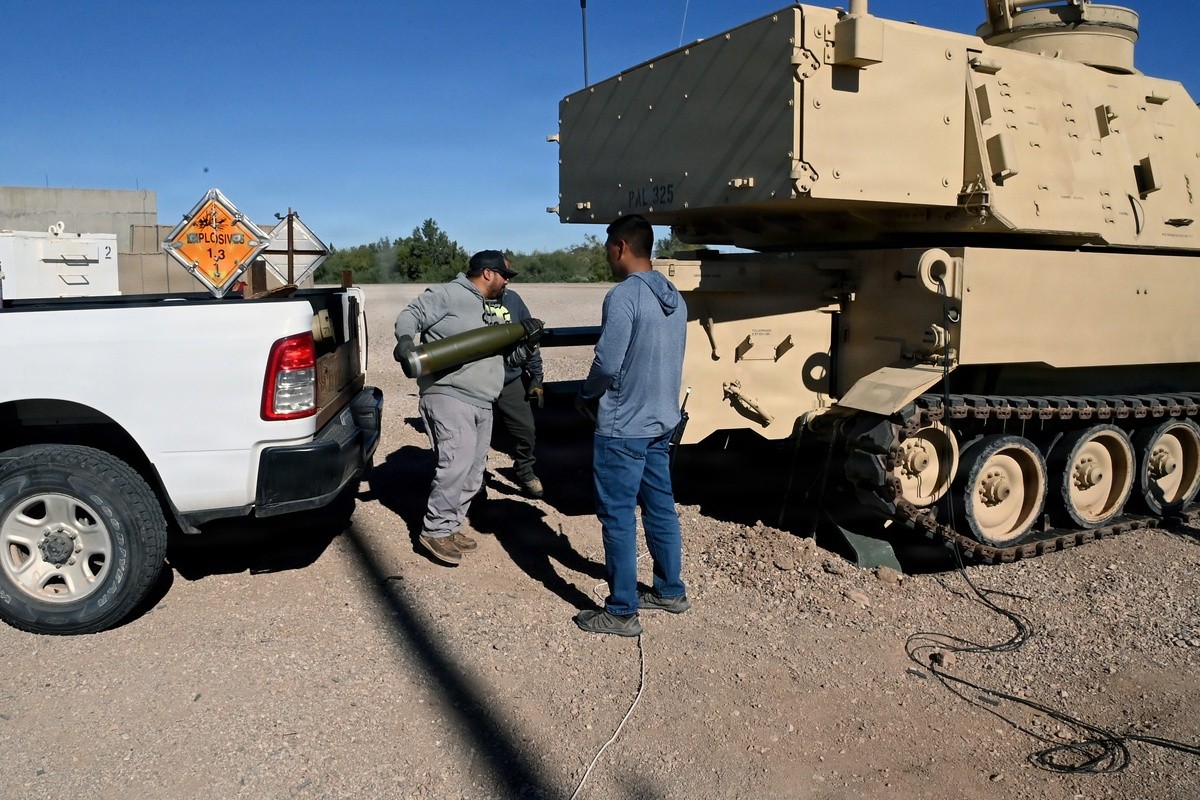
For most of its history, artillery testing has been the core mission at U.S. Army Yuma Proving Ground (YPG).
As artillery technology evolved across previous decades, YPG was on the cutting-edge testing guided and semi-guided munitions capable of hitting within mere meters of a target kilometers away.
Today, the proving ground is testing prototypes of the Next Generation Rocket Assisted Projectile (NGRAP), which intends to dramatically increase the roughly 30 kilometers a currently fielded 155mm howitzer shell is capable of when fired at top zone with rocket assistance.
“It’s going to replace the legacy M549A1 rocket projectile that was developed in the 1970s,” said Steve Flores, YPG Long Range Precision Fire Integrator.
An artillery round needs to be reliable to be accurate, and adding a rocket to any projectile adds variability to its fired trajectory. The NGRAP also needs to be compatible with a larger cannon in the future.
“We are testing a new, one-piece joint with a base closure on the end,” said Jonathan Armijo, test officer. “It is a characterization test of the strength of the design, how the projectile holds up to the stresses of firing and how the rocket performs.”
Though capable of longer ranges, the new projectile looks similar to currently-fielded 155 mm rounds. The most significant difference is in the round’s larger rocket, which testers want to ensure functions properly even when fired under extreme conditions.
“We have standard charges we upweight with extra propellant to try to reach the maximum permissible pressure for these cannons to put these bullets through the highest amount of stress that they would see in this caliber tube,” said Armijo. “It is a stress test.”
Accurately measuring this data on rounds that travel about one mile per second requires the assistance of some of the world’s most sophisticated high-speed cameras and triggering equipment. YPG’s scientific photographers have cameras capable of shooting 100,000 frames per second, though for this particular test they use only a small fraction of this impressive capability. As each round is in flight, workers back at the howitzer take readings from pressure gauges inside the gun barrel as radars and Kineto Tracking Mount operators follow its flight to target.
Methodical test fires of the new round are vitally important and carefully examining the fired rounds afterward even more so.
“We will recover the rounds to measure post gun launch dimensions,” said Armijo.
Guided munitions are designed for pinpoint accuracy yet safely testing them requires an enormous amount of range space. Testers appreciate that YPG has plenty of room for this, along with vast institutional knowledge and a favorable climate.
“There’s year-round good weather here,” said William Gardner, Next Generation Rocket Assisted Projectile test lead. “We consider it a top-notch facility that has very good applicability toward extended range tests.”
YPG is essential to Army transformation efforts because natural environments testing cannot be duplicated in a laboratory, conditioning chamber, or computer simulation.
Social Sharing