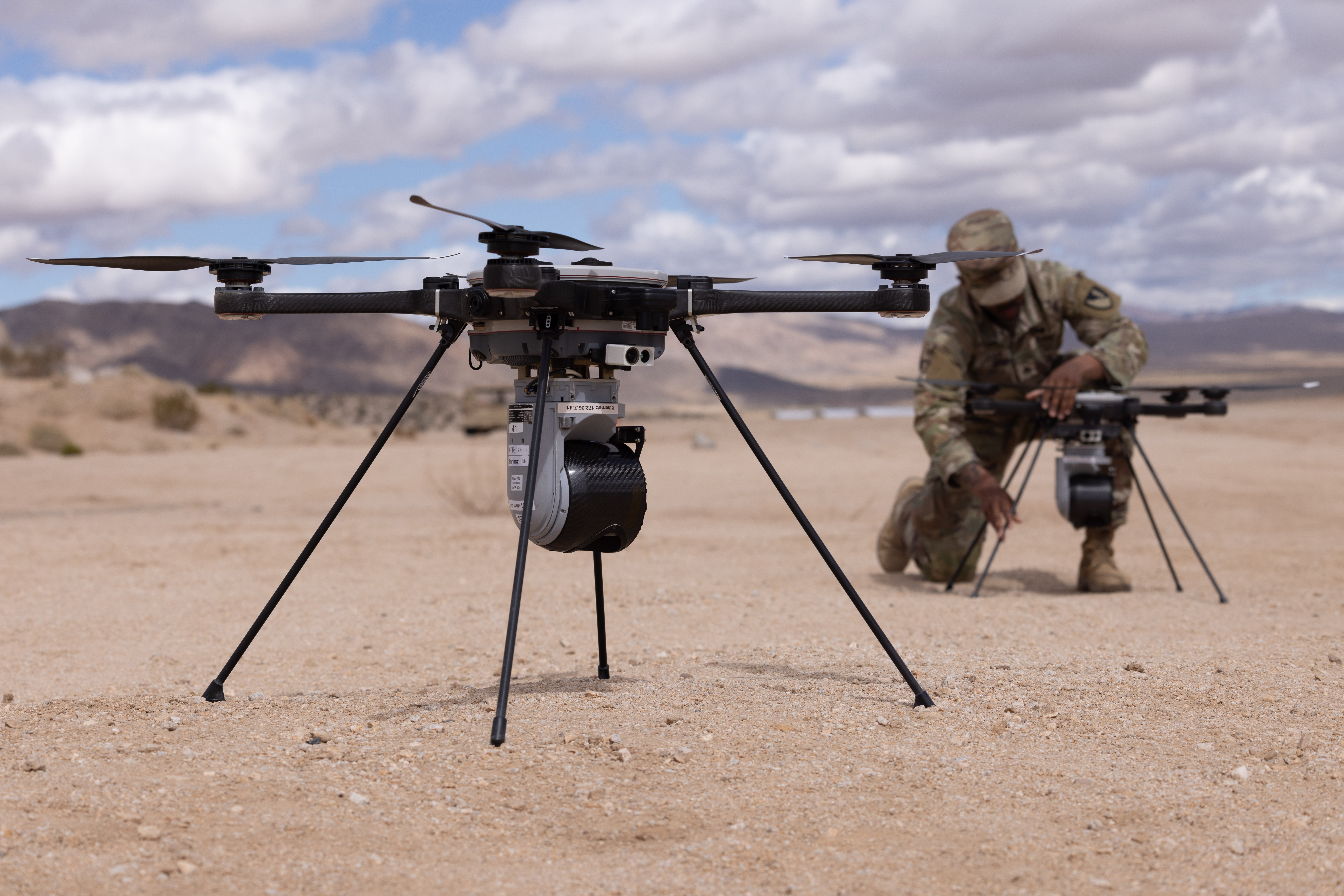
FORT BELVOIR, Va. — Amidst today’s modern battlefield, most people would only think of Soldiers swinging grappling hooks and probing the ground as historical accounts of mine-clearing techniques. Unfortunately, Soldiers still find themselves within an arm’s reach of deadly mine threats and calculated obstructions.
While the U.S. Army continues to modernize and transform, Soldiers are trying to decrease their reliance on legacy systems as they face endlessly evolving threats.
For nearly 40 years, the Army has used the M58 Mine Clearing Line Charge, or MICLIC, as a complement to Soldiers manually clearing mines and obstacles. The MICLIC’s legacy ties back to Col. Harry D. Tyson, who invented a type of mine-clearing charge during the Battle of Anzio in 1944. For decades, Warfighters have depended on the MICLIC as a standard for quickly creating breaching lanes through obstructions and minefields.
Today, the Army is modernizing breaching equipment and procedures with a renewed focus on automation and keeping Soldiers farther out of harm’s reach during breaching operations. The Command, Control, Communications, Computers, Cyber, Intelligence, Surveillance, and Reconnaissance (C5ISR) Center has collaborated with industry partners and the Project Manager Close Combat Systems under the Joint Program Executive Office Armaments and Ammunition , to develop a system to enhance breaching operations and increase Soldiers’ survivability. The Autonomous Breaching System (ABS) was born through this collaboration.
The ABS was developed to provide a faster, more reliable, and safer way to clear obstacles compared to traditional breaching methods — potentially replacing the M58 MICLIC system and other legacy systems like the Mine Clearing Roller.

Over the last few years, experts with the C5ISR Center have been working with academia and industry partners to develop multi-mission sensing payloads integrated with on-board artificial intelligence/machine learning algorithms that detect explosive hazard threats in real time. ABS is leveraging these detection algorithms in conjunction with neutralization capabilities to modernize breaching operations.
“The ABS brings precision detection and neutralization to the Soldier, to increase their lethality, survivability and stand-off from the breach lane,” said Michael Donnelly, detection lead, C5ISR Center. “Our algorithms can be ported to any system that has visible and infrared cameras to support day and night operations. Additionally, the scalability and precision ensure that you don’t have to fire a line-charge to pinpoint a single mine.”
The ABS platform represents a leap forward from legacy systems, emerging as a future critical capability multiplier for ground forces. It addresses several shortcomings of legacy systems that can remove Soldiers from immediate danger during breaching operations. This can have a profound impact on Soldiers’ survivability — placing the system in a class ahead of its predecessors.
“Some of the Army’s current technologies are from the [1960s] and it’s important to give our Soldiers the latest and greatest technology,” said Kendall Johnson, physicist, C5ISR Center. “I think where we are now [with ABS] really pushes upon any sort of scenarios, any sort of battles, or any sort of conflicts that the Army is looking forward to in the future. Especially with the push of modern robotics and artificial intelligence. It gives us a strong advantage and helps us to outpace our enemies.”
The ABS minimizes the window of vulnerability by reducing the time it takes Soldiers to breach an obstacle. Plus, the ABS’s increased range and maneuverability allows it to be effective against a broader spectrum of obstacles.

“Our work is driven by our understanding of the threat — current, as it evolves, and as we anticipate based on our understanding of emerging technology and trends,” said Beth Ferry, C5ISR director. “This knowledge, combined with our understanding of the Warfighter’s needs and operational challenges, help us to anticipate potential threats and gaps, and make informed S&T investments that will yield the future capabilities needed to ensure our warfighters maintain the decisive edge.”
By working with the C5ISR Center, industry partners can gain insight regarding the Army’s operational requirements, technology gaps, and can tailor specific developments to meet those needs before entering the acquisition process.
The C5ISR Center, through its deep technical expertise and decades-long support of breaching technology development, is constantly refining and improving the ABS to ensure its seamless integration into the Army’s broader network. As the ABS matures, it may change how the Army conducts breaching operations, increase the odds of mission success, and safeguard the lives of Soldiers across the battlefield.
———————————————————
The U.S. Army Command, Control, Communications, Computers, Cyber, Intelligence, Surveillance and Reconnaissance Center is the Army’s applied research and advanced technology development center for C5ISR capabilities. As the Army’s primary integrator of C5ISR technologies and systems, DEVCOM C5ISR Center supports our networked Warfighters by identifying, developing, maturing, and rapidly integrating innovative technologies to drive continuous transformation.
DEVCOM C5ISR Center is an asset of the U.S. Army Combat Capabilities Development Command. DEVCOM is the Futures and Concepts Command’s leader and integrator within a global ecosystem of scientific exploration and technological innovation. DEVCOM expertise spans seven major competency areas to provide integrated research, development and engineering support to the Army and Department of War. From rockets to robots, drones to dozers, and aviation to artillery, DEVCOM innovation is at the core of the combat capabilities American Warfighters need to win on the battlefield of the future. For more information, visit c5isrcenter.devcom.army.mil/
Social Sharing