Download the document here: No. 26-1096, Staff Processes in LSCO Part III: Division Planning (Jan 26) [PDF - 3.2 MB]
Staff Processes in LSCO Part III: Division Planning
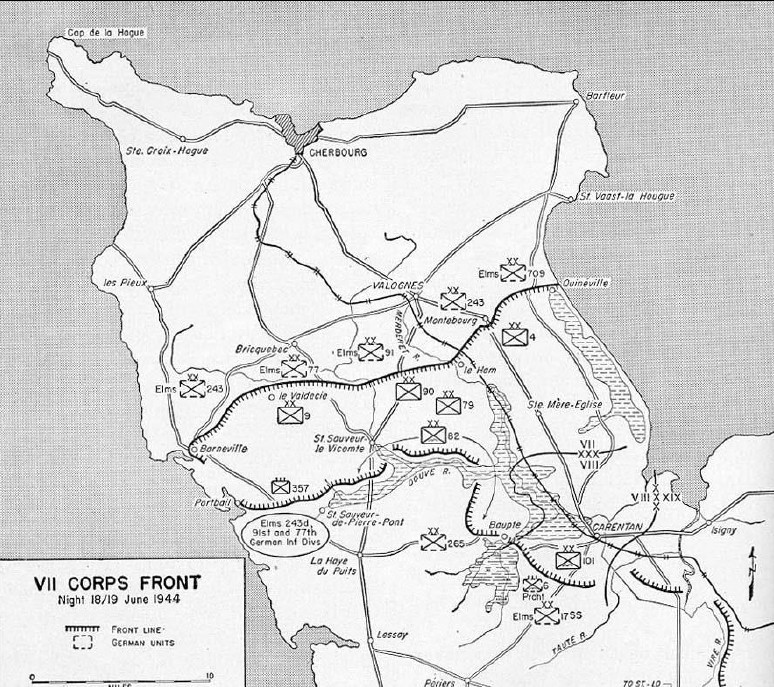
On June 10, 1944, the U.S. Army’s 9th Infantry Division (ID), veterans of earlier campaigns in North Africa and Sicily, arrived on Utah Beach in Normandy, France. After the division assembled several miles inland, the 9th ID conducted a forward passage of lines through the 90th Infantry Division on June 14. Moving through difficult hedgerow terrain, the 9th, along with the 82nd Airborne Division to its south, attacked across the Douve River and seized crucial bridgeheads on June 16. The 9th ID continued to advance west and reached Barneville on the western coast of the Cotentin Peninsula by June 18, effectively cutting off German forces in the peninsula. Quickly moving north, the 9th ID began an attack to seize the port city of Cherbourg on June 19 in concert with other units of the VII Corps. VII Corps seized Cherbourg on June 27 after a series of deliberate attacks with extensive air and artillery support. The 9th ID turned over control of its sector of Cherbourg to the 4th ID to allow it to continue clearing German forces to the west of the city.
Within a ten-day span, the 9th ID conducted what we now call reception, staging, onward movement, and integration (RSOI); a forward passage of lines (FPOL); a wet gap crossing (WGX); and a deliberate attack on an urban objective. After a short rest period and movement to another sector of the frontline in early July, the Division would find itself conducting a defense against a German armored attack. This rapid pace of operations was not atypical for U.S. Army units undertaking large scale combat during World War II. While the 9th ID benefitted from extensive combat experience at all echelons, its ability to execute and synchronize such operations was also a product of effective planning for subsequent operations while executing current operations, including a ninety-degree turn of its frontline from west to north (Figure 1). Although division staff organizations and processes have evolved since World War II, staffs must be prepared to continue planning using current doctrinal processes to enable successful large scale combat operations (LSCO) in the future. Nevertheless, current observations demonstrate that U.S. Army division staffs struggle with manning their plans and future operations (FUOPS) integrating cells and understanding each cell’s roles and responsibilities, especially regarding planning and the military decision-making process (MDMP).
We must understand that the MDMP is the primary planning process for division staffs to keep up with the complexity, tempo, and detail required to fight and win against an adversary with a smaller, more agile staff and decision-making process. It is best applied in a phased operational framework. While the staff may task organize itself differently for MDMP in different situations, the process, products, and people remain the same.
This paper will discuss:
I. MDMP before and during execution
II. Battle rhythm and rhythm of the battle
III. Role of the plans cell (use iterative MDMP to plan throughout execution)
IV. Role of the FUOPS cell (Use standardized steps of MDMP or the rapid decision-making and synchronization process [RDSP] to refine by day)
V. Recommendations
I. MDMP Before and During Execution
One question asked by planners on division staffs during academics and the Warfighter Exercise (WFX) is “what does the plans cell do after they publish the base order?” We tend to observe a difference in how divisions task-organize to conduct MDMP prior to execution versus during execution, but it is MDMP nonetheless. MCTP has observed divisions consolidating their staff under the Plans Cell prior to execution to conduct a staff-wide planning effort that produces an operations order (OPORD) that generally covers the entire conflict or at least several foreseeable phases of it. Then, when the division begins maneuvering and fighting, the MDMP transforms into an iterative process executed by smaller planning teams that focus on phases or events within the scope of the operation. In other words, the MDMP is not over-with after a base OPORD is published. It should continue but transform from the consolidated technique to a multi-cell, iterative technique. It is conducted by more than one integrating cell and is focused on more than one planning horizon throughout the duration of the conflict.
“Since planning is continuous, a plan or order is an interim product based on information and understanding at a moment that is subject to revision. The measure of a good plan is not whether execution transpires as planned, but whether the plan facilitates effective action in the face of unforeseen events.”
II. The Battle Rhythm
The division battle rhythm is not a replacement for the MDMP, but rather a structured mechanism for continuously executing it. Many battle rhythm events functionally mirror steps within the MDMP, streamlining planning and adaptation. For example, the daily battle update brief (BUB) serves as a focused re-assessment of the mission variables, akin to a daily Mission Analysis. The plans working group facilitates course of action (COA) development, while the plans update brief supports COA approval. Daily fragmentary orders (FRAGORDs) translate approved plans into executable orders. The operations synchronization meeting (OPSYNC) is a venue for bottom-up refinement and final adjustments. Crucially, the assessment working group (AWG) provides a vital feedback loop, enabling commanders and staff to visualize the battlefield’s evolving conditions, adjust plans accordingly, and inform both the Plans and FUOPS Cells. This continuous cycle is especially critical during LSCO, where the dynamic environment demands constant adaptation and reinforces the need for a robust, ongoing MDMP facilitated by the daily battle rhythm.
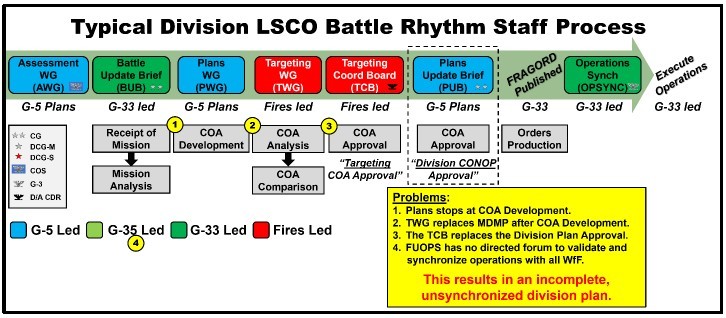
Figure 2 illustrates what MCTP observers typically see a division staff execute as a daily battle rhythm in a WFX. Notice that the names of the battle rhythm events correlate to steps of MDMP. Course of action development (COA DEV) is done in the plans cell, usually in an event called the plans working group. It is usually conducted by G-5 planners but may not be afforded the appropriate amount of scrutiny and time from the entirety of the staff. Furthermore, the sequence of staff processes in Figure 2 does not include a formal working group event in the FUOPS Cell. Therefore, the observation is that the Plans Cell produces a conceptual plan that goes from COA DEV to targeting without conducting course of action analysis (COA Analysis) or refinement in the mid-range horizon (FUOPS).
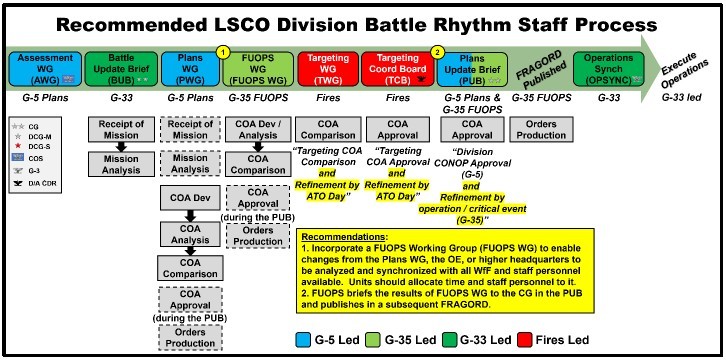
MCTP observer-coach/trainers (OC/T) recommend adjusting Figure 2 to what is depicted in Figure 3. The difference is that the plans cell is responsible for every step of MDMP, not just through COA DEV, and more importantly, the FUOPS Cell is resourced with its own formal working group that facilitates further COA DEV, COA Analysis, or any other staff process as needed. The rhythm of the battle informs what the FUOPS Cell focuses on from day to day and what processes they must use to adjust course from the plans cell’s outputs to the evolving situation in the current operation cell (CUOPS). Lastly, these processes are all steps of MDMP, not the targeting process.
For clarity, the recommendation is not to add more meetings outside of a FUOPS working group outlined below - it is to conduct existing meetings in accordance with the doctrinal steps of MDMP with senior leader involvement to enforce meeting inputs and outputs and provide required guidance and decisions. If units make their existing meetings and processes more effective in completing steps of MDMP, then they will break a vicious cycle where they add more meetings, like a visualization board, because existing meetings, such as the BUB, are ineffective at providing desired outputs. Finally, as discussed previously in the first paper on the rhythm of the battle, units must refine their meeting schedules based on the rhythm of the battle - not every meeting must happen every day.
III. The Role of the Plans Cell in Execution
Now that the initial order has been published and the division is fighting from a combination of OPORDS and FRAGORDs, we need to determine the roles of plans cell and FUOPS. Think of it like this: CUOPS controls the current fight; the FUOPS Cell focuses on the next fight; the plans cell focuses on what is beyond the next fight (Figure 4). Whether the conflict takes 10 months or 10 days is irrelevant. Once the fighting begins there is a distinct need for somebody to control and assess the current fight, plan the next fight and the fight beyond that. This must be done continuously and simultaneously. Furthermore, these “fights” should be viewed as phases within an operation. The division operation may be the entire conflict, or it may be a smaller portion of the conflict. The problem with framing the entire conflict as one long operation is that if there is only one operation, then units tend to identify only one decisive point in the operation. In that operation, there are multiple major fights that require mass and combined arms maneuver and therefore should be treated as operations in and of themselves, complete with their own decisive points, operational frameworks, end states, and orders.
Figure 1 illustrates a historic scenario in which the 9th Infantry Division executed an operation that could be framed as a series of operations: RSOI, FPOL, WGX, attack objectives, consolidation, and defense. If the 9th ID were organized by current doctrinal integrating cells, while its CUOPS cell was executing the FPOL, its FUOPS cell would have been finalizing and publishing orders for the wet gap crossing and its plans cell would have been planning the attacks on St. Colombe and Barneville to the west. As the operation transitioned from the FPOL to the wet gap crossing, the integrating cells would have each transitioned their focus to the next operation.
FM 5-0 notes that practically all key aspects of an operation must be outlined by phase, from task organization to main and supporting efforts to unit boundaries and signal support.
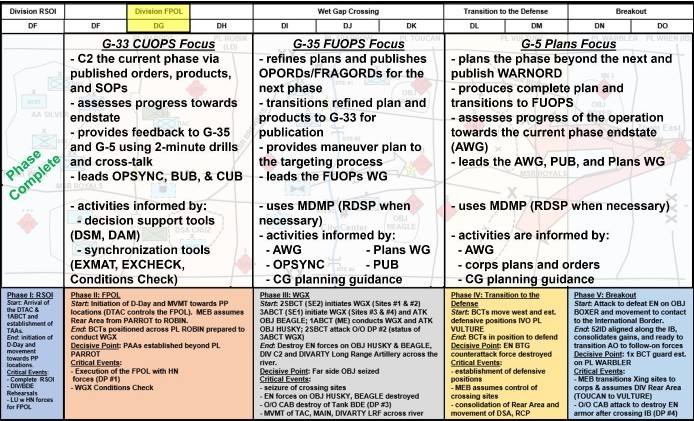
Figure 4 depicts a division conducting a series of phases in the initial portion of a larger framework (operation). The division is currently executing day two (air tasking order [ATO] day DG) of an FPOL operation that the staff assessed would take three days to complete. This notional staff knows that the next phase after the FPOL will be a deliberate wet gap crossing and the FUOPS cell is finalizing the gap crossing plan and will publish a FRAGORD for it in accordance with the 1/3 - 2/3 rule. This FRAGORD should have been preceded by a warning order (WARNORD) for the same phase from the plans cell. While the FUOPS cell is finalizing the plan and orders for the next fight, the plans cell is planning whatever phase is beyond that. In this case, it is a deliberate defense. Without a mid-range planning horizon (FUOPS) the plans cell would only be planning one fight ahead of execution and would likely not be able to plan far enough into the future to give the division time to shape and set conditions leading up to that fight.
If MDMP is the division’s primary planning process in LSCO, then who does it and how does it translate to a LSCO rhythm? Figure 3 depicts the doctrinal steps of MDMP aligned under the typical daily battle rhythm events from a division staff exercise or WFX as observed by MCTP. Think of the plans cell as an integrating cell that uses the MDMP to produce a complete plan by phase, wargames down to the by-day level of fidelity, and WARNORDs that facilitate parallel planning in the BCTs as well as requests for effects by ATO day from each warfighting function.
People
The plans cell is authorized nine personnel by modified table of organization and equipment (MTOE). By design, this cell consists of a plans chief, planners from the maneuver, intelligence, fires, and sustainment warfighting functions, a senior non-commissioned officer (NCO), an operations research and systems analysis (ORSA) officer, an operations officer, a strategic plans officer, and an information operations planner. These planners reside in the cell full-time, but they do collaborate with their respective warfighting functions to integrate warfighting function expertise into plans cell inputs, processes, and outputs. This is effective and should be sustained. However, there are two key personnel missing from the MTOE authorization: protection and C2. These can be mitigated by incorporating personnel from the G-6 Plans staff section in the division main command post (MCP) and coordinating for representation from the protection cell in the MCP.
Processes
Divisions typically execute battle rhythms in LSCO as daily cycles (Figure 3). The battle rhythm meetings can be correlated to steps of MDMP, but because a division is focusing on three different fights in different time horizons at all times, each battle rhythm event may focus on only the current fight, like the BUB, while others may focus more on FUOPS and plans horizons, like the AWG and the plans update brief (PUB).
The problem MCTP observes in most WFXs is that the division battle rhythm typically only has one daily working group (WG) for the plans cell, but the plans cell needs to conduct multiple steps of MDMP on a given day which would require more time than one working group supports. Furthermore, divisions tend to try to combine steps of MDMP into one working group, usually COA DEV and COA Analysis. This simply does not work because COA Analysis requires the outputs of COA DEV, and the two processes are completely different. The one must precede and feed the other.
We recommend that the plans cell maintain a daily working group so that when they need to pull in staff members from outside of the plans cell, they have a dedicated time and place for that collaboration. Other than that, the plans cell, if manned properly, should be able to execute each step of MDMP over the course of about two days and do it on their own schedule. The rhythm of the battle will inform the chief of staff and plans chief as to what the planning timeline should look like for a given operation or phase. Sometimes the plans cell may have two days to conduct the entire MDMP and sometimes they may have more or less time. Either way, it is crucial to understand that completing the entire process every day is not realistic, especially for multiple courses of action.
The plans cell may execute RDSP if the long-range plan requires a reframe or major adjustment, but their primary planning process should be MDMP. This paper will address the RDSP in more detail in the FUOPS section.
Outside of the individual steps of MDMP, the plans cell has a major role in the following battle rhythm events:
- Plans Update Brief (PUB) - Think of this as the plans cell’s combined mission analysis (MA) brief (for the appropriate horizon), COA approval brief, and commanding general (CG) planning guidance touchpoint that also overlaps with FUOPS. Both integrating cell chiefs should participate.
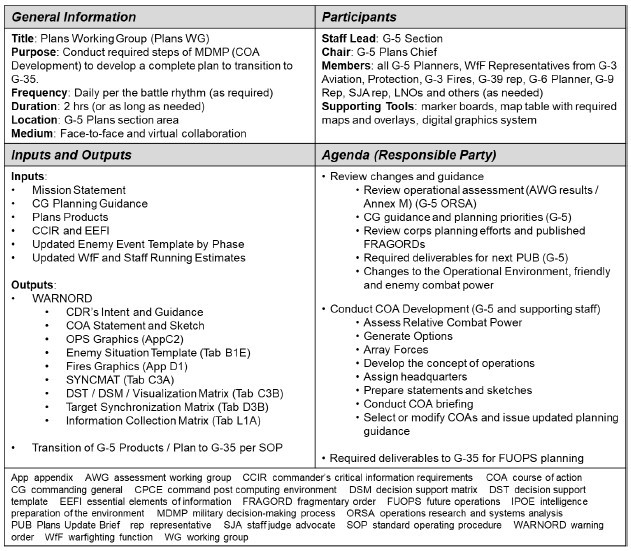
- Plans Working Group (PWG) - “Plans WG” is a typical title of a battle rhythm event, but as discussed above, one meeting is not sufficient for the amount of planning required from this cell and the PWG must be defined as some standardized process (a step of MDMP) with standard inputs and outputs to be functional. We recommend the PWG be used as the primary integrating WG for plans to bring in staff members from outside of the plans cell (like the protection cell or a planner from the combat aviation brigade) to collaborate on the planning priority for the day, but that priority may be different from day to day so there must be planning guidance that informs this. An example plans working group quad chart is depicted below:
- Plans to FUOPS Transition - MCTP observes that plans transitions are typically nothing more than digital products dropped in a folder, or at best, the two cells try to make the PUB double as the transition. The latter can be effective if done with standardized products. There is no replacement for a face-to-face briefing to ensure that nothing is lost in transition between the two integrating cells. We recommend that plans build a map board with overlays and analogue as well as digital products, use the PUB to brief the plan to the CG and the FUOPS Cell, allow for dialogue, and then move on to the next planning effort. This can be done in fifteen minutes. Furthermore, MCTP observes that many units try to avoid transitions by using the “action officer” technique in which one planner follows a plan from G-5 to G-35 to G-33 and then cycles back to G-5 to take on the next plan. This technique typically results in one planner being removed from his/her integrating cell at all times and undermines planning efforts, but it does nothing to improve transitions. There is a benefit to transitioning from one integrating cell to an entirely different cell: the team that receives the transition will look at it with a fresh perspective, ask questions, and identify necessary refinements when the original planning team fails to see after days of admiring the same problem. If the plans cell builds the standard products to the required level of detail, there is no better transition technique than a face-to-face map table/digital brief to FUOPS with a senior leader chairing the brief. At a minimum, the plans and FUOPS chiefs should drive this.
- Assessment Working Group (AWG) - This is the vehicle for CUOPS to feed changes in the current fight back to FUOPS and plans. This provides adjustment decisions to FUOPS (branches or refinements) and another source of planning guidance to plans (sequels). This must be framed by phase to use end state conditions to measure progress against. This is important because the forecasted end conditions for one phase dictate the starting conditions for planning future phases. Annex M should be formatted to show the concept of each phase with measurable end state conditions to assess.
Products
The plans cell should produce a complete plan that they transition to FUOPS. This plan should cover a phase that will likely span multiple days. In execution, warning orders for these operations should typically be verbal for WARNORD 1, and then WARNORDs 2 and 3 should be combined due to the time constraints in a typical LSCO fighting pace.
The FRAGORD should include the minimum basic, standardized products that brigades, enablers, and staff need to execute the operation using published orders in the absence of meetings (rhythm of the battle). Figure 6 offers a menu for products that make a good starting point for each integrating cell.
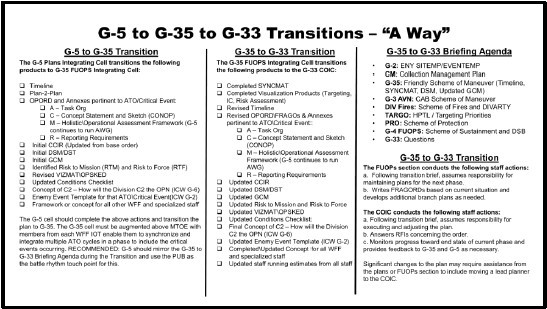
Plan by phase. Wargame to the level of detail on the SYNCMAT that at least aligns effects needed by day, in support of which brigade on which objective. Publish a WARNO (just one per phase that is a combination of doctrinal WARNOs 2 and 3 that will feed targeteers enough detail and time to requests effects 72-96 hours prior to execution and for subordinate units and enablers to parallel plan.
IV. The Role of the FUOPS Cell
The FUOPS cell has multiple responsibilities:
- Refine the OPORD received from the plans cell to fighting level of detail
- Turn assumptions into facts or non-facts using information from reports and information collection operations
- Constantly adjust the plan for the next phase based on feedback from the CUOPS cell and progress in the current phase
- Integrate the targeting process into the planning process to support the maneuver plan
The FUOPS cell receives a complete plan for an upcoming operation from the Plans Cell that has been wargamed down to the day-by-day level on the synchronization matrix (SYNCMAT). Unlike plans, however, the FUOPS cell does not necessarily execute MDMP as its daily process. It may use select steps of MDMP or RDSP to refine the plans they receive from the plans cell to the level of detail needed for CUOPS and units to fight. In other words, the plans cell produces a by-day synchronization matrix and then FUOPs refines that into an hour-by-hour execution matrix (EXMAT) using whatever doctrinal planning process makes sense for the situation. MCTP recommends FUOPS primarily use its working group to conduct a table-top wargame for the fight that will be the next division fight. The sweet spot for a division EXMAT seems to be 2 or 4-hour blocks. This detailed division plan should feed the targeting working group (TWG). The SYNCMAT is a staff tool, but not something that the CUOPS cell or brigades will usually use for execution. The brigades and CUOPS cell usually find more utility in an EXMAT or execution checklist, which is easily derived from the SYNCMAT, but the SYNCMAT must come first.
People
The FUOPS cell is authorized five personnel by MTOE. It is designed to rely on representatives from each Warfighting function to attend WGs in support of FUOPS, but based on MCTP WFX observations, this does not work. We recommend manning both the plans and FUOPS Cells with full-time planners whose primary job is in the integrating cell and whose secondary responsibility is to their Warfighting function team. If this is not possible, then the chief of staff and each Warfighting function chief must at least prioritize a capable planner to support FUOPS processes effectively; this is not the place to assume risk. Furthermore, we recommend organizing this way year-round, not just when it is time for a WFX. And lastly, we recommend aligning the rating chain so that the Warfighting function planners assigned to the Plans Cell and FUOPS Cell are rated by their respective integrating cell chiefs instead of by their organic Warfighting function chiefs to force them to prioritize support to the integrating cell. The MTOE codes a few personnel in each Warfighting function as “planners” who are intended to support the integrating cells, but the trend is that those planners spend their time in their own warfighting functions and either do not support the integrating cells or do not do it effectively. Furthermore, lack of personnel is not a valid excuse for not manning both plans and FUOPS with full-time dedicated planners when some divisions are authorized more than 580 personnel.
Processes
“The RDSP is a planning methodology that commanders and staffs may use during execution. The RDSP is not a replacement planning methodology for the MDMP, but a decision making and planning technique based on an existing order.” While the plans cell owns the long-range planning horizon, the FUOPS cell owns the mid-range horizon. Like the plans cell, the FUOPS cell should primarily use MDMP but may also use RDSP and is more likely to execute RDSP in support of major adjustments or reframes of the current plan than the plans cell. This is simply because the closer the plan gets to execution, the more the current situation evolves and therefore the more the plan requires course corrections. These are usually minor but still require a separate mid-range horizon in which to make final refinements prior to publication of orders and execution. Just like the plans cell, the FUOPS Cell requires dedicated time on the battle rhythm in which to pull in staff members from outside the cell that participate in whatever process is taking place on any day.
This FUOPs working group could be used to conduct any step of MDMP or RDSP, but the MCTP recommends it focus on COA analysis by default. If the FUOPS cell receives a complete plan by phase from the plans cell that has been planned to the by-day level of fidelity, then, assuming there is no reframe or major change, the FUOPS cell should be able to revisit COA analysis and refine the plans cell’s by-day SYNCMAT into a by-hour EXMAT that is detailed enough to use to control a fight in execution. This is also the time to revisit planning assumptions that the plans cell used and apply updated running estimates informed by ongoing reconnaissance, intel collection, reporting, and shaping operations and turn assumptions into facts or non-facts and adjust the plan accordingly.
The trend we observe in most WFXs is that divisions do not conduct COA analysis, resulting in a conceptual plan going from the plans cell to publication and units are then fighting with products that do not provide the detail required to synchronize operations, enable initiative, or seize opportunities. If there is a need for a major adjustment to a plan and no branch plan exists, then FUOPS may need to conduct COA DEV to build that branch, but as long as things are going in the right direction, COA analysis is the step of MDMP that correlates to the RDSP step “Refine and Validate the COA” (Figure 3). MCTP recommends a tabletop wargame as the preferred method of analysis, and it should take the concepts and by-day SYNCMAT from the Plans Cell and refine it into a detailed plan with an EXMAT in two-hour blocks.
The FUOPS Cell should primarily participate in the following battle rhythm events:
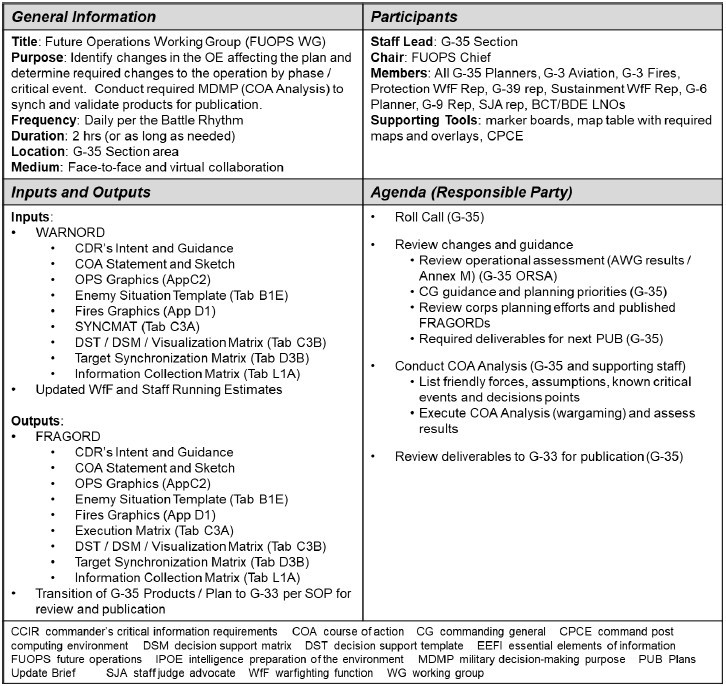
- FUOPS WG - A dedicated team that performs necessary staff processes at expert level as often as needed, daily or not, will be efficient and effective. Make this a battle rhythm event and put leadership emphasis on it. Use doctrinal steps of MDMP with standardized inputs, processes, and outputs. This process will most likely be COA analysis and/or COA comparison. The most important outputs are the adjusted concept of the operation CONOP and detailed EXMAT. Those feed the TWG and become necessary products for execution. See Figure 7 below for an example FUOPS working group quad chart.
- Targeting Working Group (TWG) - This is run by the DIVARTY team but supported by the FUOPS Cell and each Warfighting function, unit liaison officers, and enablers. This is like another wargame but should build on the wargame that FUOPS has already conducted, not replace it. The TWG synchronizes information collection and fires with the maneuver plan, but it does not produce a wholistic division plan. The combined arms division plan must come first and then the targeting process supports it. Therefore, COA analysis should produce complete and detailed plans that feed the TWG and the TWG then synchronizes the effects needed to shape future operations in time and space, by echelon, by day or hour.
- Targeting Coordination Board (TCB) - This meeting is like the MDMP step “COA Approval” or RDSP step “Refine and Validate COA,” but for the fires plan, not the overall division plan.
- PUB - This correlates to the MDMP step “COA Approval” or the RDSP step “Issue and Implement the Order.” The FUOPS team should brief the draft FRAGO for the next phase to the CG and walk through each of the products in it. The CG may offer some minor adjustment guidance, but shortly after this meeting the FRAGO should be approved and ready for publication. After the FUOPS team briefs the plan to the CG for approval, the plans team briefs the CG on the concept for the following phase and the CG provides more detailed planning guidance. Units often attempt to make this meeting double as the plans-to-FUOPS transition. That can work, but the transition must be done thoroughly and deliberately using a transition checklist and SOP enforcement.
- Orders Production - The trend is for units to drop digital products into a folder and a FUOPS planner compiles them, fills in some blanks, and publishes. This does not work. There is no replacement for a formal touchpoint with a key leader who reviews the OPORD prior to publication and forces staff members who owe inputs to provide them on time and to standard. This is much easier if the planners who provide the inputs to the OPORD are assigned to FUOPS full time as opposed to scattered through the MCP and RCP. The G-3's name is on each FRAGO, so he/she should be the reviewer and enforcer in addition to the CG who reviews it in the PUB.
- OPORD Brief - If we treat each phase as its own operation with its own FRAGO, then we must conduct an orders brief to the units followed by a back brief and rehearsals. This will not be as lengthy as the initial OPORD and rehearsals process, and it will be done digitally. MDMP is iterative and therefore so are orders briefs. This should take place once per phase, not necessarily daily.
- Operations Synchronization (OPSYNC) - This can be owned by the CUOPS or the FUOPS Cell, but the leader who drives this is not the CHOPS battle major. It is the G-3 OIC. MCTP recommend the deputy commanding general-maneuver (DCG-M) and G-3 works shifts on the COIC floor as the key C2 leaders of the division and they overlap their shifts at the OPSYNC.
- AWG - This is where the chief of staff or DCG-M can make adjustment decisions in a working group with whole-of-staff collaboration. Use the CONOP, SYNCMAT, decision support matrix (DSM) with updated CCIR, and Annex M to talk from for the current phase (CUOPS), next phase (FUOPS) and then the phase beyond that (plans). Running estimates feed the cross-staff dialogue but this is not a BUB or a staff sync. It is a measurement of progress toward the end state of a phase with recommendations for adjustments. The discussion should focus on: “Where are we at? Where are we supposed to be? What needs to change?” Those recommendations for change allow the chief of staff or DCG-M to make adjustment decisions and give guidance to FUOPS and plans. This meeting should produce some changes to products immediately after the meeting and it should feed the CG’s first touchpoint in the day, usually a BUB.
Products
The FUOPS cell should publish FRAGORDs for operational phases that include the same products they receive from the plans cell but completed to the fighting level of detail. Additionally, they should publish FRAGORDs as needed that serve to feed the targeteers, facilitate planning in subordinate units, and codify any other details as needed.
The key product that FUOPS produces that is different than what they receive from the plans cell is the EXMAT, but again, this is a derivative of the plans cell’s SYNCMAT.
Conclusion
Manning issues, confusion with processes, orders and transitions can be addressed without making changes to the MTOE, doctrine, or equipment. We must plan and train to excel at the basics (create opportunities) as well as adjust (exploit opportunities) better than our adversaries. To do this, units should replicate LSCO processes in garrison to the extent that it makes sense. This can be accomplished by tailoring rating schemes, products and processes and maximizing repetitions through home station, combat training center, and other opportunities.
More importantly, we must change how we view LSCO planning and fighting. Each fight must be framed as its own phase or operation with CG planning guidance and intent, a decisive point, measurable end state conditions, and orders. Plans cells must produce complete plans. FUOPS cells must own mid-range planning horizons.
V. Recommendations and Training the Staff
Chief of Staff
- Conduct a battle rhythm assessment as a starting point to a staff training plan and continuously reassess. Sit in each meeting on the battle rhythm in the first staff exercise (or even starting in garrison) and use each meeting’s 7-minute drill quad chart to assess whether the right leader or decision maker is chairing the meeting, the right talent is attending, the right inputs are feeding it, the right process is being conducted, the process is being conducted effectively, and the right outputs are being produced to feed the next event in the critical path.
- Codify in your unit’s tactical standing operational procedures (TACSOP) or planning standard operating procedures (PSOP) the products required in division WARNORDs, OPORDs, FRAGORDs to fight in LSCO execution as well as which meetings they feed and who is responsible for them.
- Exchange at least one planner between the rear command post (RCP) and MCP (a sustainment planner moves from the RCP to the MCP, and a maneuver planner moves from the MCP to the RCP). The purpose of this planner in the RCP is to integrate the plans cell into the RCP and enable the deputy commanding general-support’s (DCG-S) decision cycle. For example: The sustainment decision board is a battle rhythm event that usually takes place daily, at the RCP, and is chaired by the DCG-S. The sustainment plan should support the maneuver plan, therefore there should be a maneuver planner in this meeting to brief the division maneuver plan and facilitate staff integration and DCG-S decision-making. On the other hand, the plans and FUOPS Cells require a sustainment planner in the MCP to support MDMP and RDSP.
- Determine with the division knowledge management officer the best way to enable shared understanding across the integrating and functional cells by making section and Warfighting function running estimates visible to everyone and usable for supporting formal and informal planning efforts. Drive the discussion on which staff sections are the subject matter expert for specific capabilities and how to portray information and knowledge across the staff to meet information requirements for different planning horizons. Staff running estimates must be updated and always shared.
- Establish the standard to confirm what will be covered in the next day’s plans and FUOPS working group with the entirety of the staff so each section can determine the right personnel and products to prepare for each meeting. This is where we plan to plan. Immediately after the AWG is a good touchpoint for this.
G-3
- Place the FUOPS Cell as close as possible to the current operations integration cell (COIC) floor.
- Codify plans and FUOPS Cell people, processes, inputs, and products in SOP in detail, to include plans-to-FUOPS and FUOPS-to-CUOPS transitions.
- Provide command and control for the division from the COIC floor and work in shifts with the DCG-M. Use the OPSYNC as a shift hand-off.
- Review phase FRAGORDs prior to publication using standard operating procedures and checklists to enforce standards. Use orders briefs and OPSYNCs to review orders with subordinate units.
G-5 Plans Chief
- Build the team in garrison the same way it will operate in a LSCO exercise. One common difference is the intelligence Warfighting function planner. There is usually no need for a dedicated intel Warfighting function planner to work in the G-5 cell in garrison, but it is certainly a requirement in LSCO. Can examples like this be fixed so that at least there is an assigned planner for each Warfighting function that knows that he/she will be dedicated to the G-5 cell in the field rather than trying to work around talent gaps?
- Develop a “plan the plan” meeting in the battle rhythm after the CG’s primary planning guidance touchpoint (usually the PUB). This meeting is short and serves to go over planning efforts, priorities, transitions, changes, etc., for the plans cell and FUOPS cell. Each integrated cell will most likely not conduct the exact same meetings or focus on the exact same products every day, so each day requires some thought.
- Own the assessment process for the division. Every touchpoint with the CG should address the three following questions: Where are we at? Where are we supposed to be at? What needs to change? Apply the answers to each planning horizon to feed refinement guidance to FUOPS cell and to keep the plans cell connected with reality.
G-35 FUOPS Chief
- The FUOPS Cell requires a battle rhythm event of its own just like the Plans Cell.
- That working group must be based on a doctrinal process with standardized people, leadership, inputs, process, and outputs. See Figure 7.
- The TWG is not a replacement for a mid-range planning horizon process. Focus on mastery of table-top wargaming that refines the SYNCMAT to an EXMAT and DSM, adjusts the future plan based on the evolving current situation, and feeds the TWG with a wholistic division plan.
Warfighting Function Chiefs / Staff Section Leads
- Identify products your staff sections own. What are the inputs to meetings that you should provide? More importantly, identify the processes you run and what inputs you need from other warfighting functions or cells and codify those in division TACSOP/PSOP. If you are not getting the input or participation you need, often it is because nobody knows you need it. Communicate your requirements left and right and to the chief of staff.
References
Army Doctrinal Publication (ADP) 6-0 Mission Command, Command and Control of Army Forces, July 2019.
Field Manual (FM) 5-0 Planning and Orders Production, May 2022.
Field Manual (FM) 5-0 Planning and Orders Production, November 2024.
FM 3-0 Operations, October 2022.
Mansoor, Peter R. The GI Offensive in Europe: The Triumph of American Infantry Divisions. Lawrence, KS: University Press of Kansas, 1999.
Mission Command Training Program (MCTP), Key Observations, Fiscal Year 2023.
Stanton, Shelby L. World War II Order of Battle: An Encyclopedic Reference to U.S. Army Ground Forces from Battalion through Division, 1939-1946, Revised Edition. Mechanicsburg, PA: Stackpole Books, 2006.
Utah to Cherbourg (6 June- 27 June 1944). Washington, D.C.: U.S. Army Center of Military History, 1990.
Social Sharing