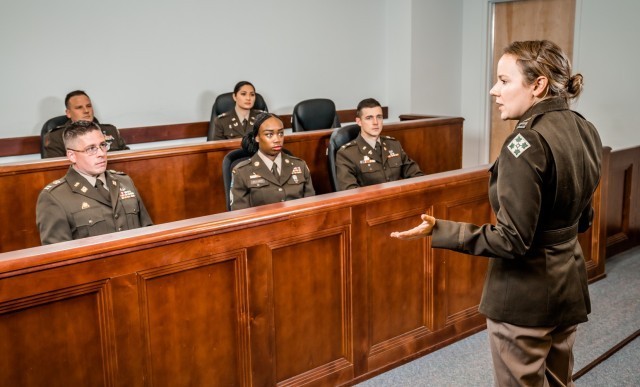
The National Defense Authorization Act for Fiscal Year 2022 directed military services to establish the Office of Special Trial Counsel to independently handle the prosecution of certain serious crimes, referred to as “covered offenses,” such as murder, sexual assault, kidnapping, child abuse and domestic violence, among others. This NDAA transfer of prosecutorial decisions for covered offenses from Commanders to independent judge advocates marked a significant reform in military justice with the goal of enhancing accountability, fairness and trust in the military justice system and ensuring that decisions about legal proceedings are unbiased.
The Army’s OSTC comprises specially trained military lawyers, legal professionals and support staff. Headquartered at Fort Belvoir, Virginia, OSTC has eight regional offices that oversee 28 field offices across the U.S., Europe and Korea.
As of Dec. 28, 2024, the OSTC’s first fully operational year, prosecutors reviewed more than 9,500 criminal investigations and exercised authority over 5,600 of those cases, according to OSTC. While the case review process remains an ongoing effort, OSTC prosecutors initiated court-martials in 514 cases and prosecuted 138 cases to completion, with the rest continuing into 2025. Sixty-three of the completed cases were domestic violence cases.
Article 128b of the Uniform Code of Military Justice, which specifically addresses domestic violence, became effective on Jan. 1, 2019. Domestic violence involves the use, attempted use or threatened use of force or violence against a person who is a spouse, immediate Family member or intimate partner, or a violation of a lawful order used for the protection of that person.
“One point I would like to emphasize is that the relatively new offense of Article 128b of the UCMJ has allowed us to see domestic violence offenses more clearly,” said Lead Special Trial Counsel Brig. Gen. Christopher A. Kennebeck.
“Before the establishment of 128b, all domestic violence was typically recorded as an assault mixed in with all other types of assault.”
While OSTC has independent prosecutorial authority, it collaborates with commanders, law enforcement and other support services to ensure comprehensive support for victims. Kennebeck explained that in addition to better oversight of domestic violence cases, OSTC also coordinates more fully with the Army Family Advocacy Program to ensure prosecutors are aware of all offenses, because victims often do not fully disclose domestic abuse to law enforcement. In addition, he stressed that specialized training is essential.
“We also believe we can be more effective as prosecutors because our personnel are specially trained to evaluate and try these cases,” Kennebeck said.
“We manage two key courses each year that are specific to domestic violence cases.”
Kennebeck acknowledged that prosecuting domestic violence cases is uniquely difficult. These crimes involve relationships and Families where children are often witnesses, which makes talking about these crimes difficult.
“Anytime a Family member or anyone in a relationship is asked to testify against a partner, spouse or parent, it is difficult,” he said.
“Domestic violence has been a focus area for us because it is one of the most sensitive types of cases we see. These cases affect Families, and they affect the readiness and discipline of our Army. By having specially trained prosecutors efficiently review each case, we are better at identifying cases that warrant prosecution and better at perfecting the evidence required to obtain and sustain a conviction,” Kennebeck said.
“Through our specialized training, close coordination with law enforcement and continued integration of Army Civilian best practices, I am confident we have the right tools and the right people to successfully prosecute domestic violence and achieve justice for victims.”
Domestic Abuse Victim Advocates are able to support victims regardless of whether they file a Restricted or Unrestricted report.
The following domestic abuse resources are available to assist Soldiers and their spouses or partners:
- Family Advocacy Program
- Domestic Abuse Victim Advocate Locator
- National Domestic Violence Hotline – 800-799-SAFE (7233) – 800-787-3224 for individuals who are deaf or hard of hearing
- Military OneSource – 800-342-9647
- Installation’s military law enforcement office or civilian law enforcement if in immediate danger
FAP can assist with filing a Restricted or Unrestricted report of domestic violence. If a Restricted report is filed, military law enforcement and command will not be notified, and information will be kept confidential. If an Unrestricted report is filed:
- Law enforcement will be notified and will investigate the incident.
- Command will be notified.
- Victims can seek a military or Army Civilian protective order.
- Victims will have access to the full range of FAP services. Victims will have access to legal services on military installations.
Victims can receive assistance when applying for transitional compensation, if applicable.
Social Sharing