
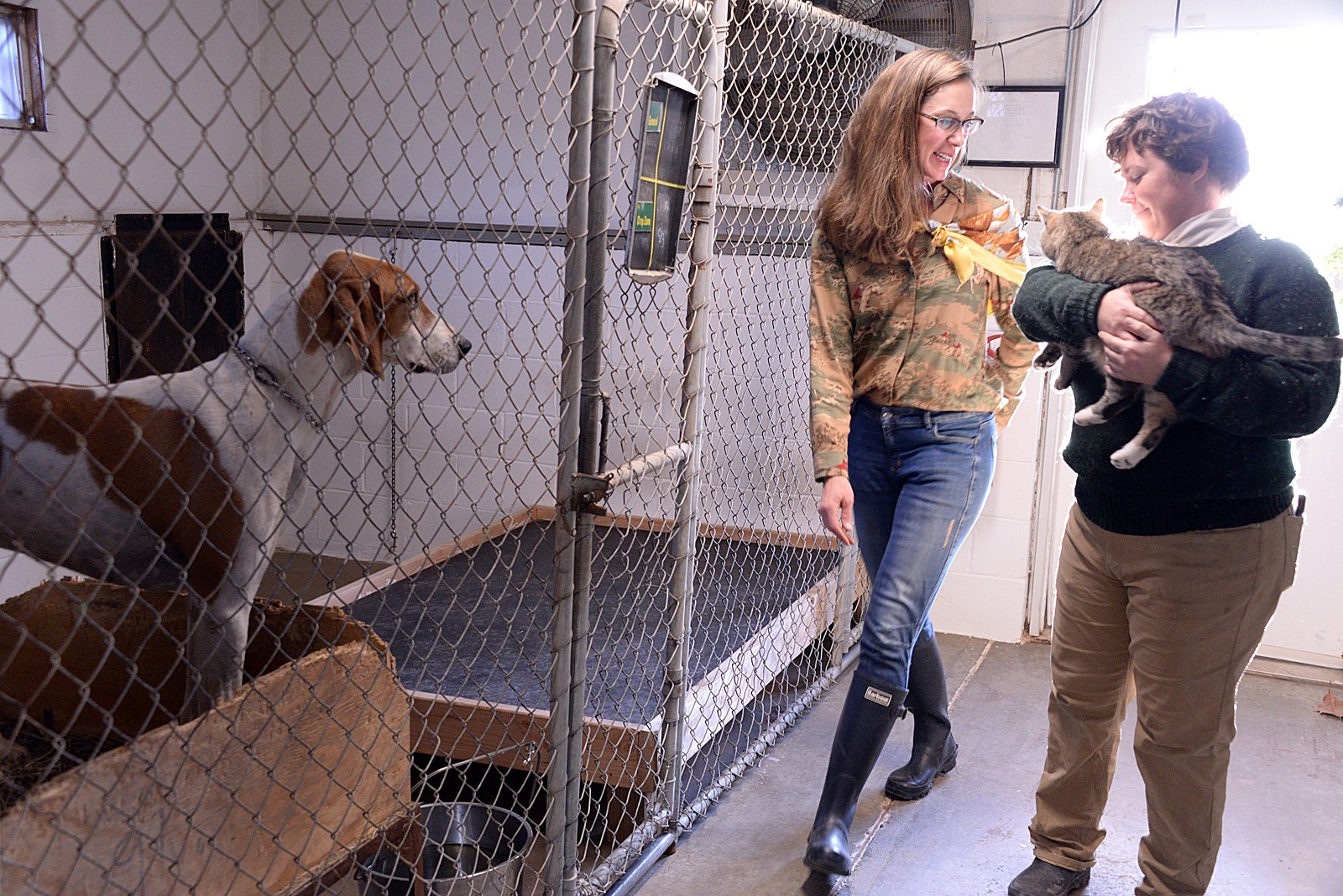
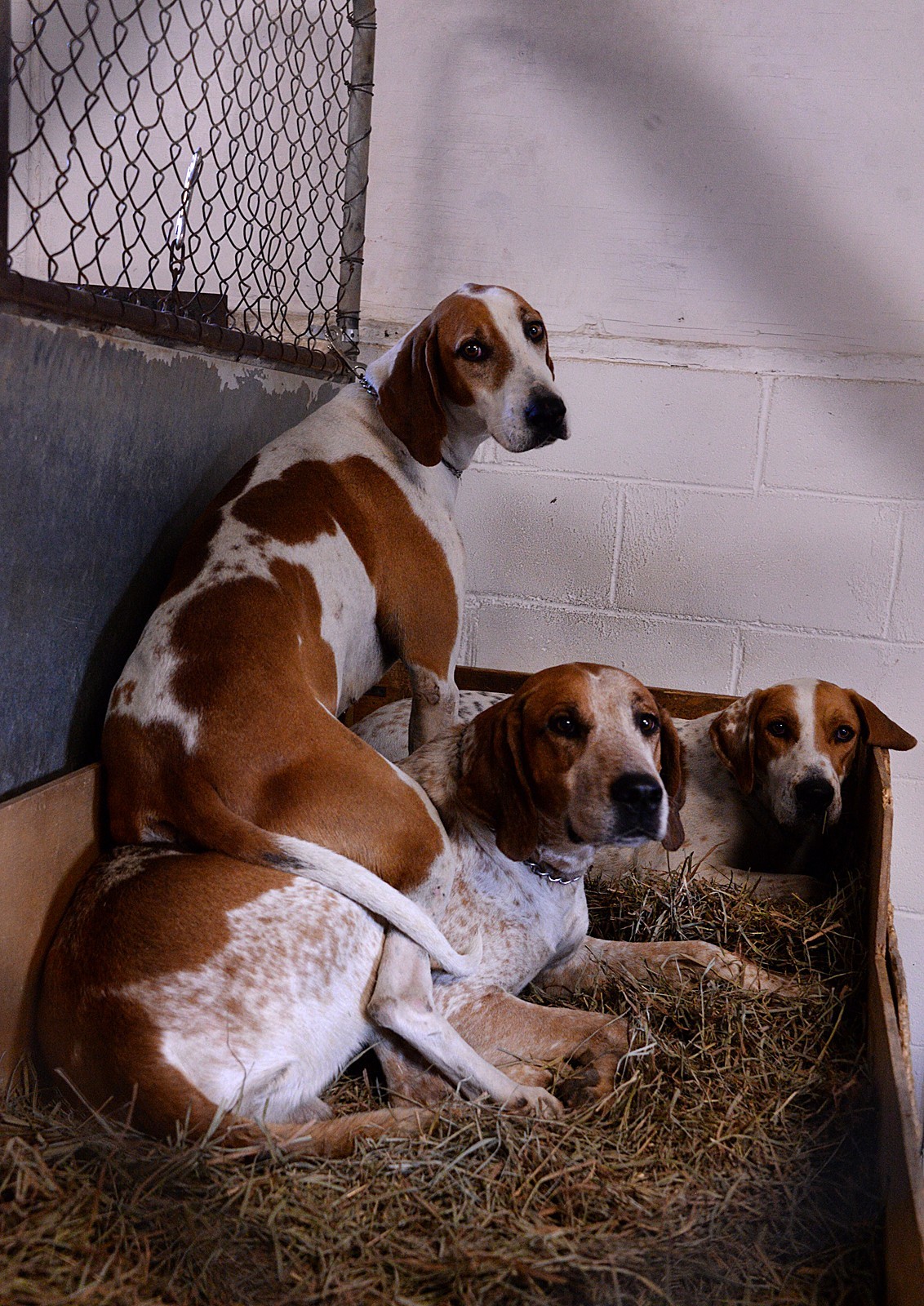
FORT LEAVENWORTH, Kansas — The Fort Leavenworth Hunt foxhounds were treated to a special day this holiday season, with extra treats and attention from FLH members and community visitors during the Hounds for the Holidays event Dec. 7, 2025, at the FLH kennels at Fort Leavenworth, Kansas.
“Some of our members only see (the hounds) when we're hunting, and they don't spend time in the kennels, so this was a great opportunity to bring more of our members down here so they could see the hounds,” said FLH member Lt. Col. Jessamyn Jempson, Combined Arms Doctrine Directorate. “If folks want something cheerful to do during the holidays, they (could) come visit and snuggle with our hounds.”
Visitors could learn about the club and its foxhounds — including how the hounds are cared for, trends in local breeding strategies, and that the hounds are actually government property — with Family and Morale, Welfare and Recreation kennel staff and FLH members on hand to answer questions and tell them more about individual hounds. As gifts of dog treats and cleaning supplies appeared around a Christmas tree during the party, staff noted that the needs of the hounds are taken care of through club dues and contributions by FLH members.
Love of equestrian sport and service
Fort Leavenworth boasts the only remaining military foxhunting club, something that used to be a common pastime on Army posts. Jempson said she was doubly excited when she was selected to attend the Command and General Staff College so that she could participate in the hunt in 2017, and after five years elsewhere, she sought out an assignment that would bring her back to Fort Leavenworth, and thus FLH.
“A lot of Army posts had foxhunting clubs back in the day, and over time they've gone away, so the Fort Leavenworth Hunt club is the last one in existence,” Jempson said. “(That is) really unique, and Fort Leavenworth is really fortunate.”
The FLH hunting season runs October through March, with hounds going on hunts about twice each week with the club’s horseback riders in rural Easton, Winchester and Leavenworth. They also attend other clubs’ hunts in the Flint Hills and Kansas City areas.
“(The hounds) get to hunt wide, large sections of property. These hounds are trained to hunt fox and coyote — they're trained specifically on that scent,” Jempson said, noting that the “hunt” is all about the chase and the pursued foxes and coyotes are not killed.
Riders of varying experience are able to join in the thrill of the hunt.
“Our membership is varied, meaning we've got lots of different riders with different backgrounds and skill sets, and some are brand new to foxhunting and others have been foxhunting for decades,” Jempson said. “Our club really tries to cater to meet riders where they are, so we typically have four fields, four groups of riders: we've got a walk-trot group, a hill-topper group, and a first and second field.”
The riders in the first and second fields jump obstacles as they follow the hounds, whereas the hill-topper and walk-trot groups do not. Lead riders are not be passed by other riders.
Hunt tradition can be said to parallel military culture, with its unique terminology, hierarchy and role assignments— for example, “masters of the hunt,” “whippers-in,” etc. — as well as protocols and standards to follow.
“Horseback riding, especially at speed, especially over varied terrain, is pretty dangerous. A lot like battle, right? You can get hurt pretty easily,” Jempson said. “A lot of these rules and the protocols that we have are to increase the safety of the sport and to make sure that there is order when we have almost chaos, so we have members who have leadership roles… Our members will wear different colored coats as a visual aid to help people understand who the staff members are at a distance. Or if something goes wrong, you can look for a red coat and ask for help from that person, and they can either get onto a radio or get you what you need.”
The riders follow the hounds, who get excited when they pick up the scent of a coyote or fox and take off after it.
Foxhound demographics
The FLH currently has 17 male and female hounds — which are counted in couples, so currently, eight and a half couple. The pack includes champion foxhound Drop Zone, who was named Grand Champion Hound of the Show in 2022 at the Central States Hound Show.
“Some of these hounds have been bred here at Fort Leavenworth, and others are trades from other hunts, (and) sometimes we have our Fort Leavenworth hounds will actually go out to other hunts — the clubs will do that to improve their breeding profiles,” Jempson explained. “Depending on where that particular hound's strengths are, they might be better suited for other clubs, depending on if other clubs have a deficiency in their pack somewhere that we can help fill, then we can do trades that way… If we're looking for a certain characteristic that we may not have, we'll ask other clubs that are known for that characteristic, if they have somebody who would be willing to trade.”
Jempson said one of the traits the FLH breeding focused on was larger hounds that could cover greater distances at greater speeds, and recently the focus is shifting to smaller hounds, which can correlate to what type of terrain the club will be hunting.
FMWR kennel staff Ruth Hensleigh and Jessica Kudzia — referred to as kennelmen — said the FLH foxhounds are referred to as crossbred, a combination of American foxhound, English foxhound with some regional subsects, like the Penn-Marydel (Pennsylvania, Maryland, Delaware) foxhound, as well. Hensleigh said the local pack is bred for type and shape rather than by a certain foxhound designation. She pointed out a couple of somewhat sleeker hounds, Easton and Egypt, who have some Penn-Marydel lineage.
“You look at him, he's a little bit taller, lighter, leaner. We wanted to see how that hound hunted our country, and if we liked it, then we could breed him.” Hensleigh said. “We do really like them, but we decided we liked a little bit heavier, more square hounds, because we have quite a bit of hilly terrain, and we needed more power and less speed.”
Hensleigh explained that, as Jempson mentioned, the club has primarily large hounds and would like to breed for slightly smaller hounds, citing terrain the club hunts but also longevity as reasons.
“A 65- or 75-pound hound will often hunt longer than a 100-pound hound, just wear and tear… and we want our hounds to be able to go a little bit longer before retirement,” she said.”
When the hounds do retire from hunting at about 6 or 7 years old, they are adopted, sometimes by FLH members like Jempson. Her family recently adopted 7-year-old retired foxhounds Colleen and Chinook.
Having hounds as part of the family might help explain why her son, 3-year-old James Buchanan, was so at ease with the FLH pack, crawling through their kennels during the open house and giving them hugs as he passed them.
Kudzia, who has been working at the FLH kennels for three years and has prior experience in shelter work preparing animals for adoption, said the hounds’ amicability is in part due to handling but also because of their breeding. She and Hensleigh, who has K-9 working dog experience, have intentionally been working with the hounds for them to make them easy for anyone to work with — or for anyone to help, if they were to get hurt in the field, for example — not to mention help ensure the daily kennel schedule runs smoothly.
Hensleigh said the pack consistently gets three hours of hands-on training every day, as well as desensitizing, by handling their faces, ears and feet. Each hound is checked over, from “nose to tip of tail” every day, and good manners are expected as they are moved around for feeding, training, loaded into trailers, taken on hikes and more.
“We try to keep the human touch. We don’t want them to be like cattle, we don’t want to just open a gate and push them through. We want it to be they understand that a door means wait, to come to their name… and to have manners,” Hensleigh said.
That combination of handling, training and breeding have combined to create a pack of friendly hounds.
“We don’t want aloof hounds; we want friendly hounds,” she said. “We understand, that the way the sport is, we have to be able to put a good face forward.”
Hensleigh said the hounds are also good with other dogs, even at times enjoying walks and playtime with pet dogs, and she described them as cat-neutral. Resident kennel cat Pete, a former stray from the Fort Leavenworth Stray Facility, walked among the kennels throughout the open house, and the hounds paid no attention to him.
FLH staff member Nick Redman, a “whipper-in” who works with the dogs to keep them from straying during a hunt, described the hounds as incredibly biddable, willing to listen. Recently the dogs started training, and excelling, on a new skill, pre-laid scent work, which allows for a guaranteed course instead of leaving it to chance that the hounds will find live game.
“We've had a really exciting summer where we just kind of had to really go back to the basics with the hounds and kind of re-school them on what the huntsman wants from the hounds when we go out,” Jempson said. “It's been really fun, and it's been very rewarding. The hounds have just really taken to the new job very well, and they're learning to be really excited about pre-laid scent instead of the live scent.”
To learn more about the Fort Leavenworth Hunt, including the free introductory foxhunting lessons offered in September, and to stay apprised of upcoming 100th anniversary events in 2026, visit https://leavenworth.armymwr.com/programs/fort-leavenworth-hunt or e-mail info@ftleavenworthhunt.org.
Social Sharing