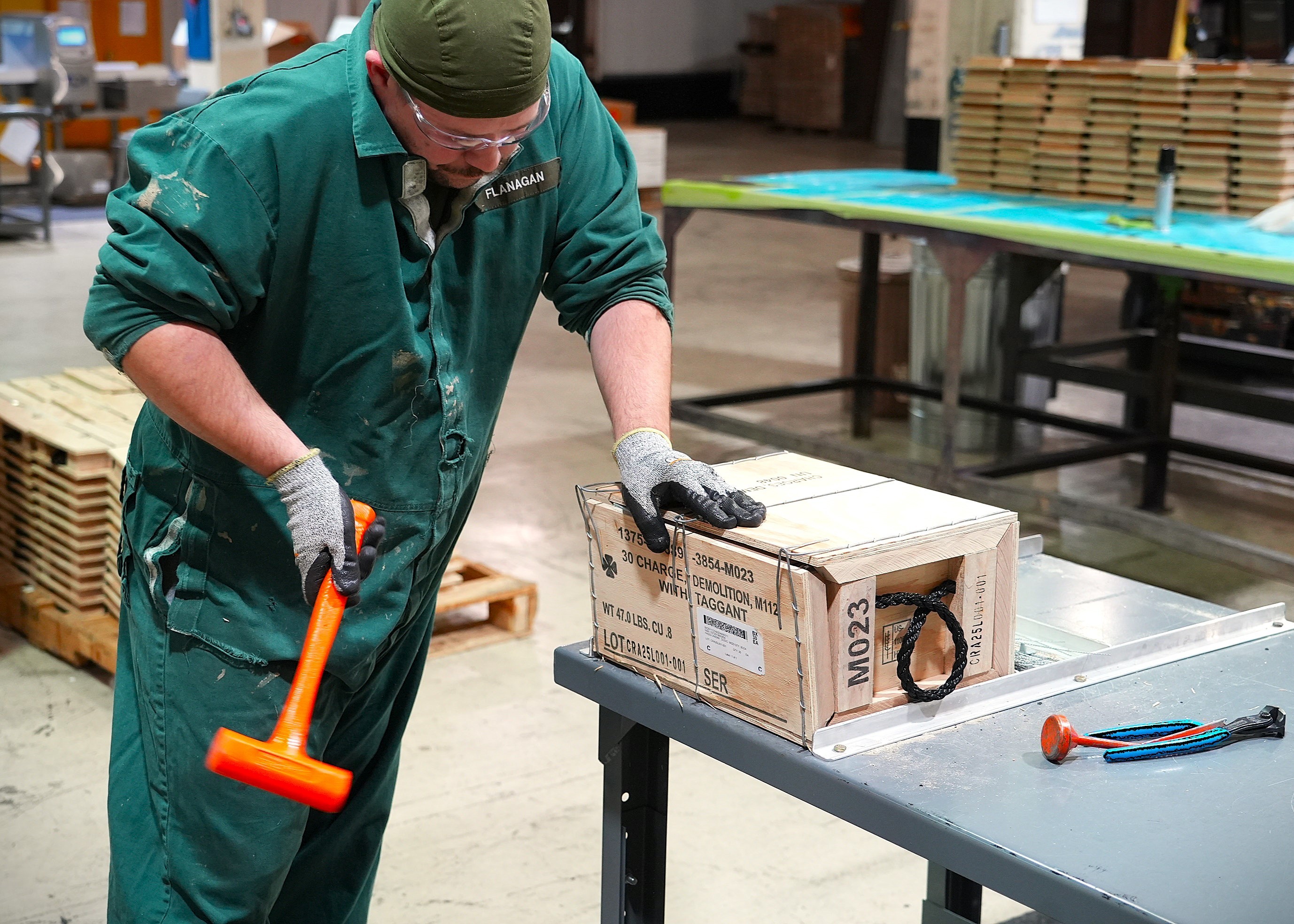
NSA Crane, Indiana – After more than a decade and a half, a team of Crane Army Ammunition Activity experts have restarted a once mothballed Composition C4 production line to meet increased demand for the malleable explosive compound. Following an aggressive ramp-up schedule, the line-based operation recently achieved full-rate production.
As Tony Barger, a commodity manager for CAAA’s Manufacturing and Engineering Division, recalled, his division was contacted in mid-2024 by the Army’s Project Manager for Close Combat Systems office regarding the possibility of resuming C4 production. At the time, Barger said, there was only one other source of C4 available within the U.S. and demand was outpacing their production capabilities.
“They wanted to go extremely fast,” Barger said referring to the request from PM CCS. His office was able to provide a cost estimate within a couple of weeks, and a timeline was agreed upon after acceptance.
“We were funded in August (of 2024) and started procuring equipment,” Barger recalled. “We started setting up the production line and were able to make our first blocks of C4 about 14 months later.”
Although Barger and his small team had a running start since much of the legacy equipment could be re-used, they had repairs to make and had to create new components to make a modern production line fully functional.
“There were some components there, fortunately. The bucket conveyors that deliver the bulk C4, an old extruder that had to be rebuilt, and the conveyors that bring C4 blocks from the extruder were still there.”
“Basically, everything (in the C4 production building) had to be reverse engineered and replaced,” added Tom Parrish, lead mechanical engineering technician for CAAA’s ME Division. “We put a lot of hours, blood, sweat and tears to get that line up and going.”
“We were able to improve the process and modernize things as we went,” he said.
Along the way, the team endured other challenges such as losing a member to an early retirement and impacts of the federal government hiring freeze. The ability to make most purchases was also hampered by vendor availability and delivery issues as well as a government-wide freeze on most credit card purchases.
Despite those challenges, Barger and his team were determined to move fast by “looking at every option and not accepting the norm.”
“There were normal contracting avenues that people always took, and my team went and tried different contracting options,” Barger said. “We were always having to weigh delivery and price variances to meet our cost objectives and timelines.”

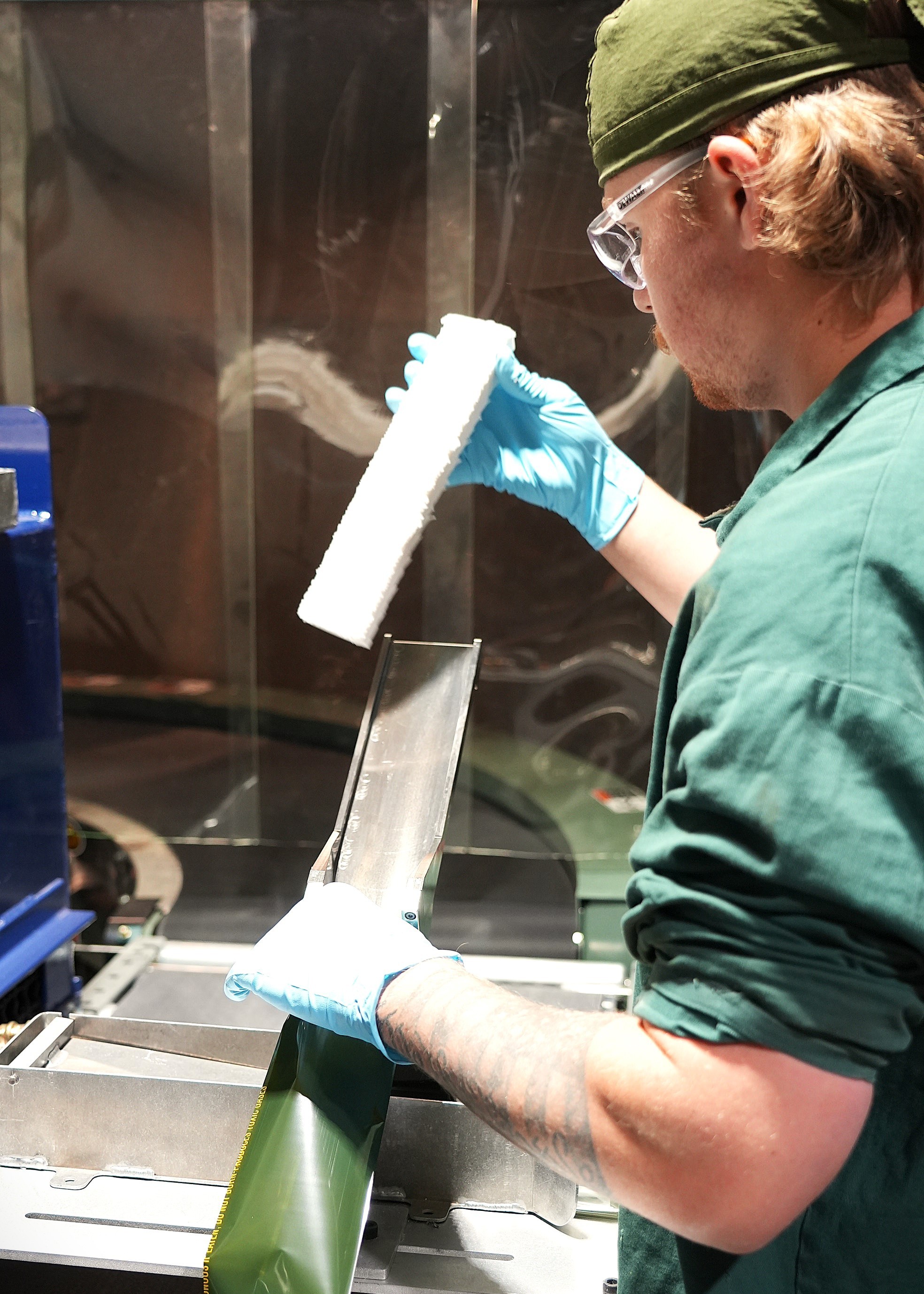
He and his team pushed vendors to ensure equipment was delivered within their tight timelines. They pushed other vendors to ensure manufacturing materials were also delivered to meet their milestones.
He added that his team completed a first article test, or FAT, milestone in November. Testing for FAT included strict compliance with C4 density, weight and size as well as testing for energy output on a Crane Army detonation range.
“All of our testing was up to standards” Barger said, adding that first article test reports were sent to JMC (Joint Munitions Command and CAAA’s higher headquarters) followed by a successful low-rate production run previous to achieving current full-rate production that Barger described as “ahead of schedule and under budget.”
“I’m proud of this team and what we were able to do in 14 months,” Barger said.
“This project is a good example of Team Crane Army’s capabilities,” said Col. Aaron Cornett, CAAA commander. “We accepted a challenge, and this team found a way to make this project happen in a truly stellar way.”

CAAA produces and provides conventional munitions in support of U.S. Army and Joint Force readiness. It is part of the Joint Munitions Command and the U.S. Army Materiel Command, which include arsenals, depots, activities, and ammunition plants. Established Oct. 1977, it is located on Naval Support Activity Crane.
Social Sharing