
VIEW ORIGINAL
This article is a continuation of the 1st Stryker Brigade Combat Team (SBCT), 4th Infantry Division’s “Moneyball for Gunnery” project, which began in 2024 and was highlighted in the Winter 2024-2025 issue of Infantry. The project leveraged data analytics to generate insights to identify “undervalued players” that can increase crew lethality while conserving time and resources. In this iteration, we analyzed data from the Ivy Raider Brigade’s February 2025 Stryker mounted machine gunnery (MMG) to identify factors that were tied to first-time Table VI qualification (Q1) and improved Table VI scores.
Some of our key findings included:
• Crews in companies with two platform-trained master gunners (MGs) were 26 percentage points more likely to achieve a Q1 than crews in companies with zero platform-trained MGs. From zero, each additional platform-trained MG in a company correlated with a 13-percentage point increase in the probability that crews in their company would achieve a Q1.
• Crews that used Stryker embedded trainers before gunnery correlated with a 20-percentage point greater probability of achieving a Q1 and a 7-percent higher Table VI score.
• Gunner selection is critical, as self-reported gunner “buy-in” strongly positively correlated with a crew’s Q1 probability.
Theoretical Framework
We began with a theoretical framework that displayed logical connections between independent (predictor) variables, control, and dependent (outcome) variables (see Figure 1).

This framework categorized predictor variables into three categories: unit, crew, and environmental factors. After collecting predictor variable data in a consistent, structured format, we applied statistical methods to test for quantitative relationships with the outcome variable. This study focused specifically on how unit and crew factors influenced Table VI performance.
Data
Based on our 2024 Moneyball for Gunnery project, the 4th Infantry Division revised its gunnery standard operating procedures (SOPs) to expand MMG data collection requirements during 2025 gunnery. However, we were unable to collect all variables due to imperfect SOP implementation and the limitation of a primarily manual data entry system. Our dataset included 164 crews in the brigade’s three Stryker infantry battalions, and we limited analysis to high-quality variables that at least two battalions collected to standard. Additionally, while MMG normally consists of six tables, we deliberately omitted Table IV from our gun line due to range constraints, which is permissible in the Army’s Integrated Weapons Training Strategy (IWTS).
In the previous study, we found that Table III scores provided statistically significant predictors of first-time Q1 success. Each additional point a crew earned on Table III correlated to an approximately 1-percentage point increase. However, in February 2025, 1st SBCT began requiring crews to earn a minimum Table III score of 800 in order to progress to the next table. As a result, this variable no longer showed predictive value. The minimum score reduced variability across crews, limiting our ability to distinguish performance and weakening its statistical significance.

Modeling Q1 Probability
We first used logistic regressions to estimate Q1 probability. A logistic regression is a type of data model that predicts the probability of a binary outcome (0 or 1) based on various factors, assigning weights to each factor to indicate their influence. The function is used to predict whether an outcome belongs to one of two groups (for example, yes or no, true or false, Q1 or Q2). If the probability was greater than 50 percent, our model predicts a Q1. If it is less than 50 percent, it predicts a Q2. During this MMG iteration, a randomly selected crew had just over a 50-percent chance of achieving a Q1 on Table VI, given that 84 out of 164 crews achieved a Q1.
Five predictor variables in the model demonstrate positive relationships with crew Q1 probability. Use of the Stryker embedded trainer and the number of platform-certified master gunners in a company are statistically significant at conventional levels (95 percent). While the Table V total score is positively correlated at 90 percent, it is not statistically significant, and we take the result as suggestive evidence. Figure 2 illustrates the output of the regression model. Solid blue lines denote statistical significance of 95 percent, dashed blue lines denote statistical significance of 90 percent, and black lines indicate non-statistically significant variables.
Table 1 demonstrates that the correlations are robust to the inclusion and omission of several variables. This is important, as robust variables indicate statistical significance. The slightly lower Akaike Information Criteria (AIC) score — a statistical measure used to compare the accuracy of different models — for Model 3 indicates that the model fits better using total Table III and V scores, in comparison to Model 4 which uses day and night scores.

Master Gunner Impact on Q1 Probability

Figure 3 illustrates that a crew’s likelihood of achieving a Q1 increases as the number of platform-trained MGs in their company increases. Crews in companies with two platform-trained MGs were 26 percentage points more likely to achieve a Q1 than crews in companies with none. Going from zero to one platform-trained MG is associated with almost 12 additional percentage points in the probability of Q1, and adding a second resulted in an additional 14-percent increase in probability of Q1.
This result suggests that while introducing this capability is beneficial, maximizing its impact might require ensuring that companies have at least two personnel trained in this capacity, as the second trained MG could bring a greater proportional gain to the overall operational success. This result underscores the importance of MGs in building crew lethality.
Stryker Embedded Trainer Impact on Q1 Probability
Next, we analyzed the use of the Stryker embedded trainer — an integrated simulation system that enables gunners to rehearse engagements. We collected this data from crews that self-reported meeting embedded trainer requirements prior to gunnery. Figure 4 illustrates the substantial positive correlation between Stryker embedded trainer use and Q1 probability. It highlights two critical factors in qualification success: practice and preparation. Crews that reported regularly using the embedded trainer prior to gunnery had a 20-percentage point greater chance of achieving a Q1, increasing from approximately 25 to 45 percent. These findings reinforce the importance of ensuring crews spend extended time on embedded trainers — and simulated training in general — prior to qualification on Table VI.

Gunner Pride Impact on Q1 Probability
We next collected a “Gunner Pride” score for two battalions (110 crews) via digital survey prior to MMG execution. We posed the question “Are you proud to be a gunner?” measured on a 0 to 10 Likert scale to measure gunner motivation or “buy-in,” which we hypothesized would impact their effort level throughout gunnery. Incorporating that variable into the previous model indicated that gunner buy-in is the most important predictor in those two battalions. Table 2 demonstrates that “Gunner Pride” score is robust across the four different models, indicative of statistical significance.

Figure 5 demonstrates a clear positive correlation with predicted probability of Q1, painting a compelling picture of the importance of gunner buy-in. A Gunner Pride score of 0 shows only a 7 percent Q1 success rate, while a score of 10 shows 59 percent. The average score for 110 crews equaled 6.48, which corresponded to a 35-percent chance of Q1.
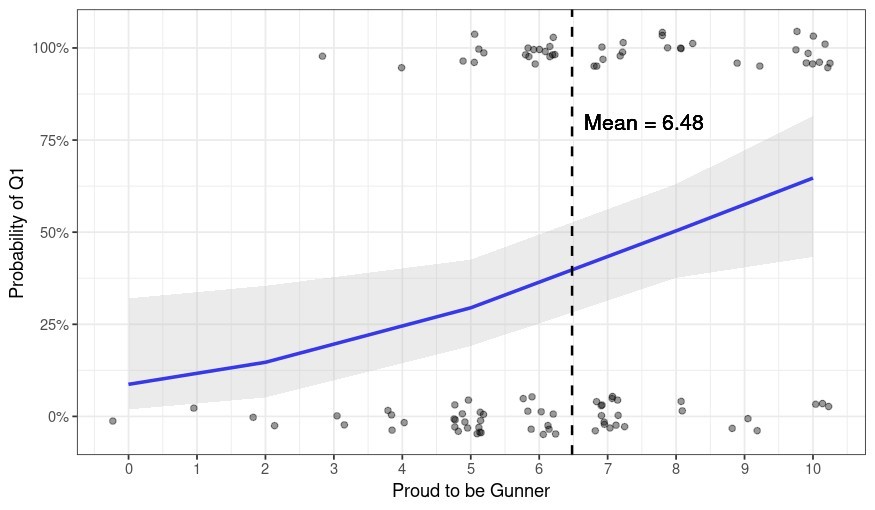
Furthermore, a one standard deviation increase in gunner pride (approximately two points) correlates with a 15-percentage point rise in Q1 qualification probability, reaching 50 percent. Conversely, a one standard deviation decrease is associated with a significantly lower 22-percent chance of Q1. These results indicate the importance of personnel management and selecting proud, motivated gunners in achieving qualification success.
Insights into Higher Table VI Scores
Lastly, we investigated factors that correlated with higher Table VI scores among the crews that achieved a Q1. We excluded non-first-time qualifications, as they were capped at a Table VI score of 700. Figure 6 illustrates a right-skewed distribution, resulting from less frequent higher scores.

Since the data was not normally distributed (bell curve shaped), we could not apply the commonly used ordinary least squares (OLS) regression. Therefore, we applied a generalized linear model (GLM) — a model in which the response variable follows a skewed distribution — that can appropriately model this data. Table 3 shows the results when running a GLM, or gamma regression.

The regression results indicated that embedded trainer use and past gunnery experience were the strongest predictors of Table VI score. Model 2 was the strongest model, as indicated by the lowest AIC value. This model suggested a possible positive relationship (at 90- percent significance) between Table V day scores and Table VI scores. Figure 7 further illustrates these relationships.

As shown in that figure, Tables III and V (both day and night iterations) had a negligible impact on Table VI scores, increasing qualification scores by fractions of a percent. However, both embedded trainer use and past gunnery experience correlated with approximately 7-percent higher scores on Table VI. These findings were consistent with our OLS regression results, with the exception of past gunnery experience becoming a possible predictor variable.
Interestingly, the interaction between past gunnery experience and embedded trainer use is negative and similar in magnitude to each individual coefficient. While only significant at 90 percent (which is not conventionally statistically significant), this provides suggestive evidence that embedded trainer use provides greatest value to new gunners. In other words, embedded trainer use is a substitute for past gunnery experience.
Future Research
There are several ways this study could be improved:
1) Enter gunnery with a deliberate data collection plan and then ensure data collectors are trained to standard on how to collect MMG data. Utilize tablets instead of whiteboards for data tracking and standardize this process across each battalion/brigade.
2) Additionally, expand data collection to measure additional variables that are likely correlated with crew performance. For instance, Soldier discipline, crew cohesion, maintenance culture, and MG involvement. The inclusion of more variables only increases our ability to accurately predict a crew’s likelihood of qualifying.
Our investigation into what factors contribute to gunnery success progresses with “Moneyball for Gunnery, Part 3,” where we will investigate the impact of biometric data, including sleep and stress, on MMG performance. Given the extended and intensive nature of gunnery, which can significantly affect a Soldier’s well-being, this iteration will employ Oura rings to measure various biometric measures. We hypothesize these factors have a critical role in a crew’s ability to qualify.
Recommendations
1. Create two modified table of organization and equipment (MTOE) billets for Stryker MGs for every rifle company. Invest in master gunner training and empower MGs during MMG. Educate company and battalion commanders and S-3s about the MG roles as “lethality advisors” when developing training plans to achieve mission essential task list (METL) and lethality objectives.
2. Incorporate Stryker embedded trainers and Virtual Battlespace 3 (VBS3) into unit gunnery preparation. 1st SBCT plans to mandate a minimum standard of three qualifications with a score over 900 before progressing to MMG qualification in the summer of 2026.
3. Invest in crew selection. If gunners are not proud to serve in the role, they will not put forth the effort necessary to excel. Deliberately manage talent among sergeants in infantry companies to balance assignments between vehicle commanders and dismounted team leaders, ensuring neither role is overvalued or undervalued.
4. Enter gunnery with a deliberate data collection plan and establish legacy unit files for gunnery data. Digitize and standardize data to ensure variables are collected in a consistent manner across units. Expand the data collection to measure additional variables that are likely correlated with crew performance, such as Soldier discipline, crew cohesion, maintenance culture, MG involvement, etc.
5. Join our team and expand the study through collaboration. The Ivy Raider Brigade encourages other units conducting Stryker gunnery to replicate or contribute to this analysis. Units interested in participating or sharing data are welcome to reach out for coordination. Broadening the dataset will help validate trends observed in this article and shape future recommendations across the force.
LTC Jon Bate is a U.S. Army Infantry officer serving in the Joint Staff J5. He previously commanded 2nd Battalion, 23rd Infantry Regiment, 1st Stryker Brigade Combat Team (SBCT), 4th Infantry Division. He has served in the 101st Airborne Division, the 1st Armored Division, and as an assistant professor of economics in the U.S. Military Academy (USMA) Department of Social Sciences. A Goodpaster Scholar in the Advanced Strategic Planning and Policy Program (ASP3), he holds a Master in Public Policy from the Harvard Kennedy School and a PhD in political science from Stanford University.
CPT Mitchell Brown is a U.S. Army Infantry officer who currently serves as the commander of Headquarters and Headquarters Company, 2-23 IN. He holds a bachelor’s degree in nuclear engineering from USMA.
1LT Ben Lopez is a U.S. Army Infantry officer who currently serves as chief of current operations for 2-23 IN. He holds a bachelor’s degree in systems engineering from USMA and maintains several published studies focusing on supply chain management and network optimization.
SSG Nicholas Lammert currently serves as a platoon sergeant in A Company, 2-23 IN and is also the battalion’s master gunner. He is a graduate of the Master Gunner, Battle Staff, and Drill Sergeant courses.
This article appears in the Winter 2025-2026 issue of Infantry. Read more articles from the professional bulletin of the U.S. Army Infantry at https://www.benning.army.mil/Infantry/Magazine/ or https://www.lineofdeparture.army.mil/Journals/Infantry/.
As with all Infantry articles, the views herein are those of the authors and not necessarily those of the Department of War or any element of it.
Social Sharing